
Form U5 is the Uniform Termination Notice for Securities Industry Registration, the filing a firm makes to end a registered person's registration when that person leaves, and it stays on the public record. You opened the copy, or the CRD notice, and the reason line is not the story you would have written. Maybe it says discharged. Maybe Section 7 flags a review you thought was finished. Hiring firms and clients can see pieces of that record on BrokerCheck while nobody has tested the underlying facts. The risk sits in the wording, the timing of the disclosure, and the gap between an allegation and a resolution. I would read the copy the day it arrives, the way you would read a complaint, not as routine exit paperwork.
Form U5 at a Glance Purpose, Filer and Deadlines
Say you left a broker-dealer on a Friday. That Friday is your employment end date. You do not file the notice yourself. The firm does.
FINRA's registration forms guidance describes Form U5, short for Uniform Termination Notice for Securities Industry Registration, as the filing used to terminate a registered individual's securities-industry registration with FINRA, another self-regulatory organization, or a state jurisdiction. The filer is the broker-dealer, investment adviser, or securities issuer. The trigger is any departure from the firm, for any reason. The form records the termination date and reason, and Section 7 addresses disclosure questions on internal reviews, regulatory issues, and termination-related events.

FINRA generally requires the filing within 30 days after the employment end date, and the firm must give you a copy within that same 30-day period. Initial filings and amendments are generally submitted electronically through the Central Registration Depository or the Investment Adviser Registration Depository. SEC recordkeeping rules (Exchange Act Rule 17a-4) require firms to retain relevant filing records for at least 3 years, with the first 2 years in an easily accessible location.
| Requirement | Rule | Who it applies to |
|---|---|---|
| Who files | Broker-dealer, investment adviser, or securities issuer | Firm, not normally the departing professional |
| Trigger | Any departure from the firm, for any reason | Every registered individual |
| Filing deadline | Generally within 30 days after the employment end date | Firm |
| Copy to individual | Within the same 30-day period | Individual |
| Filing method | Electronic, through CRD or IARD | Firm |
| Record retention | At least 3 years, first 2 in an easily accessible location | Firm |
| Amendments | Required when later-known facts make the filing inaccurate or incomplete | Firm |
Why the amendment duty changes the filing
An amendment is not a courtesy. FINRA requires the firm to amend when later-discovered facts make the original information inaccurate or incomplete. A wrong date, a thin explanation, or a review that later closes can be updated. Until that update is filed, the first version is what regulators and hiring firms can use.
The exit paperwork becomes part of the individual's registration record and can be reviewed long after the departure.
That is why the contents can affect registration, future hiring, regulatory reviews, and public background information on BrokerCheck. If you are lining this notice up against the application that opened the registration, start with what a Form U4 is.
Write down the employment end date and count 30 days. That is the window for both the filing and your copy. If the copy has not arrived, ask for it in writing that week.
What the Form Records and Why Termination Reasons Matter
A Form U5 holds two different kinds of information, and they do not substitute for each other. The first is core termination data: the date you left and the reason the firm selected. The second is the Section 7 disclosure questions, which ask about internal reviews, regulatory issues, and termination-related events. Disclosure Reporting Pages are the supplemental pages where the firm records the detail behind a Section 7 "yes." Internal Review Disclosure is the Section 7 category that covers an internal review.
FINRA's Form U5 instructions draw a sharp line between full and partial terminations. The reason-for-termination question and the Section 7 disclosure questions apply to full terminations, not to partial termination filings. A partial termination is a different path. You can drop one registration or one business line and stay associated with the firm. That filing does not carry the same reason categories or the same disclosure questions as a complete departure.
For a full termination, the firm selects among Voluntary, Deceased, Permitted to Resign, Discharged, or Other. Explanations are required for several of those categories. The category is what a reader sees first. The explanation is where disputes usually start, because a firm's allegation is not the same thing as an adjudicated finding.
| Reason category | What it tells readers | Where disputes begin |
|---|---|---|
| Voluntary | Individual chose to leave | Whether Section 7 answers still apply |
| Deceased | Registered person died | Accuracy of the filing path and dates |
| Permitted to Resign | Firm allowed a resignation in place of discharge | Wording of the explanation and any pending allegations |
| Discharged | Firm ended the association | Whether the stated reason is specific enough |
| Other | Reason not covered by the listed categories | Whether the explanation names a concrete cause instead of a leftover label |
How the reason and Section 7 work as a pair
The reason box does not answer Section 7. Each disclosure question has to be answered on its own, with enough detail for a reasonable person to understand the circumstances. A voluntary departure can still carry a Section 7 "yes" if allegations were already on the table. A discharge can still be incomplete if the explanation is a slogan rather than facts.
FINRA's rules identify Form U5 termination-reason and internal-review information for BrokerCheck disclosure, and the instructions require explanations and supporting disclosure pages when they apply. A U5 can affect hiring and public records before any regulator or tribunal has resolved the underlying facts. The useful question is not "what is a U5 form" in the abstract. It is what will be displayed, under which category, and how disputed language gets corrected. A closer look at those labels is in U5 termination reasons.
Read the reason and every Section 7 answer together. Together they decide what a later reader sees.
Section 7 Disclosures That Stay on Your Record
An advisor resigns on a Monday while an internal review is still open. The firm's first Form U5 reports that pending review. Six months later the review closes with no finding. The original filing is now incomplete unless the firm amends it and adds that outcome. People often assume the first filing freezes the story. It does not.

FINRA's 2024 regulatory oversight report is direct about the standard. The termination explanation and the Section 7 responses must each be complete, accurate, and detailed enough for a reasonable person to understand the circumstances. A generic line such as "violation of firm policy" is inadequate when more precise facts are available.
What Section 7 can require
Section 7 may require affirmative reporting of:
- Internal reviews: a review that is open, or one that has already produced a result, when the question calls for it.
- Disciplinary events: actions already taken, not just rumors inside the branch.
- Allegations of specified misconduct: securities-law violations, regulatory breaches, or investment-related misconduct.
- Resignation after allegations: leaving after those allegations were made can itself be reportable.
An authorized firm signatory verifies that the filing is accurate and complete before it goes in. That signature does not make a thin narrative acceptable. It means someone at the firm attested to what was filed.
A pending review is not a closed case, and the record has to keep pace with it.
Firms must amend a previously filed Form U5 when later-known facts make it inaccurate or incomplete. That continuing duty can run until final disposition of the matter. If the review ends in a finding, the amendment should say so. If it ends with no finding, the amendment should say that too. Leaving the "pending" language in place after the review is over misstates the record.
What to pull before you argue the wording
For a filing you dispute, the practical priorities are the complete Form U5, any Disclosure Reporting Pages, a clear list of inaccurate wording or omitted context, and the employment and investigative records that support your account. Memory of a conversation with a manager is a weak substitute for the sentences on the form. If the disclosure points toward a broader regulatory problem, FINRA disciplinary actions is the related map. Gather the form, the disclosure pages, and the review file before you decide on a next step. Every later request should quote the filing, not a paraphrase.
How Form U5 Shapes Hiring and Public Records
Hiring firms and regulators do not wait for a hearing before they look you up. They open BrokerCheck. Form U5 information can reach that report on a short clock, which means a discharge line or a Section 7 flag can sit in front of a recruiter while the allegation is still only the firm's account.
FINRA Rule 8312 sets the release timing this way:
- Three business days for most Section 7 events: events reported on Form U5, other than an Internal Review Disclosure event, wait a three-business-day period after FINRA processes the filing before FINRA releases them through BrokerCheck.
- A matching Form U4 can collapse the wait: if the same event is reported on Form U4 before that period expires, FINRA releases the Form U4 and Form U5 information together, and the three-business-day period may be shortened.
- Reviewers see the reason and the flag first: the termination category and any Section 7 marker are what a hiring reader hits before any later explanation you prepare.

The record can move faster than the dispute
A U5 can shape hiring and public records before any regulator or tribunal has resolved the underlying facts. The practical question is what will be displayed, under which termination category, and how disputed language can be corrected or amended. Three business days is not a litigation calendar. It is the short stretch you have to line up a response before many Section 7 events go public.
Say you are interviewing at a new firm and BrokerCheck already shows a discharge. The customer allegation behind it has not been heard by anyone outside the old firm. You have three choices that week: answer the interviewer with the documents you have, ask the old firm to amend, or prepare a challenge. Waiting for a "final" decision that nobody has scheduled leaves the discharge line unanswered in the meantime.
Public disclosure is not limited to broker-dealer moves. Advisers who change registration status also have to keep client-facing documents current, and Advisor Momentum on interim brochure updates is a useful walk-through of how an interim Form ADV brochure update works when facts change midstream. Different form, same habit: do not let a stale narrative stand in for the current facts.
Pull your own BrokerCheck report and compare it line by line with the Form U5 you received. Note every mismatch. Those notes are the correction list for the next step.
Challenging an Inaccurate or Unfair Form U5
Start by requesting the complete Form U5 and every Disclosure Reporting Page. The summary you remember from an exit meeting often differs from the sentences that were filed. You cannot mark an inaccuracy you have not read.
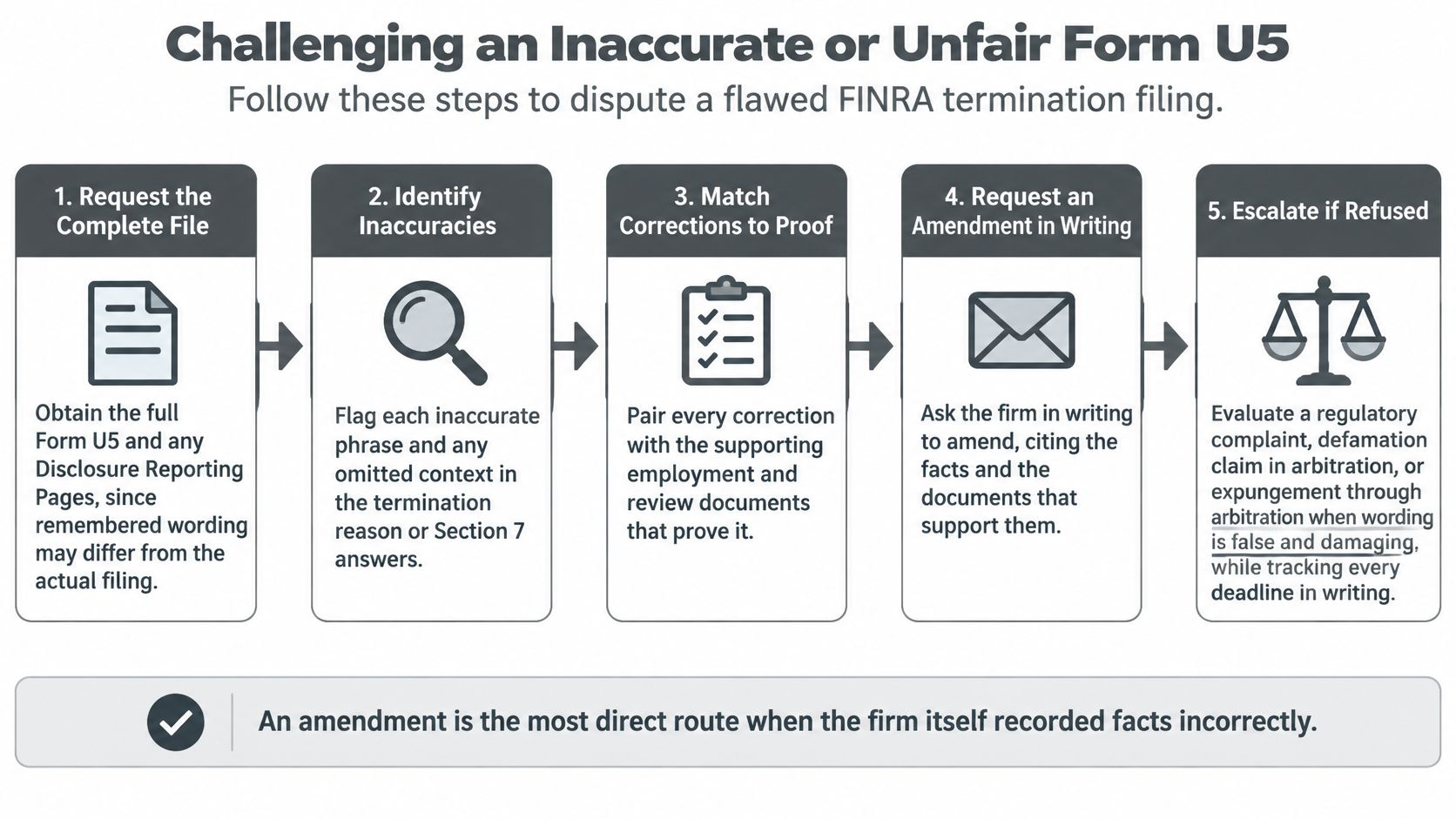
Work in this order:
- Identify each inaccurate phrase and any omitted context. Quote the termination reason and each Section 7 answer. A paraphrase is not a target you can correct.
- Match each correction to proof. Pair the fix with the employment record, the review memo, or the email that shows the fact. A request without a document is easy to ignore.
- Ask the firm in writing to amend. Cite the facts and the document that proves them. An amendment is the most direct route when the firm itself recorded the facts incorrectly.
- If the firm refuses, or the wording is false and damaging, evaluate a regulatory complaint or arbitration. FINRA's 2024 dispute-resolution statistics reported 90 arbitration cases involving libel or slander on Form U5 in 2024, compared with 104 cases in 2023.
- Track every deadline in writing. A strong factual point still fails if the forum's clock has run.
Matching the route to the problem
| Route | Best used when | What it involves |
|---|---|---|
| Amendment request to the firm | Facts changed or the wording is incomplete | Written request with proof; firm files an amended Form U5 |
| Regulatory complaint | Firm refuses to correct a filing that appears inaccurate | Written complaint to the regulator with supporting records |
| Defamation claim in arbitration | Reported wording is false and harmful | Arbitration claim for libel or slander tied to the Form U5 |
| Expungement through arbitration | Underlying allegation is unfounded | Arbitration proceeding seeking removal of the disclosure; requirements vary by case |
An amendment request fits a date error, a review that closed, or an explanation that leaves out context the firm already has. A regulatory complaint fits a refusal to fix a filing that looks inaccurate on its face. A defamation claim fits language that is false and is hurting hiring or client relationships. Expungement fits a disclosure whose underlying allegation should not remain at all, and the requirements are case-specific. The forum path is laid out in the FINRA arbitration process.
Practical rule: pick the route from the kind of error, not from how angry the sentence makes you.
A factual mistake points to an amendment. A wording fight that is still true in substance is a poor defamation case. A question about whether the allegation should appear at all is an expungement problem, not a polite rewrite. I would start with the written amendment request whenever the documents show the firm has the corrected fact in hand.
Confirm Your Form U5 Before You Act
Confirm the filing before you choose a fight. The words on the form, and the dates around them, decide which correction route is still open.
- Count the 30-day window from your employment end date for both the filing and your copy.
- Request the complete Form U5 and any Disclosure Reporting Pages, not a verbal summary.
- Compare the termination reason with each Section 7 answer, and mark where they conflict.
- Pull your BrokerCheck report and check each public entry against the form.
- Note the dates of any open internal review that could still require an amendment.
- Write down each inaccurate phrase next to the document that proves the correction.
Our Securities Arbitration practice handles securities industry employment disputes, Form U5 defamation matters, and securities industry rule violations. Kons Law can review the filing and advise which correction route is still open. If you want to discuss your business law matter, contact Kons Law at (860) 920-5181.
The decision in front of you is simple. Confirm the filing first. Facts and deadlines, not the tone of the exit meeting, determine which correction route is still open.
If the Form U5 on your record is inaccurate, incomplete, or already affecting a move to a new firm, Kons Law advises financial professionals on Form U5 disputes, amendments, and related securities employment claims. We represent advisors in securities arbitration and regulatory matters tied to termination filings. Visit Kons Law to talk through the filing you have in hand.
