
A FINRA arbitration submission agreement is the signed form that formally places a specific dispute under FINRA's arbitration system and binds the signer to FINRA's rules and to any resulting award. Signing it does not mean you're agreeing the claims against you are valid.
You're probably reading this with a packet on your desk. Maybe FINRA just sent you a Claim Notification Letter, maybe your former firm is demanding repayment on a promissory note, or maybe you're the one preparing to file. Inside the packet is a short form that looks like routine paperwork.
That appearance misleads people. The form is your written consent to the forum itself, to its procedures, and to performing whatever award comes out at the end. Treat it like a cover sheet and you can create fights over deadlines, party names, and defenses you thought you'd preserved. Treat it carefully, and it does exactly one job. It opens the door to a live case without conceding what's inside.
What the Submission Agreement Does and Who Signs It
Think of an arbitration clause like a membership rule. It says disputes in this business go to a private panel instead of a judge. The FINRA Arbitration Submission Agreement is the sign-in sheet at the door. It takes one specific controversy, with named parties and pleaded claims, and brings it into that room.
That's more than acknowledging a clause exists. Your signature confirms you submit this controversy to FINRA and accept the governing rules. The procedural framework for that submission is described in FINRA's submission agreement rule filing, which ties the filing to the Code of Arbitration Procedure.

| Role | Who signs | What the signature commits to | Paperwork held |
|---|---|---|---|
| Claimant | Customer or associated person who starts the case | Submission of the controversy and acceptance of FINRA rules | Signed form filed with the statement of claim |
| Respondent | Each named firm, individual or other party | Consent to FINRA arbitration of the named claims and performance of any award | Claim Notification Letter and blank agreement through the Party Portal |
| Officer or authorized signer | Person with actual or apparent authority for a firm, partnership or other entity | Binds the entity to the same commitments as an individual party | Completed form plus proof of signing authority kept in the file |
A claimant doesn't file the form alone. FINRA's claim filing instructions require three items together, a signed and dated Submission Agreement, a Statement of Claim identifying the relevant facts and requested remedies, and the applicable filing fee, and the parties named in the agreement must match the parties in the Statement of Claim.
A respondent learns about the case differently. FINRA sends the notification letter, Party Portal access, the Statement of Claim, and a blank agreement for each respondent to complete, sign, and return electronically, as explained in FINRA's overview of the arbitration process.
Start with a simple checkpoint. Are you the claimant, a respondent, or someone signing for an entity, and do you hold the document that matches that role? If you're unsure how this filing fits the larger case sequence, read about the FINRA arbitration process before you sign anything.
Key Clauses and What Each One Commits You To
The form is short, but each clause performs separate work. Each one operates like its own signature line: agreeing to one does not soften the others, and each binds you to something different. Reading the clauses in order, the way they appear on the page, prevents the common mistake of seeing one blanket promise where there are in fact several distinct ones.
| Clause | What it says | Practical effect | What to check |
|---|---|---|---|
| Submission of controversy | Places the claims, crossclaims, counterclaims and third-party claims under FINRA rules | Claims added later can fall inside the same forum | Caption and claims match the pleadings |
| Consent to award | Agrees to abide by and perform the award | Award becomes a binding obligation | Settlement authority and payment allocation |
| Consent to jurisdiction | Consents to any court that may enter judgment on the award, with interest | Award can be converted into a court judgment | Which courts could be involved and where assets sit |
| Time and place | Hearing time and place set by FINRA's Director or the arbitrators | Travel or appearance at a location the signer did not choose | Early request for remote or local arrangements |
| Authority to sign | Signer represents authority to bind the party | A defective signature can challenge the filing | Written authority for any entity or fiduciary signer |
| Filing fees and surcharges | Customer filing fee scales with the amount in controversy, excluding interest and expenses | Hearing-session fees added as the case progresses | Current FINRA customer fee schedule for exact figures; who pays member surcharges and processing fees |
Submission and Performance Come First
The first commitment submits the controversy, including related crossclaims, counterclaims, and third-party claims, to arbitration under FINRA's By-Laws, rules, and Code, and the parties agree to perform any award, as stated in the standard FINRA Arbitration Submission Agreement form. In plain terms, the clause does two things at once: it gives the panel authority to decide the dispute, and it obligates you to carry out the decision.
Next comes consent to jurisdiction. You agree a court of competent jurisdiction may enter judgment on the award, including applicable interest. That turns a private panel's decision into something a court can enforce against bank accounts or other assets.
Practical rule: Consent to the forum is not consent to the other side's version of the facts. Keep those two ideas separate every time you read the form.
Notice also what the form lacks. There is no checkbox or blank space to reserve objections, so signing accepts the forum itself while leaving any disputes about scope or arbitrability to be raised separately.
Place, Authority, and Money
You don't pick where or when the hearing happens. The time and place are designated by FINRA's Director of Arbitration or the arbitrators, so raise travel, health, or remote appearance needs early rather than assuming you'll sort it out later.
The authority clause matters when someone signs for someone else. An officer signing for a firm, a partner for a partnership, or a fiduciary for an account represents that they can bind that party. If that representation is shaky, the other side can challenge whether the entity ever properly consented.
Fees work on a sliding scale for customer claims. Under FINRA's customer code fee schedule, the filing fee uses the amount in controversy, excluding interest and expenses, and hearing-session fees are added later as the case progresses. The dollar tiers change from time to time, so pull the current schedule directly from FINRA before budgeting rather than relying on figures quoted secondhand.
Read any clause and ask two questions. What does this bind me to do, and what should I verify before my name goes under it?
What Signing or Rejecting Does to Your Registration
The choice is often framed as signing to make the case happen or refusing to make it stop. Neither is accurate. A disclosure on your CRD record works like a reference letter you never got to draft: the filing, the settlement questions, and any award get described to the next firm either way. Signing determines what kind of record stands behind that description.
If You Sign
The case proceeds under the FINRA Code, with panel authority, filing obligations, and hearing procedures in effect. Your signature does not concede that the claims are valid, and it does not concede the amount requested. You are agreeing to the process that will test them.
Objections stay available. If you dispute arbitrability or the scope of particular claims or parties, state that objection expressly and keep it alive, because affirmative participation without objection can create waiver arguments, as described in FINRA's party guidance on submission and authority. That same guidance explains the signer represents they are the claimant, legally authorized to bind the claimant, or a person with firsthand knowledge and actual or apparent authority to execute the submission.
Participating also builds something a refusal never can: a record. Testimony, exhibits, and panel findings become the raw material any later dispute over how the matter was characterized will depend on.
If You Refuse or Ignore It
The case proceeds anyway. FINRA continues to administer the matter, and a respondent who fails to answer or participate risks default proceedings and an award entered without their evidence or witnesses. That award can later be confirmed in court, which leaves you fighting enforcement rather than the underlying claim.
Refusing does not protect your record either. It strips it down. The disclosures a future employer or regulator reads will describe allegations you never answered and an outcome you never contested. There is no transcript to cite, no exhibit that cuts your way, no finding that narrows the accusations. When you later dispute how the matter appears on your Form U5 or in your CRD file, you are asking a panel to reconstruct a case that exists only in the claimant's version.
Registration and Pay Consequences
Get one thing straight first: the reporting obligations do not flow from your signature. Form U4 disclosure questions and Form U5 reporting are triggered by events. A filed customer arbitration, a settlement, an award, a termination. Those triggers fire whether you sign, refuse, or ignore the agreement entirely. What the signing decision changes is what sits behind each disclosure.
A pending customer arbitration may need disclosure under the Form U4 reporting questions, depending on the allegations and amounts involved, and a prospective firm may weigh that during a transition long before any panel decides the merits. If you signed and litigated, the disclosure rests on a contested outcome. If you refused and took a default, it describes an award the claimant effectively wrote alone.
Termination runs on a separate track. If your firm terminates you, it must state the reason on Form U5, and disputed wording can start its own fight over what future employers and regulators read. Those challenges are generally brought in arbitration, where a representative may request expungement under FINRA Rule 2080, a standard that turns on case-specific facts, which is why a litigated record matters and the background on Form U5 and FINRA filings deserves immediate review.
Money disputes travel alongside. Firms and departing advisors commonly fight over withheld or forfeited compensation, bonuses, deferred pay, and production credits, and promissory-note demands for repayment of upfront loans after a transition are another frequent intra-industry claim.
The submission agreement decides none of those outcomes. It determines the room where they get decided, and whether the record inside that room contains your side.
Timing, Scope and Venue Limits to Check First
Start with the clock, because every other decision has to fit inside it. Under FINRA's guidance on Rules 12302(a) and 13302(a), a claimant files a signed and dated agreement with the Statement of Claim, and respondents must generally serve a signed and dated agreement and answer within 45 days after receiving the Statement of Claim.

| Checkpoint | Trigger | Deadline or rule |
|---|---|---|
| Claim Notification Letter received | FINRA sends letter with Party Portal access | Log the date stamped on the letter |
| Respondent answer and signed agreement | Statement of claim received | Serve within 45 days, with a buffer |
| Claimant filing | Statement of claim prepared | Signed agreement, statement of claim and fee filed together |
| Claim eligibility | Occurrence of the dispute | Generally six years, separate from state and federal statutes of limitations |
| Hearing place | Case assignment | Set by FINRA's Director of Arbitration or the arbitrators |
Work the checkpoints in order. Log receipt, verify party names and signing authority, review the scope of each claim, decide on consent and objections, serve through the Party Portal before day 45, and expect the appointed arbitrators to receive the filed agreement afterward.
Scope Determines What Belongs Here
Coverage is broad for industry disputes. FINRA generally requires arbitration for disputes arising from the business activities of a member or associated person when the dispute is between members, between a member and an associated person, or between associated persons. That reaches most employment, compensation, and promissory-note fights.
Customer disputes follow the customer code instead. A claim that falls outside the arbitration clause or outside the rule's reach can be objected to, but you need to identify that argument during the scope review, not weeks after you've answered on the merits. The overview of FINRA arbitration rules helps sort which code applies to your caption.
Count the deadline from the date stamped on the letter, not from the day you finally sat down and read it.
Venue and Eligibility Are Separate Tests
Venue isn't yours to choose. The hearing place is designated by FINRA's Director or the arbitrators, and required customer-location information in the claim informs that decision. If location creates a real hardship, raise it promptly and in writing.
Eligibility is a different limit. FINRA's Code generally limits claims to those filed within six years of the occurrence giving rise to the claim, and that limit operates separately from state and federal statutes of limitations. A claim can satisfy one clock and fail the other, so check both.
Base your calendar on the stamped date and build in several days of buffer. Portal problems on day 45 are an explanation, not a defense.
Respond Step by Step and Avoid Costly Errors
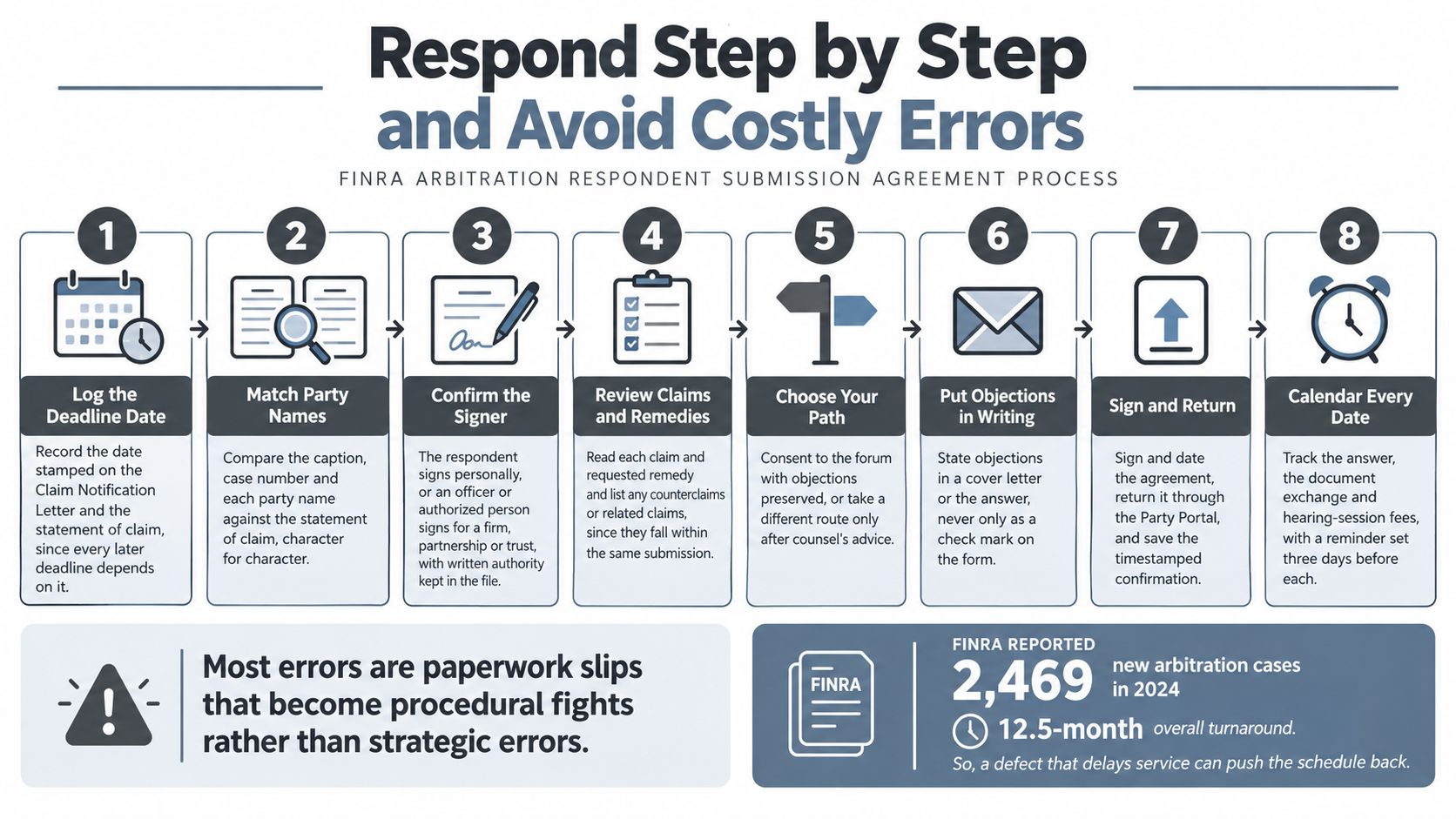
Handle the response like a filing project with a fixed end date. Signing the agreement works like walking into the arena: you accept the forum and its rules, and nothing about that signature concedes the score. These eight steps keep the signature, the answer, and your preserved defenses aligned.
The Eight Steps
- Log the receipt date. Record the date you received the Statement of Claim. The 45-day answer clock runs from that receipt, and every later deadline keys off it.
- Match party names. Compare the caption, case number, and each party name against the Statement of Claim, character for character, including middle initials, entity suffixes, and capacity designations.
- Confirm the signer. Decide whether you sign personally or an officer or other authorized person signs for a firm, partnership, or trust, and keep written authority in the file.
- Review claims and remedies. Read each claim and requested remedy, then list counterclaims or related claims you may need, because they fall within the same submission.
- Choose your path. Consent to the forum with objections preserved, or take a different route only after counsel's advice on the specific caption.
- Put objections in writing. State objections in a cover letter or in the answer. A handwritten note or a check mark on the form reaches nobody, and the form itself gives you no box to reserve rights.
- Sign and return. Sign and date the agreement, return it through the Party Portal, and save the timestamped confirmation with your case file.
- Calendar every date. Track the answer, document exchange, and hearing-session fees, with a reminder set three days before each item.
Why Small Defects Matter
Technical compliance isn't busywork. Under FINRA Rule 12307 on deficient claims, a claim is deficient when a claimant fails to file a submission agreement, doesn't sign and date it properly, omits a named party, fails to provide required customer-location information, or fails to pay required filing fees unless deferred.
A defect works like a hold on a shipment. Nothing moves until someone fixes the paperwork. Service stalls, scheduling slips, and a case that should have started on time loses weeks before the first session is even discussed.
Member surcharges and processing fees are the quiet trap in intra-industry cases. The standard form allocates them, and departing representatives and firms can end up disputing who bears those costs on top of the underlying note or compensation fight. Ask who pays, in writing, before the first invoice arrives.
| Pitfall | What goes wrong | Fix |
|---|---|---|
| Signing without comparing claims to the pleadings | Claims added later or counterclaims fall inside the forum | Check each claim and remedy against the Statement of Claim before signing |
| Inconsistent party names | Dispute over who consented, and possible deficiency | Match names exactly to the Statement of Claim and Claim Notification Letter |
| Unauthorized signer | Challenge to the filing and to the signer's consent | Obtain written authority for any officer or entity signer |
| Assuming the signature waives every defense | Objections never stated can be argued as waived | State each objection expressly in writing and keep a copy |
| Starting the 45-day count on the wrong date | Late answer and default risk | Calendar from receipt of the Statement of Claim, then subtract several days of buffer |
| Ignoring fee and surcharge allocation | Unexpected costs in intra-industry disputes | Ask in writing who pays member surcharges and processing fees |
| Treating the form as a one-page signature task | Service problems and schedule delays | Confirm the Party Portal submission and service date before the deadline |
Most of these errors aren't strategic failures. They're paperwork slips that harden into procedural fights because nobody documented the fix. That principle runs through FINRA's filing guide discussion of related claims, which notes the agreement signifies acceptance of the selected arbitrators' decision on the initial claim and related claims.
Document every correction in writing and send it through the portal. If it isn't in the portal record, assume you'll have trouble proving it happened.
Sample Language That Preserves Your Objections
The form gives you nowhere to write a reservation. There's no box that says you consent to the process but dispute whether a particular claim belongs there. That gap confuses respondents who assume signing silently preserves everything.
It doesn't. The objections belong in a cover letter or in your answer, where they become part of the record the panel sees.
Reservation Paragraph for a Respondent
Respondent submits this agreement solely to comply with FINRA's Code of Arbitration Procedure. Respondent does not waive objections to arbitrability, personal jurisdiction, venue, or the scope of the claims asserted, and reserves the right to assert counterclaims as the Code permits.
This language separates two ideas. You're complying with a procedural requirement, and you're expressly refusing to concede that every claim and party is properly in this forum.
Authority Line for an Entity Signer
The undersigned is an officer of the named entity with authority to bind it, and the entity name above matches the name in the Statement of Claim.
That single sentence answers the question the other side would otherwise ask later. Keep the underlying corporate authorization in your file to back it up.
Related Claims Note
Respondent does not consent to any claim beyond those asserted in the Statement of Claim and will respond to any amended pleading as the Code requires.
Compare the before and after. A bare signature with nothing else leaves the other side free to argue you consented broadly and waived objections you never mentioned. A signature paired with a written reservation leaves the forum intact while keeping your specific objections alive for the panel to decide.
Limit to remember: Sample wording is general information, not a filing ready for your case. Counsel should tailor it to your claims, forum, and deadlines before you use it.
The point isn't magic language. It's a contemporaneous written record that you objected, to what, and when.
Decide Whether to Bring In Counsel Before the Deadline
Bring in securities counsel before the deadline whenever the matter reaches beyond the form itself. That includes Form U5 wording or a threatened termination dispute, a promissory-note demand, withheld bonuses, deferred compensation or production credits, questions about who may sign for an entity, counterclaims, multiple respondents, a large amount in controversy, or any parallel FINRA investigation or Rule 8210 request.
In the first week, counsel reviews the agreement against the Statement of Claim, preserves objections, decides on the answer and counterclaims, and coordinates the Form U5 response. Kons Law is a business law firm that represents financial advisors and investors in FINRA arbitration and defends advisors in regulatory inquiries, including Form U5 issues, work that overlaps with the role of a regulatory compliance attorney.

Gather the Claim Notification Letter, the Statement of Claim, any Form U5, and the deadline date, then call. If you want to discuss your business law matter, contact Kons Law at (860) 920-5181.
If a FINRA Arbitration Submission Agreement is sitting on your desk with the 45-day clock running, Kons Law can review the form against your Statement of Claim, Form U5, and compensation or promissory-note records before you sign. Bring those documents to an initial discussion so counsel can preserve your objections, confirm signing authority, and build an answer that protects your registration from the first filing.
