A Hartford business owner often discovers the condition of the company's governance file at the least convenient moment. A lender requests the minute book during a refinancing. A buyer asks for the cap table, written consents, and committee approvals during diligence. A former partner demands company records, or a departing executive claims that compensation, equity, or authority was handled unfairly.
Those requests rarely concern one document in isolation. They test whether the company's corporate governance documents work together, reflect actual authority, and show how important decisions were made. The OECD Corporate Governance Factbook 2023 reviewed 49 jurisdictions, supported by 61 figures and 45 tables, and treated governance documentation as a broad system that includes constitutional documents, reports, disclosures, shareholder-rights materials, and oversight records, not merely formation paperwork (OECD Corporate Governance Factbook 2023).
Why Your Governance Documents Get Tested Before You Expect
A governance file can sit untouched for years, accumulating amendments, unsigned drafts, outdated delegations, and meeting records prepared under time pressure. Then a bank asks who approved a prior transaction, a buyer wants proof that every equity issuance was authorized, or a former owner submits a books-and-records demand. A regulator may ask for the minutes approving a product, the policy governing supervision, or evidence that the board received risk information. A departing executive may challenge a bonus decision and put the employment agreement, compensation approvals, equity records, and related policies at the center of the dispute.
Each event asks the same practical question: did the company have authority to act, and can it prove how that authority was exercised? Governance documents provide the contemporaneous record of approvals, conflicts review, information considered, voting, delegation, and follow-up. They can support a transaction, clarify an ownership dispute, or reveal an authority gap before an opposing party finds it.
Practical rule: Treat the governance file as evidence that will be read by someone who wasn't in the room.
The guide below follows the file in the order a business attorney typically reviews it. It starts with formation instruments, moves through policies and committee charters, examines meeting records, and then tests the system against Connecticut requirements and common business events. The focus is not on collecting paperwork. It's on making sure each document performs a defined job when financing, litigation, regulation, or a transaction puts the company under examination.
What Counts as a Corporate Governance Document
Corporate governance documents are the written instruments and records that assign and evidence authority, accountability, disclosure, and oversight inside a business. They include documents that create the entity, documents that govern how decisions are made, and records showing what the company decided.
The first layer contains formation-level instruments. A corporation may rely on its certificate of incorporation, bylaws, shareholder agreements, and investor-rights agreements. An LLC typically relies on its certificate of organization and operating agreement. A partnership uses its partnership agreement, together with amendments and related ownership records.
The second layer contains operating-level instruments. These include board policies, committee charters, delegation-of-authority schedules, codes of conduct, conflict-of-interest policies, related-party transaction procedures, and information-governance rules. These documents translate broad authority into procedures people can follow.
The third layer is the meeting-and-evidence record. Agendas, board packets, committee materials, minutes, written consents, resolutions, stock ledgers, cap tables, and approval logs show how authority was used. The layers must cross-reference one another. Bylaws may authorize a committee, the committee charter may define its responsibilities, and the minutes should show whether the committee exercised that authority properly. A useful overview of the relationship between these instruments appears in Kons Law's explanation of corporate governance.
| Layer | Typical Documents | Primary Governance Function |
|---|---|---|
| Formation-level instruments | Charter, bylaws, operating agreement, partnership agreement, shareholder agreement | Establish ownership, authority, voting, transfer, and amendment rights |
| Operating-level instruments | Board policies, committee charters, delegations, codes of conduct, conflict procedures | Translate authority into operating rules and oversight responsibilities |
| Meeting-and-evidence records | Agendas, packets, minutes, consents, resolutions, cap tables, stock ledgers | Prove what decision-makers considered, approved, rejected, or assigned |
When reviewing a file, don't ask only whether each document exists. Ask whether the documents agree, whether the right people signed them, and whether later records show that management and the board followed them.
Formation-Level Instruments Every Connecticut Company Needs
Formation documents establish the legal architecture that later approvals depend on. If the architecture is unclear, a polished resolution may not cure the problem.
Charter and organizational agreement
A corporation's certificate of incorporation defines fundamental matters such as authorized equity, classes of stock, and structural limits. Its bylaws should then address director elections, meetings, notices, quorum, voting, committees, officer authority, indemnification, and amendment procedures. A provision on director elections needs to work with the company's later use of written consents and shareholder voting. If the bylaws require a meeting format that the company never follows, the record can become difficult to defend.
An LLC's operating agreement should do more than repeat statutory language. It should address capital contributions and capital calls, distributions, transfer restrictions, admission of new members, buy-sell rights, drag-along and tag-along rights where appropriate, fiduciary duties and exculpation, indemnification, dispute resolution, dissolution, and amendment mechanics. Partnership agreements require the same attention to authority, allocations, transfers, withdrawal, and dispute procedures.
Investor and ownership rights
Shareholder, stockholder, and investor-rights agreements often contain reserved matters, protective provisions, information rights, transfer restrictions, registration rights, and appointment or consent rights. These agreements can control a transaction even when the bylaws appear to grant broad board authority.
The recurring failure is an amendment provision that works in one document but conflicts with a consent right or reserved matter in another. A financing may change the cap table without updating the operating agreement. A new investor may receive rights that the board's delegation schedule doesn't reflect. Connecticut entities should compare these documents against the Connecticut Business Corporation Act or Connecticut Limited Liability Company Act rather than assuming a Delaware or New York template fits local defaults.
A document that says who has authority is only half complete. It also needs to explain how that authority is exercised, limited, amended, and recorded.
Corporate resolutions formally record decisions by the board, shareholders, officers, or managers, and they belong in the minute book. Kons Law's discussion of corporate resolution documents is useful when checking whether a proposed approval accurately identifies the decision-maker and action.
Before closing a financing or sale, compare the charter, bylaws or operating agreement, ownership agreements, cap table, prior amendments, and written approvals as one set. The document that appears correct in isolation may create a conflict when read beside the others.
Board Policies and Committee Charters That Actually Govern
Policies don't govern merely because someone approved them. They govern when the company assigns responsibility, sets a decision path, and creates records showing that people followed the path.
Board-level policies should address the risks that can affect the company's decisions and reporting. Depending on the business, that may include conflicts of interest, related-party transactions, insider trading, whistleblowing, anti-corruption, information security, data governance, vendor approval, and technology use. A delegation-of-authority schedule should identify which body may approve contracts, hiring, capital expenditures, borrowing, acquisitions, settlements, and risk acceptance.
Committee charters
Committee charters should state the committee's purpose, authority, membership qualifications, reporting obligations, meeting procedures, access to advisors, and responsibility for evaluating its own work. One SEC-filed governance policy requires audit, compensation, and nominating and corporate governance committees, with charters describing their purposes, goals, responsibilities, and membership qualifications (SEC-filed governance policy).
A separate SEC-filed policy illustrates why operating details matter. It requires standing committees to meet at least quarterly and to contain between 3 and 5 directors, subject to applicable independence requirements (SEC-filed committee standards). Those figures aren't universal requirements for every Connecticut company, but they demonstrate the specificity that a functioning charter may need.
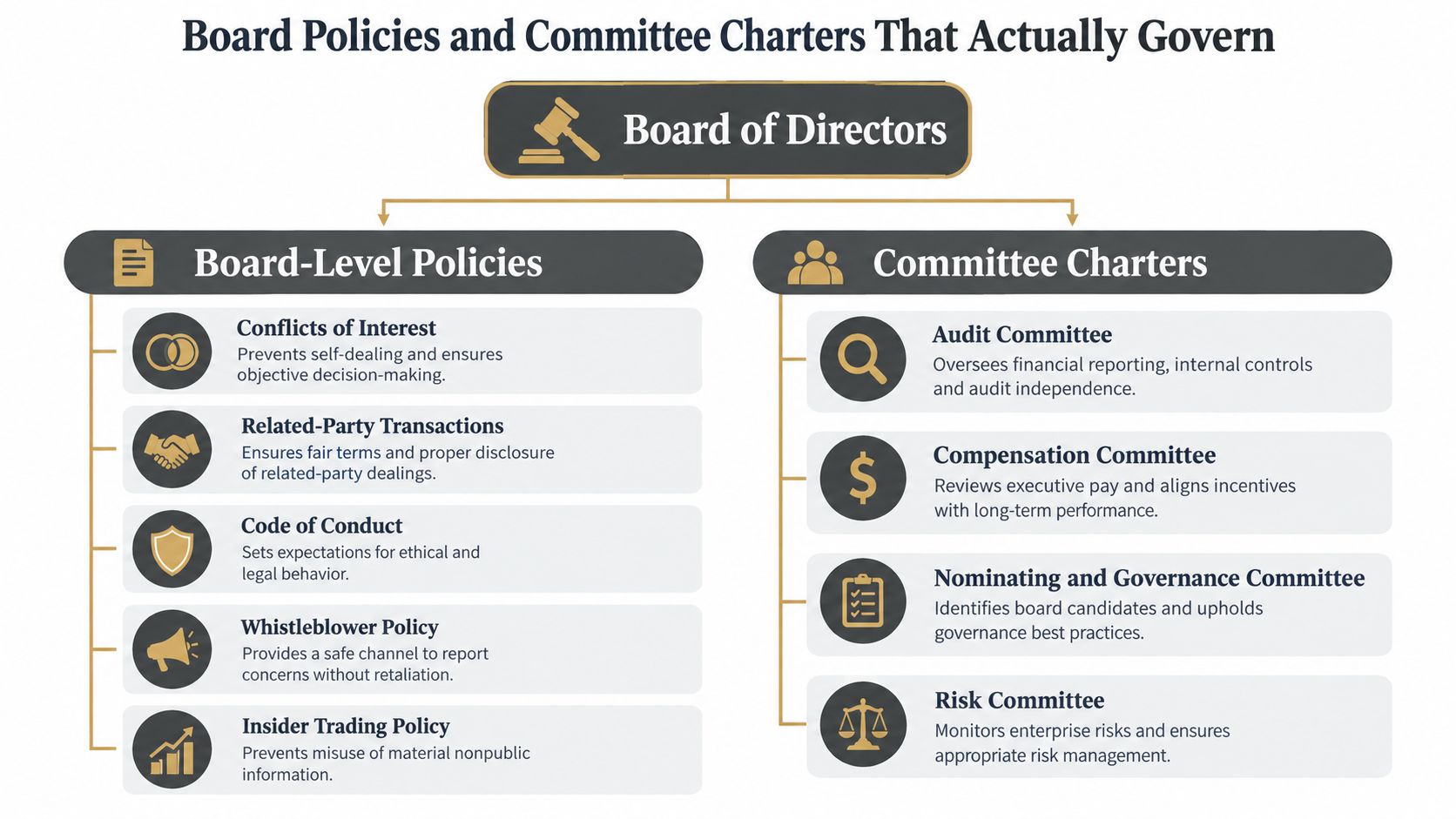
An audit committee charter might authorize the committee to review financial reporting, meet privately with auditors, oversee complaint procedures, review related-party transactions, and report material concerns to the full board. A special committee charter for a related-party transaction should identify independent members, authorize separate advisors, require disclosure of the interested person's conflict, prohibit that person from participating, and require the committee to evaluate alternatives before making a recommendation.
The committee's charter defines its authority. The minutes and packet show whether it used that authority. Governance guidance from Kons Law is available through its corporate governance best practices resources. The practical test is simple: could a reader determine what the committee was allowed to do, what it considered, and why it reached its conclusion?
Meeting Records That Hold Up Under Scrutiny
A financing, acquisition, shareholder challenge, or regulator's request can put the board minutes on the desk before anyone reviews the policy manual. Minutes should show informed oversight without reading like a transcript. A defensible record identifies attendees, confirms quorum, records conflicts and recusals, identifies the materials considered, summarizes the substance of deliberation, states the action taken, records votes and dissent where appropriate, and assigns follow-up work.
The board packet should make the requested decision easy to identify. Include the alternatives considered, material legal and financial risks, management's recommendation, relevant supporting analysis, conflicts, and the proposed resolution. The G20/OECD Principles of Corporate Governance identify board functions that include reviewing strategy, budgets, risk policy, acquisitions, major capital expenditures, executive selection, succession, remuneration, and governance effectiveness.
Minutes and written consents
Overly polished minutes may look engineered after a dispute begins. Vague minutes create a different problem because they fail to show what directors knew or considered. A useful entry might state that the board reviewed a presentation, questioned management about alternatives and risks, discussed a disclosed conflict, and approved a resolution subject to defined follow-up. It should capture the decision process, not every sentence spoken.
Written consents work well for routine approvals. They are a poor substitute for meaningful deliberation on a complicated acquisition, conflicted transaction, or major risk decision. If a challenger later asks what the directors knew, the consent may establish the formal vote while saying little about the information exchanged. Attach relevant materials, record disclosures and recusals, and preserve the approval path.
A stockholder inspection request creates another test. Under Delaware General Corporation Law Section 220, a stockholder must submit a written demand under oath, state a proper purpose, and describe requested records with reasonable particularity. The request may cover the stock ledger, stockholder list, books, and records, and may reach certain subsidiary records when the parent has possession, control, or the ability to obtain them. If the corporation refuses or does not respond within 5 business days, the stockholder may petition the Delaware Court of Chancery to compel inspection (Delaware General Corporation Law Section 220).
Preserve records deliberately, particularly when operations cross borders. The practical discussion of UK tax record keeping rules offers a comparison point, but applicable obligations depend on the business, jurisdiction, record type, and litigation status. A searchable index linking each resolution to its packet, authority, owner, deadline, and outcome is more useful than disconnected PDFs. Kons Law also discusses record retention requirements.
Connecticut-Specific Considerations for Governance Files
A Connecticut governance file has two layers of responsibility. The first is mandatory compliance with applicable Connecticut statutes, filings, notices, registered-agent requirements, and record rules. The second is recommended governance practice, such as a document-control matrix, annual review, and consistent packet indexing. The second layer can't replace the first.
For corporations, counsel should check the Connecticut Business Corporation Act provisions that affect notice, quorum, voting, action by written consent, inspection, indemnification, and exculpation. For LLCs, the Connecticut Limited Liability Company Act affects member and manager authority, operating-agreement terms, consent mechanics, inspection rights, and fiduciary-duty limitations. The exact result depends on the entity's language, formation date, amendments, and transaction history.
Where templates create risk
A Delaware form may assume a voting or consent structure that doesn't match a Connecticut entity's governing documents. A New York template may use concepts that conflict with Connecticut defaults. The problem often appears in closely held companies, where the same people serve as owners, managers, officers, and directors and informal practice replaces careful approvals.
Pay particular attention to:
- Notice and quorum: Confirm that meeting procedures match the governing statute and the company's own bylaws or operating agreement.
- Written consents: Make sure the approval method is authorized, signed by the required parties, and supported by enough information to explain the decision.
- Inspection rights: Preserve ledgers, minutes, accounting records, and approvals in a way that permits a timely response to a proper request.
- Indemnification and exculpation: Check the limits carefully. A clause cannot expand protection beyond what applicable law permits.
- State filings: Reconcile Connecticut Business Registry filings with the internal ownership, officer, manager, and registered-agent records.
Financial-services and investor-facing businesses need an additional retention review because regulatory examinations, arbitration, employment claims, and client disputes may request records from several systems at once. A Connecticut file should therefore identify which rule is mandatory, which policy is voluntary, and which document controls if two provisions conflict.
Why More Paperwork Is Not Better Governance
A thick policy library can still leave a company without accountability. Conflicting policies, scattered signatures, outdated delegations, and uncertain version control create an authority problem. Adding another policy increases the file without clarifying who may act, who must approve, or what evidence proves approval.
A document-control matrix gives the file a working structure. It connects each material decision to the approving body, voting threshold, conflict process, notice requirement, documentary evidence, and retention period. It should address director elections, related-party transactions, acquisitions, dividends, executive compensation, risk acceptance, and major capital expenditures.
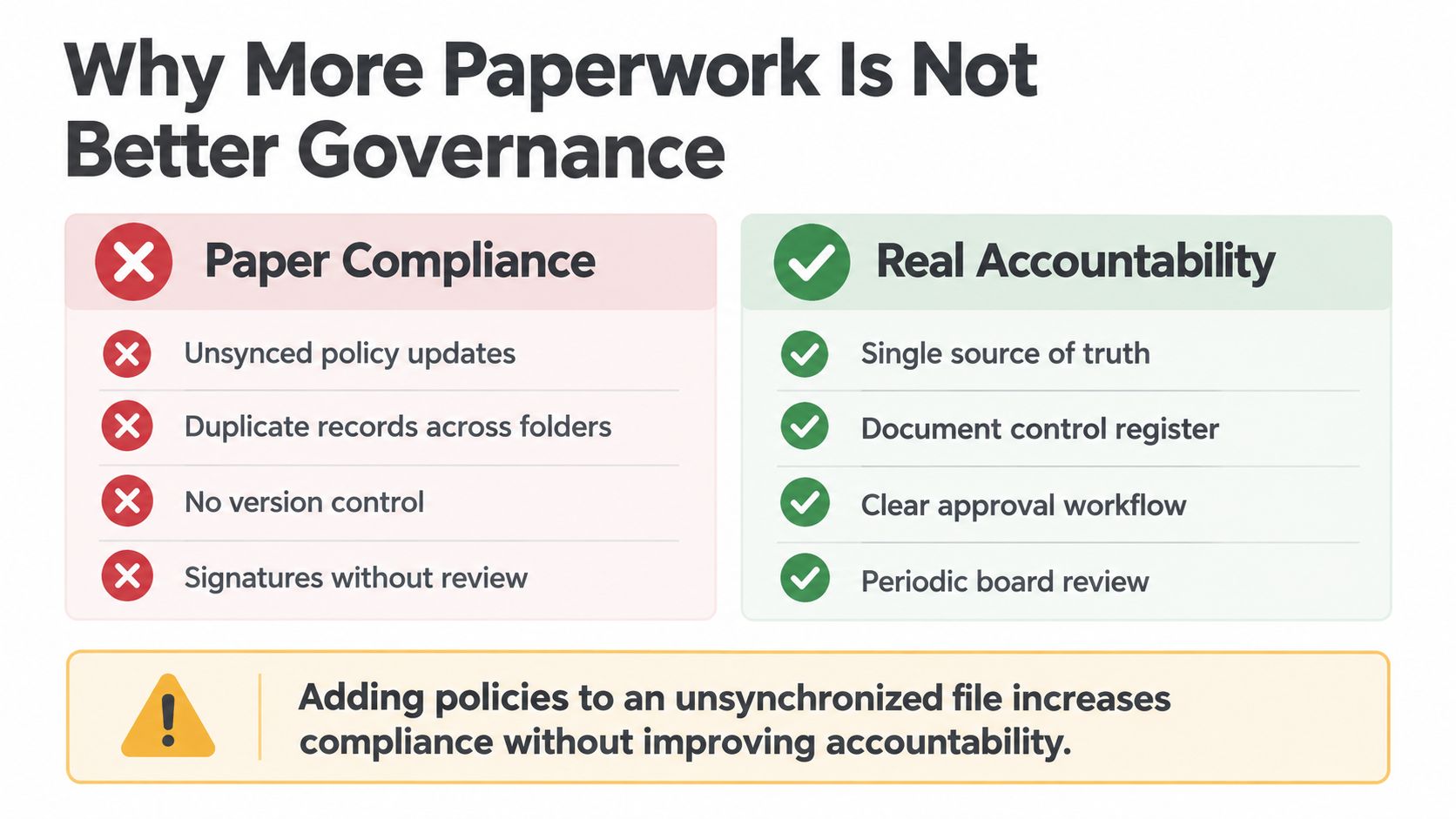
The matrix shows where written authority and actual practice separate. A bylaw may reserve a spending decision to the board while a delegation schedule gives an executive broader authority. A committee charter may require a report to the board, yet meeting agendas may never include that report. Those gaps matter during financing diligence, an acquisition, a shareholder challenge, or a regulator's request.
The G20/OECD Principles, cited earlier, address governance areas such as effective frameworks, shareholder rights, stakeholder roles, disclosure, transparency, and board responsibilities. A matrix turns those broad governance expectations into assigned approvals and retrievable records.
More documents do not automatically create more control. Consistent authority, clear ownership, and retrievable evidence do.
Assign the matrix an owner, version date, review schedule, and links to the governing instruments. Review it after a financing, leadership change, acquisition, new technology deployment, or material policy change. That review keeps stale delegations from controlling a current decision and gives counsel a usable record before a dispute or transaction exposes the file.
Scenarios Where Specific Governance Documents Surface First
A contemplated sale puts ownership and approval records at the front of the room. The buyer's diligence team will usually focus first on the cap table, equity-issuance records, investor-rights agreements, board and stockholder resolutions, related-party approvals, and transfer provisions. If drag-along or tag-along rights exist, the buyer will need to see the exact operative language and evidence that the required approvals were obtained.
A financial-services regulatory inquiry or securities arbitration follows a different path. Investigators may request written supervisory procedures, training records, employment materials, product-approval records, committee minutes, compliance reports, and records showing how the firm addressed a known concern. A board minute that says only “compliance matters discussed” won't answer who reviewed the issue or what action followed.
Compensation and departure disputes
When a senior executive or advisor leaves and claims unpaid compensation, the relevant file expands quickly. Counsel may review the employment agreement, deferred-compensation plan, equity award records, production-credit calculations, compensation committee approvals, clawback policy, code of conduct, and communications documenting the decision. A signed agreement may not resolve the dispute if later approvals changed the compensation structure or if the company applied a policy inconsistently.
A shareholder or member books-and-records demand starts with the inspection statute and then moves to the company's bylaws or operating agreement, retention schedule, ledgers, minutes, written consents, accounting records, and ownership communications. The demand's stated purpose and requested records determine the response, so the company needs an indexed file rather than an unreviewed data dump.
The order of review should follow the event:
- Sale or financing: Ownership records, governing agreements, approvals, delegations, and conflicts.
- Regulatory inquiry: Applicable policies, supervision records, training, committee oversight, and escalation evidence.
- Executive departure: Employment and compensation documents, equity records, approvals, and conduct policies.
- Inspection demand: Statutory rights, demand scope, ledgers, minutes, consents, and retention controls.
Common Governance-Document Mistakes and How to Avoid Them
The same defects appear across many company files. Each one creates a different kind of exposure.
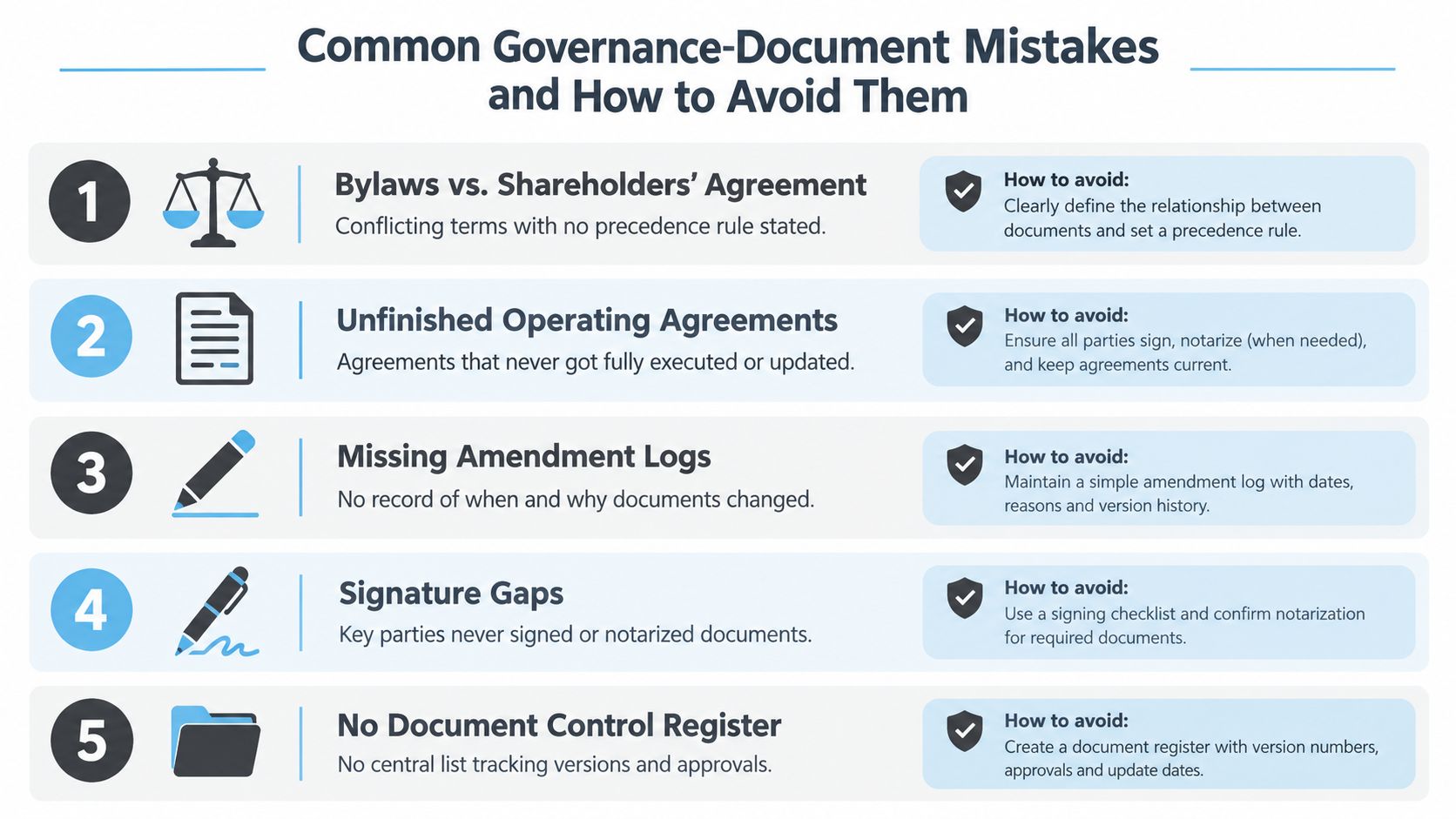
- Bylaws and shareholder agreement conflict: One document may grant board authority while another requires investor consent. Add a precedence rule, identify reserved matters clearly, and review both documents after every financing.
- Unfinished operating agreement: An LLC may operate under a draft that was never fully executed or never updated after a capital restructuring. Obtain signed counterparts, record amendments, and reconcile ownership schedules.
- Minutes that record only the vote: A bare approval doesn't show the materials considered, conflicts reviewed, alternatives discussed, or follow-up assigned. Use a concise decision record that captures those points without creating a transcript.
- Stale delegation schedule: A financing, leadership change, or acquisition may alter who can approve spending or contracts. Review the schedule after each material event and compare it with actual signatures.
- Policies that no one acknowledges: A code of conduct or data policy provides weak evidence if covered employees never received it or were never trained. Maintain distribution, acknowledgment, and training records.
Technology creates a newer version of the same problem. A company may adopt generative AI, change data practices, approve a vendor, or experience a cybersecurity incident without updating its governance record. Board guidance identifies AI strategy and risk oversight, data governance, cybersecurity, supply-chain risk, and incident-response monitoring as priority matters, while the Institute of Directors recommends an AI inventory, documented data sources, assigned accountability, impact assessments, and continuous review (KPMG board agenda guidance).
The right response isn't always another policy. It may be a board minute assigning ownership, a vendor approval record, a risk assessment tied to a specific use, an escalation threshold, and a review date. A defensible file is updated, cross-referenced, and used in decisions. It isn't merely signed and shelved.
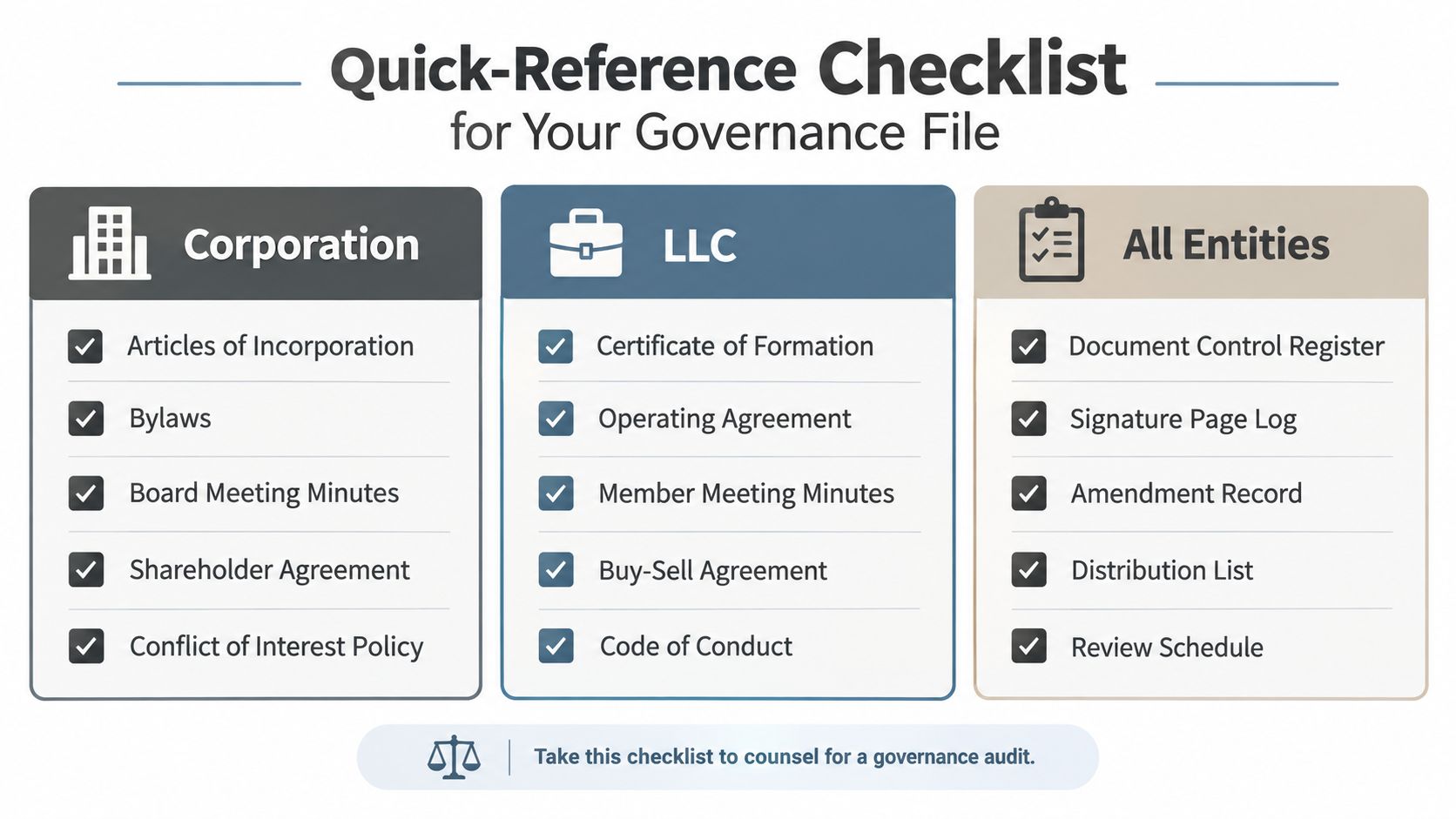
Quick-Reference Checklist for Your Governance File
Use this checklist with counsel and management. The minimum set depends on entity type, ownership structure, industry, financing history, and applicable law.
| Document | Corporation | LLC | Partnership |
|---|---|---|---|
| Formation document | Certificate of incorporation | Certificate of organization | Certificate or registration, where applicable |
| Core governance agreement | Bylaws | Operating agreement | Partnership agreement |
| Ownership record | Stock ledger and cap table | Membership ledger and ownership schedule | Partner ledger and allocation schedule |
| Approval record | Board and shareholder minutes, resolutions, consents | Member or manager minutes, resolutions, consents | Partner approvals and written consents |
| Rights agreement | Shareholder or investor-rights agreement | Buy-sell or investor agreement | Transfer and withdrawal agreement |
| Operating policies | Conflict, conduct, related-party, delegation policies | Conflict, conduct, related-party, delegation policies | Conflict, conduct, related-party, delegation policies |
Each entity should maintain cross-references among its formation document, ownership record, approval authority, amendments, and meeting evidence. The file should also identify the current version, execution status, amendment history, distribution list, and retention owner.
Review cadence and immediate triggers
At minimum, review the document-control matrix annually, audit the file after a financing, review committee minutes after a material event, and update governance documents when the company hires a senior executive, approves a related-party transaction, adopts significant technology, or changes its capital structure.
Open the governance file immediately when the company faces:
- A financing or refinancing
- A contemplated sale or investment
- A regulator inquiry
- A stockholder books-and-records demand
- The departure of an officer, director, or significant employee
If you want to discuss your business law matter, contact Kons Law at (860) 920-5181.
Kons Law can help review and align bylaws, operating agreements, resolutions, committee charters, ownership records, and approval procedures before a transaction or dispute exposes a gap. Visit Kons Law to discuss a governance audit, business dispute, financing, regulatory matter, or related corporate need.
