
You resign from a wirehouse, join a new firm, and expect the hardest part to be moving client relationships. Then the compensation notices arrive. A bonus is canceled, deferred pay is frozen, and a former employer demands repayment of a recruiting loan. What looked like an ordinary transition quickly becomes a compensation dispute involving contract language, regulatory disclosures, client movement, and personal cash flow.
These disputes rarely turn on one email or one missing payment. They turn on how the firm classified the money, when the compensation became earned, what the plan says happens after departure, and whether the employer can enforce a clawback or repayment provision. The first response often shapes the entire case.
When a Bonus Disappears on the Way Out the Door
Sarah has spent nine years at a wirehouse. She signs with a new registered investment adviser, gives notice, and starts planning the repapering process for her client book. Within days, her former firm cancels a production bonus, freezes a deferred compensation balance while it conducts what it calls a final reconciliation, and sends a demand for repayment of an unpaid balance on a forgivable loan.
The amounts matter, but the timing matters just as much. Sarah's resignation may activate a clawback provision, a forfeiture clause, and an acceleration provision in the loan agreement. The same notice may also create practical pressure around her cash flow, transition expenses, regulatory disclosures, and any covenant tied to the new firm's transition financing.
Practical rule: Treat the first notice as evidence, not as an invitation to argue by email.
The firm may describe the bonus as discretionary, the deferred account as unvested, and the loan as immediately due. Sarah may believe the bonus was already earned through production, that the deferred compensation was withheld from her pay under a formula, and that the loan should be reduced according to its forgiveness schedule. The dispute is born from those competing classifications.
An advisor evaluating incentive structures can also benefit from broader compensation context, including this resource on bonus ai dipendenti strategici. In a securities-industry dispute, however, the governing documents remain central. A general description of bonus practice won't replace the grid, plan, offer letter, note, or transition agreement that controls Sarah's payment.
Why the first month changes the leverage
The first thirty days are important because records can become harder to obtain, internal explanations can shift, and the firm may finalize regulatory or accounting entries. Sarah should preserve the documents she already possesses lawfully, identify what the firm has withheld, and avoid signing a release just to stop the immediate pressure.
FINRA's published statistics show that compensation remains a recurring category in securities arbitration. The category recorded 156 year-end cases in 2024, 75 cases through year-end in 2025, and 78 cases through August 2026. Earlier benchmarks recorded 77 cases at year-end 2021 and 84 at year-end 2022. Those figures don't determine Sarah's outcome, but they show that pay-related disputes continue to reach the industry's principal arbitration forum. FINRA's dispute-resolution statistics provide the public benchmark.
Sarah's situation can develop into a withheld-bonus claim, a deferred-compensation claim, a production-credit dispute, a promissory-note defense, or several of those claims at once. The right response depends on the documents and the forum, not on the label used in the employer's letter.
What a Compensation Dispute Really Means in Financial Services
An advisor resigns, expecting a bonus or deferred award to be paid, and instead receives a repayment demand. The firm points to forfeiture language, a “cause” provision, or an unvested balance. The advisor's documents may show a different payment history, vesting condition, or production calculation. That conflict is a compensation dispute, and it can involve an advisor and a broker-dealer, investment adviser, insurance carrier, or another financial-services business.
These disputes often surface during a move between firms rather than in an ordinary payroll cycle. Resignation may activate vesting and repayment provisions. Termination may trigger a “cause” definition or bad-leaver clause. A merger can change the production grid or how client revenue is credited. Death or disability can create separate payout and benefit questions.
Mobility provisions also serve a retention strategy. A firm may use deferred compensation, transition loans, or repayment terms to encourage an advisor to stay. Recent FINRA panels have examined whether those provisions operate as written and whether the surrounding facts support an ERISA-style analysis of plan administration or earned benefits. That framing can affect both the available theory and the forum's treatment of the dispute.
Classify the legal theory before choosing a forum
The same missing payment can support several legal theories:
- Contract: The advisor argues that the grid, offer letter, deferred plan, or note requires payment or limits repayment.
- Wage and hour: The advisor argues that the amount qualifies as earned wages under applicable state law.
- Fiduciary or statutory theory: The advisor argues that plan administration or withholding violated a statutory protection.
- Regulatory or reputational harm: The advisor challenges the accuracy or context of a Form U5 entry or another departure-related report.
A Form U4 or U5 relationship may bring the dispute within FINRA arbitration provisions. A claim outside that contractual and regulatory framework may support a stronger court argument. The presence of a securities account alone does not turn every payment disagreement into a customer securities claim.
FINRA rules matter, but they do not resolve every compensation question. Rule 3110 addresses supervision, while Rule 5121 addresses conflicts involving public customers and firms with interested persons. Neither provision decides whether a bonus vested or whether a loan balance is collectible. The governing contract, applicable employment law, and facts surrounding the payment usually control.
Claims that need separate treatment
Independent-contractor fee splits under the Investment Adviser Marketing Rule, ordinary tax disputes, and severance negotiations without a securities-account connection may require a different analysis. They may overlap with a departure dispute, yet the arbitration clause and the parties involved must be examined before choosing FINRA arbitration.
The classification affects remedies and procedure. A contract claim may focus on expectation damages and interpretation. A wage claim may raise statutory payment rules or fee-shifting. A fiduciary theory may require proof of duties that do not arise from a compensation schedule alone. Counsel should identify the legal character of each payment before filing a claim or responding to a demand.
The Four Scenarios That Drive Most Advisor Compensation Disputes
Most advisor compensation fights fall into four recurring patterns. They overlap, and one arbitration may involve more than one at the same time.
Withheld discretionary bonuses
A firm may tie a bonus to production, profitability, conduct, retention, or management approval. The key language often sits in a grid statement, annual compensation memo, or plan document rather than the offer letter.
The main question is whether the firm truly kept discretion or instead used a formula that made payment effectively earned once specified conditions were met. A later change in production-credit assumptions, bonus treatment, or branch economics can change the number the firm says is due. One reported fault line involves monthly incentive pay calculated as a percentage of production credits using preset cash-grid bands. The discussion of internal compensation accounting shows why the accounting method can matter as much as the headline bonus promise.
Deferred compensation and equity-style awards
Deferred plans commonly condition payment on continued employment through a grant date and a later vesting date. A plan may cancel an award after departure or upon specified misconduct, including securities-rule violations, fraud, or restricted solicitation.
The advisor should compare the vesting schedule with the actual departure date and then test each forfeiture trigger against the plan's wording. A federally reviewed program, for example, used a formula under which each monthly credit equaled the applicable credit rate multiplied by creditable revenue. The Department of Labor advisory opinion shows why the formula and the cancellation conditions must be read together.
Production credits and trail payouts
Production disputes arise after team moves, household reattribution, changes in channel classification, or disagreements over who generated revenue. The relevant document may define credit by account ownership, servicing responsibility, originating advisor, team allocation, or payment receipt.
A claim can also involve revenue trailers, back pay, interest, and attorney's fees. Recent FINRA-arbitration reporting describes matters in which deferred compensation and other payment theories were bundled together, with reported outcomes ranging from roughly $297,000 to more than $3 million in individual or group matters. InvestmentNews' report on a Morgan Stanley arbitration shows why a narrow focus on one withheld bonus may miss a larger classification dispute.
Promissory notes and forgivable loans
Recruiting incentives are often documented as promissory notes or forgivable loans. Industry reporting describes amortization schedules running from 5 to 12 years, with firms commonly demanding repayment of the remaining balance shortly after departure. The reporting on advisor recruiting loans explains why the resignation date and amortization schedule can become the main liability drivers.
The controlling terms include acceleration upon termination, forgiveness dates, reimbursement provisions, and the distinction between garden leave and a true clawback. A mobility agreement may release some claims while preserving others, so signing one can change the position available in negotiation.
| Scenario | Typical trigger | Controlling contract language | Key argument the advisor can make |
|---|---|---|---|
| Withheld bonus | Departure or discretionary denial | Grid formulas, approval standards, production definitions | The payment was formula-based or historically paid |
| Deferred compensation | Failure to vest or alleged misconduct | Vesting date, cause definition, forfeiture clause | The payment was earned or no trigger occurred |
| Production credits | Team move or account reattribution | Credit allocation, trail terms, household definitions | Historical reports and consistent treatment of similar accounts |
| Note or loan demand | Resignation or termination | Acceleration, forgiveness, repayment schedule | Calculation errors, offsets, enforceability, and departure classification |
A careful review of the broker compensation agreement should happen before an advisor accepts the firm's characterization of the dispute.
FINRA Arbitration and Other Avenues for Resolving the Fight
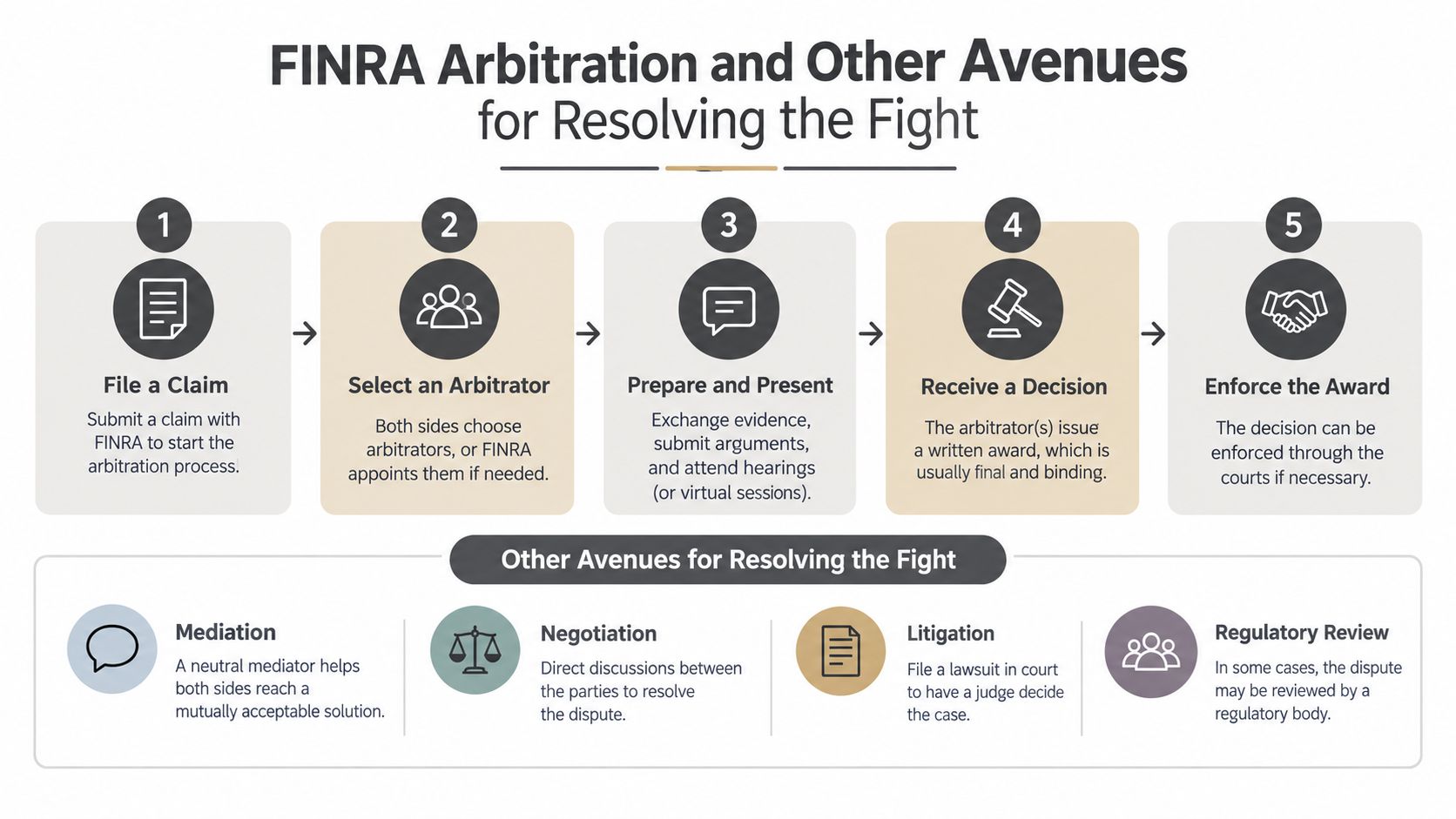
A compensation dispute usually starts with the forum clause and the paperwork that tied the advisor to the firm. In a FINRA case, the claim has to fit the FINRA arbitration rules governing statement-of-claim deadlines and the governing agreement, whether that language sits in Form U4, an employment contract, or a separate note or bonus document. The Statement of Claim should identify the parties, the payment at issue, the contract terms, the theory of recovery, and the relief requested. A clean paper trail matters because the dispute often turns on how the firm calculated the amount, when it says the money was earned, and whether any offset or forgiveness term applies.
Mediation can still help before or during arbitration, especially if both sides want privacy or want to avoid the cost of a hearing. It works best when the core dispute is over valuation, timing, or the effect of a resignation, not when one side has already issued an aggressive collection demand.
Why note cases move differently
FINRA treats promissory-note claims differently because they often arise right after a registered representative leaves and the unpaid balance becomes due at once. Rule 13806 allows expedited handling in those matters, and a single public arbitrator may decide the claim with simplified discovery in some cases. FINRA's expedited decision materials show why a note defense needs immediate attention. A full bonus or deferred-comp case may allow more time for records, but an expedited note proceeding can move before the advisor has assembled payroll history, forgiveness documents, and offset evidence.
That speed cuts both ways. A firm gets a faster path to collection, while the advisor has less room to test the ledger, challenge the acceleration date, or show that the balance was reduced by prior credits or a misapplied repayment formula.
When court litigation remains relevant
Court stays relevant when the claim falls outside the arbitration clause, when a statute creates an independent cause of action, or when the agreement's forum language is open to challenge. A court can also decide whether a dispute belongs in arbitration before the merits are heard. In some cases, ERISA-style framing changes that analysis because the remedy may turn on benefit administration rather than a pure contract fight.
Forum choice still matters, but the full court-versus-arbitration comparison belongs in the next section. Here, the practical point is narrower: counsel should check the agreement, the FINRA record, and any plan documents before assuming the case will be heard in the forum the firm prefers.
Arbitration, Court, or Settlement and How to Choose
An advisor leaving a firm may face two immediate problems: a withheld bonus or a demand to repay a note. The right forum depends on more than the amount at issue. Counsel should assess the claim's structure, the governing documents, the evidence, and the advisor's mobility and retention objectives. A deferred-compensation fight may also involve ERISA-style arguments about benefit administration, which can affect both the forum and the available remedies.
Arbitration
FINRA arbitration generally provides a focused forum for disputes between registered representatives and member firms. Discovery is often narrower than in court, and awards are generally final, with limited review. Those features can reduce delay and expense, but they also remove the jury and restrict the appeal route. Punitive-damages exposure may be narrower, depending on the claims and governing law.
For an advisor, the trade-off is speed and subject-matter familiarity versus procedural control. The case should be built for a panel familiar with production grids, forgivable loans, vesting schedules, and deferred compensation administration. The practical differences between the forums are explained in this guide to the difference between arbitration and litigation.
Recent FINRA decisions also show why the forum analysis cannot stop with contract language. A retention plan may be designed to influence an advisor's decision to stay, move, or repay an advance. If the dispute is framed around administration of an employee benefit plan, ERISA-style arguments may change how the panel evaluates the promise, the forfeiture condition, and the requested remedy.
Court litigation
Court litigation preserves formal discovery, motion practice, and, where the claim and agreement permit it, a jury. It may fit statutory claims, disputes involving parties that never agreed to FINRA arbitration, or cases requiring subpoenas and broader third-party discovery. A court can also decide whether the dispute belongs in arbitration before addressing the merits.
The costs are significant. The firm may seek to compel arbitration, motion practice may extend the timeline, and public filings can create regulatory or reputational exposure. Proving a technical compensation calculation through formal discovery and trial can also increase expense.
Settlement
Settlement often makes sense when the evidence is mixed, confidentiality matters, or the parties can resolve the dispute through a structured payment and mutual release. It can address nonmonetary terms as well, including regulatory-disclosure language, client-contact restrictions, and transition obligations.
The advisor should obtain the firm's calculation before signing a broad release. The agreement should identify the gross payment, tax treatment, note balance, deferred balance, payment timing, and regulatory consequences. A settlement that appears attractive on its face may leave the advisor responsible for an unexplained repayment demand or an unfavorable disclosure.
| Factor | FINRA arbitration | Court litigation | Settlement |
|---|---|---|---|
| Timeline | Often focused, with special handling for qualifying note disputes | Motions and discovery may extend the case | Controlled by negotiation |
| Cost | Narrower discovery may reduce expense | Broader discovery can increase expense | Usually lower if resolved early |
| Evidence | Panel-focused presentation | Formal discovery and trial rules | Depends on voluntary exchange |
| Review | Limited challenge to award | Appeals may be available | Enforceability depends on the agreement |
| Best fit | Firm-related claims within the arbitration framework | Claims outside arbitration or involving statutory issues | Confidential resolution where certainty matters |
The decision should turn on evidence strength, cash-flow needs, confidentiality, regulatory risk, and tolerance for an uncertain result. No forum removes the need to prove when the compensation became earned.
A Recent FINRA Arbitration That Shows the Stakes
A representative anonymized FINRA matter involved a senior advisor who left a wirehouse after a long tenure. The dispute centered on a transition-pay plan, a “good cause” forfeiture provision, and the firm's treatment of production credits after the advisor departed.
The advisor argued that the separation didn't meet the plan's definition of good cause and therefore didn't cancel the deferred balance. The firm argued that the award remained subject to the vesting and departure conditions. The panel's analysis focused on the actual plan language, the firm's administration of the program, and the way the advisor's production had historically been credited.
The grid became the evidence
The Grid Statement contained production-credit assumptions that became decisive. The advisor had been credited under a combined-channel methodology, while the firm later emphasized a fee-based-only approach. The dispute wasn't resolved by looking only at the final compensation report. The parties had to address whether the earlier credit basis formed part of the contractual expectation.
Departure timing created a second issue. The plan measured the deferred allocation by reference to a completed reporting period, while the firm attempted to prorate the payment based on the departure date. The panel rejected that approach and treated the plan's measurement language as controlling.
The result was a seven-figure recovery that included the disputed deferred amount and additional components awarded under the case. The lesson isn't that every advisor with a similar grid will receive the same result. It's that vesting language, production-credit assumptions, historical administration, and departure timing can work together to determine the value of a claim.
A compensation dispute should therefore be modeled from the underlying records. A headline bonus figure may be only one part of the recovery, while a seemingly technical grid definition may determine whether the larger claim succeeds.
Evidence, Defenses, and a 30-Day Response Playbook
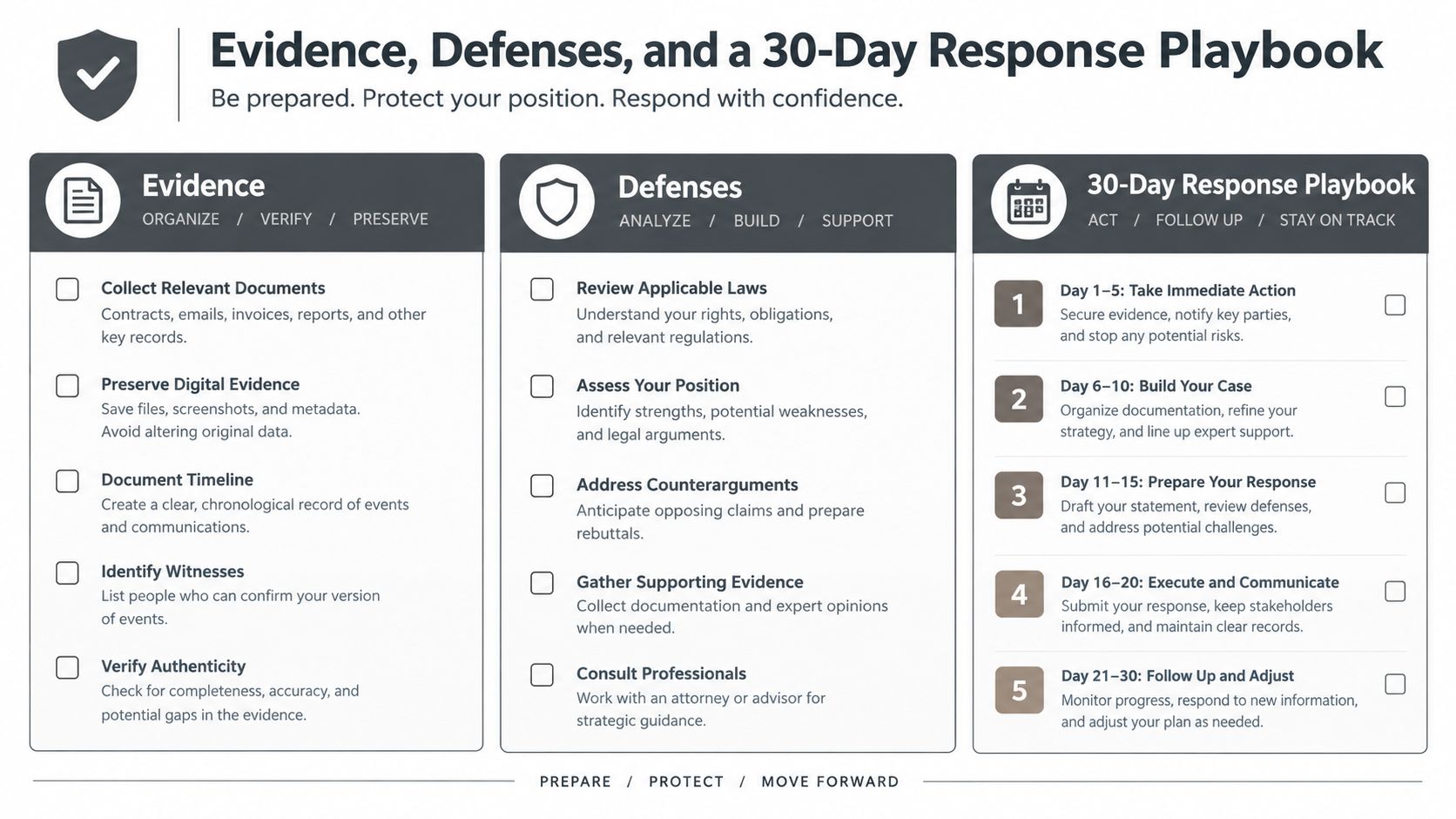
The first thirty days should produce an organized record, not an angry email chain. Start with every document that explains how compensation was offered, calculated, deferred, forgiven, or canceled.
Preserve the payment trail
Collect offer letters, grid statements, transition agreements, deferred-compensation plans, promissory notes, payout schedules, email threads, production reports, account-allocation records, and statements showing amounts withheld from commissions. Preserve the versions that existed when the compensation was awarded, not only the firm's current plan summary.
The advisor also needs a chronology. Mark the grant date, production period, vesting date, notice date, last day, demand date, and any date on which the firm changed the account or grid treatment.
Match evidence to the defense
- Vested-rights argument: Compare the vesting provision with the actual dates and identify whether the firm relies on a condition that wasn't satisfied or was added later.
- Formula challenge: Recalculate the payment from the grid, production reports, and credit definitions rather than accepting the firm's summary.
- Oral-promise corroboration: Locate emails, recruiting notes, witness testimony, and prior payout practices that support what was promised.
- Mitigation: Document reasonable efforts to reduce losses, including efforts to obtain replacement compensation where appropriate.
- Unclean-hands challenge: Examine whether the firm changed classifications, withheld records, or applied its plan inconsistently.
A former advisor should also consider whether continuing to service disputed accounts creates contractual or regulatory risk. Client communications need to follow applicable obligations and agreements, not the advisor's frustration with the former employer.
Sequence the response
During the first phase, preserve records and respond to any litigation hold or document-preservation notice. Next, calculate the firm's asserted exposure and the advisor's affirmative claim separately. Then obtain advice before making admissions, signing a release, or agreeing that a bonus was discretionary.
Early mediation can make sense when the documents are mixed and both sides want to avoid escalation. It makes less sense when the firm refuses to disclose its calculation or demands a release under an immediate deadline. Guidance on handling the initial demand appears in this resource on responding to a demand letter.
When and How to Bring in Counsel and Next Steps
A securities-litigation lawyer should be involved before the advisor responds substantively to a demand letter, promissory-note acceleration notice, threatened FINRA filing, or disputed Form U5 entry. Those events can affect both money and professional mobility.
The same applies when the firm freezes deferred compensation, asserts misconduct, changes the production calculation, or asks the advisor to sign a release. Waiting until an arbitration hearing is scheduled can leave important records and legal theories underdeveloped.
What the initial review should answer
A focused intake should collect the agreements, payment records, correspondence, regulatory documents, and relevant timeline. Counsel should then analyze:
- Exposure: What does the firm claim, and how was it calculated?
- Recovery: What compensation, interest, fees, or other relief may the advisor claim?
- Jurisdiction: Does the dispute belong in FINRA arbitration, court, mediation, or more than one forum?
- Contract terms: Which provisions govern vesting, forfeiture, forgiveness, acceleration, and releases?
- Regulatory impact: Does the dispute involve a Form U5, client transition, solicitation restriction, or other professional consequence?
A useful first meeting should end with a written issue list, a document-preservation plan, a preliminary damages model, and a recommendation about whether to negotiate, file, defend, or seek emergency relief. Counsel handling FINRA arbitration, deferred-compensation claims, note defense, and related commercial disputes can also coordinate the payment analysis with regulatory and transition concerns.
The most effective strategy is usually structured early. It identifies the firm's strongest provision, the advisor's strongest record, the deadlines that cannot be missed, and the settlement terms that would solve the business problem.
If you want to discuss your business law matter, contact Kons Law at (860) 920-5181. Kons Law represents financial professionals in compensation disputes involving withheld bonuses, deferred compensation, production credits, promissory notes, FINRA arbitration, and Form U5 concerns, and can help turn the first demand into a structured response plan.
