A routine holiday gift can turn into a regulatory problem faster than most advisors expect. A registered representative sends a client contact a basket, a bottle, or event tickets, thinks it's a courteous business gesture, and moves on. Months later, a compliance review or FINRA exam asks the question that matters most, was this a gift, who received it, what was it worth, and did the firm track it under the FINRA Gift Rule?
That's where Rule 3220 trips people up. It doesn't only catch obvious excess, it also catches the small, unlogged choices that look harmless in the moment and messy on paper later. If you're trying to get current on the 2026 amendment, the updated $300 limit, the recognized exceptions, and the supervisory steps that hold up in an exam, this is the working framework you need, with the old assumptions stripped out.
A Familiar Gift That Can Trip Up a Careful Advisor
A rep buys a holiday basket for a long-time contact at a vendor. The rep meant it as a courtesy, didn't run it through compliance, and figured the matter was too small to matter. Six months later, the firm's books and records team gets questions during a routine exam, and the rep is now explaining a gift that felt personal but was booked in connection with business.
That fact pattern is familiar because it sits right on the fault line of Rule 3220. The hard questions usually arrive in this order, what counts as a gift, when does the rule apply, who has to track it, and what is the actual cap in 2026? Advisors often know they should avoid obvious quid pro quo behavior, but they miss the administrative side, the log, the valuation, and the aggregation.
Practical rule: if the item is tied to the recipient's business relationship, treat it as a compliance question before you treat it as a gesture.
A careful advisor usually doesn't need a lecture on intent. What they need is a clean framework they can apply before the gift goes out the door. That means understanding the rule's structure, the $300 annual per-recipient limit, the exclusions that sit outside the cap, and the supervisory process the firm has to document.
For a broader fiduciary backdrop on how regulators evaluate professional judgment and client-facing conduct, see this discussion of financial planner fiduciary duty. The gift rule sits in the same universe of judgment calls, paper trails, and defensible process.
By the end, the question shouldn't be whether a holiday basket or event ticket feels polite. It should be whether the item is covered, excluded, aggregated, and logged in a way that a compliance reviewer can defend.
What FINRA Rule 3220 Actually Prohibits
Rule 3220 is not a blanket ban on generosity. It is a targeted rule aimed at things of value given in relation to the recipient employer's business, and FINRA treats a gift of any kind as a gratuity when it falls in that space. In plain English, the rule is designed to stop business influence from hiding inside hospitality, thank-yous, and casual outreach.
Who the rule reaches
The rule applies to member firms and associated persons when they provide anything of value to employees of another person or entity in connection with that person's business. This includes common brokerage settings, vendors, counterparties, institutional contacts, and other business relationships where a gift could create the appearance of influence.
The important trigger is not whether the giver had bad intent. It's whether the thing was given in relation to the recipient's business. If the connection exists, the rule asks whether the item is covered, excluded, or over the limit.
Who the rule does not reach
FINRA's 2026 clarification matters here. The rule does not apply to gifts to individual retail customers, which is a major interpretive milestone for firms that had treated every client-facing gift as if it were automatically inside Rule 3220. That doesn't mean firms can't set their own restrictions, but it does mean the rule itself doesn't regulate that relationship the same way.
A useful analogy is to think of Rule 3220 as a guardrail around business-to-business hospitality, not around every personal gift exchange in life. A birthday card to a friend is not the same thing as a seasonal gift to someone who can affect your firm's business.
A compliance issue starts when the recipient's role gives the item potential leverage, not when the giver names it a “courtesy.”
How the 2026 Amendment Reshaped the Numbers
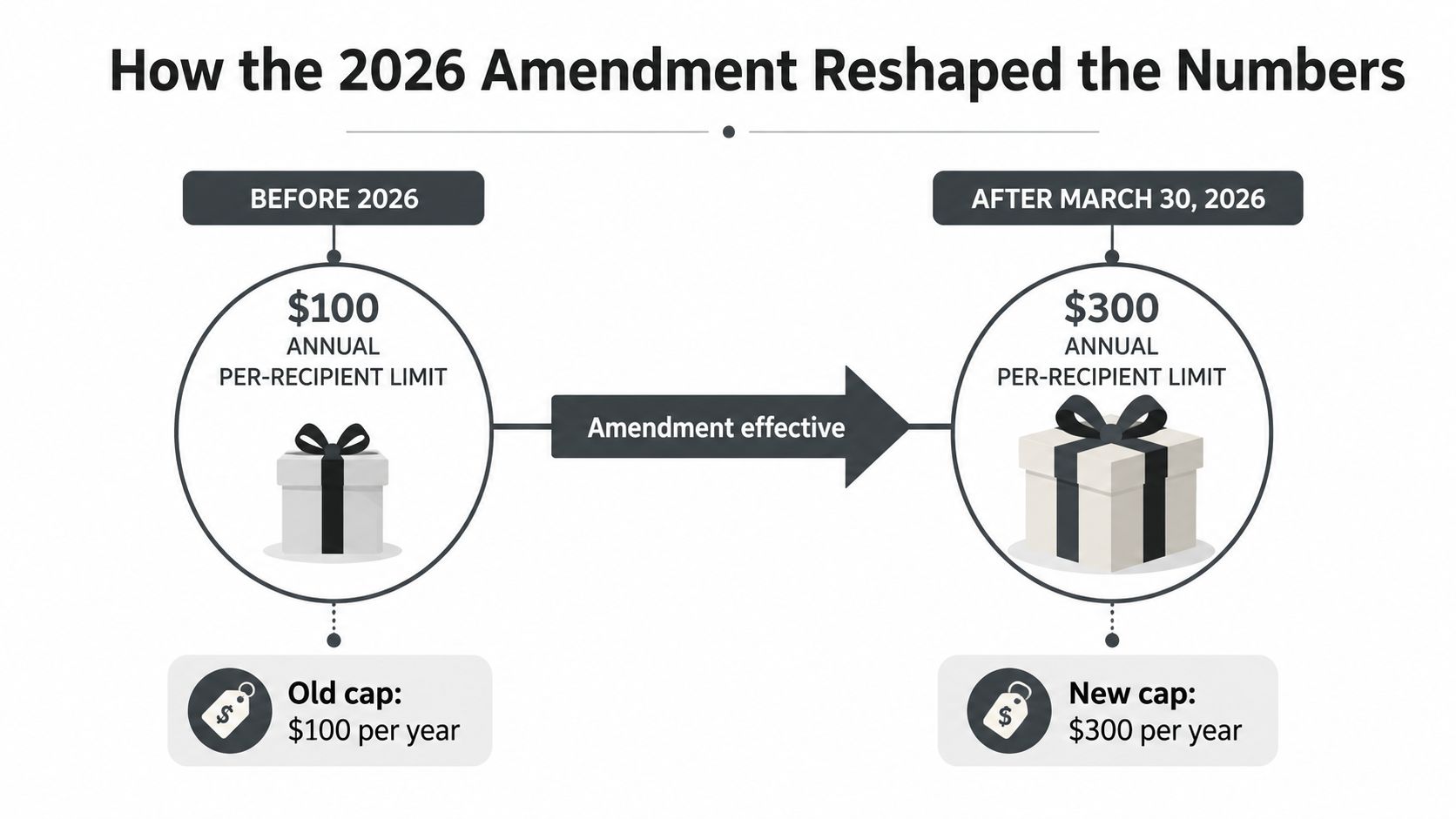
The headline change is simple. FINRA Rule 3220's annual per-recipient gift cap moved from $100 to $300, effective March 30, 2026, after SEC approval in February 2026, a 200% increase from the old cap that had been in place since 1992 (FINRA Regulatory Notice 26-05). FINRA also said the new level was intended to absorb inflation for about 10 years, which tells you the agency expected the number to survive for a while rather than be revisited immediately.
That matters because many summaries still repeat the old cap. Some firms also saw earlier 2025 commentary pointing to a $250 threshold before the final approved level settled at $300, so outdated procedures can easily be built on an intermediate number that never became the final rule. If your policy, questionnaire, or training deck still references anything other than the amended amount, it's stale.
Why the number matters operationally
The limit is per recipient, per year, not per department, not per event, and not per line item. That's the mistake that creates avoidable exam issues. A firm can't slice one relationship into smaller buckets and pretend each bucket is independently safe.
The amended rule also fits into a broader compliance design that includes valuation, aggregation, supervision, and recordkeeping. FINRA's own rule text reflects that shift, so firms that only updated the dollar amount without revisiting process have half a policy, not a real one (FINRA Rule 3220).
The number changed, but the enforcement logic didn't. Regulators still care about whether the gift could influence business judgment.
Exceptions That Take a Gift Outside the Rule
The fastest way to misread Rule 3220 is to assume every covered-looking item counts the same way. FINRA's structure leaves room for items that are too small, too personal, or too disconnected from business to sit inside the cap. The judgment call is real, though, and the documentation has to match it.
The main exclusions
De minimis items are the first category. Pens, modest desk ornaments, or similar items can be excluded when they're substantially below the $300 limit. A small branded desk piece usually fits better than an expensive engraved gift set.
Promotional items of nominal value that carry the firm's logo also fall outside the cap when they're minor. A logo mug or pen is the typical example, not a premium item dressed up as marketing.
Personal gifts tied to life events can be excluded when they're infrequent, customary, reasonable, and personal rather than business-related. Weddings and newborn gifts are the classic examples. The label matters less than the facts, so an item that feels personal but was really purchased to preserve business favor can still create trouble.
Bereavement gifts are also excluded when they're reasonable condolence gestures. FINRA's 2026 clarification makes clear that this category is not supposed to be treated like an influence payment.
Disaster-related donations also sit outside the rule when they're made under the conditions FINRA recognizes. Those are not treated as business gratuities.
A quick pattern test
| Exclusion | Threshold or Condition | Documentation Expectation |
|---|---|---|
| De minimis item | Substantially below the $300 limit | Note item type and why it is minor |
| Promotional item | Nominal value, firm logo present | Keep sample or description in log |
| Personal life-event gift | Customary, reasonable, personal, and not business-related | Record the life event and rationale |
| Bereavement gift | Reasonable condolence gesture | Note recipient relationship and occasion |
| Disaster-related donation | Falls within FINRA's exclusion | Retain basis for the charitable or relief purpose |
A key caution is that exclusions aren't self-proving. A $250 engraved pen set is not automatically excluded just because a pen can be de minimis. The facts have to support the category, and the file should show why.
For a practical comparison of how firms document these calls, a compliance documentation guide is useful because the same habit, contemporaneous notes, clear approvals, and traceable rationale, is what makes an exclusion defensible.
Valuation, Aggregation, and Written Procedures
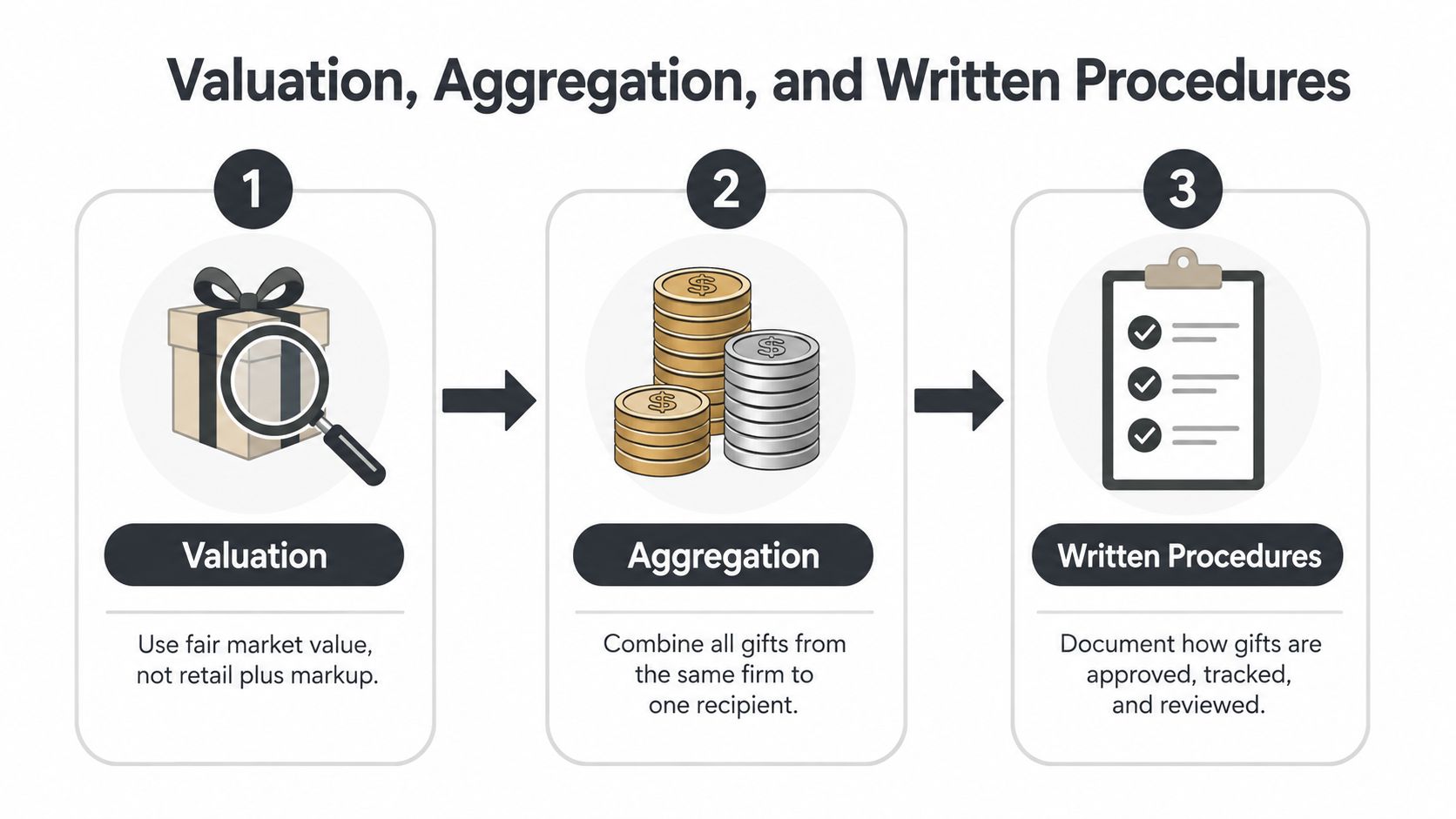
If Rule 3220 causes an exam issue, it usually isn't because the firm forgot the headline limit. It's because the firm never built a repeatable process around value, aggregation, and review. Those are the three operational pillars that turn a rule into something people can follow.
Valuation and aggregation
Valuation has to be done carefully. The practical question is what the item is worth, not how much the giver wishes it were worth. For event tickets, the analysis is especially sensitive, because the value can hinge on how the tickets are priced and documented. For ordinary gifts, the firm needs a consistent method that the compliance team can defend.
Aggregation is where many firms stumble. If one recipient gets multiple items from the same firm or its associated persons over the course of the year, those items have to be tracked together. The point of aggregation is to prevent slicing a larger gift relationship into smaller pieces that look harmless in isolation.
What a written supervisory procedure needs
A compliant written supervisory procedure should say who reviews gifts, how the firm values them, how gifts are aggregated, and who can approve or reject them. It should also explain how the firm handles exclusions and what records get retained.
For a deeper procedural reference, this explanation of written supervisory procedures fits neatly into the way Rule 3220 gets enforced.
Operational reality: if the approval path depends on memory or email threads, the firm will struggle to defend the file later.
A simple example shows why this matters. A vendor sends an advisor sporting event tickets worth $400. Even if the advisor didn't ask for them, the firm still has to value the item, see whether anything else has already gone to that recipient, and decide whether to decline, return, or pre-approve only if the final total fits the amended framework. That's the point where an automated expense system starts to look less like a convenience and more like basic infrastructure.
A clean log entry should identify the recipient, date, item, value, business purpose, exclusion analysis, and approver. If the firm can't produce that sequence without rebuilding the story from scratch, the policy is too thin.
Common Pitfalls FINRA Has Flagged
The mistakes that attract attention are usually not glamorous. They're administrative shortcuts that create a pattern regulators can reconstruct later. Once that pattern exists, a rep's explanation that “everyone knew what I meant” doesn't carry much weight.
The recurring failure modes
Split gifts are a classic problem. A team divides one gift across several people to stay under the cap, but FINRA still sees the same relationship and the same economic reality. That is exactly the kind of circumvention aggregation is meant to stop.
Undisclosed vendor entertainment causes problems when it is booked in the firm's name but not covered by the firm's procedures. The issue isn't only the item itself, it's the lack of clear ownership and review.
Sponsorship or speaking arrangements can become disguised gratuities when the payment or benefit has little real business substance. Examiners look for whether there was an actual business purpose or just a dressed-up transfer of value.
Aggregation across affiliated entities creates another common failure point. If a firm treats related entities as separate silos for gift purposes but the relationship is functionally shared, the books can understate the total.
The exam response typically starts with documents, not explanations. FINRA will ask for logs, policies, approvals, expense records, and the rationale for any exclusion. Depending on the facts and the history, the result can range from a cautionary letter to a fine, a suspension, or a broader disciplinary matter.
For a related look at how regulators treat adjacent transaction issues and paper-trail problems, this discussion of private securities transactions shows the same enforcement rhythm, the conduct matters, but the records often decide how hard the case lands.
A Practical Compliance Playbook for Advisors and Firms
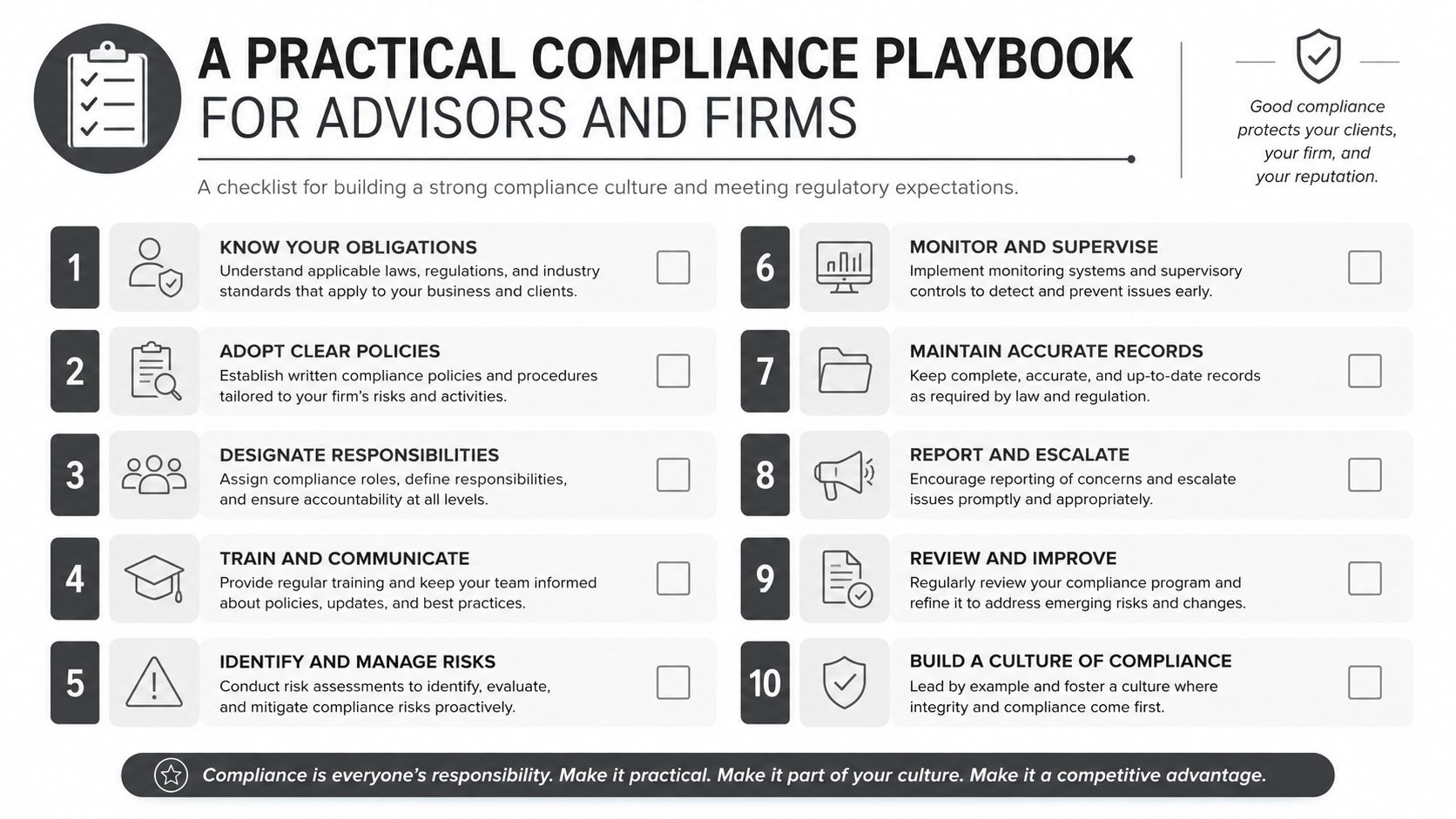
A firm doesn't need a massive project to get current. It needs a sequence. The cleanest approach is to fix the language, then fix the workflow, then test the file.
A workable next-quarter checklist
- Pull every WSP that still references the $100 cap and update it to $300, effective March 30, 2026.
- Revise questionnaire language so gifts to individual retail customers no longer trigger false positives under Rule 3220.
- Reset approval thresholds so supervisors can clear de minimis items without creating a bottleneck.
- Train advisors and vendor managers on aggregation, especially when more than one person touches the same relationship.
- Audit the prior 12 months for over-cap gifts that were missed under the old rule or booked under an outdated threshold.
- Memorialize retention rules so logs, approvals, and exception analyses are kept consistently.
A mid-sized firm can usually do most of this without outside counsel if the facts are straightforward and the workflow is simple. The parts that usually deserve legal review are edge-case exclusions, bundled hospitality, and any gift that might be viewed as part of an inducement pattern rather than a courtesy.
Responding to a FINRA Inquiry or Alleged Violation
When a gift issue turns into a FINRA question, speed matters more than improvisation. The first mistake is trying to explain the facts too casually before the firm has preserved the record. The second mistake is “cleaning up” a file after the regulator has already asked for it.
If FINRA sends an exam letter or an 8210 request, treat the matter like an investigation from the start. Preserve the email chain, expense records, approval notes, and any supporting documentation immediately. If someone proposes supplementing the story after the fact, stop there, because the after-the-fact change can become a separate problem.
The practical path usually runs from an internal review to a controlled response, then to outside counsel if the facts are unclear or the regulator's tone tightens. A routine exam finding can stay routine, or it can move into a Letter of Caution, a complaint, or formal disciplinary action if the conduct looks repeated or willful. If the matter touches a Form U4 or Form U5, the collateral damage can outlast the original gift issue.
The moment the issue is mentioned in writing by FINRA, assume the paper trail matters as much as the explanation.
A useful internal rule is simple, do not debate the merits in fragments across email. Put the documents together, identify the actual recipient, determine whether any exclusion applies, and then respond once the file is coherent. That's the point where defense counsel adds value, especially when the firm needs to distinguish a genuine recordkeeping miss from conduct that FINRA may view as a gratuity issue.
For firms and representatives dealing with an inquiry, an 8210 request, or a disclosure problem, this resource on a regulatory compliance attorney fits the moment. The right response is disciplined, factual, and contemporaneous, not reactive.
If you want help evaluating a FINRA gift issue, a supervisory procedure gap, or a pending regulatory request, Kons Law handles broker-dealer defense and securities compliance matters with the practical judgment these cases demand. If you want to discuss your business law matter, contact Kons Law at (860) 920-5181, or visit Kons Law to connect with the firm about your situation.
