
You can do everything right on paper, pass the exam, and still end up unable to touch client accounts because the registration stack was never completed correctly. That's the part most new advisors miss. A stock broker license in the U.S. isn't a single certificate you frame and forget, it's a layered regulatory setup tied to your firm, your sponsor, your product scope, and the states where you do business.
That reality matters on day one, not after a problem surfaces. The industry is large, tightly supervised, and still moving through a steady flow of new entrants and disciplinary actions. FINRA reported 639,723 registered representatives in 2025, up 5% since 2021, with 40,000–45,000 people entering the industry annually and 331,802 maintaining dual broker-dealer and investment-adviser registration, while also reporting 625 new disciplinary actions, $99.6 million in fines and disgorgement, and 187 bar sanctions in 2025 (FINRA statistics). The career is real, the oversight is real, and the paper trail follows you.
What a Stock Broker License Means
A new advisor often expects a simple path. Pass the Series 7, get hired, open an office, and start selling securities. The legal authority to act as a broker is spread across several layers, and each one covers a different part of the job.
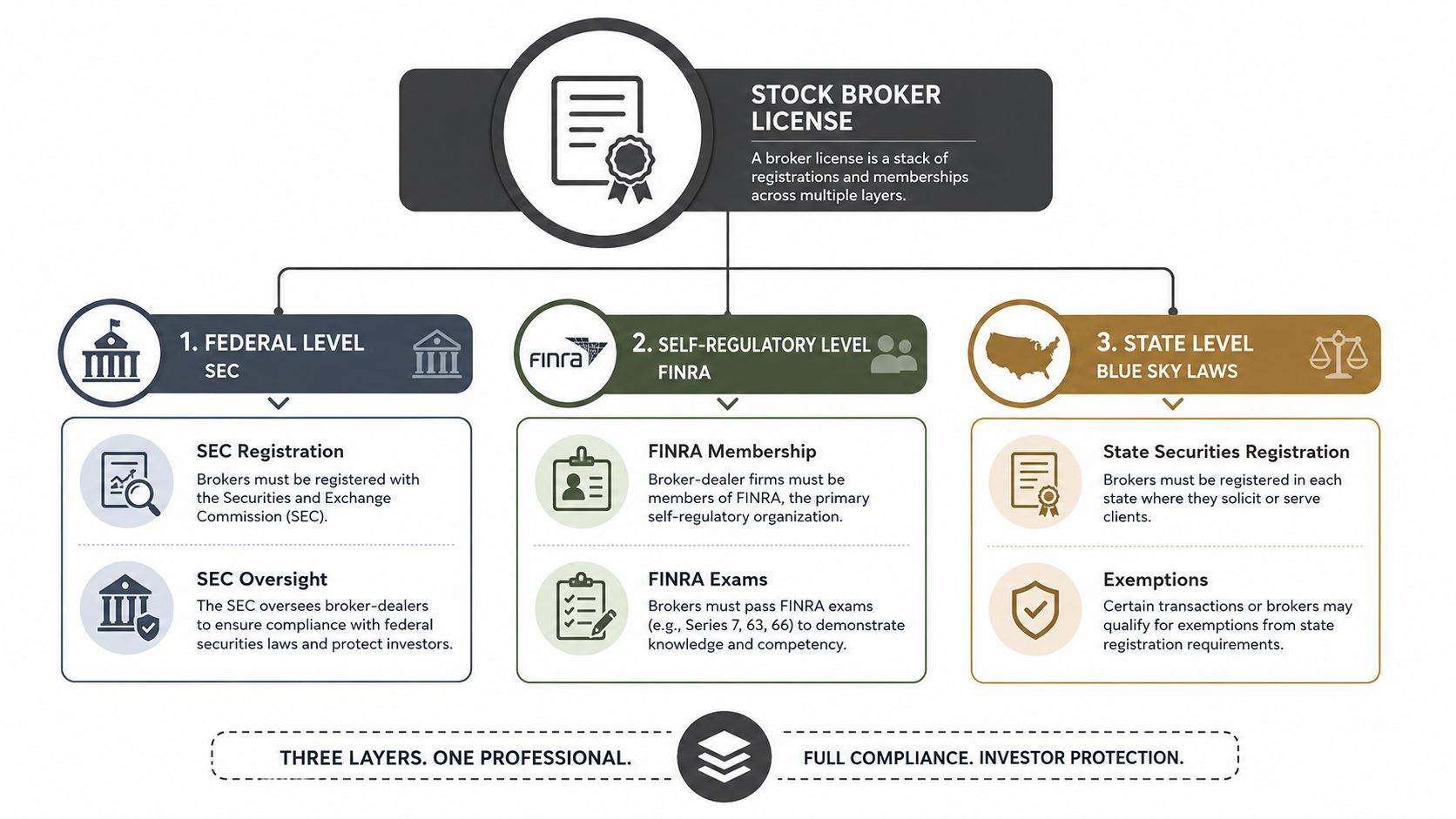
At the federal level, the firm has to register as a broker-dealer with the SEC and complete the related filing and membership steps. The SEC's broker-dealer registration guide makes clear that hiring licensed people does not, by itself, let a firm operate as a broker. The firm must file Form BD, obtain SEC registration, join an SRO, join SIPC, satisfy state requirements, and make sure associated persons meet the qualification standards for the activities they perform (SEC broker-dealer registration guide).
The firm is registered, then the person is authorized
That split trips up a lot of professionals. Firm-level registration opens the door to the market, but the individual representative still has to be authorized for the functions they will perform. FINRA's framework ties a person's permitted activity set to the correct category of registration, rather than giving out a blanket permission slip.
State law adds another layer. The practical question is not only whether you passed an exam, but whether you are permitted to do business in the jurisdictions where your clients, offices, and compensation arrangements place you. A competent lawyer or compliance team will talk about the stack, not the “license” in the singular.
Practical rule: if someone tells you the Series 7 alone makes you fully operational, you are already behind on compliance.
For financial professionals comparing licensing paths before they start, this Series 7 guide is a useful place to check the practical implications of the representative exam and what it covers.
The correct way to think about a stock broker license is straightforward. It combines firm registration, individual qualification, state authority, and continuing supervision. Lose one piece, and the rest of the structure becomes fragile.
The Exam Stack You Need to Pass
A passing score only matters if it matches the activity you are authorized to perform. People often treat brokerage exams like a simple checklist, then discover later that each exam fits a different regulatory layer and leaves different gaps open. The practical question is which functions each exam covers, and which ones still require another registration or approval.
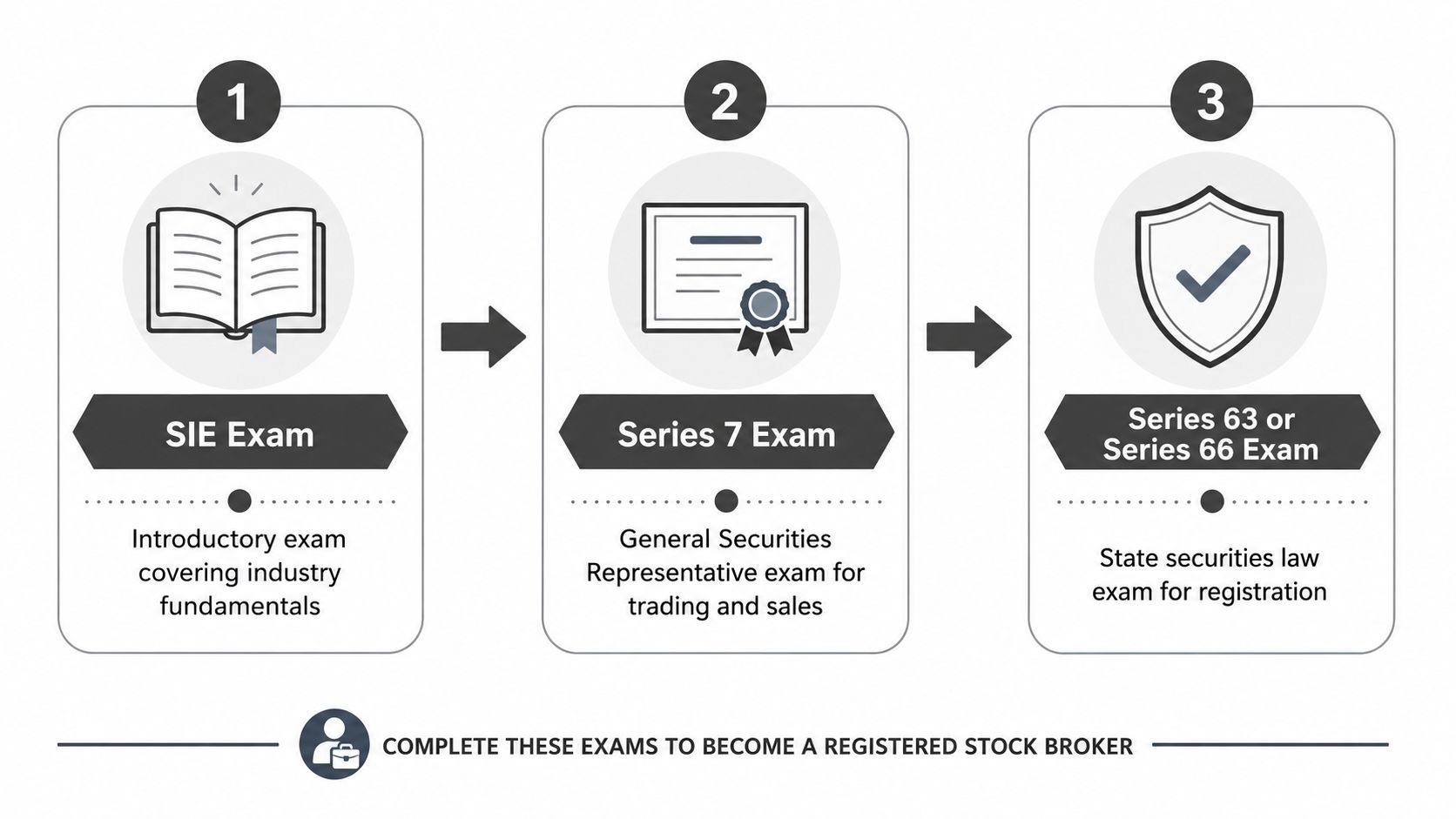
The Securities Industry Essentials (SIE) exam is the entry point. It covers the industry baseline, but it does not authorize you to act as a fully functioning representative on its own.
The Series 7 is the core representative exam for broad securities activity. Kaplan describes it as the general securities representative qualification and notes that it covers virtually any type of individual security, including preferred stocks, options, bonds, and packaged products (Kaplan on the stock broker license exam stack). That breadth is why employers care about it, because it determines whether you can be registered for a wide range of brokerage functions.
The Series 63 or Series 66 fills in the state-law piece. The Series 63 is the Uniform Securities Agent license, and many states require it alongside Series 7 for stockbroker activity or mutual fund sales, while Series 66 is commonly used when a combined state-law framework is needed. The same Kaplan overview covers that state-law layer and explains how the representative exams fit together under the broader registration stack.
When the product scope changes, the exam stack changes
If the business includes commodity futures, the Series 3 comes into play. That exam is not part of every brokerage path, but it becomes necessary when the representative's work crosses into commodity futures contracts. Product scope controls licensing scope. No amount of sales ability fixes a registration gap.
Passing one exam does not cure a mismatch in what you are selling.
A lot of people also underestimate the state-law layer because it feels secondary to the better-known FINRA exams. It is not secondary in practice. Your exam plan should reflect the jurisdictions where you will work, the securities you will discuss, and whether your role includes advisory compensation or other functions that pull in a different registration regime. For financial professionals comparing licensing paths before they start, this Series 7 guide is a useful place to review the practical implications of the representative exam and what it covers.
The correct way to think about a stock broker license is straightforward. It combines firm registration, individual qualification, state authority, and continuing supervision. Lose one piece, and the rest of the structure becomes fragile.
Employer Sponsorship and Form U4 Registration
Passing the exams does not let you operate on your own. You still need a sponsoring broker-dealer, because the firm controls the registration filing and keeps it active. That sponsorship turns a passing score into actual market access, and it also places you inside a supervisory structure from day one.
The main filing is Form U4, the Uniform Application for Securities Industry Registration. That form is where the compliance file becomes personal. It captures disclosure information that regulators and employers care about, including criminal history, customer complaints, financial judgments, and other background items that can affect your ability to register. The employer files it, but the consequences belong to you.
Your firm's job does not end when the U4 goes in. It has to keep the filing current. When circumstances change, the firm has to amend the registration record, because stale disclosure is a supervision problem as much as an applicant problem. The practical reality is that the U4 functions as an active compliance record rather than a one-time questionnaire.
If a fact is material enough to change how a firm supervises you, it is material enough to disclose promptly.
When you leave a firm, the Form U5 comes into play. That termination filing can shape what the next employer sees, how the industry reads your departure, and whether regulators start asking questions. The timing matters, but so does the wording, because phrasing about conduct, resignation, or termination can influence the next step in your career.
For advisors who want a more practical interview checklist before accepting a new seat, these questions to ask a broker are a useful reference point. The right questions are not about perks, they are about who controls the filing, how disclosures are handled, and what happens if the relationship ends badly.
Why sponsorship is more than a paperwork step
Sponsorship creates accountability. The firm is not just lending its name, it is taking responsibility for supervision, reporting, and registration maintenance. That is why a candidate with a clean resume can still get stuck if the firm's compliance team does not like the disclosure profile, the outside business activity picture, or the risk of future U5 problems.
The mistake to avoid is treating sponsorship like an HR formality. It is a regulatory control point, and it can shut the door just as easily as it opens it.
The State Registration Gap Most Advisors Miss
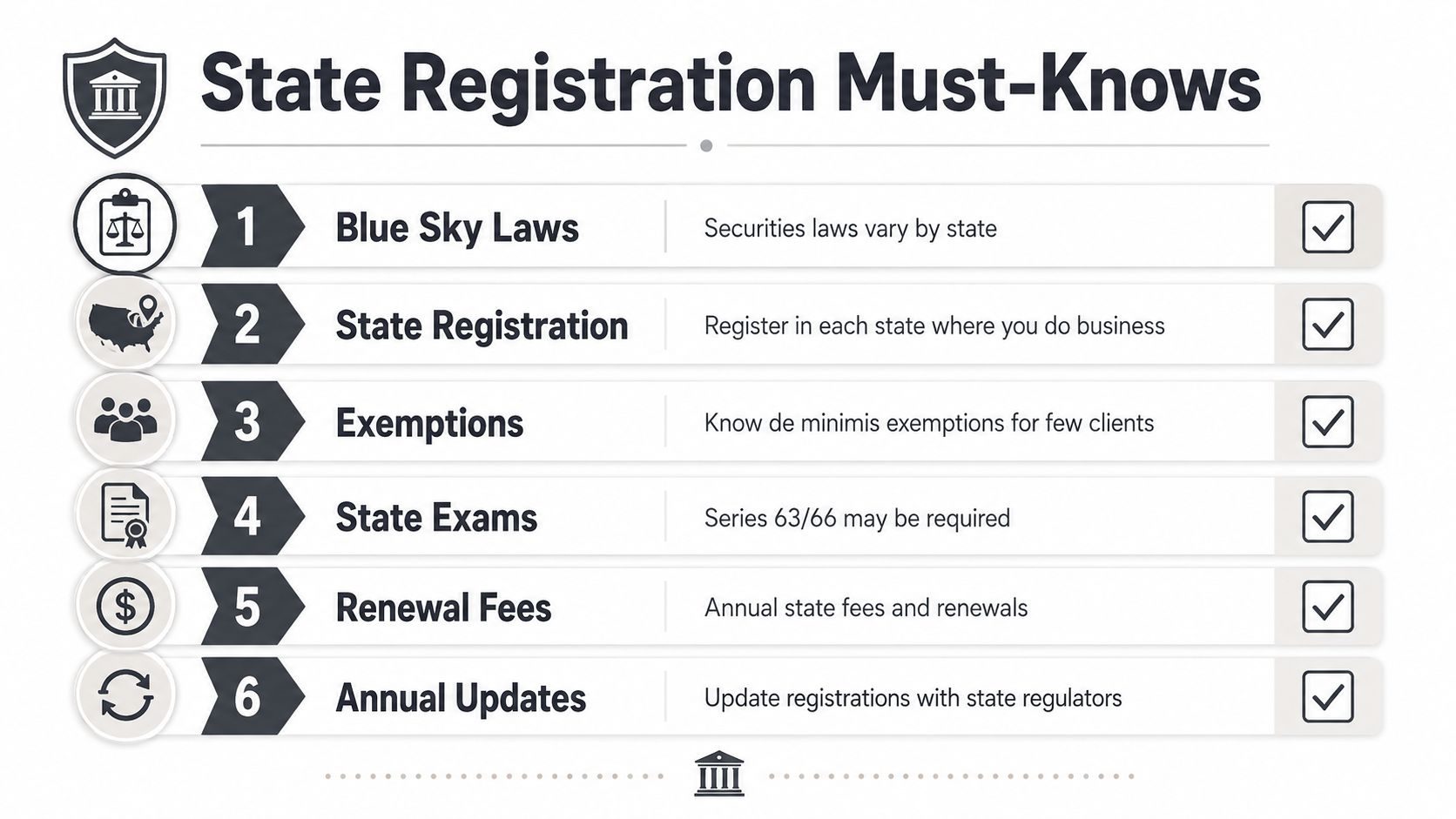
A lot of professionals assume that once FINRA is involved, the state issue is covered. That assumption breaks down fast. State registration is its own layer, and many advisors only find the gap after they have already been operating with an incomplete compliance setup.
The registration rules are layered, and broker-dealers and agents may need SEC and FINRA registration plus state qualification. State rules also differ on offices, retail clients, and advisory compensation, as explained in the FINRA registration requirements FAQ. That variability is the trap. A move, a new office, or a change in how you are paid can change the registration analysis.
The state question is jurisdiction, not convenience
If you do business where you live, but your clients live elsewhere, the registration question follows the client footprint and the business model. It does not follow personal preference. “We have always done it this way” is a weak defense when a regulator asks why activity was conducted without the right state filing.
State securities regulators care about where the activity occurs and whether an exemption applies. California's DFPI announced a new reported-agent filing fee effective July 1, 2025, which is a useful reminder that state requirements still change in ways that affect real filing decisions (FINRA registration requirements FAQ). Fee changes are only one example, but they show the point clearly. State compliance is not frozen in time.
A useful internal audit starts with three questions:
- Where are you registered now? Compare every jurisdiction against the business you conduct.
- Where do you have offices or personnel? Physical presence can create filing issues even when client counts are low.
- What changed in pay structure? Advisory compensation can pull you into a different analysis than transaction-based sales.
If any of those answers changed recently, your registration profile may be out of sync with reality. That is how problems begin.
Exemptions are not a substitute for review
Some advisors rely on exemptions because they look efficient. They work only if the facts fit precisely, and state rules can vary enough that assumptions become dangerous quickly. A clean exemption analysis is a legal analysis, not a sales shortcut.
The better practice is to keep a state-by-state matrix and update it whenever you relocate, add an office, open a new service line, or change compensation. That is not bureaucracy for its own sake. It is how you avoid accidental unregistered activity and the disclosure problems that can follow when a filing is later reviewed against your Form U5 history. For a closer look at the supervisory framework that sits behind those filings, see this explanation of written supervisory procedures.
Ongoing Supervision and Compliance Obligations
A stock broker license does not stay in good standing because you passed the exams. It stays aligned only if the firm supervises the activity, the records remain current, and the work performed matches the registration category on file. Most failures show up after onboarding, when the rep is already active and the control gaps are harder to unwind.
FINRA's framework ties registration to the actual activity being conducted. If a person solicits, facilitates, or induces securities transactions outside the scope of the registration in place, the firm can face exposure, and so can the individual. That is why supervision matters as much as the qualification exams. The title on the business card does not control the legal analysis.
Written supervisory procedures are the backbone of that system. A strong procedure manual gives reps a working map of what they may do, what they may not do, and who reviews the gray areas before the activity goes live. For a more detailed discussion of that framework, see this explanation of written supervisory procedures.
Supervision is a living process
The firms that handle this well treat supervision as an ongoing process rather than a quarterly checkbox. They match each representative's product authority, outside business activity, and jurisdictional footprint against the firm's approval matrix. When a rep starts discussing a new product, moving clients, or changing compensation, compliance should ask whether the registration picture still fits the work being performed.
That matters because supervision failures usually start as routine business decisions. A manager approves a conversation. A rep uses a template from a different channel. A branch office opens before the state filing is finalized. None of those choices looks dramatic in the moment, but each one can create a registration mismatch that surfaces later in an exam or a disclosure review.
The firm's controls should answer one question before anyone asks it later, was this person actually authorized to do this work?
A practical self-protection step for advisors is to keep a copy of approved activities, states of registration, and any written exceptions the firm has granted. If your scope changes, ask compliance to confirm the change in writing. Verbal comfort is not a defense when regulators review the file.
The hard truth is that the compliance burden sits with both the firm and the representative. The firm must supervise, and the representative should know when the work being asked of them goes beyond the registration they hold.
Disciplinary Actions and Form U5 Implications
Once a complaint, investigation, or termination lands in the file, the conversation changes fast. The question is no longer only whether you still hold registration. It becomes whether the record now follows you into every future hiring review, supervisory check, and disclosure search.
Regulators treat misconduct, supervision failures, and disclosure problems as serious matters because the sanctions can reshape a career. A bar sanction is a career-ending event in the industry, and even lesser discipline can make the next move harder than many advisors expect.
Form U5 is often the most consequential document after a departure. A voluntary resignation reads one way, while a termination for cause signals something very different to the market. If the filing mentions customer issues, policy violations, or a pending investigation, the next firm sees risk before it ever sits down with you.
For a closer look at how the filing works and why the wording matters, this Form U5 resource explains the mechanics and the practical fallout. It sits at the point where employment law, securities regulation, and reputation management collide.
Why U5 language matters more than most people expect
BrokerCheck makes disclosure searchable, so the wording on the U5 can affect client retention, hiring prospects, and internal review at a new firm. A clean separation is easier to explain. A contested termination creates friction. A regulatory bar can shut down the career path entirely.
The biggest mistake is waiting too long to challenge bad language. If the U5 contains inaccurate or damaging statements, counsel should review it quickly, because the filing can shape how every future employer evaluates risk. The same is true for FINRA Rule 8210 requests. Those requests are not casual follow-ups, they are compulsory, and ignoring them can make a bad situation much worse.
There is also a separate layer for CFP Board proceedings when an advisor holds the CFP designation. Different forum, same basic lesson, disclosure and response strategy matter.
If your file is already under scrutiny, treat every statement as if it will be read by a future employer and a regulator.
A departure is never just a departure once the U5 is involved. It becomes a record, and records travel farther than explanations do.
If a termination, resignation, or disclosure issue is moving into a new firm review, start with the basics and compare your registration footprint against what the filing says. It also helps to compare insurance for advisors while you are reviewing the broader risk picture, because professional exposure rarely sits in one bucket.
Practical Next Steps for Advisors Facing Issues
If your registration is incomplete, your state footprint is unclear, or your U5 has already been filed, move fast and document everything. Start with the registration gap, then confirm what your firm submitted, and then compare that filing against what happened. The cleanest fixes are the ones made before the next employer or regulator asks questions.
When a FINRA Rule 8210 request arrives, don't improvise. Gather documents, preserve communications, and get legal advice before answering if the request could touch disclosure, supervision, or termination issues. If the U5 language is inaccurate, address it immediately rather than hoping the market will ignore it.
For broader practice management, it can help to compare how you handle regulatory risk with how you handle other professional coverage decisions. If you're looking at insurance options for your practice, compare insurance for advisors from Professional Insurance Advisors, LLC as one point of reference alongside your compliance review.
If you want to discuss your business law matter, contact Kons Law at (860) 920-5181. Kons Law helps financial professionals with registration disputes, Form U5 problems, FINRA inquiries, and related business law issues. Visit Kons Law to get started and talk through the next step for your situation.
