
A client calls after opening a statement packet that never used the word “frozen,” only a familiar line item that looked like cash. The auction date passes, the notice says the auction failed, and a position that had been pitched as a short-term parking place suddenly behaves like a long-term obligation. That's the moment most auction rate securities problems stop being theoretical and start becoming urgent.
For investors, the hard part usually isn't understanding that something went wrong. It's figuring out what can still be done, who may be responsible, and whether the paper trail is strong enough to support a claim. For advisors, the problem is different but related, because the same legacy holdings can turn into a disclosure, supervision, or Form U5 issue long after the original sale.
When a Cash Investment Stops Acting Like Cash
A retiree buys what sounds like a conservative position. The broker describes a higher yield than a money market fund, mentions municipal tax advantages, and says the auction resets every few weeks, so the investor can exit if plans change. That pitch feels routine, which is exactly why the later shock is so severe when the investor learns the position isn't trading the way it was described.
The first sign is usually a failed auction notice, followed by a statement balance that no longer means what the account holder thought it meant. The investor expected a near-cash holding, then discovers the market has stopped functioning as promised and the security may not be readily sellable at par. That gap between label and reality is the core problem, and it's also why liquidity deserves the same attention you'd give any other investment risk, including assessing liquidity risks before relying on an instrument that only looks like cash.
A useful analogy is simple. If a position only works when someone else keeps showing up to buy it, the exit is part of the product, not an extra feature. When that exit disappears, the investor's question changes from “What yield am I getting?” to “What was I sold?”
For investors still holding legacy positions, the practical anxiety is immediate. For those who sold after the collapse, the issue becomes whether the loss came from market movement, structural illiquidity, or a sales practice that never should have happened. Those distinctions matter later when evidence and damages are sorted out, and they're the same kinds of issues that come up in defaulted bond disputes.
Practical rule: when a product's resale depends on routine dealer support, treat the exit as a disclosure issue, not just a market issue.
How Auction Rate Securities Actually Worked
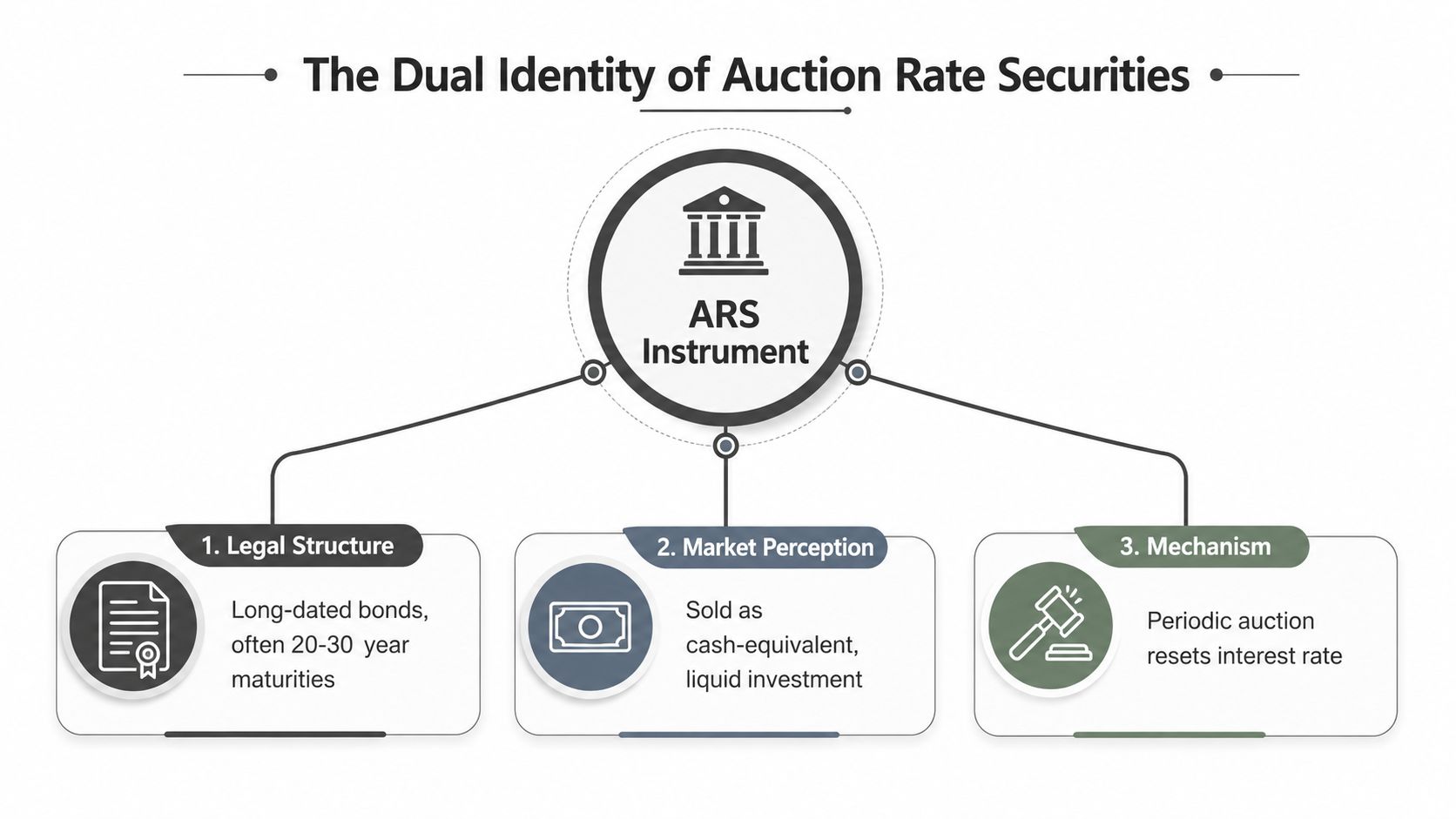
Auction rate securities sit in two different worlds at once. On paper, they are long-dated obligations, often with 20- to 30-year maturities or perpetual preferred stock structures. In practice, they were marketed and traded like short-term paper because their rates reset every 7, 14, 21, 28, or 35 days through a Dutch auction process (Investopedia). That reset cycle made them look flexible to buyers who wanted yield and believed they were not taking on a long lockup.
The basic auction mechanics
At each auction, investors and would-be buyers submitted the rate they were willing to accept. The auction agent then set a single clearing rate for all accepted orders, which was supposed to balance supply and demand for that period (R.W. Baird). If demand covered supply, the auction cleared and the rate reset.
If demand did not cover supply, the auction failed. The security then moved to the preset maximum rate in the offering documents until the next auction. That failure was more than a temporary glitch, because it could leave holders stuck with a position they had expected to sell at or near par, while the market no longer provided a normal exit.
Why issuer type matters
Municipal ARS, corporate ARS, and closed-end fund preferreds all used the same basic auction framework, but the legal exposure can differ depending on who issued the security and how it was sold. Municipal deals often sat closer to traditional public finance channels, while corporate and fund structures usually involved brokerage sales practices that matter more in arbitration and supervision claims.
Practical rule: if the auction is the only meaningful liquidity path, the offering documents and the sales conversation both matter as much as the coupon.
The legal point is straightforward. ARS were designed to behave like short-term floating-rate instruments even though they were legally long-term liabilities, and that mismatch is what made the product so dangerous once the auction process stopped functioning. As Cornerstone has described in its ARS litigation materials, the sale pitch and the actual liquidity profile did not always match what investors were led to expect (Cornerstone).
Why the Auction Stopped Working in 2008
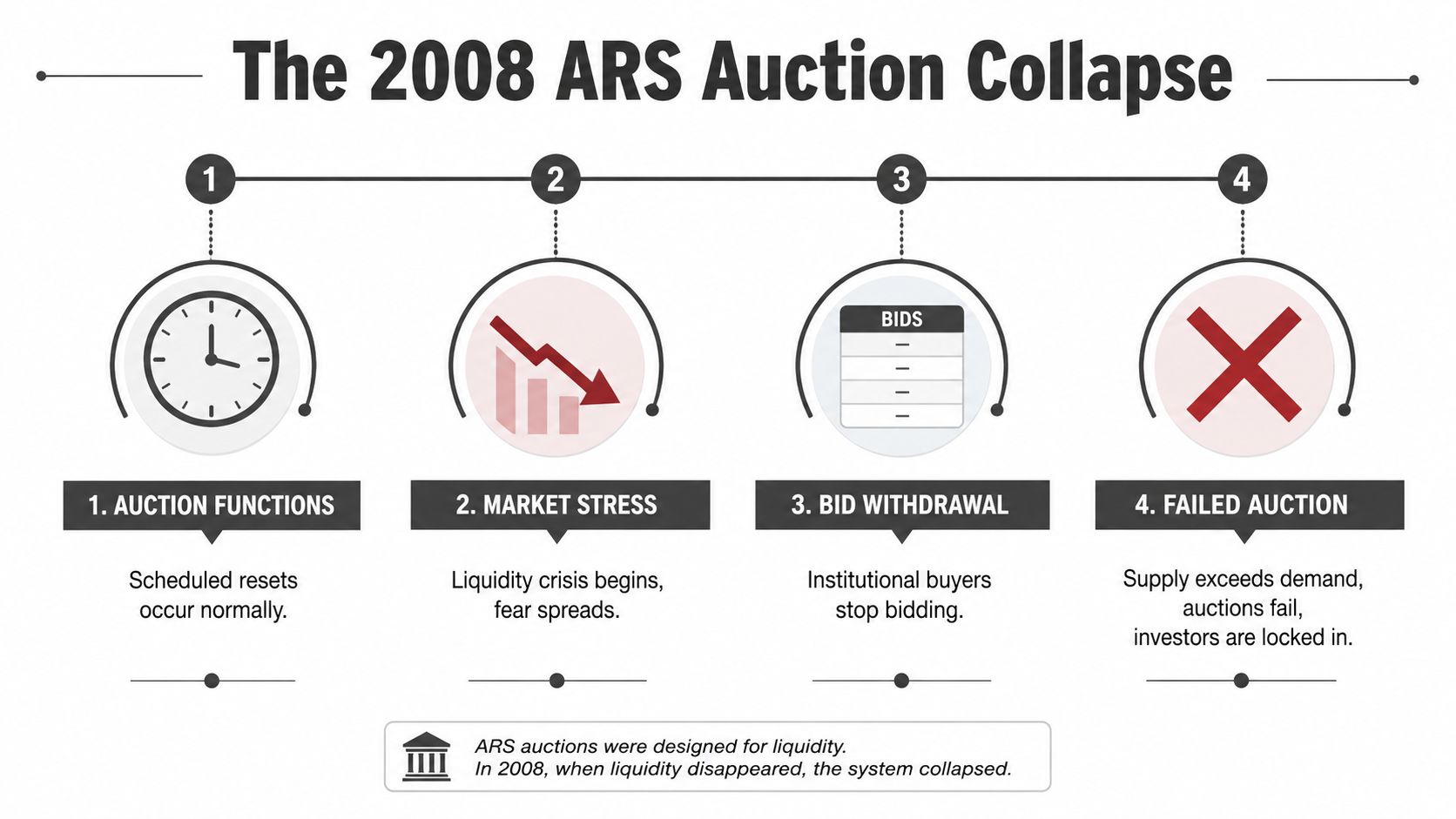
The break happened when dealer support vanished. In February 2008, major broker-dealers stopped stepping in to keep auctions clearing, and the market failed in large numbers, leaving tens of thousands of investors unable to sell their holdings (Morgan Stanley). For investors who had been sold these securities as liquid holdings, the shift was immediate and practical, because the market's stabilizing backstop turned off at once.
Why support mattered so much
For years, auction dealers made the system appear more liquid than it really was. Their support bids helped auctions clear when natural demand was thin, which kept rates from spiking and gave investors the impression that the product behaved like a cash substitute. Once that support disappeared, the structure had nothing left to hold it together.
The collapse exposed the core mismatch. These were long-term liabilities priced through short-term auctions, and when the auction layer failed, the liquidity layer disappeared with it (Federal Reserve testimony). That is why the phrase “auction failed” mattered so much to holders. It meant the investor could be locked in, not cashed out.
What a failed auction really means
A failed auction happens when demand is too weak to absorb the supply offered, often because bids do not reach the maximum-rate cap set for the program. In that situation, the auction does not rescue the seller. It traps the holder, and the next rate resets to the maximum rate until the next attempt (FINRA).
The remediation that followed was large because the harm was large. Large financial institutions were forced to repurchase more than $40 billion to $50 billion of ARS from investors, and some issuers faced penalty rates exceeding 20% after failed auctions (SEC). Those figures show how far the market moved from a supposedly routine cash-management product.
The Gap Between Marketing and Reality
The sale often sounded safe because it used the language of cash management. Brokers described ARS as liquid, convenient, and suitable for money that might be needed soon, which made the product feel close to a money market fund even though the structure was different. The pitch worked because the investor heard “short reset” and translated that into “easy exit.”
The legal problem starts there. A product does not become safe because it is described that way, especially when the seller knows, or should know, that liquidity depends on dealer support that may disappear without any contractual promise. If the investor's real objective was short-term access to principal, the gap between what was sold and what was being bought can support misrepresentation and suitability theories, and it can also fit broader breach of fiduciary duty examples when the facts show the broker put the firm's product first.
Where the mismatch shows up
The mismatch usually appears in the documents and the conversation, not just in hindsight. Prospectus language may have included risk disclosures, but a brokerage pitch could still have suggested that auctions would keep clearing or that the position was effectively cash-like. Investors often do not see the difference until they try to sell, because the problem stays hidden while the auction mechanism still appears to function.
The SEC warned investors that auction rate securities could fail to provide the liquidity many buyers expected, even when the offering materials described periodic auctions and rate resets (SEC investor bulletin). That matters because liability often turns on what the broker, branch manager, or supervisor knew about the liquidity support behind the product and how it was presented to the client.
For practitioners, the key question is not whether the market later failed. It is whether the investor was led to believe the product had a liquidity profile it did not have. That distinction drives whether the case is framed as bad luck, negligent sales practice, or actionable fraud.
Common Theories of Broker Misconduct
The strongest ARS claims usually don't rely on one legal theory alone. They're built from overlapping problems, and the best evidence often lives in different parts of the client file. The right framing depends on what the broker said, what the firm documented, and what the investor reasonably needed.
Misrepresentation and omission
This theory focuses on the words used in the sale. If a broker told a client the security was “just like a money market,” “liquid at par,” or safe for a short horizon, the issue is whether those statements were material and false in context. The critical evidence is usually recorded calls, emails, handwritten notes, and account tickets that show how the product was pitched.
Suitability
Suitability looks at fit. A security can be technically disclosed and still be wrong for the client if the investor needed cash access, had a short horizon, or couldn't tolerate lockup risk. The file should show whether the broker knew the customer's objective and whether the position matched that profile.
Supervisory failure
Supervisory claims move up the chain. They ask whether the firm had reasonable procedures, whether supervisors watched for unsuitable ARS sales, and whether internal controls failed to catch risky communications or concentrated holdings. These cases often turn on branch-level supervision records, exception reports, and policy documents.
Bottom line: the collapse matters, but the claim usually rises or falls on what was documented before the collapse.
For a fiduciary-duty comparison in a related context, see this discussion of breach examples. It's relevant because many ARS complaints are really about how advice was given, not just what was sold.
Regulatory Response and Arbitration Remedies
After the collapse, the response came in layers. Regulators scrutinized disclosures, auction-agent conduct, and sales practices, while large firms negotiated buybacks for certain investors. The result was a remediation framework that helped many holders, but not all, and it did not automatically erase individual claims.
What the buybacks did and didn't do
The buyback programs mattered because they gave many investors an exit after the market froze. But those programs also created release issues. Some investors accepted repurchases and later discovered that the paperwork limited what they could still claim, while others were excluded altogether because their holdings were outside the settlement terms.
That distinction matters in arbitration. If an investor already accepted a repurchase, counsel has to examine whether the release preserved any remaining claim and whether the damages theory survives after rescission or settlement credit. If the investor never got a buyback, the claim posture can be stronger, especially where the dealer or selling firm never remedied the loss.
Where claims go today
Most modern disputes move into FINRA arbitration, though AAA and JAMS can also matter depending on the account agreement and the parties involved. Forum choice affects discovery practice, motion practice, and the panel that hears the case, so it isn't just a procedural footnote. For a procedural overview, the FINRA arbitration process is the practical starting point.
The compliance side has its own lessons too. Firms that handled legacy ARS positions alongside broader supervision or onboarding controls often look to stronger identity, suitability, and recordkeeping systems, which is why a resource like KYC AML solutions for fintech can be useful when thinking about how controls are built. It's not an ARS fix, but the discipline around records and customer screening is the same kind of discipline these disputes expose.
Evidence That Moves an ARS Claim Forward
Arbitrators don't decide these cases from impressions. They decide them from documents, timelines, and credibility under pressure. A strong file shows what the investor was told, what the firm wrote down, and what happened when the auction stopped clearing.
What to gather first
The most useful materials are usually the least glamorous. Account opening documents, the original suitability questionnaire, trade confirmations, monthly statements around the failure period, emails, and any recorded call summaries can move a case from vague complaint to viable claim. Investors should also look for notes made at the time, especially if they wrote down what the broker promised right after the sale or during the collapse.
Practical rule: contemporaneous documents beat memory almost every time.
Expert analysis often comes later, but it needs a clean record to work with. That can include auction-failure history, comparison of the security to more liquid alternatives, and damages work that separates market movement from illiquidity harm. If the file can't show when the investor learned the truth, or whether the firm disclosed the actual liquidity risk, the claim gets harder to value.
| Evidence Category | What It Typically Proves | Where to Find It |
|---|---|---|
| Account opening documents | Risk tolerance, time horizon, and objectives | New account packet, brokerage portal |
| Suitability questionnaire | Whether the broker knew the client needed liquidity | Client file, onboarding records |
| Emails and account notes | What the broker said before and after the sale | Personal inbox, firm correspondence, statements attached to the account |
| Recorded calls or call summaries | Exact sales language, if preserved | Brokerage records, client recordings, written summaries |
| Statements around February 2008 | When the position became illiquid or was repriced | Monthly or quarterly statements |
| Investor notes and calendars | What the investor understood in real time | Personal files, notebooks, saved messages |
For a broader fraud framework, this securities fraud guide is a useful reference point. In ARS matters, the same basic truth applies: the stronger the paper trail, the more favorable position the claimant usually has.
Practical Next Steps for Affected Investors and Advisors
If you still hold ARS, start with the account documents and the original sale materials. Identify the exact security, the dealer, the auction agent, and the date the auctions began failing, then preserve every statement and every email before anything gets deleted or archived out of reach. If you already sold, the next question is whether the sale happened at a loss, whether a buyback release was signed, and whether the release narrowed your remaining rights.
Advisors should treat legacy ARS complaints differently from ordinary customer-service disputes. If a regulator, former client, or firm compliance team asks for records, gather the file before speaking casually about what you remember, because the written record will matter more than recollection. The same is true if a Form U5 issue or a supervision inquiry is tied to old ARS recommendations, since the key question is usually what was documented, not what the branch thought it had “meant.”
A short working checklist
- Preserve the full file: statements, confirmations, new account forms, and any disclosure packets.
- Pin down the sales story: who recommended the position, what time horizon was discussed, and whether liquidity was described as dependable.
- Sort the damage theory: held position, sale at a loss, repurchase, or release-limited claim.
- Check the forum language: arbitration clause, governing venue, and any waiver language in prior remediation paperwork.
- Get counsel early if a regulator is involved: the first response can shape the rest of the matter.
Kons Law handles investor and advisor disputes involving legacy securities, arbitration, and regulatory scrutiny, including cases where the dispute turns on what was said, what was written down, and who was responsible for supervision. If your ARS position, customer complaint, or compliance inquiry needs a focused review, contact Kons Law at (860) 920-5181 and be ready to discuss the specific documents, dates, and parties involved.
If you need to discuss an investor claim, advisor defense, or compliance matter tied to auction rate securities, Kons Law can help you assess the file, the forum, and the best path forward. The firm works through arbitration, regulatory inquiries, and securities disputes with a practical focus on evidence, liability, and next steps.
