
A client walks into an advisor meeting having read a few articles and watched a few clips about “getting paid to wait.” They like the stock, they don't want to chase it at today's price, and they've decided a cash secured put sounds like a tidy way to generate income while staying patient. That conversation sounds simple until you map it to cash reserves, assignment risk, suitability, and what happens to the rest of the client's portfolio if the trade moves against them.
That's why the cash secured put strategy deserves more than a surface-level explanation. It is part income trade, part stock-acquisition tool, and part compliance issue once a professional recommends it inside a real account. For advisors, the relevant question is never just whether the premium looks attractive. It's whether the trade fits the client's liquidity needs, risk tolerance, tax posture, and willingness to own the stock if assignment occurs.
Why Financial Advisors Need to Understand Cash Secured Puts
A client can sound completely reasonable and still be asking for the wrong trade. They want to sell puts on a company they admire, they've read that the strategy lets them “get paid to wait,” and they assume the only real decision is which strike to pick. That framing is too narrow for an advisor, because the trade is not just an income play. It is a conditional stock-purchase obligation backed by reserved cash.
The strategy's attraction is easy to understand. In a low-return equity environment, investors often look for ways to extract more from idle cash without using borrowed money. Cboe describes cash-secured put writing as a defined-capital strategy where the seller sets aside enough cash to buy 100 shares per contract if assigned, and the seller keeps the premium if the option expires worthless. That combination of premium collection and potential entry at a lower price is exactly why clients keep bringing it up. Cboe's explanation of cash-secured put writing makes the core mechanics clear.
The advisor's job is broader than trade selection
The work starts after the client says they want in. A financial professional has to decide whether the strategy fits the client's spending needs, concentration profile, and tolerance for owning the underlying shares. That's where fiduciary analysis matters, because the trade can look conservative on the surface while still creating a meaningful portfolio concentration if assignment lands in a name the client already owns or a name that's too large a bet for the account.
Practical rule: if the client would be unhappy owning the stock at the strike price, the cash secured put strategy probably doesn't belong in the portfolio.
The compliance angle matters too. Advisors who recommend option strategies without documenting the rationale usually create avoidable problems later. A strong suitability record should explain why the trade makes sense now, why the reserved cash won't impair liquidity, and what the client agreed to do if assignment occurs. For a related fiduciary discussion, see Kons Law's analysis of financial planner fiduciary duty.
How the Cash Secured Put Strategy Works
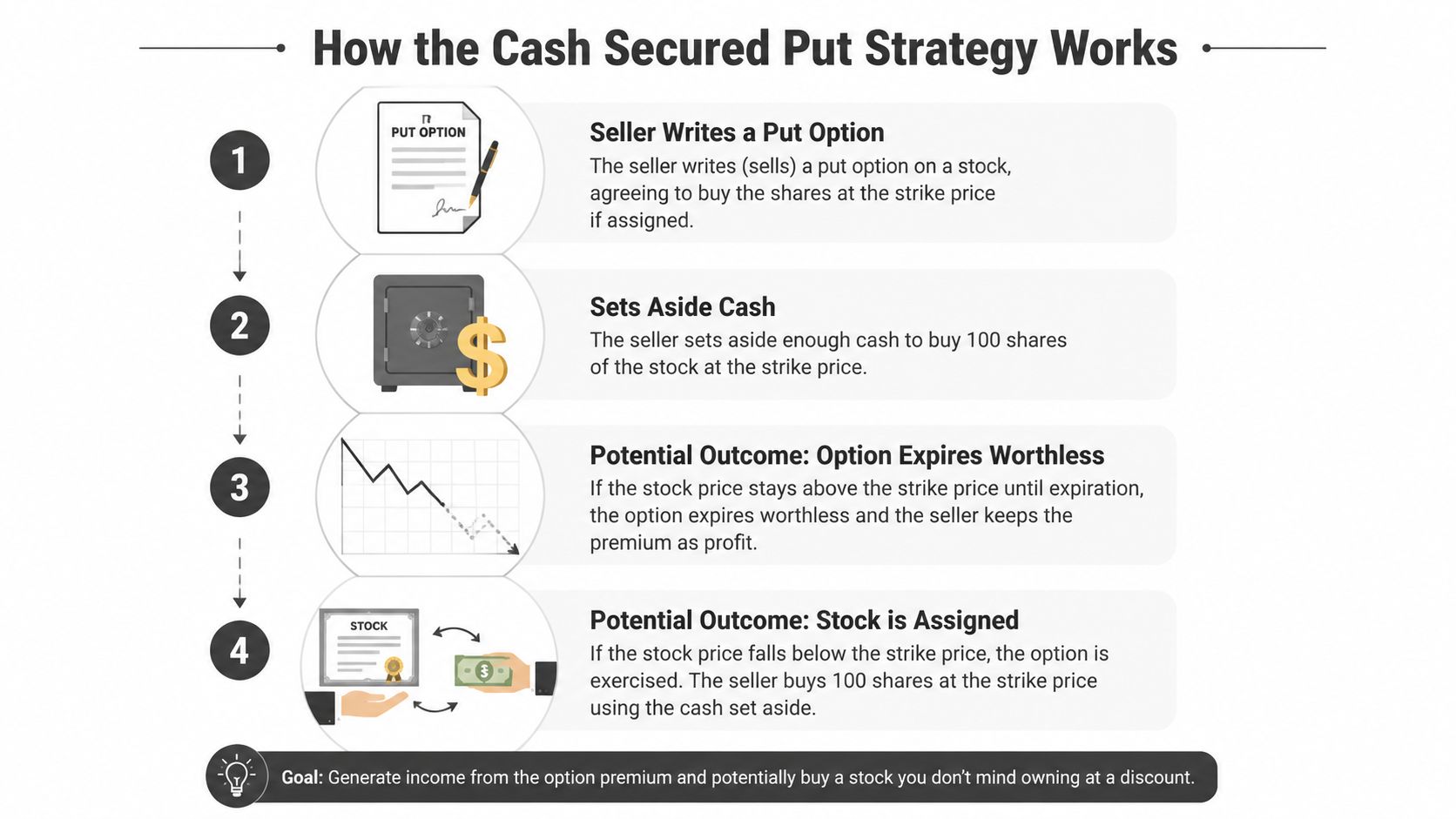
A cash secured put starts with a simple promise and a real balance sheet commitment. The seller writes a put option and sets aside enough cash to buy 100 shares if assignment occurs. That reserve is not a soft target. It is the core of the trade, and broker-dealers treat it that way because the obligation can turn into stock ownership at expiration.
The mechanics are easy to state, but the portfolio consequences are where advisors earn their fee. A stock trades at $50. The investor sells the $47 put, and the cash collateral required is $4,700 because the collateral requirement is strike price × 100 shares per contract. If the investor receives a premium, that premium is collected upfront, while the reserved cash still has to remain available if the option is assigned. The same math applies at other strikes, so a $45 strike requires $4,500 and a $100 strike requires $10,000 under the verified data provided. That structure is described in Cboe's cash-secured put discussion and the practical primer at Ryan O'Connell Finance.
Two expiration outcomes drive everything
If the stock finishes above the strike at expiration, the put expires worthless and the seller keeps the premium. If the stock finishes below the strike, the seller is obligated to buy the shares at the strike price. That is why the strategy is often used as an income-and-entry approach. It produces premium up front, and it can also convert into a stock purchase later.
That second outcome is where suitability and compliance become real, not theoretical. If assignment would leave the client with a concentrated position, an illiquid holding, or a name they would not willingly own at the strike price, the strategy deserves a hard pause. The question is not only whether the trade can be done, but whether it fits the client's objectives, cash needs, and tolerance for receiving shares.
Cash secured puts are not naked puts. A naked put leaves the seller exposed without full cash backing, which is a different risk profile and a different regulatory posture. In practice, brokerages require full cash collateral here because the account has to absorb assignment without creating a margin event. The reserved cash keeps the trade inside a defined-capital framework rather than a borrowing-driven one.
The premium is income only if the client is prepared for the stock outcome that premium is compensating them to accept.
Hypothetical Trade Walkthroughs with Full Calculations
A good client conversation needs more than a definition. It needs numbers, because the numbers show where the trade works and where it becomes expensive patience. The cleanest way to explain it is to model one outcome where the option expires worthless and another where assignment occurs.
Scenario one, the stock stays above the strike
Use the earlier example. The stock trades at $50, the investor sells the $47 put, and the reserved capital is $4,700. If the premium collected is $2 per share, the total premium received is $200 because each contract covers 100 shares. If the stock finishes above $47 at expiration, that $200 is kept and the position is closed.
The reserved capital did its job, and no shares are purchased. The return on reserved capital is the premium divided by the cash set aside, so $200 ÷ $4,700 is the basic period return on capital in this hypothetical. Annualized yield depends on the time to expiration, so the advisor should never quote it without first stating the holding period and the client's exact contract terms.
Scenario two, the stock is assigned
Now assume the stock drops to $43 at expiration. The seller is assigned and buys 100 shares at $47, using the reserved $4,700. Because the investor already collected $200 in premium, the effective cost basis becomes $4,500 total, or $45 per share in this hypothetical. The unrealized loss at the moment of assignment is the difference between the market value of 100 shares at $43 and the effective cost basis of $45 per share, which is $200 on paper.
That is the part clients often overlook. The premium improves the entry price, but it does not eliminate downside. If the stock keeps falling after assignment, the position behaves like long stock, just with a lower entry point.
Cash Secured Put Payoff Scenarios
| Stock Price at Expiration | Option Outcome | Effective Cost Basis | Net Profit or Loss |
|---|---|---|---|
| Above $47 | Expires worthless | N/A, no shares assigned | Premium kept |
| $47 | At the strike, assignment may occur | $45 per share in this hypothetical | Premium reduces purchase cost |
| $43 | Assigned | $45 per share in this hypothetical | Unrealized loss on shares |
The payoff table is crude by design. It forces the client to see the trade the way the account will experience it, either as premium income or as stock ownership at a net basis that still moves with the market.
Comparing Cash Secured Puts to Alternative Strategies
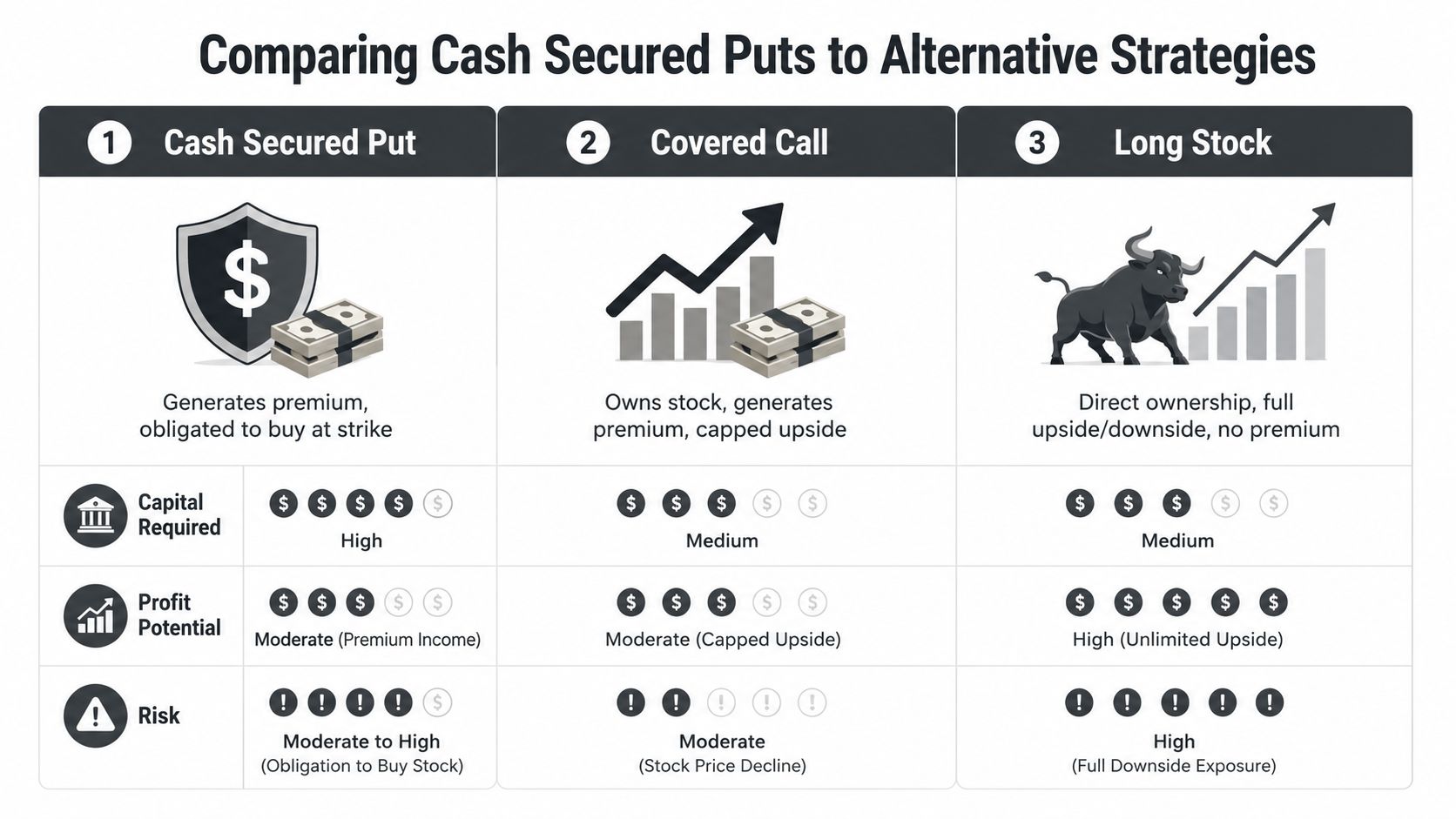
The question most retail material dodges is the one advisors need to answer. Is tying up full strike cash the best way to express a bullish view, or is it just the most familiar one? The answer depends on the client's goal, because the cash secured put strategy is only one way to reach a stock-acquisition or income outcome.
The retrieved sources clearly show the mechanics and the income narrative, but they also leave a practical gap. They explain the premium and assignment structure, yet they don't rigorously compare the strategy against defined-risk alternatives or direct stock entry on a risk-adjusted basis. That gap matters because the opportunity cost of parking full strike cash can be real, especially when the client could use a defined-risk structure instead of committing the full reserve.
Three alternatives deserve separate analysis
Bull put spreads reduce capital use because the position is defined-risk rather than fully cash secured. That can make sense when the client likes the premium structure but doesn't want to reserve full strike cash. The trade-off is that the upside is capped differently and the structure is more complex.
Covered calls fit a client who already owns the shares. The premium helps generate income on stock that's already in the account, but upside is capped. That makes it a different choice from the cash secured put, because the capital is already committed to equity ownership.
Direct stock purchase is the cleanest expression of bullish conviction. There's no option complexity, no assignment decision, and no premium collected upfront. But the client gives up the ability to use the strike as an entry filter, and the account takes full stock exposure immediately.
| Strategy | Capital Use | Main Benefit | Main Trade-Off |
|---|---|---|---|
| Cash Secured Put | Full strike cash reserved | Premium plus potential discounted entry | Cash is tied up until expiration or close |
| Bull Put Spread | Lower capital than full cash reserve | Defined risk and more capital efficiency | Requires more structure and monitoring |
| Covered Call | Stock already owned | Premium on existing shares | Capped upside |
| Direct Stock Purchase | Full stock purchase cost | Full participation in upside | No premium cushion |
A careful advisor uses the client's real objective to choose the structure. If the client wants a possible entry price and has idle cash, a cash secured put can fit. If capital efficiency matters more, a defined-risk alternative deserves a hard look. If the client wants the shares, buying them outright may be cleaner.
Step by Step Implementation and Risk Management
Execution quality often decides whether the trade feels disciplined or sloppy. The strategy is easy to describe, but profitable implementation depends on strike selection, expiration choice, liquidity screening, and an exit rule before the order is entered. A vague plan turns into messy decisions the first time the market moves.
Start with the stock, not the premium
The underlying should be something the client is willing to own. Strike selection should reflect a level the account can tolerate, not just a premium number that looks appealing on a screen. If the client cannot explain why they would own the shares at the strike, the trade is misaligned from the start.
Expiration choice should also be deliberate. The verified research cited by ThetaLoop points to historical results for 16-delta cash-secured puts on moderate-volatility stocks and mentions the appeal of shorter-dated management, but that does not replace judgment about the specific name and account. ThetaLoop's cash secured put overview is useful background, but the advisor still has to decide whether the trade belongs in the first place.
Practical rule: if the order book is thin, the headline premium can vanish in the spread.
Screen for liquidity and set exit rules
Liquidity matters more than many investors admit. In less-liquid names, wide bid-ask spreads and weak open interest can erode the theoretical edge before the trade ever matures. The retrieved sources note that tight spreads, meaningful option volume, and adequate open interest matter, and that slippage can damage realized returns, especially in thinner chains. A good trade on paper can become mediocre after a poor fill.
A simple checklist helps:
- Define the purpose: income, stock acquisition, or both.
- Verify willingness to own shares: assignment should be acceptable, not surprising.
- Check liquidity first: tight spreads and sufficient open interest matter before premium does.
- Size conservatively: one assignment should not distort the portfolio.
- Pre-plan exits: close early, roll, or accept assignment based on market behavior.
If the position moves favorably, early closure can lock in a reasonable result and free cash for the next trade. If the position becomes challenged but the stock thesis still holds, a roll to a later expiration or different strike may be reasonable. If the stock thesis is broken, assignment or closing the position should be evaluated on portfolio terms, not emotion. For a related margin discussion, see Kons Law's resource on what a margin call means.
Regulatory Compliance and Suitability Obligations for Advisors
The compliance issue is where many retail explanations go thin, and that's a problem for professionals. A cash secured put recommendation can be perfectly rational and still become a regulatory headache if the file doesn't show why it was suitable for that client at that moment. FINRA Rule 2111 and Regulation Best Interest both require more than a generalized belief that the strategy is conservative or income-oriented. They require a documented basis for the recommendation in light of the client's profile.
That means the record should reflect the client's objectives, risk tolerance, liquidity needs, and ability to absorb assignment without damaging the broader plan. If the account needs cash for near-term obligations, full strike collateral can be a poor fit even when the premium looks attractive. If the client already has concentration in the same sector, assignment can create a risk profile that no suitability memo should ignore.
Account approval and supervision matter
Broker-dealers also require the appropriate options account approval level before these trades can be placed. That approval is not a formality, because it ties directly to whether the client has been screened for options use and whether the firm has permission to supervise the activity. When recommendations later attract scrutiny, examiners often look at the initial account file, the disclosures given, and whether the written rationale matches the client's profile.
This is also where advisors can get tripped up by optimistic language. Calling the strategy “safe” or “like earning rent” can create a misleading impression if the record doesn't show the downside plainly. The premium is not free money, and the adviser should be able to explain that in plain English. For a related compliance discussion, see Kons Law's analysis of compliance for RIAs.
Suitability is not about whether the trade is popular. It's about whether the client, the account, and the documentation all point in the same direction.
FINRA inquiries can escalate quickly when option recommendations are involved, especially if there are disclosure gaps, concentration issues, or a mismatch between the client's stated objectives and the actual trade pattern. Advisors should assume that account notes, emails, and supervision records may matter later if a complaint, FINRA inquiry, or Form U5 issue follows. That is why this strategy needs a compliance file as much as it needs a trading plan.
Putting the Cash Secured Put Strategy to Work in Client Portfolios
A client with idle cash, a moderate risk tolerance, and a real willingness to own the shares if assignment occurs is usually the cleanest fit. In that setting, a cash secured put can serve a practical purpose, it can generate premium while the client waits for a preferred entry. For the wrong client, the trade ties up capital, limits flexibility, and can create regret when the market moves away from the strike.
The better question is whether the trade fits the account's role in the household balance sheet and the adviser's documentation. If the client needs near-term liquidity, the opportunity cost can outweigh the premium. If the client is seeking income from excess cash and already has a buy list for the underlying name, the trade may fit a disciplined process. That is why advisers need to evaluate the strategy through suitability, supervision, and capital efficiency, not just yield.
Historical benchmarks help frame the expectation setting. ThetaLoop reports that 16-delta cash secured puts on moderate-volatility stocks have historically landed in the 8% to 12% range on secured capital, unlevered, and that the same research cites a 95% win rate for a 16-delta SPY put versus the 84% implied by options pricing, along with about a 90% win rate when positions are managed at 50% of max profit. Those figures can help explain why the strategy appeals to income-oriented traders, but they do not guarantee similar outcomes in a live account. Strike selection, liquidity, assignment risk, and trade management still determine whether the result is acceptable for the client. ThetaLoop's research summary
Tax treatment belongs in the initial conversation, not as an afterthought. Premiums are generally treated as short-term gains, and assignment changes the stock's basis for later gain or loss calculations. The after-tax result can therefore differ from the premium shown on the order screen.
Compliance and suitability analysis should sit beside the trade idea from the start. If the recommendation later draws scrutiny, advisers will want the account notes, disclosures, and written rationale to show why the position matched the client's profile and the firm's supervision standards. For a related duty discussion, see Kons Law's resource on FINRA Rule 2090.
If the client relationship is already documented well and the strategy fits the portfolio's cash bucket, the trade can be a sensible use of idle capital. If the file is thin, the risk conversation is vague, or the client is unlikely to tolerate assignment, the premium is not worth the compliance and suitability exposure.
