The letter usually arrives at the worst possible time. A regulator asks for documents, management starts forwarding emails, and someone says, “Pull the WSP manual.” That moment tells you what your firm really has. A functioning supervisory system, or a binder that looked adequate until someone had to defend it.
That's why the written supervisory procedures definition matters more than most firms think. WSPs aren't just a compliance formality. They're the written record of how supervision happens, who owns each supervisory task, what gets reviewed, when escalation occurs, and what evidence shows the review really took place.
The practical problem is familiar. Many firms can draft procedures. Fewer can prove they enforce them. Regulators don't stop at the document itself. They compare the manual to daily practice, review logs, exception handling, complaint escalation, and proof that supervisors did more than sign off on a template. When that evidence is thin, the manual stops helping and starts hurting.
Your First Line of Defense in a Regulatory Inquiry
A firm receives a formal inquiry. The request list is predictable. Supervisory records, communications, complaint files, trade review materials, and the WSPs. Leadership often treats that first request as administrative. It isn't. The WSP manual becomes the lens through which the rest of the file will be read.
If the procedures are suited, current, and specific, the firm starts from a position of control. If they're generic, stale, or disconnected from actual operations, every later production becomes harder to explain. Examiners notice quickly when the manual says one thing and the records show another.
What the request for WSPs really means
When regulators ask for WSPs first, they're not just collecting policy language. They're testing whether the firm can explain its supervisory structure in a way that matches reality. The manual should tell them who supervises registered persons, how reviews occur, what gets escalated, and where the proof of that work lives.
A weak manual creates two immediate problems:
- It frames the firm as reactive. The firm looks like it adopted procedures to satisfy a rule, not to run a supervisory system.
- It exposes internal inconsistency. Review files, email approvals, complaint handling, and exception reports are all measured against the written procedures.
- It shifts the burden to witnesses. When the manual is vague, employees end up trying to explain unwritten practices under pressure.
Practical rule: If a supervisor can't point to the exact record that proves a review happened, the firm is already behind.
That's especially important in matters that can escalate beyond an ordinary exam. Firms facing the kind of scrutiny discussed in SEC investigation matters already know that document quality often determines the tone of the inquiry.
The difference between comfort and exposure
A good WSP manual doesn't guarantee the firm avoids criticism. It does something just as important. It gives the firm a defensible narrative supported by records. Leadership can show what the process was, who was responsible, what happened when an issue was identified, and how the firm responded.
A bad manual does the opposite. It invites questions the firm should never have to answer, such as why a supervisor approved activity without notes, why an escalation path exists only in practice, or why the manual covers businesses the firm no longer conducts.
Defining Written Supervisory Procedures vs Compliance Guidelines
The core written supervisory procedures definition is often misunderstood because firms blend WSPs into broader compliance materials. That's a mistake. The two documents may sit next to each other, but they serve different jobs.

What WSPs are
FINRA drew the distinction directly in Notice to Members 99-45. The definition of Written Supervisory Procedures distinguishes them critically from “compliance guidelines.” While compliance guidelines set forth the applicable rules, policies, and specific prohibited practices, WSPs specifically document the supervisory system established to ensure those guidelines are followed and to prevent and detect prohibited practices.
That distinction matters in practice. A compliance guideline says, in effect, “Don't do this.” A WSP says, “Here is who reviews this activity, how often they review it, what they look for, how they document the review, and what happens if they find a problem.”
What compliance guidelines do instead
Compliance guidelines are still necessary. They identify standards, prohibited conduct, and policy expectations. They tell associated persons the rules they must follow. But they usually don't answer the operational questions regulators care about during an exam or investigation.
A supervisor cannot defend a review process by pointing to general policy language alone. Regulators want the mechanics.
Use this practical comparison:
| Document | Primary purpose | Key question it answers |
|---|---|---|
| Compliance guidelines | State rules, policies, and prohibited practices | What conduct is allowed or prohibited? |
| WSPs | Document the supervisory system | Who supervises, how, when, and with what evidence? |
That's why a broad corporate compliance program overview doesn't replace a real WSP manual. Leadership needs both. One establishes the compliance framework. The other documents the supervisory engine that enforces it.
The operational difference firms feel during exams
Notice 99-45 also emphasized practical elements that too many manuals skip. WSPs should identify the qualifications important for supervisors, the procedures for determining whether a supervisor has those qualifications, and the methods for monitoring supervisor performance. They must also identify responsible executives by name or title and they must be in writing. Verbal custom doesn't satisfy the rule.
The real test is simple. If a new supervisor joined the firm tomorrow, could they carry out the supervisory function from the WSP alone?
If the answer is no, the manual is probably a policy summary, not a supervisory procedure. That gap creates trouble fast in communications review, trade surveillance, books and records oversight, and complaint handling, where regulators expect more than a statement of principles. They expect documented supervision tied to accountable people.
Understanding the FINRA and SEC Regulatory Mandate
This obligation isn't discretionary. FINRA Rule 3110 requires every broker-dealer member to establish, maintain, and enforce written procedures to supervise the types of business in which it engages and the activities of its associated persons, and those procedures must be “reasonably designed to achieve compliance with applicable securities laws and regulations,” as stated in FINRA Rule 3110.
What the rule requires in practical terms
The phrase “reasonably designed” does a lot of work. It means a firm's WSPs must fit the business it conducts. If the firm sells certain products, uses particular communication channels, or has a defined branch structure, the manual has to address those realities. A borrowed template won't carry much weight if it reads like someone else's business.
The rule also places ultimate responsibility on the member firm. That matters for leadership. Firms often talk about supervision as though it belongs solely to an individual principal or manager. The rule doesn't allow that framing. The firm owns the supervisory system and the consequences when it fails.
Specific obligations leadership should focus on
A sound reading of the rule leads to several concrete expectations:
- Business-specific design. Procedures must align with the lines of business the firm conducts.
- Maintenance and enforcement. Writing the manual once isn't enough. The firm has to maintain it and enforce it.
- Location and access. A copy of the WSPs must be maintained in each Office of Supervisory Jurisdiction and at every location where supervisory activities are conducted, according to FINRA Rule 3110.
- Prompt amendment. Firms must amend WSPs to reflect rule changes, securities law changes, and changes in the firm's own supervisory system.
- Communication of amendments. Relevant associated persons must be told about changes based on their responsibilities.
The practical consequence is straightforward. WSPs are treated as living documents, not annual artifacts.
A manual that stays static while the business changes becomes evidence of weak supervision, not evidence of compliance.
SEC and FINRA scrutiny often converges around the same issue. Does the written procedure accurately describe the supervision the firm says it performs? If leadership can't answer that confidently, the problem isn't drafting. It's governance.
Essential Components of an Effective WSP Manual
A usable WSP manual reads like an operating document, not a policy brochure. It should let a supervisor open the manual, identify the exact review required, perform it, document it, and escalate issues without guessing.
What has to be inside the manual
At a minimum, the manual should cover the firm's supervisory structure, lines of authority, review processes, recordkeeping expectations, and issue escalation. It should also track the actual tools and systems the firm uses. If your team reviews communications in one platform and stores evidence somewhere else, the manual should say so.
One practical benchmark comes from guidance on broker-dealer WSPs, which explains that effective WSPs must include specific, actionable sections on escalation procedures that detail step-by-step guidelines for addressing and reporting violations, including incident reporting protocols for employees and explicit escalation hierarchies to the Chief Compliance Officer, senior management, or the board.
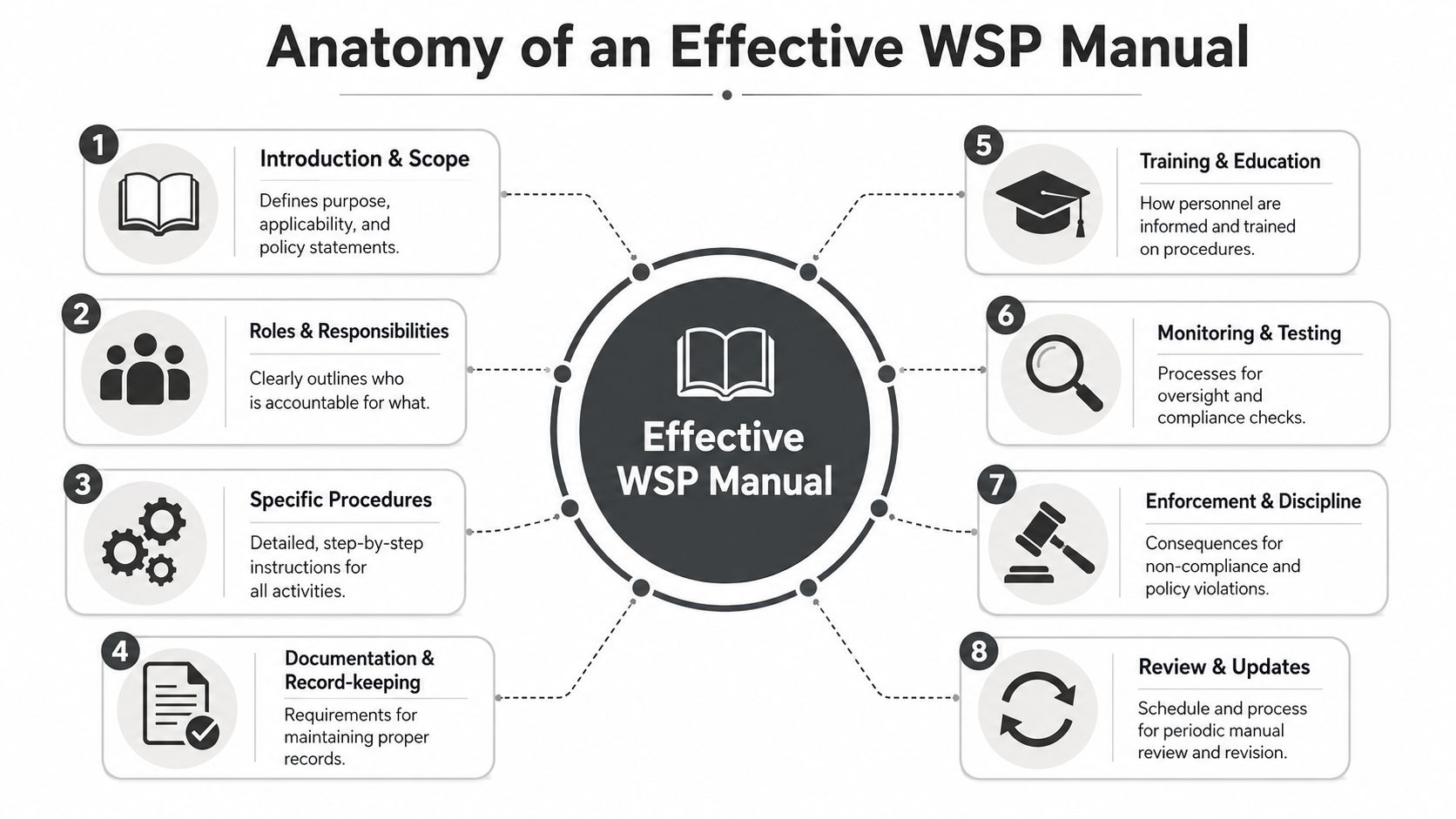
Eight building blocks that make the manual work
The strongest manuals usually include these components:
- Introduction and scope. Define what businesses, personnel, and locations the manual covers.
- Roles and responsibilities. Identify who supervises whom, including principal oversight and escalation ownership.
- Specific procedures. Spell out the review steps for communications, trades, complaints, recordkeeping, and other supervised activity.
- Documentation and recordkeeping. State what records the supervisor must create, where they're stored, and how the firm can retrieve them.
- Training and education. Explain how personnel learn new procedures and updates.
- Monitoring and testing. Distinguish ongoing supervision from periodic testing.
- Enforcement and discipline. Address what happens when procedures aren't followed.
- Review and updates. Establish how revisions are initiated when business or regulatory changes occur.
A weak manual usually fails on specificity. It says a supervisor “reviews communications” but doesn't identify the review method, timing, exception criteria, or evidence required. A stronger manual states the review trigger, the person responsible, the record created, and the escalation path.
What firms often miss
Technology has made this more operational, not less. If your supervisory process relies on Microsoft 365, archive tools, workflow approvals, or shared compliance repositories, the manual should reflect those systems accurately. Firms trying to align supervision with modern documentation practices may find value in this discussion of Microsoft 365 compliance in finance, especially where evidence retention and workflow traceability matter.
Another frequent omission is complaint escalation. Leadership may assume the complaint process is obvious. Examiners won't. The manual should identify intake, routing, required review steps, documentation standards, and who decides whether the matter becomes a formal internal investigation or regulatory report.
Common WSP Deficiencies and Regulatory Enforcement Risks
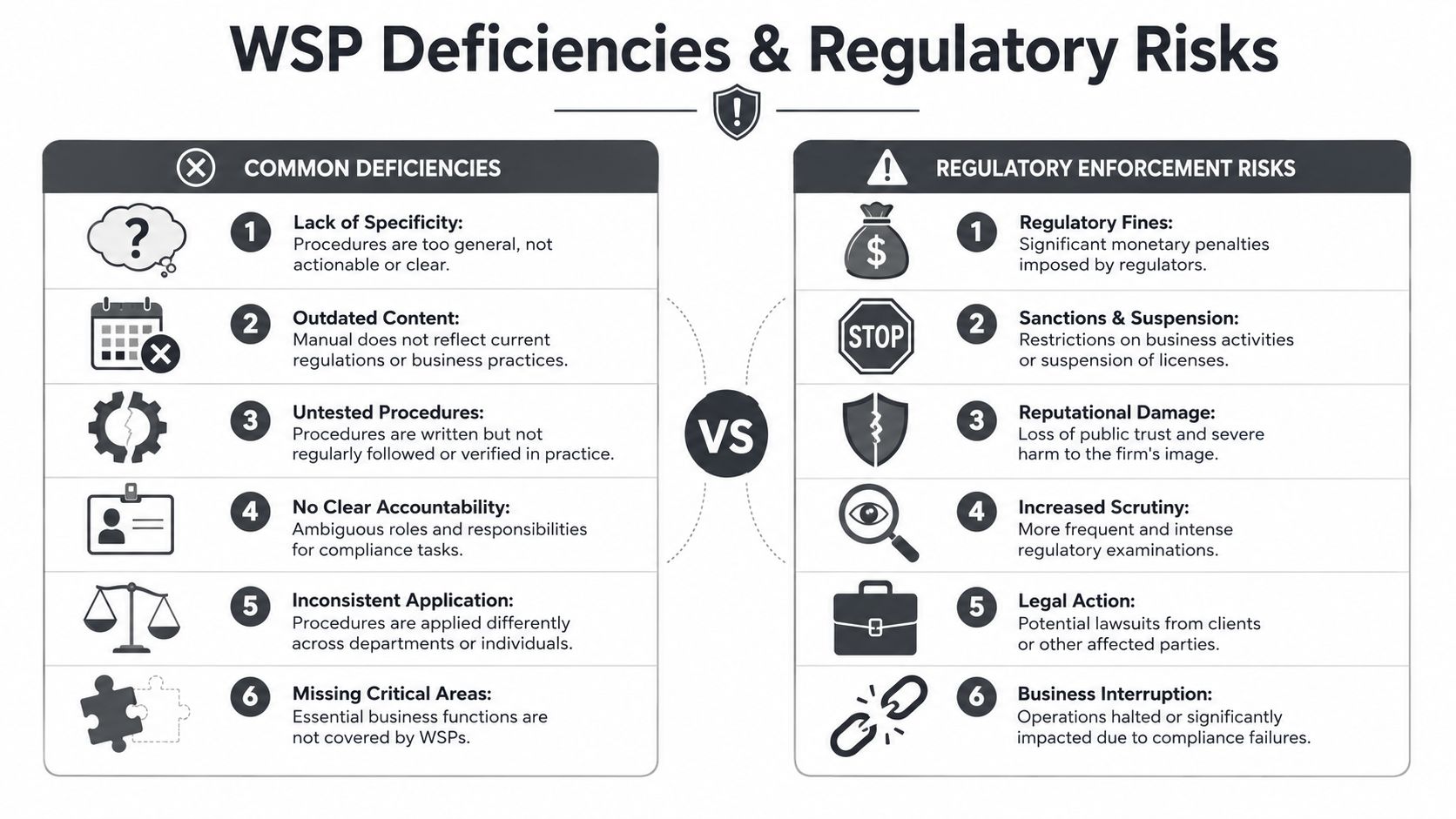
Most firms under scrutiny have a WSP manual. The problem usually isn't total absence. It's that the manual doesn't match operations, doesn't assign accountability clearly, or doesn't leave a trail proving supervision occurred.
The paper compliance problem
One of the most important gaps in this area is the difference between designing procedures and enforcing them. As explained in this discussion of written supervisory procedures, regulators focus on how firms document active supervision versus mere paper compliance. Supervisors must supervise, not just exist on paper, and the lack of documented active supervision is a primary defense failure point.
That point shows up in ordinary ways. A supervisor signs a monthly checklist but leaves no notes. A review tool flags an issue, but no one records the resolution. A complaint reaches management informally, but the WSP-required escalation path never starts. The firm may insist supervision occurred. The file says otherwise.
Deficiencies that create the most trouble
These are the failures I see raise the fastest credibility problems:
| Deficiency | Why it hurts |
|---|---|
| Generic language | It suggests the manual was copied, not designed for the firm's real business |
| Outdated procedures | It shows leadership didn't update supervision when the business changed |
| Unclear ownership | It becomes impossible to tell who was supposed to review and escalate an issue |
| Checklist-only evidence | It rarely proves the substance of a review |
| Missing records | It leaves the firm unable to demonstrate active monitoring |
| Uneven application | It creates the appearance of ad hoc supervision |
If the only evidence of a supervisory review is a signature, expect a regulator to ask what was reviewed, what issues were found, and where the analysis is documented.
What active supervision evidence looks like
Regulators increasingly want the proof behind the procedure. That can include review notes, timestamps, exception records, documented follow-up, annotated approvals, and records showing when issues were escalated and resolved. The exact format may vary by firm and system. The principle doesn't. The file must show the supervisor engaged with the task.
What doesn't work is relying on unwritten custom. “That's how we've always done it” has little value when the manual says something different or the record is silent.
Practical Guidance for Drafting and Reviewing WSPs
Drafting WSPs well requires discipline. Reviewing them well requires honesty. Leadership has to test whether the manual describes the business that exists, not the one the firm thinks it runs.
Start with the supervisory map
Before editing language, map the business. Identify products, lines of supervision, communication channels, branch structure, complaint intake points, trade review workflows, and the systems used to create and retain records. Then compare that map to the current manual.
That exercise usually exposes the actual drafting priorities. Sections that looked acceptable in the abstract turn out to be disconnected from daily operations.
A key requirement here is assignment of responsibility. As noted in this compliance glossary discussion of WSPs, FINRA Rule 3110 specifically demands that the firm assign each registered person to an appropriately registered representative or principal responsible for supervising their activities, and requires reasonable efforts to confirm that all supervisory personnel are qualified by experience or training.
A workable review process
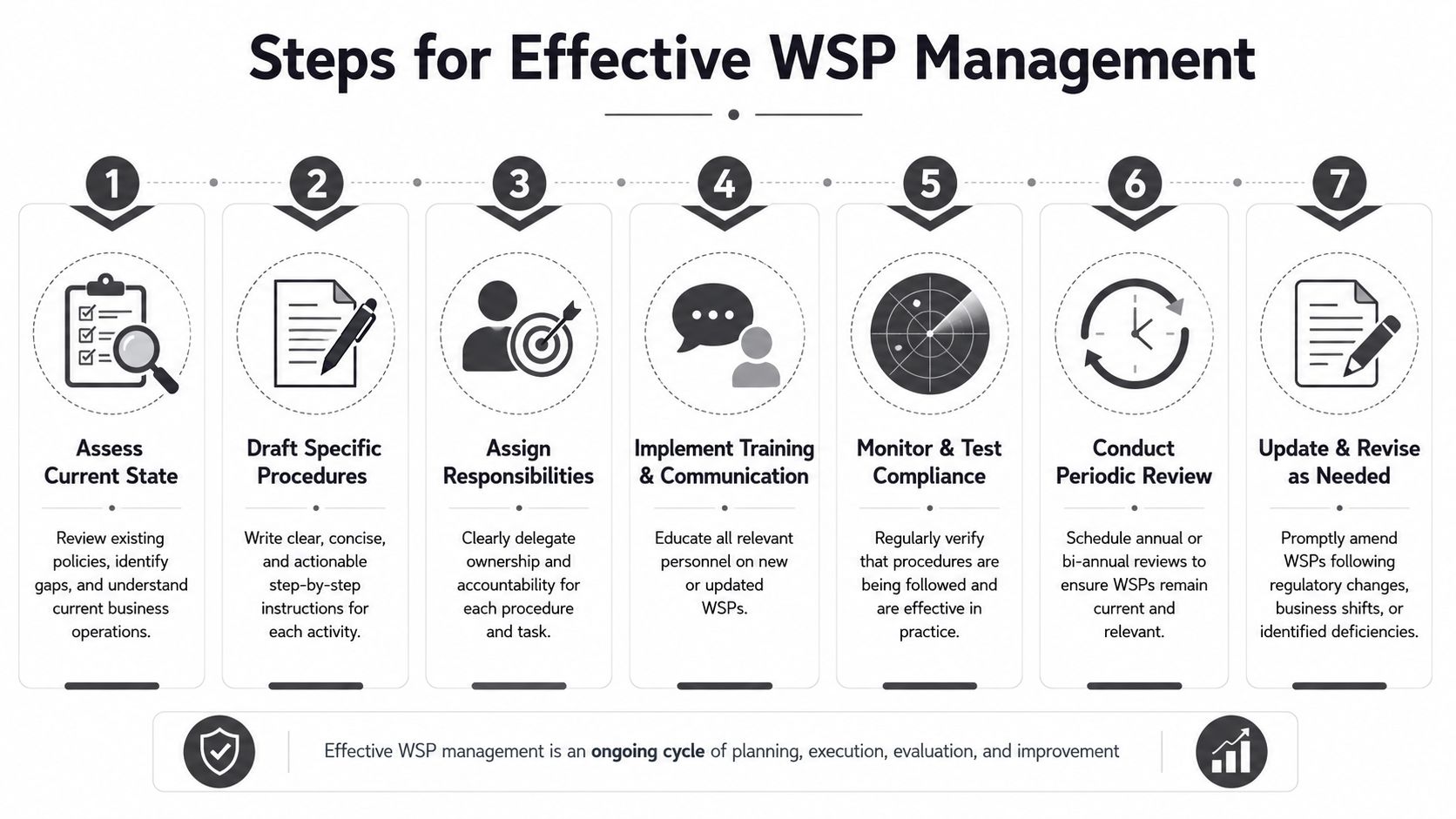
A practical WSP review usually works best in this sequence:
- Compare the manual to the actual workflow. Don't review text in isolation. Pull the systems and records that support the procedure.
- Interview the people who perform the task. Supervisors, operations staff, and compliance personnel will usually reveal where the written process diverges from practice.
- Rewrite vague steps. Terms like “as needed,” “periodically,” and “where appropriate” often create avoidable ambiguity.
- Tie every supervisory task to a record. If the manual requires a review, identify what evidence proves the review happened.
- Test the escalation path. Confirm employees know when and how to raise issues.
For firms also refining adjacent control frameworks, this resource on anti-money laundering compliance program design is useful because AML supervision often exposes the same drafting failures seen in broader WSP manuals.
What to change first in an older manual
Don't try to rewrite the entire document at once unless the current version is unusable. Start with the sections that create the most risk if challenged:
- High-exposure supervision. Communications, complaints, and transaction-related review processes should be examined first.
- Named responsibility. Every critical task should have a clearly assigned owner, plus a backup path if that person is unavailable.
- Documentation standards. State what records must be created and retained for each supervisory function.
- Amendment triggers. The firm should know what business or regulatory change requires an update.
Strong WSPs don't just tell people what to do. They make it difficult to skip a step without leaving a visible gap.
Moving from Paper Compliance to Proactive Supervision
The firms that handle regulatory scrutiny best usually share one trait. Their supervisory procedures are used, not archived. Leadership treats the manual as an operating tool, and supervisors understand that documentation isn't administrative clutter. It's the proof that the firm did its job.
That shift matters beyond securities regulation. Businesses that build practical governance frameworks often apply the same discipline across technology and operations. A useful parallel appears in this discussion of effective IT policies for SMEs, where the lesson is the same. Policies help only when they're specific, current, and consistently followed.
The right approach to WSPs is simple to state and harder to execute. Draft them around actual workflows. Assign accountable people. Train the people who have to use them. Create records that show supervision occurred. Update the manual when the business changes. If the firm does that, the WSP manual becomes more than a rulebook. It becomes a defensible record of active supervision.
When a regulator asks for the manual, that difference is obvious.
If you want to discuss your business law matter, contact Kons Law at (860) 920-5181.
