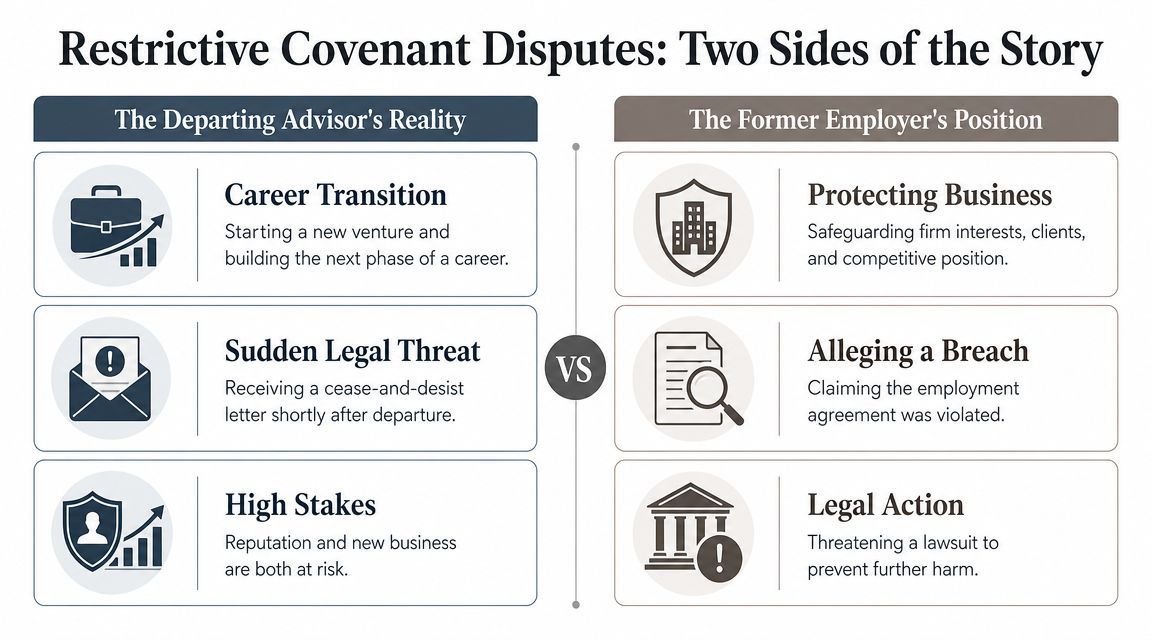
You've lined up the move. You've spoken with the new firm. You may have already told a few trusted clients that a transition is coming. Then the letter arrives. It's from your former firm's counsel, and it accuses you of a restrictive covenant breach. It demands that you stop contacting clients, return information, and preserve documents. It may also threaten court action, FINRA arbitration, and repayment of a promissory note.
For financial advisors, this isn't an ordinary contract dispute. It can affect your book, your compensation, your Form U5, and the narrative your former firm builds around your departure. A badly handled response can create avoidable admissions. An overaggressive response can make a temporary business dispute look like a regulatory problem.
The practical starting point is to identify exactly what agreement is being enforced and what conduct is being challenged. Many disputes that get described broadly as “non-compete cases” are really fights over client solicitation, confidential information, team recruiting, or transition-related communications. If you need a baseline on the contract framework itself, start with this explanation of a restrictive covenant agreement.
Introduction to Restrictive Covenant Disputes
A restrictive covenant dispute usually begins before anyone files a lawsuit. It starts with account reviews, screenshots, phone records, CRM activity, and internal suspicion about where clients are moving. By the time a cease-and-desist letter lands, the former firm often believes it already has enough to seek emergency relief.
That doesn't mean the claim is strong. It means the other side is moving early, when speed can matter as much as proof.
Why these disputes hit advisors differently
In financial services, the pressure point is rarely just the contract language. It's the combination of business interruption and reputational risk. An advisor can survive hard litigation. What's harder is losing momentum during a transition while a former employer frames the departure as disloyal, improper, or noncompliant.
A restrictive covenant breach allegation can also widen fast. What begins as a complaint about solicitation may turn into accusations involving data access, client privacy, team raiding, note repayment, or misleading communications to clients. Once that happens, the case is no longer just about whether a clause exists on paper. It becomes a fight over credibility.
Practical rule: Treat the first demand letter as the opening move in a larger strategy, not as a routine piece of correspondence.
What usually matters first
The first legal questions are direct:
- What covenant is at issue. Non-compete, non-solicit, confidentiality, or a mix.
- What conduct is alleged. Calls, texts, social media posts, downloaded information, or recruiting efforts.
- What forum controls. State court, FINRA arbitration, or parallel proceedings.
- What immediate remedy is threatened. Injunction, damages, note acceleration, or all three.
Financial advisors do best when they evaluate those questions quickly and without emotion. Delay rarely helps. So does improvising.
Understanding the Types of Restrictive Covenants
Most advisors use the term “non-compete” as shorthand for every post-employment restriction. That's a mistake. Different covenants protect different interests, and each one creates a different litigation risk.
Early in the dispute, counsel should sort the agreement into its component parts. That's how you separate a scary letter from a legally serious claim.
Non-compete provisions
A non-compete restricts where, when, or for whom you can work after leaving. In the advisor world, these clauses often create more intimidation than actual enforceability, especially when they try to bar broad categories of work rather than a specific competitive threat.
A former firm may argue that your move to a nearby competitor breaches the covenant. The practical response is to ask narrower questions. Are you servicing the same households? Are you working in the same market? Does the clause target a real business interest or solely try to suppress mobility?
Non-competes often get weaker when they're drafted too broadly. Firms that overreach sometimes discover that a court or arbitrator is less interested in punishing departure than in protecting legitimate client relationships and confidential information.
Non-solicitation restrictions
For most financial advisors, a key battleground is the non-solicitation covenant. This clause usually bars you from asking former clients to move accounts or asking former colleagues to join you.
The hard part is that solicitation isn't limited to a formal sales pitch. A “just wanted to let you know where I landed” message may be framed as a targeted effort to move business. So can a coordinated outreach campaign, a personal email blast, or a social media announcement timed to your resignation.
Here's the trade-off. Advisors want to preserve relationships they built over years. Firms want to characterize those same relationships as firm-owned goodwill. That's why facts matter. A generic public announcement is different from a curated list of top households contacted the same day you resign.
Confidentiality and non-disclosure terms
A confidentiality covenant usually causes the fastest escalation. If the former firm believes you took client lists, reports, account notes, or internal strategy documents, the dispute can move from contract enforcement to trade secret allegations.
Common flashpoints include:
- Downloaded records taken shortly before resignation
- Screenshots or exports from CRM systems
- Forwarded emails containing client or firm data
- Personal device storage of planning files or contact information
An advisor's intent matters, but so does appearance. If the metadata shows unusual access before departure, the former firm will use it.
A lot of “solicitation” cases are won or lost on the confidentiality facts underneath them.
The Legal Standard for a Covenant Breach
A former employer's accusation is only the start. To enforce a restrictive covenant, the firm still has to show that the clause is enforceable and that the challenged conduct falls within it. Courts don't automatically accept the employer's label.
In employment disputes, the central issue is usually reasonableness. That means the restriction must be specifically designed to protect a legitimate business interest without going further than necessary. If you want a practical outside overview of how non-competes are enforced, that framework is useful because it focuses on scope, duration, and the employer interest behind the restriction.
What reasonableness looks like in practice
The three recurring pressure points are:
| Issue | What decision-makers examine |
|---|---|
| Geographic reach | Is the territory tied to the advisor's actual market or drafted far more broadly? |
| Time period | Is the duration limited enough to protect relationships without shutting down a livelihood? |
| Restricted activity | Does the covenant target actual competitive conduct, or does it sweep in ordinary work? |
Connecticut courts, like many others, don't evaluate these questions in a vacuum. They look at the role the advisor held, the clients served, the information accessed, and the practical burden on future employment. A narrow client-based restriction can be easier to defend than a broad prohibition on working in the industry at all.
That distinction is why parties should also understand the difference between a mere breach allegation and a material breach of contract. Not every technical violation justifies sweeping relief.
Proof matters more than rhetoric
Employers often write demand letters as if every contact with a former client proves misconduct. Courts and arbitrators usually want more. They look for evidence such as communications, timing, account movement, downloaded files, and testimony showing that the advisor violated the clause.
In other commercial settings, the consequences of covenant failure can be immediate and severe. In debt agreements, a covenant breach can place a borrower into technical default even when payments are current, as explained in this project finance discussion of covenant breach and technical default. Employment cases are different, but the lesson is the same. A covenant isn't “just paperwork.” Once triggered, it can enable powerful remedies.
What firms often get wrong
Former employers weaken otherwise decent cases when they overstate harm or demand relief broader than the contract supports. If the firm asks for an injunction that goes beyond the actual text, it invites scrutiny of its motives and drafting choices.
Advisors make the opposite mistake when they assume an overbroad covenant is automatically unenforceable. It might be. It might also be narrowed through litigation strategy, forum-specific rules, or factual findings that make some restrictions easier to enforce than others.
Navigating Remedies and Key Defenses
Once litigation starts, the employer usually focuses on speed. The advisor should focus on pressure points. Those are not always the same.
The former firm's immediate goal is often to freeze conduct before business shifts further. The advisor's goal is to prevent a temporary order from becoming the practical end of the transition.

Remedies employers usually seek
The most disruptive remedy is an injunction. A temporary restraining order or preliminary injunction can stop outreach, freeze use of information, and limit contact with clients or staff while the case is still young. Even if the employer never wins damages, early injunctive relief can change the economics of the dispute.
Employers may also pursue:
- Monetary damages for lost revenue or business diversion
- Forensic inspection demands involving devices and accounts
- Promissory note claims tied to transition or termination
- Declaratory relief establishing that the covenant remains enforceable
In property law, restrictive covenant cases show how strong equitable remedies can be. Courts may order a party to stop an activity, undo completed work, or pay damages, as discussed in this guide to remedies for breach of restrictive covenants in property matters. Employment disputes involve different facts, but the strategic point carries over. Non-monetary remedies can hurt more than a later damages award.
The prior-breach defense
One of the strongest defenses is that the employer breached first. If the firm materially violated the employment agreement, it may lose the ability to enforce the restrictive covenant.
This comes up more often than many advisors realize. Compensation changes, altered payout structures, broken succession promises, or failures to follow the agreed termination process can all matter. Recent commentary notes that courts may apply the prior-breach doctrine in employment cases and may refuse enforcement where the employer materially breached first, including by changing compensation, as explained in this analysis of restrictive covenants and prior employer breach.
Defense insight: Before arguing about what the advisor did after departure, examine what the firm did before departure.
That inquiry needs documents, not assumptions. Offer letters, compensation grids, amendments, branch policies, email exchanges, and termination notices often become central.
Waiver and selective enforcement
Another practical defense is waiver or acquiescence. If the employer tolerated similar conduct for years, enforced the covenant selectively, or ignored repeated violations by favored producers, that history can undercut enforcement.
This defense is fact-heavy. It requires examples, witnesses, and consistency. One forgiven departure won't usually prove waiver by itself. But a pattern of tolerated departures, inconsistent enforcement, and selective outrage can reshape the case.
A side-by-side view of the dispute
| Employer argument | Advisor response |
|---|---|
| The advisor solicited clients | The communications were informational, responsive, or outside the covenant's scope |
| The advisor took confidential data | The information was not confidential, not used, or remained accessible through lawful channels |
| Immediate harm requires an injunction | Any harm is speculative, delayed, or caused by the firm's own handling of the transition |
| The contract is clear and enforceable | The covenant is overbroad, unreasonable, waived, or discharged by prior employer breach |
What works in these cases is disciplined factual development. What doesn't work is broad indignation. Advisors who respond with “everyone does this” usually help the other side. Firms that rely on boilerplate accusations without specifics often lose urgency with the tribunal.
Immediate Steps After a Breach Allegation
The first response window is short, and mistakes made there can live through the entire case. The right move is controlled action. The wrong move is speed without discipline.
A restrictive covenant breach allegation should trigger a response plan on both sides. Advisors and firms have different objectives, but both need to preserve evidence and avoid making the dispute worse.
If you're the advisor
Start by slowing down your communications, not by disappearing.
- Preserve everything. Keep the demand letter, texts, emails, calendar entries, notes, and any transition-related instructions from the new firm.
- Stop improvising with clients. A casual reply can become Exhibit A if it sounds like a solicitation or admission.
- Secure your devices and accounts. Don't delete files, wipe phones, or “clean up” message threads.
- Review the actual agreements. Many advisors argue from memory and miss the clauses that matter most.
- Get counsel involved before responding. A careful response can narrow issues. An emotional one usually expands them.
If you need a starting point for handling a formal demand, this guide on how to respond to a demand letter is a useful first read.
If you're the firm
A former employer should move deliberately, not theatrically. Unsupported accusations can backfire, especially if emergency relief is sought.
Key steps include:
- Lock down records that show access, downloads, CRM activity, and client movement
- Identify actual contractual provisions instead of threatening every possible claim
- Assess business harm accurately before seeking injunctive relief
- Draft a precise notice that preserves rights without overstating the facts
Compliance teams often struggle with proof presentation. It isn't enough to say controls existed. You need to show them. For a useful practical frame, AuditReady's guide to demonstrable control is helpful because it emphasizes documented, reviewable evidence rather than abstract compliance language.
Preserve first. Argue second.
What neither side should do
There are three recurring errors:
Advisors making admissions in anger
“Those were my clients anyway” is the kind of sentence that gets quoted repeatedly.Firms alleging theft without evidence
If the facts support a contract claim but not a trade secret claim, overpleading can hurt credibility.Anyone altering data
Spoliation issues can become more damaging than the original covenant dispute.
How Covenant Disputes Intersect with FINRA and Form U5
For financial advisors, the employment case is only half the problem. The other half is regulatory optics. A restrictive covenant fight can spill into FINRA processes, shape a termination narrative, and affect what future employers and clients see.
That's why these cases need to be managed as both litigation and record-control disputes.

Form U5 risk is often the real leverage
When a firm reports the circumstances of a departure, the language used can affect your future mobility and reputation. Even before the underlying dispute is resolved, the U5 can frame the event as a compliance concern, a customer issue, or a contract-related termination.
That's why advisors should understand the stakes around a FINRA Form U5 and related disclosure issues. In practice, many employment disputes become battles over wording, timing, and whether the former firm is using the U5 process to its advantage.
A public-facing record problem also creates a separate reputation-management issue. Advisors dealing with online fallout should understand the constraints around addressing harmful content as a financial advisor under FINRA-related considerations.
FINRA arbitration and promissory notes
Many advisor disputes don't stay in court. They move into FINRA arbitration, where firms often bundle claims together. The firm may allege improper solicitation while also demanding payment on a promissory note tied to recruiting compensation or a forgivable loan.
That creates a two-front problem. The advisor is defending conduct and defending a debt claim at the same time.
From the firm's perspective, that structure adds pressure. From the advisor's perspective, it can strengthen their position in settlement negotiations if the note and covenant issues are factually connected. For example, if the departure followed a disputed compensation change, the same facts may affect both enforceability arguments and repayment claims.
Selective enforcement matters here too
A firm that wants to pursue a departing advisor aggressively should be prepared for scrutiny of how it treated others. That issue isn't academic. Legal commentary discussing a March 2025 South Dakota Supreme Court decision reports that decades of tolerated violations and no enforcement supported waiver/acquiescence, rendering the covenants unenforceable, as summarized in this discussion of non-enforcement making restrictive covenants unenforceable.
In the financial services setting, that can matter in several ways:
- Exit history may show that some teams were allowed to leave without objection
- Recruiting practices may reveal inconsistent application of the same covenants
- U5 wording patterns may expose whether certain departures are described more harshly than others
A firm that enforces selectively may weaken both its contract case and its credibility.
Protecting Your Career and Your Business
A restrictive covenant breach dispute is never just about one clause. For a financial advisor, it can affect transition timing, client relationships, compensation, arbitration exposure, and the record you carry forward in the industry. For a firm, it's about protecting legitimate business interests without overplaying a case that won't hold up under scrutiny.
The advisors who address these disputes best act early, document carefully, and treat every communication as if it may appear in an exhibit binder. The firms that handle them well focus on precision. They identify the core covenant at issue, the actual conduct involved, and the remedy they can justify.
Whether you're leaving a firm, defending your book, challenging a U5 narrative, or responding to a promissory note claim, the right strategy depends on the agreement, the facts, and the forum. Hoping the matter fades on its own usually makes it worse.
If you want to discuss your business law matter, contact Kons Law at (860) 920-5181.
