
You're ready to move firms. Your clients trust you, your production is strong, and your next platform may be a better fit. Then someone pulls out the employment paperwork you signed years ago and points to a paragraph that suddenly matters more than your recruiting package. It says you can't solicit clients, employees, or both after departure.
For financial advisors in Connecticut, that moment is rarely about a textbook definition. It's about whether you can announce your move, answer a former client's call, hire a former assistant, or bring over households you personally served for years. A non solicitation agreement often sits right at the center of that problem.
These agreements are common because employers want something narrower than a full non-compete. That narrower approach matters in a market where restrictive covenants are still widely used. Federal Reserve data from 2022 showed that 11.4% of adult workers currently had non-compete clauses, which helps explain why businesses often turn to more targeted restrictions instead of broader employment bans, as discussed by the Federal Reserve Bank of Minneapolis on non-compete contract data.
Your Key Relationships After Employment
A successful advisor rarely leaves with “accounts” in mind. The primary asset is the relationship. You know the family structure, the concentrated positions, the trust documents, the risk tolerance, and the unspoken reasons a client stayed through market volatility. When a firm asks you to sign a non solicitation agreement, it's trying to protect that relationship network after you leave.
That's why these agreements show up so often in financial services. A broker-dealer or RIA may accept that you can continue working in the industry, but it still wants to limit what happens on the way out. The restriction usually targets the conduct that creates the most immediate risk. Calling former clients. Messaging a former team member about joining you. Using internal contact data to make the transition easier.
Why advisors feel these clauses more sharply
Financial professionals live in a relationship business. A manufacturer may care most about formulas or equipment. An advisory firm usually cares about client goodwill, internal team stability, and the information that supports both.
A non solicitation agreement also creates a different kind of pressure than a non-compete. You may be free to join another firm tomorrow and still find yourself unable to speak first to the clients you know best. That distinction often surprises people because the contract doesn't stop the career move itself. It changes how you can execute it.
Practical rule: In advisor transitions, the dispute usually isn't whether you can work. It's whether your first weeks at the new firm involved prohibited outreach.
What employers are really trying to prevent
Most firms aren't trying to eliminate competition in the abstract. They're trying to prevent departure conduct that looks like appropriation of relationships the firm believes it funded, supported, or institutionalized.
That concern usually falls into a few buckets:
- Client migration risk: The firm fears targeted outreach to households it considers its own.
- Team-raiding risk: Management wants to stop a departing advisor or branch manager from recruiting support staff or junior producers.
- Confidential relationship data: The firm wants to prevent use of CRM entries, pipeline notes, account preferences, and internal lists.
- Disruption during a transition: The days before and after resignation often create the highest litigation risk.
For the departing advisor, the practical question isn't whether the agreement exists. It's how much of it will hold up, how it fits with Connecticut law, and what conduct will trigger a fight.
Defining a Non Solicitation Agreement
A non solicitation agreement is a restrictive covenant aimed at specific relationships, not a blanket ban on earning a living in your field. The easiest way to think about it is this: a non-compete acts more like a net, while a non-solicit acts more like a spear. One tries to block broad competitive activity. The other targets defined channels of contact.
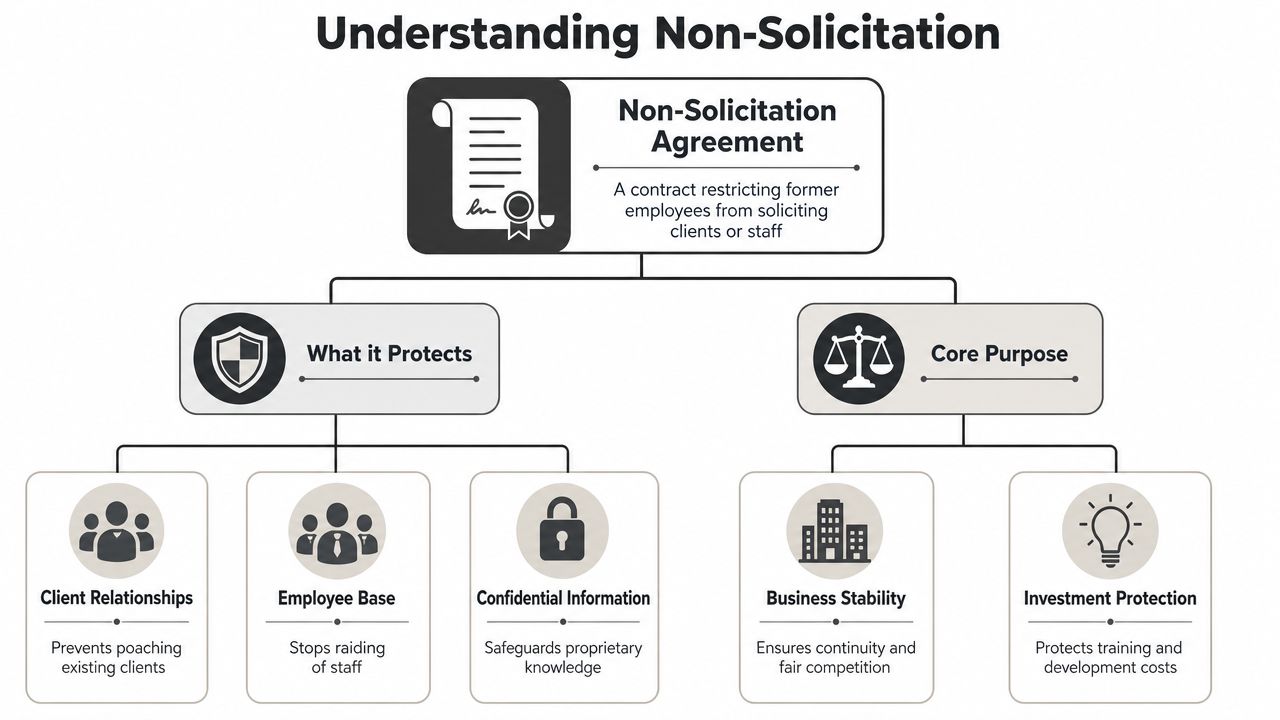
Courts generally view these clauses more favorably when they are limited to defined relationships and for a duration often in the range of 6 to 24 months, rather than trying to control an entire market, as explained in this discussion of what makes a non-solicitation agreement reasonable. If you want a broader primer on restrictive covenants, this overview of a restrictive covenant agreement is a useful starting point.
What the clause usually protects
Most non solicitation agreements cover one or both of these categories:
- Clients and customers: Current clients, former clients, prospective clients, referral sources, or some combination.
- Employees and contractors: Co-workers, support staff, producers, or affiliated contractors the employer doesn't want recruited away.
Some agreements go further and define “solicit” to include direct and indirect efforts. That's where drafting starts to matter. “Direct” is usually clear. A phone call or a personalized email is easy to identify. “Indirect” is where many disputes live. Employers often try to capture introductions through third parties, social media outreach, or communications designed to prompt a response without an explicit ask.
What it isn't
A non solicitation agreement usually does not say you can't work in wealth management, securities, insurance, or banking. It says that if you do, you can't use certain relationships in certain ways for a limited period.
That distinction matters because experienced readers often assume a clause is harmless if it doesn't contain the words “non-compete.” Sometimes it is narrower and manageable. Sometimes it's drafted so broadly that it functions like one in practice.
A clause that bars outreach to every customer the company has ever touched can look less like a tailored non-solicit and more like a disguised market-wide restraint.
A practical example
If an advisor resigns and sends a targeted email to households he serviced saying, “I've joined a new firm and can transfer your accounts immediately,” that looks like the conduct these provisions are written to stop.
If the same advisor updates his public biography and a client independently reaches out, the analysis becomes more fact-specific. The answer usually depends on the contract language, the timing, the channel, and what happened next.
The Legal Test for Enforceability in Connecticut
A non solicitation agreement only matters to the extent a Connecticut court, or an arbitration panel applying similar principles, is willing to enforce it. The governing theme is reasonableness. A business can protect a real interest, but it can't impose a restraint broader than necessary to do it.

Across many states, courts focus on whether the restriction is tied to a legitimate business interest and whether it is no broader than needed. Clauses that bar contact with all customers, regardless of whether the employee knew or serviced them, face more scrutiny than clauses tied to identified relationships, as described in this analysis of when non-solicitation agreements are enforceable. For added background on the Connecticut approach to restrictive covenants, see this discussion of Connecticut non-compete agreements.
What Connecticut decision-makers tend to examine
In practice, Connecticut enforceability analysis often turns on a small set of recurring questions.
- Duration: How long does the restriction last, and is that period defensible in light of the business interest?
- Scope of protected relationships: Does it cover only clients the advisor serviced or learned about through the job, or every client in the firm's book?
- Type of conduct barred: Is the clause limited to solicitation, or does it also prohibit accepting business, servicing accounts, or indirect contact?
- Impact on the employee: Does the restriction leave the person with a realistic ability to continue working?
- Public impact: Does the clause unduly interfere with client choice or ordinary competition?
Legitimate business interest is the core
An employer can't merely state, “We don't want competition.” That isn't enough. The interest has to be concrete. In advisor cases, that often means client goodwill, stability of a team, confidential relationship information, or another business asset the law recognizes as worth protecting.
What tends to work better is language that ties the restriction to a narrow and identifiable risk. A clause limited to households the advisor serviced, or materially learned about through firm access, is easier to defend than one drafted around every name in a database the advisor may never have seen.
What usually weakens the clause
I often see the same drafting problems create unnecessary risk:
- Unknowable restrictions: The agreement covers customers or prospects the employee couldn't realistically identify.
- Overloaded definitions: “Solicitation” is expanded to include almost any communication.
- Mismatch between role and restraint: A support employee gets the same restriction as a top producer or branch leader.
- Poor coordination with other documents: Offer letters, handbooks, compensation plans, and separation papers use different terms.
If a departing advisor can't tell which clients fall within the restriction, that ambiguity won't help the employer nearly as much as employers often assume.
For Connecticut parties, the strategic goal isn't maximum breadth. It's a restriction that a decision-maker will regard as proportionate, specific, and tied to an actual protectable interest.
Non-Solicit vs Non-Compete vs NDA A Clear Comparison
The fastest way to make a bad decision in a transition is to treat every restrictive covenant as if it does the same thing. It doesn't. A non-solicit, non-compete, and NDA regulate different conduct, create different risks, and call for different response strategies.
Here's the comparison I use most often with advisors and practice owners.
| Agreement Type | Primary Purpose | What It Restricts | Example for a Financial Advisor |
|---|---|---|---|
| Non-solicitation | Protects specific business relationships | Contacting or recruiting defined clients, employees, or contractors | An advisor may join a new firm but can't initiate outreach to households covered by the agreement |
| Non-compete | Limits competitive employment activity | Working for a competitor, in a role, territory, or market segment covered by the clause | An advisor is restricted from joining another wealth management firm in a defined area for a period |
| NDA | Protects confidential information | Using or disclosing nonpublic business information | An advisor can't take CRM exports, client notes, fee data, or internal strategy materials to a new firm |
A lot of employment packages include all three. When they do, the restrictions can overlap. An advisor may be allowed to work for a competitor but still be prohibited from using confidential client information and from soliciting specific households or staff.
Why the distinction matters in an advisor transition
An NDA often becomes important before resignation, because that's where data-handling mistakes happen. A non-solicit usually matters most during the immediate post-departure period, when communications are being scrutinized. A non-compete can affect whether the move itself is feasible.
That's why review has to be document-specific. If you're sorting through confidentiality obligations, this discussion of an employee non-disclosure agreement helps frame the separate issues.
One clause can change another
A broad definition in one agreement can affect how another covenant works in practice. For example, if the NDA defines client information expansively, an employer may argue that any post-departure targeted contact necessarily relied on confidential information. If the non-solicit defines “client” and “prospective client” loosely, ordinary networking may be recast as prohibited outreach.
That's why side-by-side review matters. You're not just reading one paragraph. You're reading a system.
Drafting and Reviewing Key Clauses
The quality of a non solicitation agreement usually turns on definitions. Not legal jargon. Definitions. If “client,” “prospective client,” “solicit,” and “indirectly” are fuzzy, the dispute often becomes expensive before anyone reaches the merits.
For employers, the objective is enforceable precision. For employees and advisors, the objective is spotting words that subtly expand the restriction beyond what seems obvious at first glance.
Clauses that tend to hold up better
Good drafting usually does three things at once:
- Names the protected relationship clearly: A clause should identify whether it covers current clients, active prospects, referral sources, employees, or some subset.
- Links the restriction to the employee's role: The language should connect the restraint to relationships the person serviced, supervised, or learned through employment.
- Defines prohibited conduct with care: It should distinguish active solicitation from passive acceptance of inbound opportunities, if that distinction is intended.
For multi-jurisdiction teams, it also helps to compare drafting conventions with broader employment contract practices. This discussion of key aspects of Canadian employment law is useful because it highlights the same contract-discipline problem seen in U.S. restrictive covenant disputes: vague language creates avoidable risk.
Sample client non-solicit language
Illustrative clause: For a period of twelve months following the end of employment, the employee will not directly solicit business from any client of the company whom the employee personally serviced, or about whom the employee obtained confidential relationship information during the last period of employment, for the purpose of providing competing financial services.
Why this works better than a broad form:
- “Directly solicit” narrows the conduct and avoids sweeping in every possible communication.
- “Personally serviced” ties the covenant to a relationship the employee can identify.
- “Obtained confidential relationship information” connects the restraint to a protectable interest.
- “Competing financial services” avoids blocking unrelated interactions.
Sample employee non-recruitment language
Consider a separate clause for co-workers rather than burying it in the client language.
- Target the right group. Limit it to employees or contractors with whom the departing person worked or supervised.
- Tie it to competitive hiring. Recruiting someone to join a competing advisory practice is different from a social conversation.
- Avoid blanket bans. A clause that bars discussion with every employee, in every role, tends to invite challenge.
A workable example might prohibit a departing branch leader from encouraging specified employees to leave for a competing practice for a defined period. It shouldn't read as a lifetime prohibition on talking to former colleagues.
What to ask before signing
If you're reviewing a non solicitation agreement, ask these questions early:
- Who exactly is covered? Named clients, all clients, prospects, referral partners, former clients?
- What counts as solicitation? Direct only, or indirect too?
- Can you respond to inbound contact? The answer shouldn't be left to assumption.
- Does the clause match your job? A support role shouldn't carry a producer-level restraint by default.
If the agreement needs review or revision, one option is counsel that evaluates the language together with the surrounding employment record. Kons Law does that kind of review in business and advisor disputes, including analysis of restricted parties, restricted conduct, and how the covenant fits with related documents.
The Gray Area For Financial Advisors What Is Solicitation
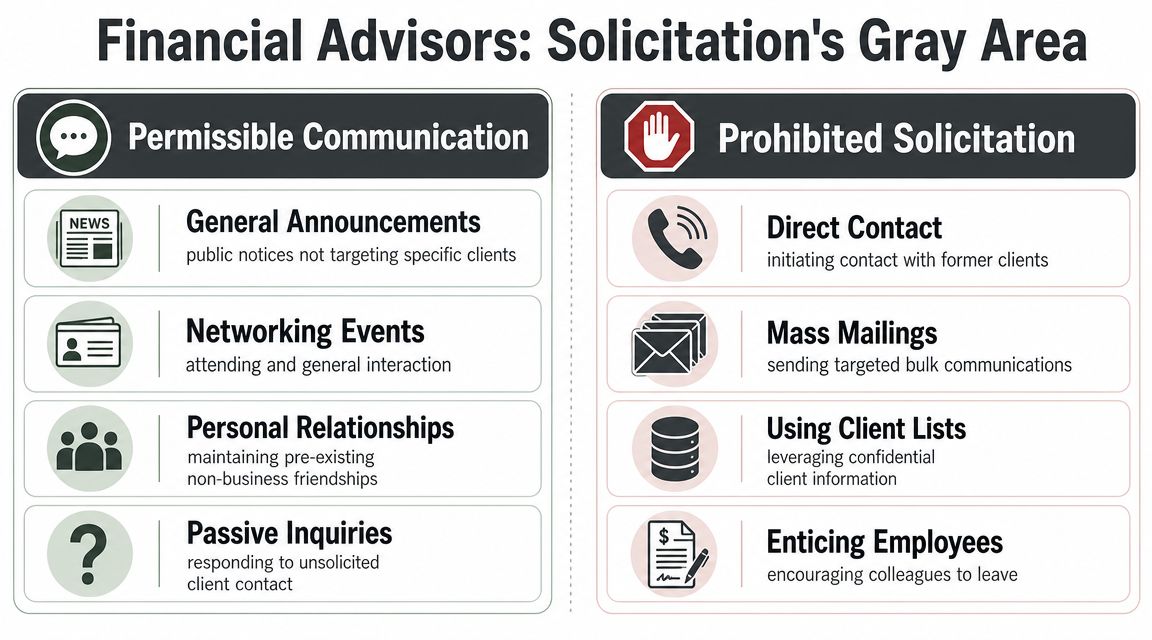
For advisors, the hardest issue usually isn't the headline restriction. It's the edge case. A LinkedIn announcement. A new email signature. A response to a client who reached out first. A holiday message that happens to mention your new firm.
That gray area matters more today because restrictive covenant law has tightened significantly at the state level. In 2023–2024, California expanded its non-compete ban through AB 1076 and SB 699, both effective January 1, 2024, and other states also imposed targeted limits, including a law effective July 1, 2023 that barred physician non-competes longer than one year and limited geographic reach to 15 miles from the primary practice site, as summarized in this review of state law changes affecting employee restrictive covenants. The practical effect is straightforward. Courts and employers are paying closer attention to scope and wording, which makes the exact meaning of “solicitation” more important.
Public announcement versus targeted outreach
A general public announcement is often easier to defend than individualized contact. If you update your LinkedIn headline, revise your firm bio, or post a neutral career update available to everyone, that usually looks different from emailing a former client list.
But “neutral” can disappear fast. The tone, audience, timing, and content all matter. A message that states where you work now is different from one that invites transfers, highlights services, or gives a direct path to move assets immediately.
The line is rarely drawn by a single word. It's drawn by the overall context and whether the communication looks like an attempt to persuade.
Scenarios that create real disputes
The disputes I see most often involve combinations of ordinary tools and bad timing.
- LinkedIn updates: A plain profile change is one thing. A personalized direct message to former clients is another.
- Inbound client calls: A former client may call you first, but what you say next still matters.
- Email signatures and auto-replies: A neutral notice may be defensible. Promotional wording can create trouble.
- CRM access before departure: Even lawful communications can look unlawful if they follow suspicious data activity.
- Messages through third parties: Asking a mutual contact to spread the word can be framed as indirect solicitation.
The safest practical approach
For advisors planning a move, discipline matters more than improvisation.
- Use one communication plan: Don't let your recruiter, assistant, and new firm all send different messages.
- Separate personal from firm data: Don't rely on contact information pulled from employer systems unless counsel says the use is permitted.
- Script inbound responses: If clients call you first, your response should be measured and consistent.
- Review platform rules too: In a broker transition, FINRA obligations, books-and-records issues, and firm protocol questions may sit beside the contract analysis.
The legal boundary between lawful relationship management and prohibited solicitation is often fact-driven. That's especially true in financial services, where a client may believe the relationship belongs to the advisor while the firm believes it purchased and protected that goodwill.
Enforcement Negotiation and Your Next Steps
Most non-solicitation disputes don't begin with a trial. They begin with a letter, a preservation demand, an internal investigation, or a request for emergency relief. Once that happens, timing matters. So does message discipline.
A firm trying to enforce a clause may seek evidence of client contact, team recruiting, downloads, call logs, text messages, social media activity, and calendar entries. A departing advisor often makes the situation worse by answering too quickly, deleting communications, or assuming that a “friendly” client-initiated contact can't be challenged.
A central dispute point is often whether the communication was a general announcement, indirect contact, or a true solicitation. That's exactly why post-transition cases frequently turn on specific conduct like LinkedIn updates, responses to inbound messages, and other detailed facts, as discussed in this guide to what counts as solicitation under non-solicitation agreements.
What usually helps
- Preserve evidence immediately: Keep texts, emails, calendar records, and device information intact.
- Review the whole contract set: The non-solicit rarely stands alone.
- Respond strategically to demand letters: A rushed answer can lock in bad facts. This guide on how to respond to a demand letter outlines the basic approach.
- Negotiate before the move when possible: A carve-out for pre-existing clients, personal relationships, or defined inbound contact can prevent a later fight.
What usually hurts
Silence can hurt. Overexplaining can hurt more. So can informal side conversations with former colleagues, recruiters, and clients that aren't coordinated with counsel.
If you're an employer, narrow drafting and consistent enforcement usually put you in a stronger position than an aggressive clause nobody can apply cleanly. If you're an advisor, careful planning before resignation is almost always cheaper than emergency defense after the fact.
If you want to discuss your business law matter, contact Kons Law at (860) 920-5181.
