A FINRA cycle exam notice lands in the principal's inbox. The request list is familiar, and near the top sits the item that often drives the rest of the review: your written supervisory procedures. At that moment, nobody cares whether the manual looks polished. Regulators want to know whether it matches how the firm operates, whether supervisors follow it, and whether the firm can prove that supervision happened.
That is why a written supervisory procedures definition shouldn't be treated as a vocabulary exercise. In practice, WSPs are evidence. They're often the first document that frames how an examiner, enforcement lawyer, or outside counsel understands your control environment. If the procedures are generic, outdated, or disconnected from the business, the firm starts the conversation on defense.
Leadership teams usually discover this problem too late. A branch adds new communication channels. A producing manager takes on extra supervisory duties. Marketing starts using social content that wasn't contemplated in the manual. Outsourced vendors begin handling tasks once performed in-house. The business evolves, but the WSP manual stays frozen. That gap is what creates exposure.
Good WSPs do something different. They show that the firm has identified its actual risks, assigned responsibility, documented review steps, and created escalation paths that people can follow under pressure. That makes them more than a compliance binder. They become the firm's primary defense shield when scrutiny arrives.
For firms that are reassessing their broader obligations, it also helps to understand the wider regulatory compliance landscape for businesses in regulated industries. WSPs sit inside that larger system, but in the securities context they carry unusual weight because they connect policy to day-to-day supervision.
Introduction Why Your WSPs Are Your First Line of Defense
A principal facing an exam request usually asks two questions. First, are our procedures complete? Second, can we defend them?
The second question matters more. A manual can appear thorough and still fail if it doesn't describe what the firm genuinely does. In an investigation, regulators compare the written procedure against emails, approvals, logs, exception reports, complaints, and testimony from supervisors. If the paper process and the operational process don't match, the WSP becomes an exhibit against the firm instead of a shield.
Why examiners start here
WSPs are often the cleanest way for a regulator to test the firm's control culture. They reveal who holds responsibility, how often reviews occur, where records are maintained, and what the firm claims it does when something goes wrong.
A weak WSP doesn't just show a drafting problem. It suggests the firm may not know who is supervising what.
That's why firms under pressure shouldn't ask only whether a requirement appears somewhere in the manual. They should ask whether the procedure is specific enough that a supervisor could execute it on a difficult day, with a real issue, and leave a record that stands up months later.
What leadership should focus on now
Senior management should review WSPs the same way trial counsel reviews a witness statement. Look for overstatements, vague verbs, and promises the firm can't consistently keep.
A practical review should test whether the manual answers these questions:
- Who owns the task by name or title, and is that allocation realistic?
- What gets reviewed and does the scope match the actual business?
- How the review occurs in a way that can be documented and repeated.
- When exceptions escalate and who has authority to resolve them.
- Where evidence is stored so the firm can produce it quickly.
Firms that answer those questions clearly are in a much better position when regulators ask for proof instead of assurances.
The Core Definition of Written Supervisory Procedures
A written supervisory procedure is the firm's set of documented instructions for how supervision occurs. In practice, it defines the controls the firm expects supervisors to carry out, the circumstances that trigger review, the records that prove the review happened, and the escalation steps when something goes wrong.

Under FINRA Rule 3110, each member firm must establish and maintain a supervisory system reasonably designed to achieve compliance. The WSP manual is the written proof of that system. During an exam, an investigation, or an enforcement inquiry, regulators often read the manual as the firm's statement of how risk is controlled. If the document overpromises, ignores actual business lines, or leaves key decisions to guesswork, it can become evidence against the firm.
That is the point leadership should keep in mind. A WSP manual is not only a compliance artifact. It is the firm's first written defense when a regulator asks, “Who was supposed to catch this, and how?”
A defensible definition of WSPs includes four practical elements:
- Assigned responsibility. The procedure should identify the supervisory role with enough precision that accountability is clear.
- Covered activity. It should specify the business function, product, communication channel, or conduct being supervised.
- Review method. It should explain how supervision occurs, including timing, criteria, exception handling, and required evidence.
- Record location. It should state where the firm maintains the procedure and the resulting supervisory records.
Firms get into trouble when the manual stays abstract. “Supervisors will review activity as appropriate” does not tell a branch manager what to do, and it does not help counsel defend the firm later. A usable procedure gives a supervisor a repeatable process and gives the firm a record it can produce under pressure.
The trade-off is real. Highly detailed procedures are harder to maintain, especially when products, staffing, or technology change. Vague procedures are easier to draft and much harder to defend. Most firms are better served by writing to their actual workflow, then updating the manual on a disciplined schedule instead of relying on broad language that creates false comfort.
This is also why WSPs sit closer to operating procedures than to policy statements. A broader discussion of how a corporate compliance program operates in practice helps frame that distinction. Policies state expectations. WSPs tell supervisors what to do on Monday morning, who signs off, and where the evidence goes.
The same principle applies when firms supervise technical tools or coded workflows. If part of the supervisory process depends on automated logic, access controls, or custom review tools, the procedure should reflect that dependency with enough detail to be defensible. In some cases, that means pairing the manual with a targeted Claude Code security review so the firm can show that the control environment described on paper matches the system operating in production.
Essential Components of a Compliant WSP Manual
A compliant WSP manual earns its value in an examination or enforcement inquiry. The document has to show how the firm supervises risk, who is responsible, what evidence gets created, and how exceptions get escalated. That is what makes the manual defensible. Under FINRA Rule 3110, the procedures must be reasonably designed for the firm's business, size, structure, and customer base, so a generic template usually creates more exposure than protection.

Supervision of personnel
Start with accountability.
A manual should assign supervisory responsibility with enough precision that there is no confusion when a problem surfaces. That means identifying who supervises registered representatives, branch staff, producing managers, and personnel with special functions such as advertising review, complaint handling, or outside activity approvals. If the manual uses titles instead of names, those titles need to track the actual reporting structure and current org chart.
The stronger approach is operational. State the reviewer, the event that triggers review, the timing, the required documentation, and the escalation path. A regulator reading the section should be able to tell how supervision happens without interviewing three departments to fill in the gaps.
Communications review
Communications supervision often breaks down first because business teams adopt new channels faster than compliance updates the manual. A defensible section does not stop at saying communications are monitored. It states which content requires pre-use approval, which content is subject to post-use review, who performs each review, what standards apply, and how records are retained.
Useful coverage usually includes:
- Retail communications that require principal approval or other pre-use controls.
- Correspondence and electronic messages reviewed through sampling, surveillance, lexicon-based flagging, or exception reports.
- Social and digital content governed by a documented process for drafting, approval, posting, edits, and archiving.
Technology can help, but it also creates a proof problem. If the firm says a vendor tool reviews communications, leadership should be able to show what the tool captures, what it misses, who reviews alerts, and how overrides are documented. Firms implementing automated workflows sometimes use an external technical assessment, such as a Claude Code security review, to confirm that the control described in the WSP matches the system operating in practice.
Customer complaints and issue escalation
Complaint procedures need to do more than route emails to a shared inbox. The manual should define what the firm treats as a complaint, where complaints must be sent, who investigates them, when compliance or legal must be notified, and what deadlines apply to review and response.
Firms often miss the follow-up piece. A sound WSP section explains how complaint data is trended, when repeat issues trigger heightened supervision, and who decides whether the underlying supervisory procedure failed. That is the difference between logging a problem and showing a regulator that the firm learns from one.
Business conduct and activity-specific controls
This section is where a manual either reflects the business or exposes that it was copied from somewhere else. A firm selling retail products, approving private securities transactions, supervising variable compensation, or running multiple branch locations should have procedures that address those risks directly. A firm with different lines of business may need tighter language around discretionary trading, outside business activities, email review, or remote supervision.
The practical drafting method is simple. Map each business line, product set, and recurring risk to a specific supervisory control. Then test whether the procedure answers five basic questions: who acts, when they act, what they review, how they document it, and when they escalate. If a section cannot answer those questions, it will be hard to defend under pressure.
Recordkeeping, training, and updates
Supervision that cannot be proven is hard to defend. The manual should specify what records supervisors create, where those records are stored, how long they are kept, and who can retrieve them quickly during an exam, arbitration, or internal investigation. It should also describe training in practical terms, including who gets trained, on what topics, how often, and how attendance or completion is documented.
The update process matters just as much. Many firms review WSPs annually and still end up with stale language because product changes, staffing shifts, and technology changes happen midyear. The better approach is to require targeted updates when the business changes, then document who approved the revision and when it became effective.
A simple comparison shows the difference between language that sounds compliant and language that can protect the firm:
| Area | Weak WSP language | Defensible WSP language |
|---|---|---|
| Supervision | Management reviews activity | Designated principal reviews specified activity, documents findings, and escalates exceptions |
| Communications | Marketing content must comply with rules | Drafts are submitted through the firm approval process, reviewed by assigned personnel, and archived with approval record |
| Complaints | Complaints are handled promptly | Complaints are logged, routed, investigated, resolved, and trended through a documented process |
| Updates | Procedures are reviewed periodically | Procedures are amended promptly when business, law, or supervisory systems change |
Real World WSP Excerpts and Examples
The best way to understand WSP drafting is to see how operational language sounds on the page. Below are short illustrative excerpts. They are not templates, and they shouldn't be copied without tailoring. Their value is in showing the level of detail regulators expect.
Social media supervision excerpt
A weak clause says: “Employees may not use social media in violation of firm policy.”
A useful clause says something closer to this:
Associated persons who intend to publish business-related social media content must submit the proposed content through the firm's designated review process before publication when pre-approval is required. The assigned reviewer will assess the content for accuracy, balance, prohibited promissory language, and consistency with approved disclosures. Approval or rejection will be documented in the firm's records, and any material revision requires a new review before use.
That language works better because it identifies the actor, the trigger, the review criteria, and the record created.
Outside business activity excerpt
Outside business activities create recurring problems because firms often collect the initial disclosure but don't document the analysis. A more defensible provision would read like this:
An associated person must provide written notice of any proposed outside business activity before beginning the activity. The designated supervisor reviews the description of duties, expected compensation, customer overlap, use of firm resources, and potential conflicts. The supervisor records the decision, including any conditions placed on the approval, and re-evaluates the activity if the scope changes.
Notice what this avoids. It doesn't say the firm “monitors all outside activities continuously” unless the firm has a process to support that statement.
Customer complaint review excerpt
Complaint language needs to move beyond intake.
- Initial routing should specify where the complaint goes immediately after receipt.
- Investigation steps should identify who collects documents, interviews personnel, and assesses whether the complaint reveals a larger supervision issue.
- Remediation should include a path for revising procedures, training staff, or escalating to legal counsel when needed.
A short example:
Written complaints received by branch personnel must be forwarded to the designated compliance contact promptly upon receipt. The assigned reviewer will classify the complaint, obtain relevant account records and communications, determine whether immediate supervisory restrictions are necessary, and document the resolution. Complaints that indicate possible supervisory weakness must be escalated for review of related procedures and supervisory practices.
Why examples matter
These excerpts share one feature. They are executable. A supervisor reading them knows what to do next. That is what separates a manual drafted for real scrutiny from a manual drafted to fill a binder.
Common WSP Violations and Enforcement Risks
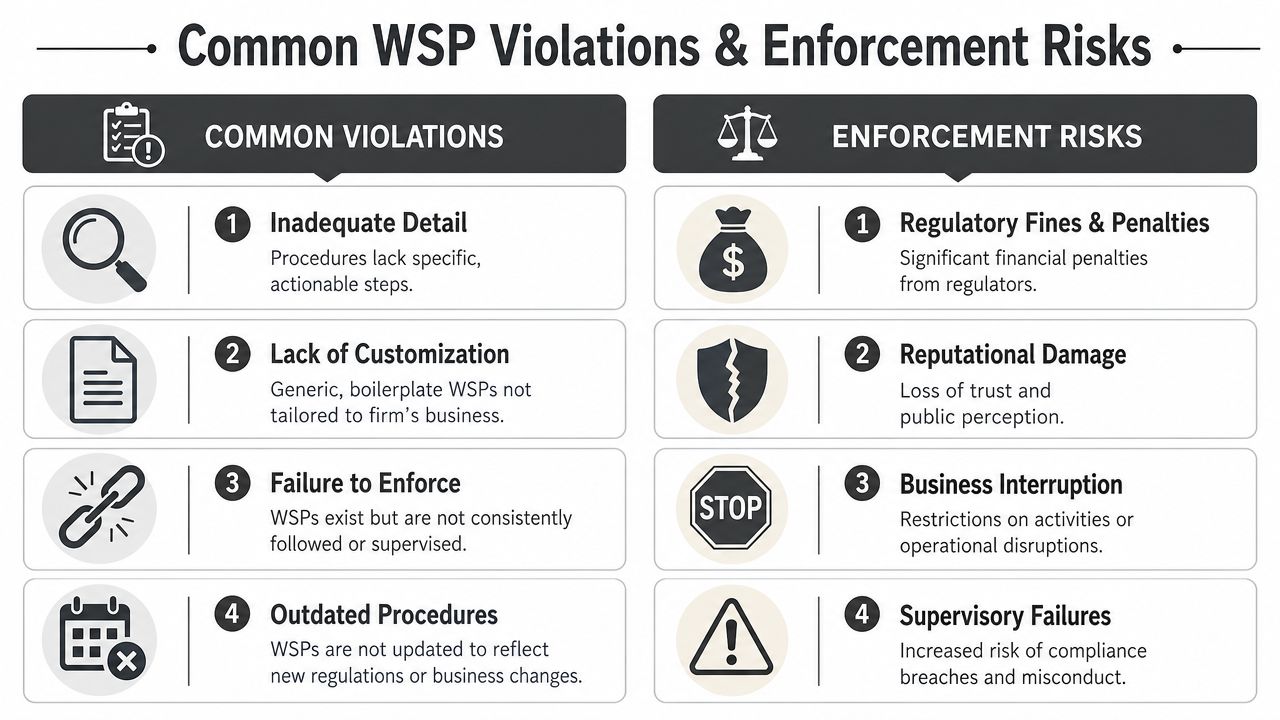
Most WSP failures are not dramatic drafting mistakes. They are ordinary disconnects between the written process and the operational process. Those disconnects create real enforcement risk because they allow regulators to argue that the firm's supervisory system was not reasonably designed or was not functioning.
Boilerplate that doesn't fit the business
The most common problem is a manual built from generic language. It names risks the firm doesn't have and ignores the ones it does. That becomes obvious quickly in an exam.
If the firm uses text messaging, social platforms, delegated review functions, or specialized products, the WSP should reflect those realities. If it doesn't, the manual signals weak risk assessment and weak governance.
Procedures that exist only on paper
A polished manual can still create trouble if supervisors don't follow it. This usually appears in small ways: approvals happen outside the stated workflow, reviews occur without documentation, branch personnel bypass escalation steps, or principals use informal workarounds that never made it into the written process.
The most dangerous sentence in a WSP review is often, “That's not how we actually do it.”
Once that admission appears, every related control is vulnerable. The issue stops being document quality and becomes supervisory credibility.
Outdated procedures after business changes
A manual may have been accurate when drafted and still become noncompliant later. Rule 3110 requires procedures to be amended promptly when the law, regulations, or supervisory system changes. Firms often miss this after personnel shifts, acquisitions, office changes, product expansion, or adoption of new communication tools.
A practical way to think about this is simple: when leadership changes the business, someone should ask whether the WSP changed with it.
Adviser-side risk and outsourced functions
Investment advisers face a related problem when they assume outsourcing reduces responsibility. It doesn't. SEC-related guidance under Rule 206(4)-7 requires advisers to adopt written policies and procedures designed to prevent violations, assess adequacy and effectiveness at least annually, and account for recordkeeping and outsourcing where relevant, as reflected in SEC-filed compliance guidance discussing annual review, outsourcing, and firm responsibility.
That issue surfaces often in firms using third-party compliance consultants, marketing vendors, technology providers, or back-office support. The vendor may perform the function. The firm still owns the supervisory obligation.
For firms dealing with exam or enforcement pressure, that risk often overlaps with broader SEC investigation issues in securities matters, especially when regulators ask whether delegated functions were monitored with enough precision.
Best Practices for Drafting and Maintaining Defensible WSPs
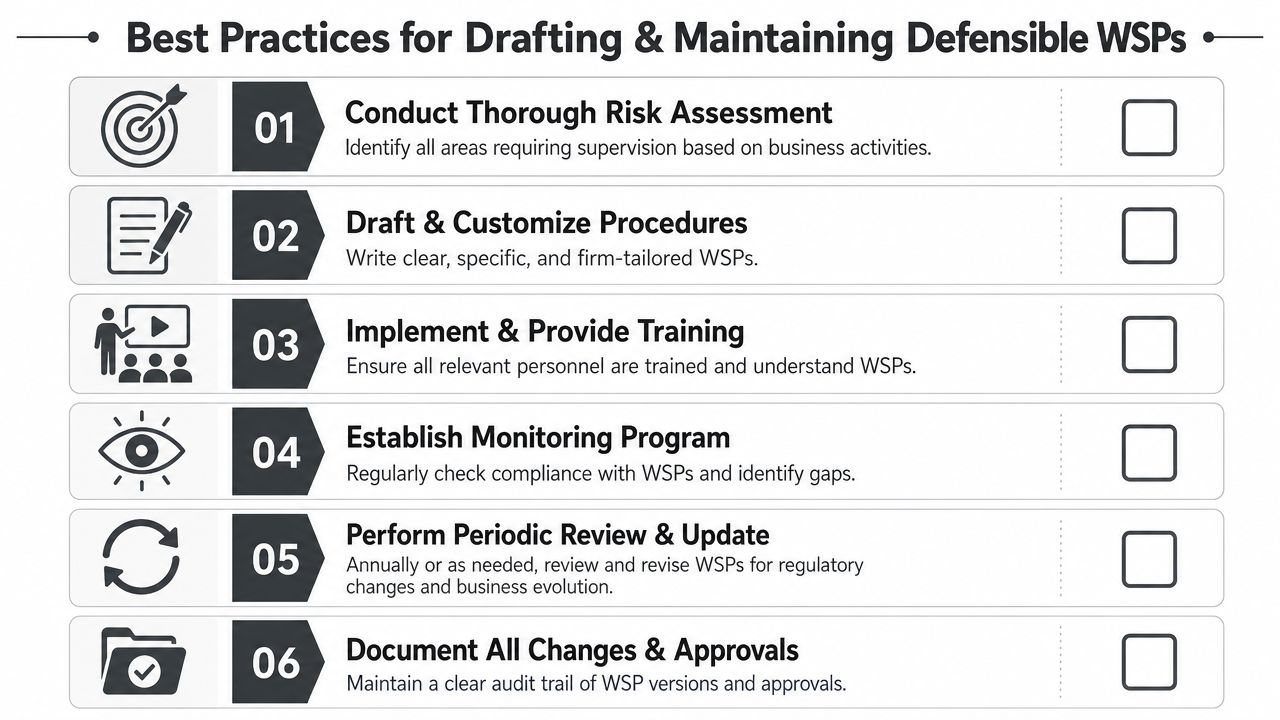
A defensible WSP starts with the business as it exists today, not with the template someone used years ago. The drafting process should follow the firm's revenue lines, communication channels, staffing model, vendor relationships, and actual supervisory choke points. If the firm can't map those clearly, it's not ready to draft a manual that will survive scrutiny.
Start with a risk map
Before rewriting language, identify what needs supervision. List business activities, applicable rules, supervising roles, review methods, and evidence created by each process. This exercise usually exposes gaps quickly. It also shows where the manual is overstating controls or omitting them.
A practical workflow often includes:
- Inventory business lines and high-risk activities.
- Assign supervisory ownership to a role with authority and capacity.
- Describe the review step in operational terms.
- Identify the record created by the review.
- Define escalation triggers and response paths.
Draft for evidence, not aspiration
The strongest WSPs use verbs that can be proven. “Reviews,” “documents,” “approves,” “escalates,” and “retains” are stronger than “oversees” or “monitors” standing alone. Broad promises invite attack if the firm can't produce matching evidence.
That is where process tooling matters. Firms evaluating workflow support should pay attention to the core capabilities of compliance software, especially features tied to audit trails, task assignment, document retention, and review logs. Technology won't fix bad procedures, but it can make good procedures provable.
Build an annual review that means something
An annual review should test whether the procedures remain adequate and effective, not merely confirm that the manual still exists. Good reviews compare the written process to actual records, interview the people performing supervisory tasks, and identify where practice has drifted.
Use a short decision matrix:
| Question | If yes | If no |
|---|---|---|
| Does the procedure match current workflow? | Keep and test it | Amend it |
| Can the supervisor produce evidence of review? | Validate consistency | Build documentation controls |
| Has outsourcing or delegation changed the risk? | Strengthen oversight terms | Reassess vendor monitoring |
| Has the business line changed? | Confirm tailoring | Redraft the section |
Train people on the process, not just the rule
Training often fails because firms teach standards in the abstract. Supervisors need scenario-based instruction. Representatives need to know what triggers disclosure, approval, escalation, or documentation.
One area where this matters is private deal activity and affiliated opportunities. Firms should make sure personnel understand how supervisory obligations attach to private securities transactions and related compliance risks, because those issues often expose gaps between written restrictions and actual behavior.
Good WSPs don't depend on memory. They create habits, records, and accountability.
Keep version control and change logs
When a regulator asks when a procedure changed and why, the firm should be able to answer immediately. Maintain version histories, approval records, implementation dates, and notes describing what business or regulatory change prompted the revision. That history often helps prove that the firm was actively managing supervision instead of reacting after the fact.
Conclusion Your WSPs as a Strategic Asset
Firms get into trouble when they treat WSPs as a filing requirement. They put themselves in a stronger position when they treat WSPs as operating instructions that must hold up under pressure. That shift changes everything. Drafting becomes more disciplined. Reviews become more honest. Documentation becomes part of the control itself.
The most useful written supervisory procedures definition is the practical one. WSPs are the firm's written proof of how supervision operates. If they are customized, current, followed, and documented, they help the firm explain itself early and credibly in an exam or investigation. If they are generic or stale, they do the opposite.
Leadership should view WSPs as a strategic asset because they reduce ambiguity at the precise moment ambiguity becomes expensive. They help supervisors act consistently. They help counsel defend the firm. They help regulators see a control environment that was designed, implemented, and maintained with intention.
If your firm is revisiting its procedures because of an exam request, a business change, a complaint trend, or concern about delegated functions, that review shouldn't be delayed. WSP weaknesses rarely stay isolated. They spread into communications, recordkeeping, complaint handling, and supervisory accountability.
If you want to discuss your business law matter, contact Kons Law at (860) 920-5181.
