You get the contract by email at 4:47 p.m. The other side calls it “standard.” They want signature by tomorrow. You skim the first page, recognize the business terms, then hit the legal clauses and realize the core agreement isn't in the pricing box. It's in the indemnity, the renewal language, the termination rights, the forum clause, and the section that assigns operational risk to your company.
That's the point where many Connecticut business owners ask the wrong question. They ask whether they need a lawyer only if something goes wrong later. A better question is whether a lawyer should review the agreement before the business is locked in.
For small and mid-sized businesses, contract problems rarely start with a dramatic breach. They start with avoidable drafting issues, unclear performance obligations, one-sided remedies, and language that looked harmless when everyone expected the relationship to go well. A good lawyer for contract work helps you catch those issues early, negotiate the parts that matter, and align the paper with how your business operates in practice.
Why a Contract Lawyer Is a Partner Not a Problem

Most business owners don't wake up wanting to hire a lawyer. They want to close a sale, launch a vendor relationship, hire the right employee, or secure financing. Legal review can feel like friction.
That view changes once you understand what contracts do inside a business. They don't just document a deal. They allocate risk, assign responsibility, control exit rights, and determine what happens when performance slips. In practice, a lawyer for contract work is often protecting margin, advantage, and cash flow long before any dispute exists.
Industry benchmarking shows how much room there is for error. Only 11% of businesses said their contract management was “very effective,” and WorldCC estimates poor contract processes can cause value leakage of up to 9% of annual turnover, according to Juro's contract management statistics roundup. That isn't a drafting problem alone. It's an ownership, workflow, and risk problem.
What business owners usually miss
A contract can look reasonable and still expose your company in ways that don't show up until months later.
- The scope is vague: Your team thinks it's promising one thing. The other side thinks it's buying more.
- The remedies are weak: If the other side underperforms, your practical recourse may be minimal.
- The renewal language is buried: You may be committed longer than you think.
- The dispute provisions are one-sided: You may be forced to fight in an inconvenient forum under unfavorable rules.
Practical rule: If a contract affects revenue, operations, staffing, intellectual property, or long-term obligations, legal review isn't overhead. It's part of the business decision.
Business owners also tend to underestimate how much legal work overlaps with operational design. A seasoned business lawyer doesn't just mark up clauses. The lawyer asks who owns the deliverable, who approves change orders, when payment is due, who gives notice, and what happens if a relationship has to end quickly. That's the broader role described in this overview of what a business lawyer does.
The right frame for cost
The comparison isn't lawyer fee versus no lawyer fee. It's lawyer fee versus the cost of signing bad paper.
That cost can show up as delayed payment, unrecoverable losses, extra staff time, a forced renewal, or a dispute over language nobody focused on during the deal. In that sense, the lawyer is not a problem introduced into the transaction. The lawyer is often the person removing hidden problems from it.
When to Call a Lawyer for a Contract

The best time to call a lawyer is usually earlier than most businesses think. Not after the threat letter. Not after the payment default. Not after the other side says your interpretation is “not what we agreed.”
The better time is before signature, while bargaining power remains.
As one practical business-law source puts it, the key is to reframe the question from “do I need a lawyer for this breach?” to “should a lawyer review this before I sign?” That same guidance notes that a lawyer's value is often highest at the drafting stage, where unclear obligations, weak remedy language, and boilerplate can be fixed before a dispute arises. A key question is whether the business consequence of one bad clause outweighs the legal fee, as discussed in this business contract guidance.
Call before you sign in these situations
Some contracts deserve legal review almost every time because the downside is too large or the terms are too sticky.
Commercial leases
Lease language affects more than rent. It can shift repair obligations, default rights, personal exposure, relocation terms, use restrictions, and renewal control.Vendor agreements with operational dependence
If a vendor touches your systems, inventory, data, customer delivery, or critical inputs, the contract should address service failures, termination, transition help, and responsibility for losses.Master services agreements and statements of work
These often create trouble when the MSA says one thing and the SOW says another. Scope control, acceptance, change requests, and payment triggers need to work together.Employment and independent contractor agreements
These should fit the actual working relationship and protect the business where appropriate on confidentiality, ownership of work product, and post-separation obligations.
Call when the paper looks “standard”
Standard forms are often standard for the sender, not for you. That means the draft likely reflects the other side's priorities, assumptions, and preferred remedies.
A lawyer for contract review should be part of the process when:
- One clause changes the economics: A broad indemnity can matter more than the pricing page.
- The deal has a long tail: Auto-renewal, exclusivity, or restrictive exit rights can outlast the initial business enthusiasm.
- You don't control performance alone: Shared obligations create interpretation risk.
- The other side resists edits: Resistance itself is useful information. It tells you where the key risk sits.
The strongest contracts aren't the longest. They're the clearest about who must do what, by when, and what happens if they don't.
If your company is handling recurring agreements, outside review also helps create a repeatable playbook. That's especially useful for businesses working through procurement, sales, staffing, or expansion issues. For a closer look at that process, this discussion of contract negotiations with counsel is a useful starting point.
A simple business test
If a bad clause could cost more than the review, get the review.
That applies even to relatively small agreements. Small contracts can carry large obligations if they involve data access, indemnity, renewals, exclusivity, collection risk, or customer-facing performance commitments. Size alone doesn't determine legal risk. Clause structure does.
Finding and Vetting the Right Connecticut Contract Lawyer

Not every lawyer who can read a contract is the right lawyer for your business. For a Connecticut SMB, the better fit is someone who understands transactions, disputes, and the practical consequences of each clause in day-to-day operations.
That level of skill has real market value. The median annual wage for lawyers was $151,160 in May 2024, and the role has become more technical as lawyers use tools such as AI-powered contract analytics to identify risks and insights more efficiently, as described by Thomson Reuters in its contract analytics guide. The point for a client is simple: you aren't paying for proofreading. You're paying for judgment, issue spotting, negotiation strategy, and process.
What to look for in a modern contract lawyer
A strong lawyer for contract work should be able to do three things well.
First, translate legal language into business consequences. If the lawyer can't explain what a clause means in plain English, that's a problem.
Second, negotiate proportionally. Not every issue deserves a fight. Good counsel distinguishes between cosmetic edits and terms that materially change your exposure.
Third, work efficiently. Today that often includes document systems, structured issue lists, clause libraries, and technology-assisted review for larger document sets.
Ask how the lawyer reviews contracts in practice. The answer should include process, not just experience.
For law firms themselves, process and communication shape client confidence as much as credentials do. If you're comparing firms and want a sense of how professional service businesses present expertise and trust online, Rebus's guide to legal marketing offers a useful outside perspective on what clear positioning and client-focused communication look like.
Questions worth asking on the first call
Use the intake call to test fit, not just price.
- What kinds of contracts do you review most often? Industry familiarity helps. A software MSA, a manufacturing supply agreement, and a commercial lease present different pressure points.
- How do you scope a review? You want to know whether the lawyer provides a high-level risk memo, clause-by-clause markup, negotiation support, or all three.
- How do you handle urgency? Businesses often need turnaround tied to a deal timeline.
- What happens if the contract turns into a dispute? A lawyer who understands both drafting and enforcement sees issues differently.
- Can you work with our internal process? That matters if your business has finance, operations, procurement, or outside stakeholders who need input.
Signs of a weak fit
A poor fit often shows up quickly.
- The lawyer speaks only in abstractions: You need direct answers tied to your facts.
- Every point becomes a major issue: Over-lawyering can slow deals without improving protection.
- There is no process for revisions: Contract review should not feel improvised.
- The lawyer doesn't ask about your business model: Contract advice without business context is incomplete.
For Connecticut companies seeking business-focused counsel, one practical option is Kons Law's business law resources. Review the firm's published material the same way you'd review a potential vendor. Look for evidence of commercial judgment, not just legal terminology.
Understanding Legal Fees and Engagement Letters
Legal fees make business owners uneasy for one reason: uncertainty. Business owners can typically handle paying for advice they need. What they don't like is not knowing how the meter runs, what work is included, and when a simple review turns into a larger project.
A useful engagement starts with a clear fee model and a clear engagement letter. If either is vague, misunderstandings follow.
Comparison of Common Legal Fee Structures
| Fee Model | How It Works | Best For | Potential Downside |
|---|---|---|---|
| Hourly | You pay for time spent reviewing, advising, negotiating, and revising | Complex or unpredictable matters where scope may change | Total cost can be harder to forecast at the start |
| Flat fee | One set fee covers a defined task | Routine reviews, standard drafting projects, and clearly bounded assignments | Scope disputes can arise if the work expands |
| Retainer | You pay an upfront amount, usually applied against future work under agreed terms | Ongoing business relationships with recurring contract needs | Businesses sometimes assume all work is covered when it isn't |
| Hybrid | Combines a fixed component with hourly or staged charges for added work | Matters with a predictable base task but variable negotiation or follow-up | Needs careful definition so the transition points are clear |
Each model can work. The right choice depends on how predictable the assignment is.
If your business needs regular access to counsel for contracts, governance, and issue spotting across the year, a broader outsourced relationship may make sense. Fractional general counsel services are often a practical fit for SMBs that need steady legal support without building a full in-house department.
What the engagement letter should say
The engagement letter matters as much as the fee model. It should make the business relationship legible.
Look for these points:
- Scope of work: Is the lawyer reviewing one draft, handling negotiation comments, joining calls, or advising through signature?
- Who the client is: This matters if you own multiple entities or are signing through an affiliate.
- Billing practices: How often are invoices sent, and what level of detail will they include?
- Communication expectations: Who will receive updates, and how quickly should you expect responses?
- Termination terms: Both sides should know how the relationship ends and what happens to the file.
A good engagement letter reduces friction later because it answers the questions clients usually ask only after confusion starts.
Cost control without false economy
Trying to save money by skipping legal review is often the wrong kind of efficiency. Better cost control comes from narrowing the assignment and preparing your lawyer well.
Send the full draft. Explain the business deal in plain terms. Identify the clauses you already know are sensitive. Tell the lawyer your deadline and whether the paper is negotiable. That lets counsel focus time where it matters most.
Law firms spend a lot of time thinking about pricing structure and workload balance. If you're curious how firms analyze those trade-offs internally, this article on optimizing law firm profitability through pricing models is a useful business-side read. For clients, the takeaway is straightforward: the more clearly the matter is scoped, the easier it is to match the right fee arrangement to the work.
Key Clauses and Negotiation Points in Business Contracts
A contract review usually doesn't fail because someone missed a typo. It fails because the parties signed language they didn't fully pressure-test.
In higher-stakes negotiations, lawyer skill has measurable effects. A peer-reviewed acquisition-contract study found that lawyers with higher relative expertise compared to opposing counsel secure better risk allocation for their clients and more favorable target prices, while also shortening negotiation time so higher hourly rates do not necessarily increase total cost, according to the Berkeley study on lawyer expertise in acquisition contracts. The lesson applies beyond M&A. Good contract lawyers don't just add comments. They change outcomes.
What a review often looks like in practice
A business owner sends over a draft services agreement. The pricing is acceptable. The business team is ready to sign. Legal review starts, and a different picture emerges.
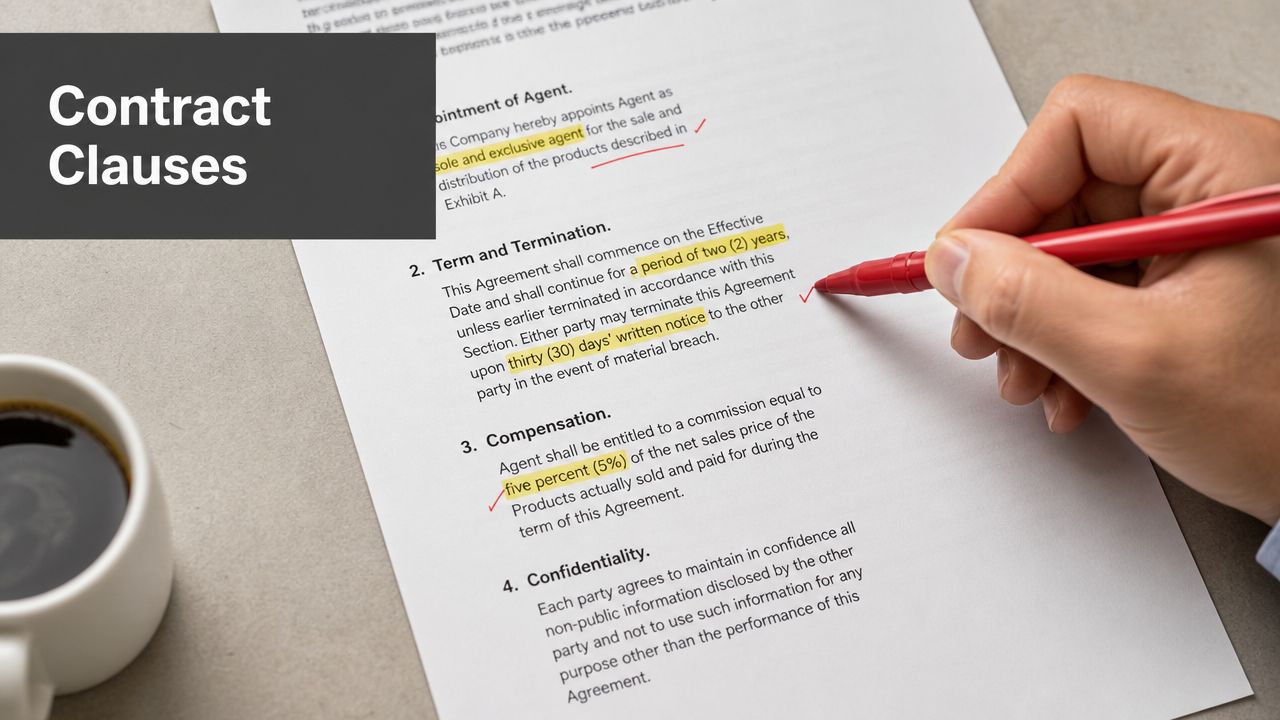
The indemnity is broad enough that your company could be responsible for losses beyond its own conduct. The limitation of liability excludes the very damages most likely to matter. The termination clause lets the other side exit for convenience but locks you in. The payment section gives the customer broad discretion to dispute invoices. None of those issues may appear on the first page, but each one affects the true economics of the deal.
Clauses that deserve close attention
Indemnification
In plain English, this clause says who pays if a third-party claim lands. A fair clause usually ties responsibility to each party's own conduct or specific risks it controls. A bad clause can make your business absorb losses caused by someone else's actions.Limitation of liability
This clause caps exposure and defines what kinds of damages can be recovered. The key question isn't whether there is a cap. It's whether the cap fits the transaction and whether the carve-outs are sensible.Termination rights
Every contract should answer how the relationship ends. Immediate termination rights for material breach may be appropriate. Termination for convenience may or may not be. The practical issue is whether your business has enough exit flexibility if performance, economics, or strategy changes.Payment and acceptance terms
Revenue disputes often start here. If acceptance standards are vague or invoice objection rights are unlimited, collections become harder.Governing law and forum
These provisions decide where disputes are handled and under what law. Businesses often treat them as boilerplate until a conflict arises and the location suddenly matters.
Strong negotiation often means concentrating on five clauses that drive risk instead of making twenty edits that don't change the business result.
Good and bad versions in business terms
A useful way to evaluate a clause is to ask what happens on a bad day.
If the customer stops paying, can you suspend performance? If your vendor fails, can you replace them quickly? If there is a claim, does the contract clearly identify who defends it and who pays? If the relationship ends, who keeps data, work product, inventory, or deposits?
That's where the value of a lawyer for contract negotiation shows up. The lawyer isn't negotiating for style points. The lawyer is reducing the chance that your company gets trapped in expensive ambiguity.
Speed matters too
Many business owners assume careful legal work always slows deals. That's not necessarily true. Often the opposite is true when counsel is experienced.
A lawyer who knows which clauses matter can move faster, focus comments, and avoid wasting cycles on edits the other side will never accept or that don't materially improve your position. Better negotiation is often more disciplined, not more aggressive.
Connecticut-Specific Business and Contract Considerations
Generic contract advice only gets you so far. Connecticut businesses operate in a specific legal and commercial environment, and local knowledge matters when a contract touches enforcement, unfair trade practices exposure, collections, or a dispute likely to land in a Connecticut forum.
That local dimension starts before litigation. Contract language should fit the way your business performs in Connecticut, the industries you work in, and the counterparties you deal with. It also matters when a dispute crosses state lines or when the other side has assets somewhere other than where the contract was signed.
Why local counsel adds practical value
A Connecticut-focused business lawyer can often spot issues that a generic contract reviewer may miss, including local commercial expectations, enforcement realities, and how certain clauses play out once a matter becomes contested.
That includes broader state-law context. Businesses operating here should understand the surrounding legal environment, including statutes and common issues affecting commercial conduct. Connecticut business law considerations are part of the analysis, not an afterthought after signature.
Enforcement is part of the contract strategy
Many businesses think the legal job ends once the paper is signed. It doesn't. A contract is only as useful as your ability to enforce it.
As one practical disputes source notes, many businesses don't think about how they'll enforce a contract or collect on a judgment until it's too late. A lawyer's job isn't just drafting. It's making sure paper rights can be turned into recoverable dollars, which may require familiarity with cross-jurisdictional enforcement tools such as domestication of judgments and post-judgment discovery, as discussed in this overview of contract dispute enforcement issues.
That matters for Connecticut companies in several common situations:
- An out-of-state customer doesn't pay
- A vendor relationship breaks down and key property or data must be recovered
- An arbitration award still has to be converted into actual collection
- A judgment exists on paper, but assets are hard to locate or reach
The practical takeaway is simple. A lawyer for contract work should think about drafting, negotiation, dispute posture, and recoverability as one continuous problem. Businesses that treat those as separate stages often discover the enforcement issue after the bargaining power is gone.
If you want to discuss your business law matter, contact Kons Law at (860) 920-5181.
