
A possession case can look finished on paper and still fail at the curb. The complaint is filed, the hearing is done, the order is in hand, and the officer arrives to restore possession. Then someone who was never named steps forward and says they live there, work there, store property there, or have some independent right to stay. That last-minute objection can turn a straightforward recovery into a new round of delay, service issues, and hearings.
Business owners run into this problem more often than they expect. Commercial landlords see unauthorized occupants after a tenant's business has already collapsed. Lenders encounter holdovers after foreclosure or turnover. Creditors trying to recover access to a site discover that the person who signed the contract isn't the only person in possession.
The prejudgment claim to right of possession is designed to deal with that problem early, before judgment instead of after it. California has formalized the concept with a specific procedure, but the underlying strategic lesson matters just as much in Connecticut. If possession is the objective, your pleadings and service plan should be built to flush out occupant claims at the front end, not react to them on lockout day.
Securing Property Before Judgment
A common failure point in possession cases isn't the merits. It's the assumption that the named defendant is the only person who matters.
A commercial tenant stops paying rent and abandons most of the space. The landlord does what it should do, moves promptly, obtains a possession judgment, and coordinates enforcement. On the day possession is supposed to be restored, an individual appears and says he has been operating from a back office for months. He was never named. He claims the case doesn't apply to him. Whether that claim succeeds or not, the immediate result is friction, delay, and cost.
Why this issue matters to creditors
For a creditor or property owner, delay has consequences that go beyond legal fees.
- Space stays offline: A landlord can't confidently re-let or renovate the premises.
- Collateral remains exposed: Equipment, records, or inventory may remain inaccessible.
- Operational planning suffers: Contractors, buyers, and new tenants often have to wait while the legal issue gets sorted out.
- Enforcement power diminishes: The longer possession remains uncertain, the more bargaining power shifts to the occupant on site.
Practical rule: If there's any realistic chance that someone besides the named defendant occupies the property, treat that as a pleading and service issue from day one.
Connecticut businesses don't always use the California label, but they face the same risk. The strategic question is simple. How do you make sure the final possession order reaches everyone who may later claim a right to remain?
What works and what does not
What works is a front-loaded possession strategy. Counsel identifies possible occupants early, drafts the case accordingly, and serves the papers in a way that minimizes later due-process objections.
What doesn't work is assuming that a strong claim against the primary tenant automatically resolves possession against every person on the premises. It often doesn't.
The value of the prejudgment claim to right of possession, and of Connecticut procedures that serve the same function, is that they force the issue early. Unknown occupants either come forward in time to be heard, or they lose the ability to derail enforcement at the last minute.
What Is a Prejudgment Claim to Right of Possession
A prejudgment claim to right of possession is best understood as an early notice device aimed at unnamed occupants. It tells people in possession that a case is pending, that their occupancy may be affected, and that they must assert any claim promptly rather than waiting until enforcement.
In California, this concept became a standardized eviction tool through Code of Civil Procedure section 415.46, which requires service by a marshal, sheriff, or registered process server and is used to alert unnamed occupants before judgment. Its practical significance ties directly to enforcement because, under Code of Civil Procedure section 1174.3, an unnamed occupant who was not served with a prejudgment claim may file a claim of right to possession after the writ is served and up to the moment the levying officer returns to effect the eviction. The statewide form implementing that procedure is CP10.5, revised effective June 15, 2015, as described in this discussion of California's prejudgment claim procedure.
The core purpose
The purpose is not paperwork for its own sake. It is to prevent a hidden-occupant problem from surfacing at the worst possible time.
California practitioner guidance states that the main purpose of the prejudgment claim is to prevent last-minute occupant challenges that can disrupt lockouts. After being served, unnamed occupants generally have 10 days to file the claim to join the case, and if they fail to do so they can be removed under the judgment against the named tenants, as explained in this practitioner summary of the notice and response process.
That structure reflects a basic due-process principle. If someone may be bound by a possession judgment, that person should receive notice and an opportunity to be heard early enough for the court to resolve the issue in an orderly way.
Why Connecticut businesses should care
Connecticut doesn't depend on California forms, but the business problem is identical. A landlord, lender, or secured party still needs a case structure that reaches beyond the obvious defendant when possession on the ground is unclear.
That starts with investigation. Lease files, site visits, payment records, signage, utility use, and employee observations often reveal whether the space is occupied by more people or entities than the contract identifies. Tools can help organize that review. For example, an AI agent for legal agreements can help a business team quickly review rental or occupancy documents for assignment language, subletting terms, default provisions, and notice clauses before counsel decides how to frame the possession action.
It also helps to distinguish real property possession from recovery of movable goods. If the dispute is really about specific personal property rather than occupancy of premises, the analysis may point toward a different remedy entirely, such as the Connecticut process discussed in this overview of what a replevin action is.
The strongest possession cases don't just prove default. They also eliminate ambiguity about who is entitled to remain on the premises when the officer arrives.
The Legal Process and Connecticut Application
California's model is useful because it shows how a jurisdiction can force occupant claims to the surface before judgment. Even if you're litigating in Connecticut, the process illustrates what a disciplined possession strategy looks like.
The model process
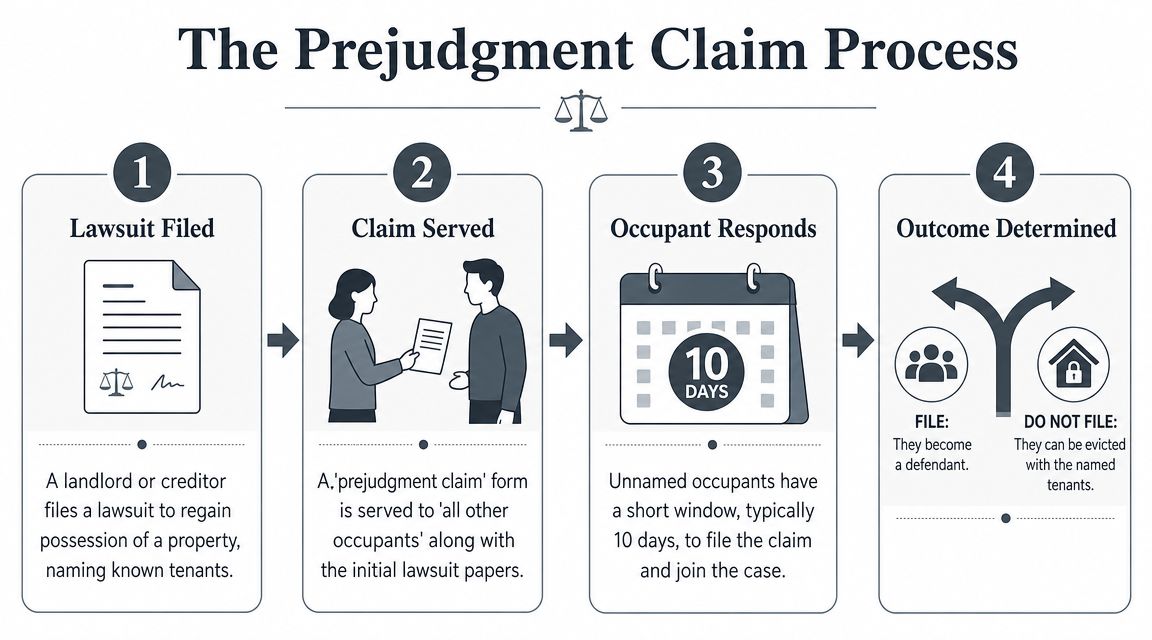
At a high level, the process works in four moves.
File the possession case against the known parties.
The plaintiff names the tenants or occupants it can identify from the lease, foreclosure record, or other possession documents.Serve a notice aimed at unnamed occupants.
The goal is to put “all other occupants” on notice that the case affects their claimed right to remain.Force an early response.
California practitioner guidance explains that the prejudgment claim creates a 10-day response window for unnamed occupants. It can delay eviction by about 5 days only when the named defendants were personally served. If any named defendant was served by substituted service or posting and mailing, the prejudgment claim generally does not add delay, according to this practitioner discussion of timing and strategy.Bind the result to the people who failed to come forward.
If an occupant files, that person is brought into the case. If not, enforcement is less vulnerable to a last-minute objection.
What that means in Connecticut
Connecticut doesn't use a single statewide form with the same name, but the strategic equivalent is familiar. In possession matters, counsel should evaluate whether the complaint, caption, and service plan need to account for occupants whose identities aren't fully known at filing.
That can include:
- Naming known business entities and individuals accurately: Trade names, related entities, guarantors, and holdover occupants should be reviewed carefully before filing.
- Using occupant-focused pleading where appropriate: If unknown persons are in possession, the pleadings should be drafted with that reality in mind rather than pretending the premises are occupied only by the signatory tenant.
- Planning service around enforceability: The objective isn't just obtaining a judgment. It's obtaining a judgment that can be executed on the premises without avoidable disputes.
- Coordinating with the officer and process server early: Good communication often exposes occupancy issues before they become expensive.
For businesses pursuing broader recovery strategies, that possession planning should also fit into the overall collections approach, including execution risk, collateral access, and settlement advantage. This is part of the larger framework described in Kons Law's discussion of protecting creditors' rights in Connecticut debt collection matters.
Evidence issues that often decide the fight
Occupancy disputes are often factual before they are legal. If someone claims an independent right to remain, the court may care about who has keys, who receives mail, who stores equipment there, who pays utilities, and what the written agreements say.
Where language access is an issue, especially in testimony or sworn examinations, clarity matters. Misunderstood testimony can distort whether the occupant had notice or a possessory claim. In those situations, counsel may need reliable deposition interpreting services to develop a clean factual record.
Early occupant work is cheaper than post-judgment cleanup. Once enforcement is scheduled, every unresolved notice issue becomes more expensive.
Strategic Use Cases for Creditors
The best use of a prejudgment claim to right of possession strategy is selective. Not every possession case needs it. Some do.

Post-foreclosure properties
After foreclosure, title may be settled while possession is anything but settled. Former owners, relatives, informal occupants, caretakers, or business operators may still be on site.
A lender or successor owner who assumes the only relevant party is the borrower often walks into avoidable resistance. The smarter move is to investigate occupancy immediately and structure the case to address anyone with a plausible claim to remain. That reduces the chance that a person who was invisible during litigation becomes very visible when turnover is scheduled.
Commercial spaces with unauthorized occupants
Commercial landlords often discover occupancy drift. The named tenant may have allowed another business to use part of the premises. A manager may be sleeping on site. Storage rooms may be controlled by someone who never signed the lease.
Those cases require more than a standard nonpayment mindset. They require a possession mindset. If the objective is clean recovery of the premises, counsel should ask who is physically there, who claims rights there, and how the record will look when enforcement happens.
For companies dealing with these scenarios repeatedly, it helps to view them through a broader creditors' rights lens rather than as isolated leasing problems. This resource on creditors' rights lawyers gives useful context on how possession disputes fit into a larger enforcement strategy.
Secured lenders recovering access to business locations
A secured lender may not just want title to collateral. It may need practical access to equipment, records, or inventory located inside occupied space. That creates a layered problem. The borrower may be in default, but the people physically controlling the premises may include employees, related entities, or unauthorized occupants.
In that setting, the prejudgment claim concept is valuable because it shifts the focus from paper rights alone to site control. If the lender's recovery depends on entering and clearing a location, unidentified occupants are not a side issue. They are central to execution risk.
When this strategy is worth the effort
This approach is usually worth serious attention when:
- Occupancy is uncertain: The file suggests there are people on site who aren't on the core agreement.
- The property has changed hands under stress: Foreclosure, business shutdown, or abandonment often produces murky possession facts.
- Time-sensitive turnover matters: A replacement tenant, buyer, contractor, or liquidator is waiting for access.
- The premises contain valuable business property: Delay can expose collateral, records, or equipment to damage or interference.
How It Compares to Other Legal Remedies
A prejudgment claim to right of possession serves a narrow function. It helps resolve who may remain in possession of premises before enforcement becomes chaotic. That makes it powerful, but only when used for the right problem.
Replevin
Replevin is about recovering specific personal property, not real estate occupancy. If a creditor needs machinery, inventory, vehicles, files, or other identifiable goods, replevin may be the better fit.
That distinction matters in practice. A business may think it has a “possession” issue when it has two different issues. One is the right to control premises. The other is the right to recover tangible items inside those premises. Those remedies overlap factually, but they do not do the same legal work.
Attachment
Prejudgment attachment is designed to secure assets for satisfaction of a potential money judgment. It protects collectability. It does not, by itself, solve who can stay in the building.
If your real concern is dissipation of assets, attachment may be central. If your concern is a lockout that could be challenged by an unnamed occupant, attachment is not the tool that fixes that.
Injunctive relief
An injunction orders someone to do something or stop doing something. In the right case, injunctive relief can be important. For example, it may address interference, waste, removal of property, or other urgent conduct.
But injunctions often raise a different set of burdens and are not the routine substitute for possession procedure. If the primary goal is to make a possession judgment enforceable against everyone who might later object, the prejudgment claim concept targets that problem more directly.
Lien foreclosure
Lien foreclosure addresses another category of rights entirely. It concerns enforcing a lien interest according to the governing statute or contract. Depending on the setting, that may eventually affect ownership or sale rights, but it still doesn't automatically resolve every occupancy dispute on the premises.
Businesses sometimes conflate these remedies because the same distressed property can involve unpaid debt, collateral claims, occupancy disputes, and lien rights at the same time. The better approach is to separate them and choose the procedural tool that matches each objective. This discussion of foreclosing a lien is a useful example of how different enforcement remedies address different legal interests.
A quick comparison
| Remedy | Main objective | Best use |
|---|---|---|
| Prejudgment claim to right of possession | Flush out unnamed occupant claims before judgment | Reducing lockout disruption and due-process challenges |
| Replevin | Recover specific personal property | Equipment, inventory, or goods wrongfully withheld |
| Attachment | Secure assets for a money judgment | Protecting collectability during litigation |
| Injunction | Command or restrain conduct | Urgent behavior that threatens rights or property |
| Lien foreclosure | Enforce lien rights | Property subject to a valid lien claim |
Choose remedies by objective, not by label. “Possession” can mean premises possession, collateral recovery, or asset control, and each requires a different procedural answer.
Potential Risks and Common Defenses
A prejudgment claim strategy is effective only if the execution is clean. Most problems arise from procedure, notice, or overconfidence about who occupies the property.
Risks on the creditor side
The first risk is defective service. If the notice process is sloppy, the occupant issue isn't resolved. It's deferred. That defeats the purpose of using the strategy in the first place.
The second risk is underinclusive pleading. If the complaint names only the obvious defendant while the facts suggest shared or informal occupancy, the record may invite later objections rather than closing them off.
A further problem is complexity. When an unnamed occupant does respond, the case can become more fact-intensive. That's not necessarily bad. In many cases it's better to litigate that issue before judgment than during enforcement. But counsel should expect the dispute, not act surprised by it.
Defenses occupants may raise
An occupant who comes forward may assert several different positions:
- An unexpired lease or sublease: The occupant claims a contractual right independent of the named defendant's default.
- An equitable or ownership interest: The occupant argues that possession rests on more than permissive occupancy.
- Defective or unclear notice: The occupant challenges whether service conveyed meaningful notice.
- Mistaken identity of the occupant relationship: The person says the plaintiff misunderstood who occupied the premises and under what authority.
California court guidance and self-help materials also highlight a deeper practical problem. A key challenge is ensuring due process. While the CP10.5 form allows an unnamed occupant to join the case, a gap can exist when occupants in shared or informal housing never see or understand the notice, leading to disputes over the quality and effectiveness of service, as reflected in California court guidance on form CP10.5.
The business takeaway
The creditor's best defense is disciplined preparation. Verify who appears to occupy the site. Match the pleadings to the facts. Use a process server or officer strategy that supports later enforcement. And document everything in a way a judge can evaluate quickly if the occupant issue surfaces.
Conclusion and Recommended Best Practices
The prejudgment claim to right of possession is valuable because it addresses the part of a possession case that businesses often underestimate. Not whether they can win on paper, but whether they can enforce in practice without surprise claims from people who were never brought into the case.
For Connecticut creditors, the lesson isn't to copy California forms blindly. It's to adopt the same discipline behind them. Build the possession case around who may be on the premises, not just who signed the lease, note, or contract.
A sound approach usually includes:
- Inspect early: Gather facts about who is using the space and how.
- Draft for enforceability: Plead the case with real occupancy conditions in mind.
- Serve carefully: Possession orders fail when notice records are weak.
- Separate remedies clearly: Premises possession, property recovery, and asset security are different legal jobs.
- Avoid self-help: Shortcuts around process usually create bigger problems later.
Handled correctly, this strategy turns a late-stage ambush into an early, manageable dispute. That is often the difference between a possession order that exists and one that can be executed.
If you want to discuss your business law matter, contact Kons Law at (860) 920-5181.
