Imagine your business delivers goods or services, but the invoice goes unpaid. What happens next? This is where a creditors rights lawyer becomes your most important partner. They are far more than just a collection agency; they are legal specialists who wield the full power of the law to enforce your financial agreements and protect your bottom line.
Understanding the Role of Creditors Rights Lawyers
When a customer fails to pay, it doesn't just create a headache—it can seriously disrupt your cash flow and threaten your business's stability. While friendly reminders and phone calls are the right place to start, they often fall on deaf ears. This is the moment a creditors rights lawyer steps in. Think of them as the enforcement arm for any business that extends credit.
Their mission is straightforward: to make sure you get paid. To do this, they navigate a complex maze of state and federal laws to hold debtors accountable. Their expertise isn't limited to just one type of debt, either. It covers a wide range of commercial disputes, including:
- Unpaid invoices for goods delivered or services rendered
- Defaulted business or personal loans
- Breached commercial contracts
- Failure to pay on promissory notes
If a financial agreement has been broken, these attorneys have the legal toolkit to force a resolution.
Creditors Rights Lawyer vs. Collection Agency
The biggest difference between a creditors rights lawyer and a collection agency comes down to one word: authority. A collection agency's power is limited. They can send letters and make phone calls, but that's where their influence ends. They can't file a lawsuit, get a court-ordered judgment, or legally seize assets. Their primary tool is persistence, which a determined debtor can often ignore with few immediate consequences.
An attorney, on the other hand, operates with the full backing of the legal system. They can take a debtor to court, argue your case, and secure a legally binding judgment. Once that judgment is in hand, they can pursue powerful enforcement actions that agencies can only dream of. You can learn more about this crucial step by exploring what it means to become a judgment creditor in our detailed article. This legal leverage completely changes the game, compelling debtors to take their obligations seriously.
| Attribute | Creditors Rights Lawyer | Collection Agency |
|---|---|---|
| Primary Tools | Lawsuits, judgments, liens, garnishments, levies | Letters, phone calls, credit reporting |
| Legal Authority | Can file lawsuits and represent you in court | Cannot file lawsuits or provide legal advice |
| Enforcement Power | Can legally seize assets (bank accounts, property) | No legal authority to seize assets |
| Scope of Work | Handles entire legal process from demand to enforcement | Limited to pre-litigation communication |
| Effectiveness | High, backed by court orders and legal consequences | Varies greatly; depends on debtor's willingness to pay |
In short, a lawyer brings the weight of the courthouse to the negotiation table, while an agency can only knock on the door.
A creditors rights lawyer transforms a private dispute over an unpaid bill into a legal matter with court-enforced consequences. They convert an ignored invoice into a powerful legal tool for recovery.
The Growing Need for Specialized Counsel
Recent economic shifts have only underscored how vital this specialty has become. From trade disputes to regulatory changes, today's business climate is ripe for financial disagreements. A report from Thomson Reuters highlighted a major surge in demand for creditors rights specialists as businesses scramble for expert help to resolve disputes over debts and assets.
This has led many companies to seek out midsize firms, which offer focused expertise without the staggering price tag of a massive corporate law giant. This trend is great news for lenders and trade creditors, as it means expert legal help for collecting debts is more available and efficient than ever.
If you want to discuss your business law matter, contact Kons Law at (860) 920-5181.
The Legal Toolkit For Debt Recovery
A creditors’ rights lawyer has a whole arsenal of legal tools designed to get debtors to pay. Think of it as a systematic way to turn up the heat, moving from formal warnings all the way to decisive, court-ordered actions. Once you understand these tools, you can see the clear path from an unpaid invoice to recovered cash.
The process almost always starts before anyone steps foot in a courtroom. While a debtor can easily ignore your invoices and reminder calls, a formal demand letter from an attorney is a different story. This isn't just another bill. It's a formal notice that carries real legal weight, spelling out the debt, why they owe it, and the serious consequences—including a lawsuit—if they continue to ignore it. That step alone is often enough to get a previously silent debtor to pick up the phone.
From Lawsuit To Judgment
When a demand letter doesn't do the trick, it’s time for litigation. Your attorney will file a lawsuit in the proper court, officially kicking off the legal process to recover what you're owed. The entire point of the lawsuit is to secure a judgment—a court’s official order declaring that the debtor is legally required to pay you a specific amount.
This judgment is the key that unlocks a whole new set of powerful enforcement tools.
The hierarchy of authority in debt collection is pretty clear. A collection agency can call and write letters, but a lawyer operates with the full force of the legal system behind them.
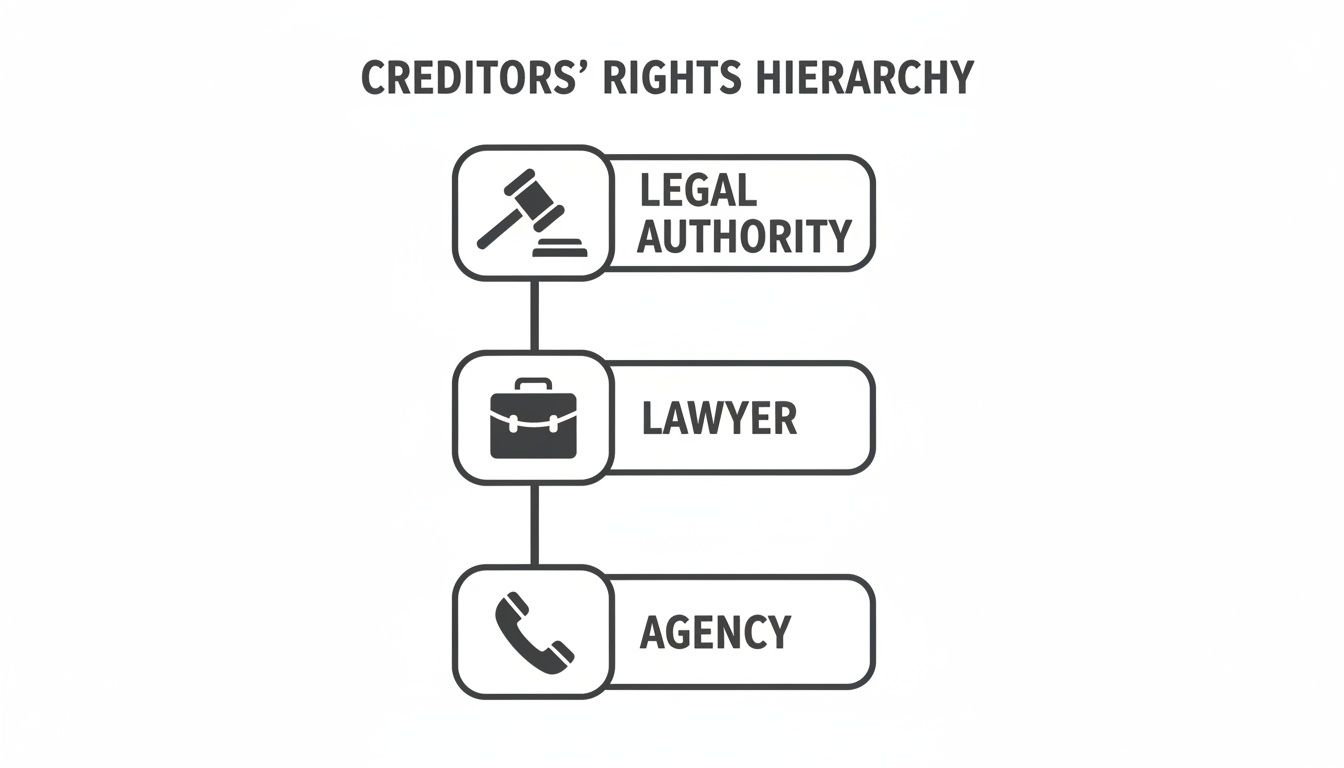
As you can see, a lawyer can take enforceable actions that an agency simply can't.
Post-Judgment Enforcement Remedies
Winning a judgment is a huge victory, but it’s still just a piece of paper until you enforce it. This is where a creditors' rights lawyer really proves their worth by using post-judgment remedies to seize assets and finally get you paid.
- Wage Garnishments: This is a powerful tool that lets you take a piece of the debtor’s paycheck before it even hits their bank account. A court orders their employer to send a percentage of their earnings directly to you until the debt is cleared.
- Bank Levies: With a bank levy, your attorney can legally freeze and seize funds straight from the debtor's bank accounts. It’s a fast and incredibly effective way to recover a lump sum.
- Property Liens: A lien is a legal claim we can place on a debtor's real estate. It doesn't force a sale right away, but it does mean they can't sell or refinance the property without paying you first.
For any creditor, getting a handle on the specifics of enforcement is crucial. We break down the process in our guide on how to enforce a judgment.
Specialized Tools for Secured Creditors
If your business deals in secured loans—where the debtor has put up specific property as collateral—you have an extra set of tools available under the Uniform Commercial Code (UCC). To use these effectively, a lawyer must first master key concepts and terms in contract law.
The most powerful UCC remedy is repossession. If a debtor defaults on a secured loan for a vehicle or piece of equipment, your lawyer can help you legally and peacefully take back that collateral to satisfy the debt.
These tools, from the first demand to the final asset seizure, are the foundation of effective debt recovery. A skilled attorney knows exactly which one to use and when, applying just the right amount of legal pressure to protect your bottom line.
If you want to discuss your business law matter, contact Kons Law at (860) 920-5181.
How Debt Collection Works in Connecticut
Successfully recovering a debt isn't just about knowing general legal principles; it's about mastering the local rules of the game. The debt collection process in Connecticut follows a very specific roadmap, and for any creditor trying to turn an unpaid account into recovered funds, understanding each step is absolutely critical.
This journey is defined by strict deadlines, particular court procedures, and unique enforcement methods that only a skilled creditors rights lawyer can navigate effectively.
It all starts with a thorough case assessment. Before a single legal document is filed, your attorney will dive deep into all the paperwork tied to the debt—contracts, invoices, purchase orders, personal guarantees, and any communication you've had with the debtor. The goal here is to build a rock-solid case file that leaves no doubt the debt is valid and owed.
The Clock is Ticking: Connecticut’s Statutes of Limitations
One of the most unforgiving factors in any Connecticut debt collection case is the statute of limitations. Think of it as a legal deadline that dictates exactly how long you have to file a lawsuit. If you miss this window, your right to sue is gone forever, no matter how strong your case is.
In Connecticut, these time limits are very specific:
- Written Contracts: For debts based on a written agreement, you generally have six years from the date the contract was breached to file a lawsuit.
- Oral Contracts: For debts based on a simple verbal agreement, the window shrinks dramatically—you only have three years.
Because these deadlines are absolute, acting quickly is vital. Delaying legal action can be an incredibly costly mistake, turning a recoverable asset into a complete write-off.

Filing the Lawsuit and Serving the Debtor
Once your attorney confirms you’re within the statute of limitations and have the evidence to back up your claim, the next move is to file a lawsuit in the correct Connecticut Superior Court. This involves drafting a formal complaint that clearly lays out the details of the debt and the legal grounds for your claim.
After the lawsuit is filed, the debtor has to be officially notified. This isn't just a courtesy call; it's a formal process known as "service of process." In Connecticut, this is typically handled by a state judicial marshal. Proper service is a non-negotiable legal step that ensures the debtor knows about the lawsuit and has a chance to respond, which officially gives the court jurisdiction over them.
A judgment is the court's official declaration that a debt is legally owed. But in Connecticut, this order is only the beginning. The real power comes from using state-specific enforcement tools, like property executions and wage garnishments, which are carried out by judicial marshals to convert that judgment into actual payment.
Post-Judgment Enforcement: The Connecticut Way
After securing a judgment, the focus immediately shifts to enforcement. This is where knowing Connecticut's specific procedures is paramount. Your attorney can apply for various court orders to seize the debtor's assets, and these orders are then handed over to a judicial marshal to execute. For a deeper look into the state's specific rules, our guide to navigating debt collection in Connecticut offers detailed insights.
Common enforcement actions include applying for bank executions to levy a debtor's accounts or obtaining a wage garnishment to intercept a portion of their paycheck. For debts related to consumer goods or services, Connecticut law allows for a wage withholding of up to 25% of the debtor's disposable earnings. For business debts, your recovery options can be even broader. This practical, state-specific approach ensures you are using the most effective methods available to recover what you are owed.
If you want to discuss your business law matter, contact Kons Law at (860) 920-5181.
When a Debtor Files for Bankruptcy
For a creditor, a bankruptcy notice can feel like hitting a brick wall. The second that petition is filed, a powerful legal injunction called the automatic stay kicks in, immediately freezing all collection activities. Lawsuits stop. Demand letters cease. Any and all efforts to get your money back are brought to a screeching halt.
It might seem like the end of the road, but for a creditor with the right strategy, it’s just a pivot. This is exactly where an experienced creditors’ rights lawyer proves their worth. Their first job isn't to retreat but to dive headfirst into the complexities of the bankruptcy court to protect you. While the automatic stay is active, your attorney is already working to defend your financial stake within the bankruptcy proceedings. The rules of engagement change drastically in bankruptcy, so it helps to understand the dos and don'ts of bankruptcy from the start.
Filing a Proof of Claim
Your first, non-negotiable step is filing a proof of claim. Think of this as your official ticket to get in line for any distributions from the debtor's estate. It's a formal document filed with the bankruptcy court that lays out exactly how much you're owed.
If you don't file one, the court essentially doesn't know you exist. You could be left with nothing. Your attorney will make sure the proof of claim is perfectly accurate, backed by all the necessary documents like contracts and invoices, and filed well before the court's unforgiving deadline. Miss that date, and your right to collect could be gone for good.
Challenging the Discharge of a Debt
In bankruptcy, not all debts are created equal. While the goal for the debtor is often to have their debts discharged—or legally wiped out—some obligations simply can't be erased. A sharp creditors' rights lawyer will immediately dig into the history of your debt to see if it qualifies as non-dischargeable.
One of the most powerful arguments against discharge is fraud. If the debtor took on the debt by lying or through deceit—say, by faking their financials to get a loan—your lawyer can file an "adversary proceeding." This is basically a lawsuit within the bankruptcy case, asking the judge to rule that your specific debt survives the bankruptcy. Another common tactic is to look for a fraudulent conveyance, where the debtor illegally shifted assets around to hide them from people they owe. You can learn more about what constitutes a fraudulent conveyance in our detailed guide.
In a bankruptcy proceeding, the distinction between a secured and an unsecured creditor is paramount. A secured creditor has a claim tied to a specific asset (collateral), giving them priority and a direct path to recovery. An unsecured creditor has no such claim and must wait in line with others, often recovering only a fraction of what they are owed.
Maximizing Recovery in Chapter 11
In a Chapter 11 reorganization, an attorney's role becomes even more dynamic. They are your voice and your vote. Your lawyer will fight for your interests on creditor committees, scrutinize the proposed reorganization plan, and formally object to any terms that shortchange you. The entire goal is to ensure your claim gets the respect it deserves and to maximize every dollar you get back from the estate.
If you want to discuss your business law matter, contact Kons Law at (860) 920-5181.
Choosing the Right Creditors Rights Lawyer for Your Business
Picking the right legal partner is one of the most important decisions you'll make for your business—it's not just like hiring another vendor. The right creditors rights lawyer can be the difference between recovering a major debt and writing it off completely. It all comes down to carefully looking at their experience, their strategic thinking, and how they communicate.
When your company's finances are on the line, a general practice attorney simply won't cut it. You need a specialist. Look for a firm with a deep, proven history in commercial collections and creditors' rights, and make sure their experience is directly relevant to your industry and the specific types of debts you're dealing with.
Local knowledge is also a huge advantage. An attorney who is in Connecticut’s courtrooms day in and day out understands the local procedures, knows the judges, and has relationships with the judicial marshals. That kind of insider perspective can seriously speed things up and dramatically improve your odds of getting paid.
Evaluating Experience and Track Record
When you're vetting a potential attorney, don't be shy about digging into the specifics. A real track record is about more than just how many years they've been practicing; it's about a history of getting results.
- Ask for Case Examples: Have them walk you through cases similar to yours. What was their strategy? What kind of outcome did they secure for their client?
- Verify Connecticut Court Experience: Make sure they have a long history of actually litigating and enforcing judgments right here in the Connecticut Superior Court system.
- Look for Commercial Focus: Their bread and butter should be business and commercial law, not consumer debt. The rules of the game are completely different, and you need someone who knows them inside and out.
The legal world is getting more complex by the day. Projections for the US litigation scene in 2026 show that creditors' rights lawyers are more critical than ever. They're on the front lines of growing commercial disputes, which go hand-in-hand with top-tier practices like Commercial Litigation and Bankruptcy/Creditor Debtor Rights. Between regulatory changes, new cybersecurity threats, and plaintiffs using AI-powered tools, creditors are facing a whole new set of challenges. This climate demands a specialist who can resolve a contract dispute or collect a debt, whether through smart negotiation or a courtroom battle. If you want to dive deeper into these trends, you can discover more insights about recent litigation predictions.

Understanding the Fee Structures
Of course, legal fees are a major part of the equation. It's vital to find a fee structure that makes sense for your budget and the specifics of your case. There’s no single right answer, so it pays to understand your options.
- Hourly Rate: This is the traditional model where you pay the attorney for each hour they spend on your case. It’s common for complicated, contested lawsuits where it's tough to predict how much time will be needed.
- Flat Fee: You pay a single, upfront fee for a clearly defined service, like sending a demand letter or handling a simple, uncontested case. This gives you total cost certainty.
- Contingency Fee: The lawyer’s fee is a percentage of whatever money they successfully recover for you. If they don’t collect anything, you don’t owe them a fee. This is a fantastic model because it perfectly aligns your lawyer's incentives with your own—they only get paid if you get paid.
Choosing a fee structure is a strategic decision. A contingency arrangement often makes the most sense for straightforward collections, as it minimizes your upfront financial risk while motivating your legal partner to pursue the debt aggressively.
The Importance of Communication
Finally, remember that debt recovery is almost always a race against the clock. You need a legal partner who is responsive and keeps you in the loop. Pay close attention to how they communicate during your first conversation. A good creditors rights lawyer should be easy to reach, explain things clearly, and give you proactive updates. You're not just hiring a lawyer; you're building a partnership, and strong, consistent communication is what holds it all together.
By carefully weighing these factors—experience, fees, and communication—you can find a creditors rights attorney who isn’t just skilled, but who is genuinely committed to helping your business succeed.
If you want to discuss your business law matter, contact Kons Law at (860) 920-5181.
Common Questions We Hear From Creditors
When you're trying to recover money that's rightfully yours, a lot of questions pop up. It's only natural. Getting clear, straightforward answers is the first step toward making a smart business decision and knowing what to expect.
Here are some of the most common questions we get from creditors who are thinking about taking legal action.
How Long Does This Actually Take?
This is usually the first thing everyone wants to know. The honest answer? It depends entirely on how the debtor reacts.
If we file a lawsuit and the debtor simply doesn't respond, we can often get a default judgment in just a few months. That's the best-case scenario, as it lets us move straight to the enforcement phase—the part where we actually start collecting your money.
But if the debtor decides to fight back and hire a lawyer, the timeline stretches out. A contested case means we'll go through discovery, file motions, and maybe even go to trial. That process can easily take a year or more, depending on how backed up the courts are and how complicated the arguments get. Once we review the details of your specific situation, we can give you a much more realistic timeline.
What's the Difference Between a Secured and an Unsecured Creditor?
This is a big one. Knowing which category you fall into is crucial because it dramatically changes your power, especially if the debtor declares bankruptcy. It all comes down to one word: collateral.
A secured creditor has a loan backed by a specific piece of the debtor's property. Think of it as holding the title to their car until the loan is paid off. That car is the collateral. If they default, you have a direct legal right to take that specific asset and sell it to get your money back.
An unsecured creditor, on the other hand, doesn't have a claim on any specific asset. Your claim is based purely on the debtor's promise to pay you back.
- Secured Debt Examples: Mortgages, car loans, and business equipment financing.
- Unsecured Debt Examples: Unpaid invoices for services rendered, most credit card debt, and personal loans made on a handshake.
In a bankruptcy, secured creditors are at the front of the line. They get paid first from the sale of their collateral, which gives them a great chance of being made whole. Unsecured creditors have to wait and often end up with pennies on the dollar—if they get anything at all.
Can I Make the Debtor Pay My Legal Fees?
This is a critical question because it directly impacts whether pursuing the debt makes financial sense. In Connecticut, you can't automatically recover your attorney's fees just because you won. It almost always hinges on the piece of paper you and the debtor signed at the very beginning.
The rule of thumb is that you can only get your legal fees back if your original contract, loan agreement, or promissory note has a specific clause in it. This clause needs to state that if the debtor defaults, they are on the hook for all costs of collection, including reasonable attorney's fees.
Without that specific language, it's nearly impossible to get a judge to order the debtor to cover your legal costs. This is exactly why having an ironclad contract from the start is one of the most important things any business that extends credit can do.
Is It Even Worth Suing Over a Small Amount?
Deciding whether to chase a smaller debt is a pure cost-benefit analysis. It's a business calculation where you have to weigh what you might get back against the time, energy, and money you'll spend getting it.
Here's what you need to think through:
- The Debt Amount: Is it large enough to justify court filing fees, the cost of serving papers, and legal help?
- The Chance of Recovery: Does this person or business actually have any assets or income? Suing a "judgment-proof" debtor who has nothing to their name can be a complete waste of resources.
- The Cost of the Fight: What will the legal fees look like? For some smaller claims, a contingency fee arrangement can be a great option, as it lowers your upfront financial risk.
For truly small debts, Connecticut’s small claims court might be a more cost-effective route than Superior Court. This is where a quick chat with a creditors rights lawyer can save you a lot of headache. We can help you look at the numbers and decide if going after the debt is a sound financial move.
If you want to discuss your business law matter, contact Kons Law at (860) 920-5181.
