
You may be dealing with this right now. Your company is getting ready to launch a product, a new service line, or a new brand name. Someone tells you to “protect the IP,” but that phrase hides several different legal jobs.
For many Connecticut businesses, the first mistake isn't failing to file. It's filing the wrong thing, at the wrong time, with the wrong kind of lawyer. A patent issue, a trademark issue, and a broader business risk issue often show up together, but they are not the same problem.
That's where patent trademark lawyers enter the conversation. The useful question isn't just whether you need a patent lawyer or a trademark lawyer. It's whether your legal strategy fits your business model, budget, growth plans, and tolerance for risk. A startup raising capital, a manufacturer introducing a new process, and a service business rebranding all need different advice.
Patents vs Trademarks Protecting Different Business Assets
A simple comparison helps. If your company builds a new sensor, formula, machine component, or software-driven process, the invention itself may raise patent issues. If your company sells that product under a distinctive name or logo, the brand attached to it raises trademark issues.
A patent protects functional innovation. A trademark protects market identity.
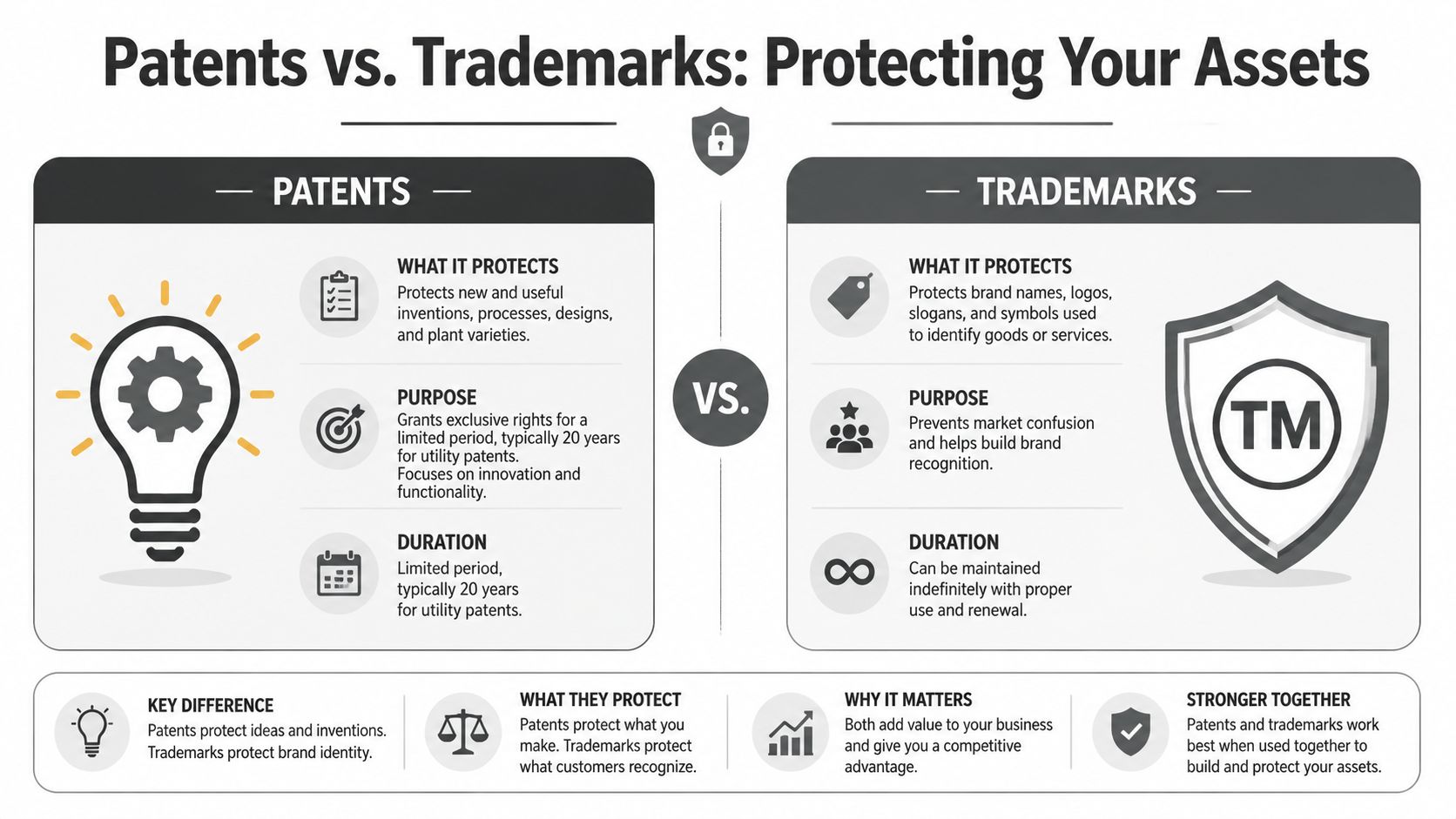
What each one is really doing
Patents are about excluding others from making, using, or selling a qualifying invention for a limited period. In practice, that means patents matter most when your competitive edge comes from how something works, how it is made, or how it is engineered.
Trademarks do something different. They help customers identify your goods or services and reduce confusion in the market. That's why names, logos, slogans, and in some cases trade dress can become business-critical assets even when the underlying product isn't patentable.
Here is the business version of the distinction:
| Asset | Likely issue | Core legal question |
|---|---|---|
| New machine design | Patent | Is it novel and legally protectable as an invention? |
| Product name | Trademark | Is it distinctive and available to use? |
| Manufacturing process | Patent | Does it create protectable technical value? |
| Company logo | Trademark | Will customers associate it with your business? |
Why businesses get this wrong
The confusion usually starts when owners assume “IP lawyer” means every intellectual property lawyer does every IP task with equal skill. That's not how this works in real practice.
A 2023 USPTO report indicated that 28% of pro se trademark applications were rejected due to substantive errors like improper specimen or descriptiveness issues, compared to just 15% for represented filings, and the same source notes that inventors sometimes hire patent-focused lawyers who are not trained in trademark law, leading to avoidable mistakes (USPTO discussion of trademark filing errors).
Practical rule: If the asset is technical, think patent first. If the asset faces customers, think trademark first. If it affects funding, contracts, licensing, or expansion, involve business counsel at the same time.
The strategic difference for Connecticut companies
For a small or midsize business, the primary issue is allocation of legal spend. You don't want to pay for a full patent analysis when the actual value lies in the brand. You also don't want to spend heavily on branding only to learn the product's core innovation was publicly disclosed before patent counsel reviewed it.
A broader business-law perspective helps because IP choices affect contracts, ownership, employee invention assignments, vendor relationships, and financing. For a practical overview of strategies for protecting your brand, it helps to look at brand protection as part of overall commercial risk, not just a filing exercise.
Businesses that want a broader legal checklist should also review this guide on how to protect intellectual property.
The Lifecycle from Search to Enforcement
Most owners think filing is the main event. It isn't. Filing is one stage in a longer process that starts with clearance and ends, if needed, with enforcement.
The legal work changes at each phase. So do the risks.

Step one is clearance, not paperwork
Before filing anything, counsel should ask a simple question. Is this asset available to protect and safe to use?
For patents, that means examining prior art, competitor filings, and public disclosures. For trademarks, that means searching for conflicting marks, not just exact name matches but similar commercial impressions, overlapping goods or services, and market channels.
A weak search creates downstream trouble. You can spend time and money building around a name that can't survive examination or can't be enforced later.
Filing starts the process, not the finish line
Once the search supports moving forward, the filing stage turns business facts into legal claims. Patent applications demand precision because the wording of the claims can shape the value of the right later. Trademark applications also require care because the identification of goods and services, ownership details, and evidence of use can affect the entire application.
That matters in a crowded system. About 80% of U.S. trademark applications filed with attorney assistance achieve registration, and in 2022 the USPTO processed over 900,000 applications, which shows both the value of skilled prosecution and the volume of competing filings (trademark registration and filing volume data).
A filing that looks “good enough” to a business owner often gives an examiner, or an opponent, a clear opening.
Prosecution is where many applications are won or lost
“Prosecution” is the back-and-forth with the USPTO after the application is filed. Examiners raise objections. Lawyers respond. Sometimes the issue is technical scope. Sometimes it is distinctiveness, likelihood of confusion, or the adequacy of the application record.
For business owners, the key point is that prosecution is not clerical. It is advocacy. Counsel has to know when to narrow, when to argue, and when to change course.
If a trademark challenge escalates into a dispute before registration, this overview of a trademark opposition attorney gives a useful sense of what that conflict can involve.
Maintenance and enforcement require actual discipline
Once rights are secured, companies still have work to do:
- Maintain records: Keep assignment documents, chain of title records, and proof of use organized.
- Watch the market: Monitor competitors, marketplaces, websites, and new filings.
- Renew on time: Trademark rights and patent rights each have their own maintenance requirements.
- Act consistently: Selective enforcement can weaken practical protection.
A neglected IP portfolio often fails not because the original filing was impossible, but because the business didn't maintain ownership records, monitor infringement, or respond when warning signs appeared.
Knowing When Your Business Needs an IP Lawyer
Timing matters more than many owners expect. If you wait until after launch, after a cease-and-desist letter, or after investor diligence starts, your options usually narrow.
Some moments justify immediate legal review.
The clearest trigger points
If your team has developed something new and is preparing to show it publicly, speak with patent counsel first. Public disclosure can affect patent strategy. The same is true if key employees or contractors contributed to the invention and ownership paperwork isn't clean.
If you're about to launch a new company name, product line, or consumer-facing brand, get trademark clearance before you print packaging, buy signage, or commit to a domain and ad campaign. Rebranding after a conflict is much more disruptive than screening names early.
Transactions raise a different level of risk
IP counsel becomes particularly important during licensing, acquisitions, investor diligence, and secured lending involving technology assets. The legal issue isn't just whether the asset exists. It's whether the rights are enforceable, properly owned, and commercially usable.
In M&A due diligence, engaging a firm with registered patent attorneys for freedom-to-operate opinions can identify 15-20% more blocking patents than general reviews, helping reduce the risk of infringement problems after closing (freedom-to-operate and due diligence guidance).
The right time to call is usually before the business commitment becomes expensive to reverse.
A business lawyer can spot the issue early
Not every company needs a pure IP boutique for every step. Often, a business lawyer is the first person who sees that a branding decision, a vendor contract, an employment agreement, or an asset sale has hidden IP consequences.
That's especially true for Connecticut companies trying to match legal spend to commercial reality. If you need a broader view of how legal counsel fits into operations, contracts, and risk management, this explanation of what a business lawyer does is a useful starting point.
How to Evaluate and Select the Right Counsel in Connecticut
Hiring the right lawyer isn't about finding someone who says they “handle IP.” It's about finding someone whose training, process, and judgment match the asset you need to protect.
For patents, credentials matter in a very specific way. For trademarks, practical brand clearance and enforcement experience matter just as much.

What to verify before you hire anyone
For patent work, confirm that the lawyer is registered to practice before the USPTO and has a technical background relevant to your industry. A software company should care whether counsel understands software and systems. A manufacturing business should care whether counsel can read technical drawings and process descriptions without translation.
For trademark work, ask about clearance searches, office action responses, opposition work, coexistence agreements, and enforcement strategy. A lawyer who only files simple applications may not be the right fit if your brand competes in a crowded market.
Quality also matters at the drafting level. Top-tier patent firms are distinguished by quality scores based on low error rates in patent claims, and in 2025 Harrity & Harrity led firms with over 500 issued patents, underscoring how precision affects examination and later challenges (patent quality rankings and claim drafting data).
Questions worth asking in the consultation
Use the first meeting to test how the lawyer thinks, not just what they charge.
- Ask about fit: Have you worked with businesses of my size and in my sector?
- Ask about workflow: Who will draft the application, who will review it, and who will communicate with me?
- Ask about scope: What is included in the initial search, and what is not?
- Ask about risk: What are the main reasons this application could be refused or challenged?
- Ask about business impact: How does this filing affect contracts, investors, licensing, or a future sale of the company?
- Ask about tools: Do you use systems such as PatSnap, WIPO databases, or structured trademark search platforms to support your analysis?
Don't ignore communication style
A technically strong lawyer who can't explain trade-offs clearly can still be a poor fit for an SMB. You need someone who can tell you when a narrower filing is smarter than a broad one, when to defer a patent filing because ownership isn't settled, or when a trademark is too weak to justify a fight.
Technology also changes how firms work. If you're comparing law-firm workflows and legal tech adoption, this article on comparing artificial intelligence for law firms offers a practical look at how firms evaluate support tools. The point isn't hype. It's whether the lawyer uses systems that improve consistency without replacing judgment.
For companies that need recurring legal coordination instead of one-off filings, fractional general counsel services can also be worth evaluating.
Understanding Legal Fees and Budgeting for IP Protection
Most business owners don't object to paying for legal work. They object to uncertainty. IP matters become frustrating when the company doesn't know what the first phase covers, what might trigger added fees, and which steps are optional versus essential.
That's why budgeting should start with the fee structure, not the invoice.

The common billing models
A flat fee often works for a defined task, such as an initial trademark application or a basic clearance review. It gives predictability, but only if the engagement letter clearly states what happens if the USPTO issues substantive refusals or if a third party opposes the application.
An hourly model is more common when the amount of work is hard to predict. Patent prosecution, office action responses, licensing negotiations, and disputes often fit here because the cost depends on what the examiner or the opposing party does next.
A retainer or ongoing counsel arrangement can make sense when IP decisions arise regularly inside broader business operations. That approach often works for companies managing contracts, branding decisions, employment issues, and product launches at the same time.
Cost pressure is real for Connecticut businesses
Many smaller companies are priced out of traditional IP strategies, especially when they sit above income thresholds for assistance programs but still can't justify specialty-firm rates for every issue.
A 2025 CT Business Bureau survey found that 60% of local small businesses cite IP costs over $10,000 as a significant barrier, and available pro bono options often don't solve the problem for mid-sized firms (USPTO legal assistance resources and Connecticut cost barrier discussion).
Budget for IP the way you budget for insurance, financing, or key vendor contracts. It protects enterprise value, not just paperwork.
How to budget without wasting money
A practical budget usually includes three layers:
- Initial assessment costs for search, ownership review, and filing strategy.
- Expected prosecution costs for examiner responses or application revisions.
- Contingency funds for disputes, oppositions, enforcement letters, or cleanup work.
Business owners already understand this logic in other areas. Public communications provide a useful comparison. Companies often compare scope and deliverables before buying outside writing support, much like they would when reviewing AP style press release writing costs. The same discipline helps with legal budgeting. Ask what the quoted fee includes, what assumptions sit underneath it, and what events will increase the bill.
FAQs for Connecticut Businesses and Financial Professionals
Can a general business lawyer file my trademark application
Sometimes, yes. The more important question is whether that lawyer regularly handles trademark clearance, filing strategy, identification of goods and services, and post-filing issues. A straightforward filing may not require a narrow boutique. A contested matter, weak mark, or multi-state rollout often does.
For many businesses, the best approach is coordinated counsel. A business lawyer can frame the commercial risk, ownership structure, and contract issues, then involve trademark-focused counsel when the brand risk justifies it.
What is the difference between a patent agent and a patent lawyer
A patent agent can practice before the USPTO on patent matters if properly qualified and registered. A patent lawyer is also an attorney, which means that person can usually advise on a wider range of legal issues surrounding the patent work, such as contracts, ownership disputes, licensing terms, and litigation strategy.
If your issue is narrowly technical, a patent agent may be useful. If the problem touches financing, employment, licensing, acquisition risk, or threatened litigation, legal counsel with broader business training is often the safer choice.
Do I need a lawyer physically based in Connecticut to file with the USPTO
No. Patent and trademark filings before the USPTO are federal matters. You do not need a Connecticut-based lawyer solely because the application is federal.
That said, local business context still matters. A Connecticut company may need help with entity formation, founder agreements, contractor ownership clauses, secured transactions, deal documents, or state-court disputes tied to the IP asset. That part of the work often benefits from counsel who understands the company's operating environment.
What if I already chose a business name and started using it
Don't assume prior use means clear rights. It may help, but it doesn't eliminate search, registration, or enforcement issues. Before investing further in packaging, signage, ad spend, or expansion, get a proper review of conflict risk and filing options.
When should investors and lenders care about IP counsel
As soon as the value of the deal depends on proprietary technology, brand strength, exclusivity, or freedom to operate. If repayment, enterprise value, or exit strategy depends on those assets, weak ownership records or avoidable infringement risk can change the economics of the transaction.
What does a practical IP strategy look like for an SMB
It usually starts with prioritization. Protect the asset that drives value now. Clean up ownership. Avoid preventable conflicts. Match legal spend to actual business goals. Don't buy a large-company IP program if your company needs a focused, staged approach.
The businesses that handle this well usually treat patents, trademarks, contracts, and corporate planning as connected decisions, not separate silos.
If you want to discuss your business law matter, contact Kons Law at (860) 920-5181.
