A leave issue usually lands on your desk at the worst possible time. A reliable employee says they need time off. Operations are tight. Someone else is already covering two roles. The immediate instinct is practical: Who will do the work?
In Connecticut, the legal question comes just as fast. If your business has even a small local workforce, the answer often isn't based on what you remember about federal FMLA. Connecticut's rules are broader, faster to trigger, and more likely to apply to newer or part-time workers than many employers expect.
That creates a real compliance problem for small and mid-sized businesses. Owners and HR managers often assume leave laws mainly affect larger employers with formal HR departments. For Connecticut employers, that assumption can lead to the wrong denial, the wrong notice, or the wrong explanation to an employee who may be entitled to job protection, wage replacement, or both.
An Employee Needs Leave What Every CT Employer Must Know
A common scenario looks like this. A growing Connecticut company with a lean staff gets a request from an employee who needs time off to care for a grandparent. The owner knows federal FMLA exists, but the business isn't large, and the employee hasn't been around that long. The first reaction is often that the law probably doesn't apply.
That reaction can be costly.
Connecticut employers now deal with a leave framework that reaches much further than many people realize. The hard part isn't just knowing the law exists. It's spotting when a routine staffing conversation has become a legally protected leave request.
An employee doesn't need to say "I am requesting CT FMLA." They may tell a supervisor they need time off for surgery, bonding with a new child, or to care for a family member. If the company misses the signal, the problem starts early and usually gets worse.
Practical rule: Treat the first leave-related conversation as a compliance event, not just a scheduling problem.
That matters even more because Connecticut's definition of family is broader than what many managers expect. A request involving a sibling or grandparent may feel outside the usual FMLA script to someone trained only on federal rules. It may still require immediate attention under Connecticut law.
For employers trying to build better manager judgment, resources discussing understanding the impact of employee rights on work can be useful because they frame leave issues as workplace-management issues, not just legal checkboxes.
When businesses get CT FMLA eligibility wrong, the damage isn't limited to one absence. It can affect morale, documentation, payroll coordination, and later termination decisions. The better approach is simple: identify covered employers early, verify employee eligibility carefully, and separate job-protection questions from paid-benefit questions before anyone gives the employee an answer.
Understanding CT FMLA Employer Coverage
A small Connecticut employer can get into trouble fast here. The owner assumes leave law is a big-company issue, a supervisor treats the request as a simple scheduling problem, and the business gives an answer before anyone checks which law applies.
For Connecticut employers, employer coverage is usually the easy part. Since January 1, 2022, CT FMLA has applied broadly to private-sector employers with at least one employee in Connecticut, according to the Connecticut Department of Labor's overview of CT FMLA. Federal FMLA still follows a much narrower coverage rule tied to larger employers.
That difference matters operationally. A business may be covered by CT FMLA even when it is nowhere close to federal FMLA coverage. HR managers who use only the federal headcount test often miss that first step, and that mistake affects notices, documentation, and leave decisions from day one.
Who should assume coverage
Most Connecticut private employers should begin with a simple working assumption: CT FMLA likely applies unless you have confirmed a specific exemption.
That includes businesses that often overlook leave compliance:
- Startups and very small companies: Low headcount does not keep you outside CT FMLA.
- Family-run businesses: Informal decision-making creates risk when no one owns the leave process.
- Growing employers: Old handbooks and forms often still track federal FMLA only.
- Multi-state employers: A company may have limited Connecticut operations and still trigger CT FMLA obligations for its Connecticut workforce.
Some employers are excluded, including certain public and federally connected entities. The point for most private businesses is practical, not academic. Do not spend the first conversation assuming you are too small. Verify that assumption before responding.
What employers need to do with that rule
Covered status does not answer every leave question, but it tells you to start the analysis instead of dismissing the request.
Use this order:
- Confirm whether the employer is covered under CT FMLA
- Check whether the employee meets CT FMLA eligibility rules
- Assess whether the reason for leave may qualify
- Separate job protection from wage replacement, because CT FMLA and CT Paid Leave are related but not identical
- Address scheduling and staffing after the legal framework is clear
That fourth step is where many employers slip. CT FMLA deals with leave rights and job protection. CT Paid Leave concerns income replacement through a separate program. If managers blend those programs together, employees get bad information and the company creates a record it may have to defend later.
If your policies still assume leave law starts at a much higher headcount, review your broader small business compliance checklist for Connecticut employers and update leave procedures, forms, and manager training at the same time.
The real trade-off for small employers
Small teams absorb absences harder than larger ones. That is real. Coverage still applies.
The best response is a simple process that a supervisor can follow under pressure. Identify one person to handle leave questions, require managers to escalate medical or family-care requests early, and use written forms that distinguish CT FMLA, federal FMLA, and CT Paid Leave. Businesses that rely on instinct usually make avoidable mistakes. Businesses that use a short, repeatable intake process are in a much better position.
Decoding CT FMLA Employee Eligibility Criteria
A supervisor gets a call from a new employee who needs time off for a parent’s serious health condition. The supervisor assumes the employee is too new to qualify and says no. In Connecticut, that answer can be wrong, and it can create a problem fast.
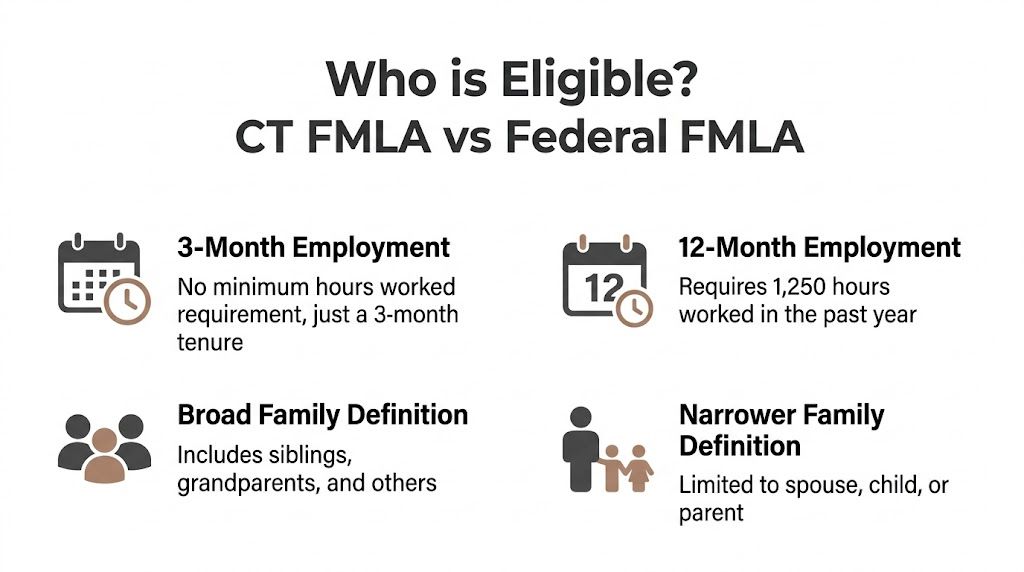
Employee eligibility under CT FMLA is broader than many managers expect. Connecticut uses a short tenure standard and does not use the federal hours-worked test. Federal FMLA still uses the better-known 12-month and 1,250-hour framework discussed in FMLA Rules and Regulations. For day-to-day administration, that difference matters because a part-time employee or recent hire may qualify for state job-protected leave long before a manager expects it.
The practical mistake I see most often is simple. Employers use federal instincts to screen a Connecticut leave request. That shortcut misses eligible employees and usually starts with labels that are not legally useful, such as "part-time," "temporary," or "too new."
Start with records, not assumptions.
Review the employee's hire date, payroll history, and whether the person remained employed through the relevant period. If eligibility is close, verify dates before giving an answer. A quick verbal denial by a supervisor is harder to fix than a short pause for HR review.
That approach matters for employees whose schedules do not fit a standard full-time pattern. Reduced hours do not automatically defeat CT FMLA eligibility. Seasonal work patterns can also raise avoidable confusion if managers focus on weekly hours instead of actual employment status and dates.
Family relationships are another common trouble spot. Connecticut recognizes a wider group of family members than federal FMLA, and that changes how HR should evaluate a request. State guidance explains that covered relationships can include siblings, grandparents, grandchildren, in-laws, and individuals whose close association with the employee is equivalent to a family relationship. The Connecticut Department of Labor addresses these rules in its state FMLA materials, and employers that need broader updates on Connecticut business law compliance topics should review their leave policies as part of that larger process.
The affinity-based relationship category deserves extra care. Managers should not decide on the spot that a relationship sounds too informal. The better practice is to route the request to one trained decision-maker, ask for the facts needed to evaluate the relationship, and document the basis for the eligibility decision.
A workable intake check looks like this:
| Question | Why it matters |
|---|---|
| How long has the employee been employed? | Connecticut uses a more employee-friendly tenure standard than federal FMLA |
| What do payroll and HR records show? | Eligibility decisions should be based on records, not manager recollection |
| What is the reason for leave? | Eligibility alone does not make every absence protected |
| Who is the family member involved? | Connecticut recognizes more family relationships than federal law |
| Has HR issued the right notices and certification forms? | Process errors create risk even when the leave request is legitimate |
The operational takeaway is straightforward. Train supervisors to identify a possible leave request, then send it to HR or the person handling leave administration. The faster your team separates assumptions from the actual CT FMLA eligibility test, the fewer preventable mistakes you will have to clean up later.
CT FMLA vs Federal FMLA vs CT Paid Leave A Clear Comparison
A common Connecticut HR problem starts like this. An employee says she needs surgery and time away from work. Payroll asks whether the company has to pay her. The supervisor asks whether her job is protected. HR asks whether the state program handles the claim. Those are three different questions, and mixing them together is how employers make preventable mistakes.
Use this framework instead. CT FMLA and federal FMLA deal with job-protected leave. CT Paid Leave deals with wage replacement benefits through a state-run program. In some cases, all three matter at the same time.
For employers that want a general federal refresher, FMLA Rules and Regulations can be a useful high-level reference. In Connecticut, the harder part is building a process that separates job protection from pay and then applies the right law to each request.
Comparison of CT Leave Laws
| Feature | CT FMLA | Federal FMLA | CT Paid Leave (CTPL) |
|---|---|---|---|
| Purpose | Unpaid, job-protected leave under Connecticut law | Unpaid, job-protected leave under federal law | Partial wage replacement benefit program |
| Employer coverage | Broad Connecticut employer coverage, as discussed earlier | Usually applies to larger employers that meet the federal coverage test | Administered by the CT Paid Leave Authority |
| Employee eligibility | More employee-friendly than federal FMLA, as noted earlier in this guide | Requires the federal tenure and hours test | Based on earnings and covered Connecticut work, subject to the state program rules |
| Family relationships | Broader Connecticut definition of covered family members | Narrower federal definition | Tied to qualifying reasons under the paid program |
| Duration | Up to 12 weeks in a 12-month period for many qualifying reasons, with certain Connecticut-specific extensions | Up to 12 weeks for typical qualifying reasons | Benefits may be available during a qualifying leave period, subject to program rules |
| Administration | Employer handles notices, designation, tracking, and reinstatement duties | Employer handles notices, designation, tracking, and reinstatement duties | State authority reviews and pays benefit claims |
The biggest point of confusion
CT Paid Leave is separate from CT FMLA.
That distinction matters in day-to-day administration. The state may decide whether the worker receives income benefits. The employer still has to decide whether the absence is protected, what notices must go out, whether medical certification is needed, how the time is tracked, and whether reinstatement rights apply.
The Connecticut Paid Leave Authority explains the program structure, eligibility rules, and benefit administration on its official benefits and eligibility pages. Employers should use the official state source for those questions because benefit approval does not answer every employer-side leave issue.
How these laws work together in practice
Sometimes only one system applies. Sometimes two apply. Sometimes all three apply at once.
A small Connecticut employer may have duties under CT FMLA even when federal FMLA does not apply. An employee may receive CT Paid Leave benefits while the employer separately manages job protection under CT FMLA. A larger employer may have to apply both state and federal FMLA at the same time and run the leave concurrently instead of treating each law as a separate bank of time.
That is where process discipline matters. Use one leave file, one decision-maker or leave team, and one set of dates. If payroll treats the absence as disability, the manager treats it as attendance, and HR later treats it as protected leave, the company has created its own problem.
A good internal review of how the company follows workplace rules and leave procedures often shows that leave mistakes start with inconsistent handling, not with a hard legal question.
The safest approach is to answer three questions separately: Is the absence job-protected, is the employee eligible for wage replacement, and what employer documentation is required next?
The practical takeaway
Connecticut employers do better when they stop using "FMLA" as shorthand for every leave issue. Treat CT FMLA, federal FMLA, and CT Paid Leave as connected but distinct systems. Once your team separates pay from job protection and assigns each decision to the right process, leave administration becomes far easier to manage.
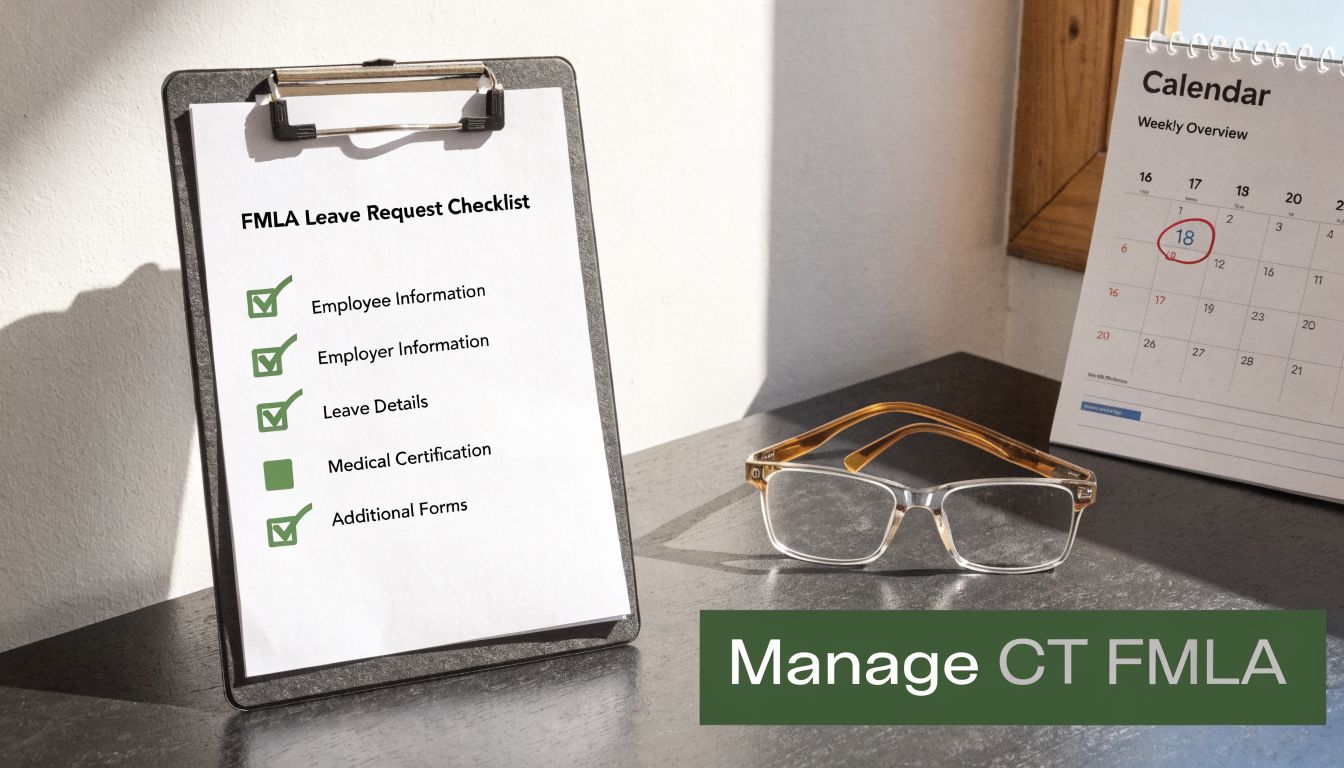
A Practical Guide to Managing CT FMLA Leave
A compliant response starts before anyone uses legal terminology. Most leave mistakes happen at intake, not at the end.
An employee may say they need time off for treatment, recovery, bonding, or to care for a relative. A supervisor may hear that as a staffing issue. HR should hear it as a signal to start the leave review process.
Step one recognizes the request early
Train managers to escalate any statement that suggests a potentially qualifying absence. They don't need to decide whether the request is valid. They only need to recognize that it may trigger legal obligations.
Red-flag examples include:
- Medical references: Surgery, hospitalization, treatment, recovery, chronic condition
- Family care references: A relative needs care, transportation, or support during treatment
- New child references: Birth, adoption, placement, bonding
- Military-related references: Deployment or family military issues
The wrong move is asking the manager to sort protected leave from ordinary attendance issues on the spot.
Step two sends the right notices quickly
Once the employer has enough information to understand that leave may be covered, the company should send the required eligibility and rights notices promptly. The planning assumption many HR teams use is a five business day internal deadline because delay creates confusion and weakens the employer's position.
Create a standard notice packet. Keep it current. Use the same packet every time, with room for individualized facts.
Your notice workflow should tell the employee:
- Whether the employer is treating the request as potentially protected leave
- What documentation is required
- What deadlines apply
- Whether paid time off substitution or coordination issues may arise
- What happens during the return-to-work process
A leave process is strongest when the employee hears the same message from HR, payroll, and the direct supervisor.
Step three requests certification carefully
If the leave reason permits medical certification, ask for it in writing and use consistent forms. Avoid improvised email requests that leave out deadlines or fail to explain what information is needed.
Practical rules help here:
- Keep the request narrow: Ask only for information needed to evaluate the leave.
- Use one channel: Have HR or a designated administrator handle follow-up questions.
- Document every contact: Save requests, reminders, and employee responses in the leave file.
If certification comes back incomplete or unclear, don't jump straight to denial. Give the employee a fair opportunity to cure the issue through the proper process.
Step four makes a designation decision
After the employer has the necessary information, it should issue a designation decision and begin tracking the leave accordingly. This step often gets skipped in smaller businesses, especially where everyone informally "knows" the employee is out on medical leave.
That informality causes trouble later. Without a designation record, employers struggle to prove what leave was counted, what rights were explained, and whether the time was treated consistently.
A clean designation practice should include:
- The start date used for tracking
- Whether the leave is continuous or intermittent
- Any certification-based limits
- Whether the leave also intersects with company PTO policies
Step five tracks leave in real time
Good tracking systems are boring on purpose. A spreadsheet, HRIS entry, or leave-management platform can all work if someone owns the file and updates it consistently.
What usually fails:
- A manager keeps notes in email
- Payroll codes the absence one way
- HR tracks it another way
- No one reconciles intermittent time
That setup almost guarantees mistakes. The company should use one official record.
Step six plans for return and restoration
Before the employee returns, confirm any fitness-for-duty or reinstatement steps allowed by your process and by applicable law. Then coordinate with the supervisor in advance.
A bad return-to-work process often sounds like this: "We're glad you're back, but your role changed while you were out." Sometimes changes are lawful. Sometimes they are the beginning of a retaliation claim. The answer depends on facts, documentation, and timing, so this stage deserves real review.
The employers that handle leave well do three things consistently:
- They centralize decisions
- They document each step
- They train supervisors not to freelance
That approach doesn't eliminate disruption. It does reduce legal risk and keeps ordinary staffing stress from turning into a leave dispute.
Common CT FMLA Compliance Pitfalls to Avoid
Most CT FMLA problems don't start with bad intentions. They start with assumptions.
A supervisor assumes a new employee can't qualify. An owner assumes a grandparent isn't covered. Payroll assumes state paid benefits mean the employer no longer has responsibilities. Each assumption feels practical in the moment. Each can put the business in a bad position.
Pitfall one using federal standards to deny state leave
This is the classic mistake. The employer remembers the federal framework and applies it automatically. That often leads to a denial based on the wrong tenure or family-relationship analysis.
Connecticut's broader family-member definition includes siblings, grandparents, grandchildren, in-laws, and certain affinity relationships, which can increase both the volume and variety of leave requests, according to the Connecticut Department of Labor guidance on CTFMLA.
If your managers are still making fast judgments based on federal concepts alone, they need retraining.
Pitfall two confusing job protection with wage replacement
Some employers tell workers to "apply through the state" and stop there. That is incomplete advice. The paid-benefit claim and the employer's leave-administration duties are related, but they are not the same thing.
The employee may need instructions on both fronts:
- how to pursue paid benefits through the state-administered system, and
- how the employer will handle notice, certification, designation, and return-to-work issues.
When those messages get mixed together, employees receive inconsistent information and HR loses control of the process.
Pitfall three treating notices as optional paperwork
A lot of small businesses know what they intended to do but can't prove what they communicated. In leave disputes, that gap matters.
Late or missing notices don't just create administrative sloppiness. They can limit the employer's ability to enforce its own process.
Use standard forms. Use one file. Keep the dates.
Pitfall four retaliation after the employee returns
The easiest retaliation cases to spot are obvious. A demotion, reduced schedule, changed duties, or disciplinary write-up issued right after protected leave will attract scrutiny.
More subtle examples are common too:
- The employee loses a valued account after returning
- A manager starts criticizing attendance that was protected
- Promotion discussions vanish
- The employee is labeled "unreliable" because they used leave
Employers already reviewing broader workforce-classification and supervision issues may find it useful to consider how leave mistakes can overlap with other contractor and employment law risks.
Pitfall five failing to protect medical confidentiality
Medical details should stay with the people who need them to administer leave. They shouldn't become team gossip or a supervisor's explanation for missed deadlines.
The practical rule is simple. Supervisors may need work restrictions and scheduling information. They usually do not need detailed diagnoses.
What works is role-based access to information. What doesn't work is forwarding certification paperwork around the company because "everyone needs to know what's going on."
Frequently Asked Questions on CT FMLA Eligibility
Can an employee take CT FMLA intermittently
Often, yes, if the qualifying reason supports intermittent or reduced-schedule leave and the documentation supports that need. The key for employers is not to treat intermittent leave casually. It should be designated, tracked, and communicated with the same care as block leave.
For intermittent leave, use one tracking method and one owner of the record. Intermittent cases become messy when supervisors approve time informally and HR hears about it later.
How should employers calculate the leave year
Employers need a clear written method and must apply it consistently. Different employers use different lawful frameworks, but inconsistency is what creates exposure. If your handbook is vague, update it before the next leave request arrives.
A practical mistake is changing the calculation method depending on who is asking for leave. That approach looks arbitrary and is hard to defend.
What if medical certification is incomplete or unclear
Don't deny immediately unless your process and the facts support that result after the employee has had a fair opportunity to address the problem. Ask for clarification through the proper channel and document the request.
A rushed denial often creates a second dispute on top of the original leave issue. A short, documented cure process is usually the better move.
Are part-time employees treated differently for ct fmla eligibility
Not in the way many managers assume. Part-time status by itself doesn't answer the eligibility question. Employers should focus on the applicable Connecticut criteria, not on whether the employee works a traditional full-time schedule.
That is one of the biggest practical differences between Connecticut leave administration and older assumptions drawn from federal-only training.
What should a supervisor say when an employee first raises the issue
The safest answer is simple and neutral: acknowledge the request, avoid promises or denials, and route the matter to the person who handles leave administration. Supervisors should not speculate about eligibility, paid benefits, or whether the reason is "covered."
What records should the employer keep
Keep the request, notices, certification materials, designation decision, leave-tracking records, and return-to-work communications in a dedicated file. Separate medical information from ordinary personnel records where appropriate.
Consistent records protect the business twice. They help you make better decisions in real time, and they help you defend those decisions later.
Conclusion Securing Your Businesss Compliance
Connecticut leave law catches employers off guard because it reaches businesses that don't think of themselves as large enough for formal leave administration. But CT FMLA eligibility isn't a niche issue. For many employers in this state, it is a live compliance obligation from the moment the business begins hiring in Connecticut.
The operational pressure is real. A leave request can disrupt staffing, deadlines, and customer service. Still, the wrong response usually costs more than the disruption itself. Denying leave too quickly, using federal-only assumptions, or confusing CT FMLA with the paid-leave system creates avoidable legal risk.
The employers that handle this well aren't necessarily the biggest. They are the most disciplined. They train supervisors to recognize leave triggers. They centralize decision-making. They document notices, certifications, and designation decisions. They keep job protection separate from wage replacement in their analysis.
If your current process depends on memory, manager discretion, or outdated templates, it needs attention. A short policy review now is usually far cheaper than dealing with a leave dispute after the fact.
If you want to discuss your business law matter, contact Kons Law at (860) 920-5181.
If you need practical guidance on leave compliance, workforce policies, or another business law issue, contact Kons Law.
