
You’ve won your lawsuit. The court has issued a judgment in your favor. But there's a problem: the debtor or their assets are in Connecticut, and your judgment is from another state. On its own, that out-of-state judgment is just a piece of paper here. It has no legal teeth.
This is where the Uniform Enforcement of Judgments Act (UEFJA) comes in. Think of it as the legal mechanism that gives your court victory power across state lines, saving you from the enormous expense and delay of starting a brand-new lawsuit.
Giving Your Judgment Power Across State Lines
Winning in court is only the first step; actually collecting the money is the real goal. Before the UEFJA became law, a creditor who won a case in New York against a debtor in Connecticut was in for a long, frustrating fight.
The old process required filing an entirely new lawsuit in Connecticut just to have the New York judgment recognized. This meant more legal fees, more court dates, and more wasted time—giving the debtor plenty of opportunity to move assets or simply disappear. For creditors, trying to collect across state lines was a procedural nightmare.
How the UEFJA Modernized Collections
The Uniform Enforcement of Judgments Act streamlined this entire system. It created a standard, efficient procedure for "domesticating" a foreign judgment. In legal terms, "foreign" just means any judgment from outside of Connecticut, whether it's from Massachusetts, Florida, or California.
The core principle of the UEFJA is simple but powerful: A valid judgment from one state should be given the same respect and enforcement power in another state. This upholds the "Full Faith and Credit" clause of the U.S. Constitution.
The UEFJA gives a judgment creditor—the person or company owed the money—a clear path to make their out-of-state victory enforceable here in Connecticut. As a business owner or creditor, this process is a game-changer.
- Faster Enforcement: The registration process takes a fraction of the time it would take to file a new lawsuit.
- Lower Costs: You avoid the high costs of re-litigating the entire case from scratch.
- Greater Efficiency: A complex legal battle is turned into a straightforward administrative filing.
In short, the UEFJA stops debtors from using state borders as a shield to avoid paying what they owe. If your business deals with customers or partners in different states, understanding how to use this Act is the first step in turning that court order into actual cash. If you want to discuss your business law matter, contact Kons Law at (860) 920-5181.
Enforcing an Out-of-State Judgment in Connecticut
Winning a judgment in another state is a huge step, but that court order doesn't automatically have power here in Connecticut. To start collecting, you first need to "domesticate" it, which is the legal process of converting your out-of-state (or "foreign") judgment into a local one. Thankfully, the Uniform Enforcement of Judgments Act (UEFJA) gives creditors a clear and efficient path to do just that.
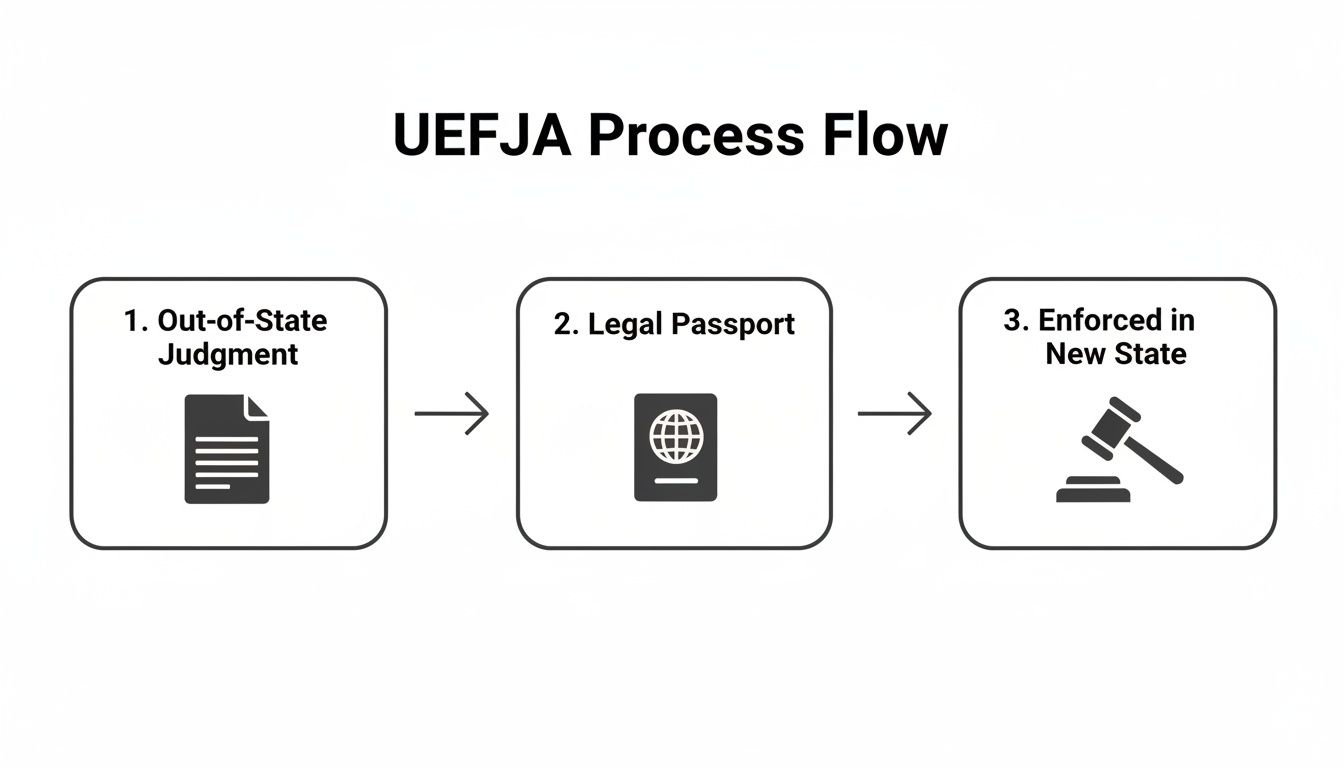
The whole process kicks off when you get an authenticated copy of the original judgment from the court that issued it. This isn't a simple photocopy from the office printer; it's a certified document that carries the court's official seal, proving its authenticity. Think of it as your judgment's legal passport—it’s what the Connecticut courts need to see before they’ll recognize it.
With that authenticated copy in hand, your next move is to file it with the clerk of the Connecticut Superior Court. This is the formal act of registering your judgment and putting it on the map within our state's legal system.
The Domestication Process in Detail
Filing the judgment is more than just a simple drop-off. You also have to submit a specific form called a "Notice of Filing of Foreign Judgment." This document officially tells the court and the debtor that you plan to enforce your judgment in Connecticut.
Along with the notice, you’ll need to include an affidavit containing some crucial details:
- The name and last known address for both you (the judgment creditor) and the judgment debtor.
- A sworn statement confirming the foreign judgment is valid, enforceable, and hasn't already been paid.
Getting these details right is absolutely critical. Even a small error, like a typo in an address or a missing piece of information, can get your filing rejected and send you back to square one. It’s a process that demands careful attention.
Before the UEFJA, creditors had to file a brand new lawsuit just to get an out-of-state judgment recognized. This old common law method was slow, expensive, and a major headache. The UEFJA changed everything by creating a simple registration process.
The table below breaks down just how much better the modern UEFJA process is compared to the old way of doing things.
UEFJA Process vs Common Law Action
| Aspect | UEFJA Process (In Adopting States) | Common Law Action (Old Method) |
|---|---|---|
| Initial Step | File an authenticated copy of the judgment. | File an entirely new lawsuit. |
| Timeframe | Fast. Enforcement can begin in about 30 days. | Slow. Can take many months or even years. |
| Cost | Low. Involves simple filing fees. | High. Requires full litigation costs, including service of process and potentially a trial. |
| Complexity | Simple. A straightforward administrative filing. | Complex. Involves pleadings, discovery, and court appearances. |
| Debtor Defenses | Limited to procedural issues (e.g., jurisdiction, fraud in obtaining the judgment). | The debtor could attempt to raise a wider range of defenses, complicating the case. |
As you can see, the UEFJA provides a far more direct and cost-effective route for creditors. It eliminates the need for redundant litigation and gets you to the enforcement stage much faster.
This flowchart gives you a great visual of how the UEFJA acts as a "legal passport," making your judgment enforceable across state lines.
Notifying the Debtor and What Comes Next
Once your paperwork is filed correctly, the court clerk takes over and mails a notice of the filing to the judgment debtor using the address you provided. This is a vital step that satisfies legal due process, officially informing the debtor that their out-of-state judgment is now active in Connecticut.
The debtor then has a limited window of time, usually 30 days, to object to the filing. It’s important to understand they can't re-litigate the original case. Their challenges are restricted to very specific procedural grounds, like arguing the original court didn’t have jurisdiction over them.
Proposed back in 1962, the UEFJA has become the standard for a reason. It's now in place in 48 states, the District of Columbia, and the US Virgin Islands, allowing a foreign judgment to be treated with the same force as a local one. For Connecticut businesses, this means enforcement success rates can top 85% when the rules are followed perfectly, shrinking recovery timelines from months down to just weeks.
After the waiting period expires without a successful challenge from the debtor, your judgment is officially domesticated. It now carries the full weight of Connecticut law, and you can begin pursuing all available collection remedies. You can learn more about those options in our guide on how to enforce a judgment.
If you need to discuss a business law matter or the enforcement of a judgment, contact Kons Law at (860) 920-5181.
Turning Your Connecticut Judgment Into Cash
You've successfully domesticated your out-of-state judgment. Congratulations. On paper, it now carries the same weight as any order issued by a Connecticut court. But let's be honest—you're not in this for the paperwork. The real work starts now: turning that judgment into actual money in your account.

Think of the Uniform Enforcement of Judgments Act as the key that unlocks a whole new toolbox. You're no longer a creditor from another state with a judgment that feels distant and unenforceable. You now have the full authority to pursue the debtor's assets right here in Connecticut, just as if you'd won the lawsuit locally.
Unlocking Connecticut's Collection Remedies
With your newly registered judgment, it's time to get strategic. The goal is to identify where the debtor's assets are and then use the right legal mechanism to seize them. This isn't a haphazard process; it requires precision and a clear plan.
Here are the most powerful collection tools now at your disposal:
- Bank Account Garnishments: This is often the fastest and most direct route to recovery. We can get a court order that freezes the debtor's business or personal bank accounts, allowing us to seize the funds directly. Imagine the debtor is a contractor who owes you money. A bank garnishment on their operating account brings their business to a halt, forcing them to finally settle the debt.
- Property Liens: If the debtor owns real estate in Connecticut—a commercial building, an office, or even a vacant lot—you can place a judgment lien on it. This lien is a public claim against the property. It effectively stops the debtor from selling or refinancing until your judgment is paid. Your debt is now secured by a tangible, valuable asset.
- Wage Attachments: When the debtor is an individual with a job, a wage attachment (or garnishment) is a powerful tool. The court can order their employer to withhold a portion of their weekly earnings and send it directly to you. This creates a consistent payment stream that continues until the debt is satisfied.
A domesticated judgment isn’t just a piece of paper. It’s a court-ordered mandate. These enforcement tools are what give that mandate its power, turning a legal victory into a financial recovery.
From Paperwork to Payment
Moving from a filed judgment to a paid one involves a series of precise legal steps. For a bank garnishment, for example, we must file an application with the court to get an execution order. The bank then receives that order and is legally required to freeze the account up to the amount owed.
Similarly, placing a lien on real estate means filing a judgment lien certificate with the town clerk where the property is located. This makes your claim a matter of public record, putting any potential buyers or lenders on notice.
These are the critical actions that connect your legal win to your financial recovery. They are what finally apply the pressure needed to make the debtor pay. For a more detailed look at the collection process, feel free to read our guide on how to collect on a judgment.
If you're ready to enforce your judgment and discuss your business law matter, call Kons Law today at (860) 920-5181.
Common Defenses and Pitfalls to Avoid
Getting your out-of-state judgment domesticated under the Uniform Enforcement of Judgments Act is a huge win, but it’s not the end of the road. While a debtor can't re-argue the original case, they can raise specific, targeted defenses to block you from enforcing the judgment here in Connecticut. Knowing what to expect—and avoiding simple procedural missteps—is absolutely essential.
One of the most powerful defenses a debtor can raise is lack of jurisdiction. They’ll argue that the court that issued the original judgment never had the legal authority over them to begin with. This is a substantive challenge, and if they can prove it, the judgment is considered void from the start.
Another common argument is improper service of process. If the debtor can show they were never properly notified of the original lawsuit according to that state's rules, the resulting judgment can be invalidated.
Other Potential Roadblocks
Beyond those core challenges, a debtor might try to stop enforcement by claiming:
- The Judgment Was Obtained by Fraud: This is a serious allegation that the judgment was secured through deceit or misrepresentation in the original court. It’s a high bar for the debtor to clear, but it can be a potent defense.
- The Judgment Has Been Paid: The most straightforward defense, of course, is proof that the debt has already been satisfied, vacated by a court, or discharged in bankruptcy.
- The Statute of Limitations Has Expired: Judgments don’t last forever. If a creditor waits too long to enforce it, the judgment can become legally worthless. You can learn more about these timelines from our guide on the statute of limitations on debt in CT.
Critical Procedural Pitfalls for Creditors
Often, the biggest threat to enforcing your judgment isn’t a clever defense from the debtor—it's a simple procedural mistake on your part. These errors can derail the entire process, costing you precious time and money and forcing you to start over.
The Uniform Enforcement of Judgments Act is designed to be efficient, but that efficiency depends on strict compliance with its rules. Precision is not optional; it is required.
Make sure you steer clear of these common pitfalls:
- Filing in the Wrong Venue: Your judgment must be filed in the correct Connecticut Superior Court judicial district. Filing in the wrong location is a fast track to rejection.
- Failure to Provide Proper Notice: You are required to give the court the debtor's last known address so the clerk can mail the official notice of filing. Missing this step violates the debtor's due process rights and renders your enforcement efforts invalid.
- Inaccurate or Incomplete Affidavit: The affidavit you file alongside the judgment has to be perfectly accurate and complete. Any mistakes or omissions can lead to significant delays or an outright dismissal of your case.
Successfully navigating the enforcement process and avoiding these costly errors demands strict adherence to procedural timelines. This highlights just how important it is for your firm to have a solid grasp of legal docketing and its role in protecting your rights. If you want to discuss your business law matter, contact Kons Law at (860) 920-5181.
Enforcing Judgments from Other Countries
What happens when your judgment comes not from another state, but from a different country? A court order from Germany, Canada, or the UK doesn’t just automatically have power here in Connecticut. This is where an entirely different set of rules comes into play, designed for the world of international business and cross-border disputes.
While the Uniform Enforcement of Judgments Act (UEFJA) handles judgments between U.S. states, it has no authority over orders from foreign nations. For that, we turn to its international counterpart: the Uniform Foreign-Country Money Judgments Recognition Act (UFCMJRA). This is the legal framework for getting a monetary judgment from another country recognized and enforced.
The Global Equivalent to Domestic Enforcement
Think of the UFCMJRA as a formal checkpoint for an international court order. Unlike a sister-state judgment, you can't just register it. A Connecticut court must first formally "recognize" the foreign judgment, and this process is far more demanding than simple paperwork.
A court is going to take a hard look at the original foreign case to ensure it met basic standards of American due process. Recognition really comes down to a few key questions:
- Did the foreign court actually have jurisdiction over the debtor?
- Was the debtor properly notified and given a real chance to defend themselves?
- Was the judgment issued by a system with impartial tribunals and fair legal procedures?
If the court finds that the foreign legal system lacked basic fairness or operated with bias, it simply will not recognize the judgment. You can't enforce a ruling here that wasn't obtained fairly over there.
Unlike the UEFJA's direct registration process, enforcing a foreign-country judgment is a two-step dance: first recognition, then enforcement. A Connecticut court has to be fully convinced the foreign judgment is legitimate before it will give it any legal power here.
The Growing Importance of International Standards
The legal landscape for recognizing international judgments has come a long way. The move from the original 1962 Uniform Foreign Money-Judgments Recognition Act to the updated 2005 version reflects a major push toward creating more predictable and reliable standards. This shift alone slashed non-recognition rates from a staggering 35% before 1962 to under 10% today in states that have adopted these modern acts. You can review more about these developments and their impact on nationwide collections practices.
This is more important than ever as global commerce expands. While international treaties like the Hague Judgments Convention aim to simplify this process further, U.S. adoption is still limited. For now, state-level acts like Connecticut's UFCMJRA are the primary tools for businesses trying to collect on international debts. For any creditor facing a cross-border dispute, understanding these global rules is the first step toward recovery.
If you want to discuss your business law matter, contact Kons Law at (860) 920-5181.
When You Need a Business Law Attorney
While the Uniform Enforcement of Judgments Act simplifies the process of bringing an out-of-state judgment to Connecticut, enforcing it isn't always a straight line. Certain situations are fraught with legal tripwires, and trying to handle them yourself can be a costly mistake. This is when an experienced business law attorney shifts from a helpful resource to an essential part of your team.
You absolutely need a lawyer on your side when:
- The debtor decides to fight back and aggressively contests the judgment’s enforcement.
- The judgment involves a significant amount of money, raising the financial stakes.
- You suspect the debtor is hiding assets, which calls for sophisticated investigation and legal maneuvers to uncover them.
- You are navigating the complexities of an international judgment.

To effectively tackle these challenges, law firms must operate with maximum efficiency. Many are now exploring solutions tailored for legal firms that help manage the immense paperwork and procedural details involved in complex cases.
An attorney is more than just legal counsel; they are a strategic partner. They ensure you remain fully compliant with the law, anticipate and counter legal challenges, and work to maximize your chances of a full financial recovery.
This is especially true as global business grows. New frameworks, like the 2019 Hague Judgments Convention, are being developed to streamline cross-border collections. For Connecticut businesses with international dealings, these uniform rules are critical—they are projected to cut enforcement-related disputes by 40-60%.
If you need to discuss a business law or judgment enforcement matter, call Kons Law today at (860) 920-5181.
Answering Your Top Questions on Enforcing Out-of-State Judgments
Even after you've won a judgment in another state, the fight isn't over. You still have to collect. We get a lot of questions from creditors about the nuts and bolts of making an out-of-state judgment count here in Connecticut. Let’s clear up some of the most common ones.
How Long Does It Actually Take to Enforce a Judgment in Connecticut?
This is the big question for most creditors, and the Uniform Enforcement of Foreign Judgments Act (UEFJA) gives us a clear, and relatively quick, path forward. Once we file your authenticated judgment and the necessary paperwork with the court, the clerk officially notifies the debtor.
From that point, the debtor has a 30-day window to object. If they don't, or if their objection is legally groundless, your judgment is ready to be enforced. All told, if things go smoothly without major legal pushback from the debtor, you're often looking at a 30 to 45-day process from filing to enforcement.
What If the Debtor Seems to Have No Assets?
Hitting a dead end on an initial asset search is frustrating, but it’s rarely the end of the road. This is precisely when we move into what’s known as post-judgment discovery. It’s a powerful legal process that forces a debtor to disclose their financial situation under oath.
You're not just taking their word for it. We can use several legal tools to get the truth:
- Interrogatories: These are formal written questions about their finances, which they are legally obligated to answer truthfully.
- Depositions: We can question the debtor directly, under oath, in a formal session to uncover where assets might be hidden.
- Requests for Production of Documents: This is a demand for concrete proof, such as bank statements, pay stubs, tax returns, and property deeds.
More often than not, this process shines a light on assets the debtor was hoping to keep in the dark, giving us a clear path to collection.
Can I Use the UEFJA for a Judgment from a Small Claims Court?
Absolutely. The UEFJA doesn't discriminate based on the court that issued the judgment. A final, valid money judgment from another state's small claims court is just as enforceable in Connecticut as one from a higher court.
The only thing that matters is that the judgment is final, properly authenticated, and entitled to "full faith and credit" under the U.S. Constitution. The size of the court that issued it is irrelevant.
Do Judgments Expire?
Yes, and this is a critical point. Judgments are not valid forever. Here in Connecticut, a judgment is typically enforceable for 20 years. When you bring an out-of-state judgment here, its lifespan is usually the shorter of Connecticut's statute or the one from the state where it was originally issued. Time is of the essence—it’s crucial to start the enforcement process as soon as you have the judgment in hand.
If you want to discuss your business law matter, contact Kons Law at (860) 920-5181.
