
Think of a guaranty agreement as a business co-signer. It’s a legally binding promise from a third party to step in and cover someone else’s debt if they can't pay. For a lender, it's a critical financial safeguard; for a borrower, it can be the key to securing a loan or getting better terms.
Understanding the Core Concept of a Guaranty
At its heart, a guaranty agreement is all about managing risk. Lenders, landlords, and suppliers are naturally cautious when extending credit, especially to newer businesses that haven't built up a long financial track record. A guaranty bridges that trust gap. It brings in a third party—the guarantor—who essentially backs the primary debtor with their own financial strength.
This arrangement is a cornerstone of commercial and banking transactions. When a guarantor agrees to answer for another party’s debt or performance, they shift the credit risk away from the lender. As you can learn by exploring more about how this shifts risk on contractscounsel.com, this shift often dramatically increases the lender’s chances of recovery. It’s what allows countless deals to move forward that might otherwise be considered far too risky.
The Three Key Players
Every guaranty agreement creates a triangle of relationships between three distinct parties. Getting a handle on each role is the first step to understanding how the whole thing works.
It's helpful to see these roles clearly defined.
The Three Key Roles in a Guaranty Agreement
| Party | Role | Primary Responsibility |
|---|---|---|
| The Debtor (or Principal Obligor) | The Borrower | The individual or business that originally takes on the debt. Their main duty is to make payments as agreed. |
| The Creditor (or Obligee) | The Lender | The lender, landlord, or supplier who is owed the money. They are the ones who benefit from the guaranty's security. |
| The Guarantor | The Back-Up | The third party who promises to pay the debt if the debtor defaults. Their liability is typically "secondary," kicking in only after the debtor fails to pay. |
This three-party structure is the bedrock of the entire agreement. The guarantor’s promise gives the creditor another path to collection, which significantly cuts down the financial risk of the deal.
If you need to discuss a business law matter in Connecticut, contact Kons Law at (860) 920-5181.
Exploring the Common Types of Guaranties
A guaranty agreement isn't a one-size-fits-all document. To really get a handle on what a guaranty is, you need to understand the different shapes they take, each one designed for specific business needs and risk levels. Think of them as different kinds of safety nets, each built for a particular situation.
The most common distinction you'll run into is between a Personal Guaranty and a Corporate Guaranty. A personal guaranty is something lenders almost always ask for from the owners of small or new businesses. In this setup, the business owner puts their personal assets on the line—their home, savings, or investments—as security for the business's debt.
On the other hand, a corporate guaranty is when one company, often a larger parent corporation, backs the debt of another, usually a subsidiary or related entity.
Scope and Duration: How Big is the Promise and How Long Does It Last?
Beyond just who is making the promise, guaranties are also defined by what the promise covers and for how long it's good. This is where the fine print becomes absolutely critical for both the creditor and the person signing the guaranty.
Two key types define the scope:
- Limited Guaranty: This puts a specific dollar cap on the guarantor's potential liability. For instance, a guarantor might agree to cover up to $50,000 of a $200,000 loan, which clearly limits their financial exposure if things go south.
- Unlimited Guaranty: This is the big one. Here, the guarantor is on the hook for the entire debt, no matter how large it grows with interest and fees.
The duration matters just as much:
- Continuing Guaranty: This is very common for businesses that have ongoing credit needs, like a revolving line of credit with a supplier. The guaranty covers all future transactions until it's officially revoked according to the terms of the agreement.
- Specific Guaranty: This is much narrower. It covers a single, specific debt, like one particular loan for a piece of equipment. Once that specific debt is paid off, the guaranty is fulfilled and simply goes away.
This diagram shows how the key players in any guaranty agreement relate to one another.
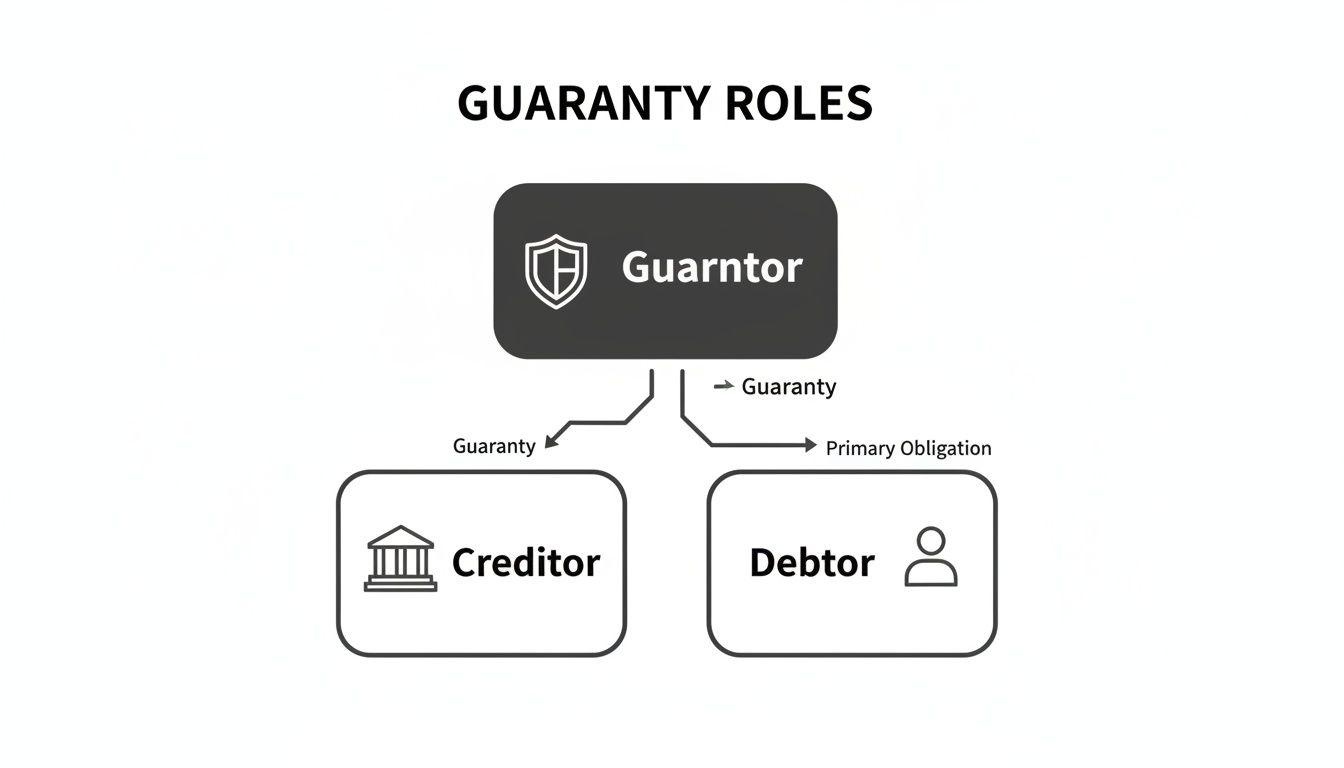
As you can see, the guarantor essentially acts as a backstop, giving the creditor a layer of security if the primary debtor can't pay.
Absolute vs. Conditional: When Can the Creditor Come Calling?
Finally, we get to what might be the most critical distinction of all: when can the creditor actually demand payment from the guarantor? This is the trigger for the guarantor's obligation.
An Absolute Guaranty (often called an unconditional guaranty) is what most lenders want. It allows them to demand payment from the guarantor the moment the primary debtor defaults. The creditor doesn’t have to waste time and money chasing the debtor first; they can go straight to the guarantor.
This distinction is massive in large-scale lending. Lenders rely on these "irrevocable, absolute, and unconditional" promises to secure their investments, especially when default rates are on the rise.
In contrast, a Conditional Guaranty forces the creditor to jump through some hoops first. They might have to formally demand payment from the debtor or even file a lawsuit before they can turn to the guarantor. This type offers more protection to the guarantor, but you rarely see it in standard commercial lending.
While a guaranty is a separate contract, the underlying debt itself is usually spelled out in another document. To see how these pieces fit together, you can check out our guide on what a promissory note is. If you want to discuss your business law matter, contact Kons Law at (860) 920-5181.
The Core Elements of a Legally Binding Guaranty
A simple handshake or a verbal promise just won't cut it when it comes to creating an enforceable guaranty. This is a serious financial commitment, and for it to hold up in court, it has to be built on a solid legal foundation. Think of it like a recipe with essential ingredients; if you leave one out, the whole thing can fall apart.
Getting these core elements right is the first step toward creating a valid agreement and spotting potential weaknesses that could lead to headaches down the road. Without them, what looks like a rock-solid contract might just be an empty promise.
The Statute of Frauds: Get It in Writing
The single most important rule for a valid guaranty is that it must be in writing. This isn't just a suggestion; it’s a legal doctrine that has been around for centuries called the Statute of Frauds. It mandates that certain major contracts—especially the promise to answer for someone else's debt—are only enforceable if they are written down and signed.
This isn't just a legal technicality. The writing requirement serves a few critical purposes:
- It Prevents Fraud: It protects you from being falsely held responsible for a debt you never actually agreed to cover.
- It Demands Clarity: It forces everyone involved to spell out the exact terms, which drastically cuts down on misunderstandings about who owes what.
- It Creates Hard Evidence: It gives you a clear, physical record of the agreement that can be presented in court if a dispute ever arises.
A guaranty is fundamentally separate from the underlying contract, and its enforceability depends—as with any contract—on mutual assent between the parties. New Jersey’s Statute of Frauds also requires that any assumption of liability for the debt of another be in writing and signed by the party assuming liability.
Consideration: The Exchange of Value
For any contract to be legally binding, there has to be consideration—meaning something of value is exchanged between the parties. This can feel a little confusing in a guaranty agreement because the guarantor usually doesn't get a check for signing on the dotted line.
But the law sees it differently. The "value" here is the action the creditor takes based on the guarantor's promise. For instance, a lender agrees to fund a loan, or a landlord signs a lease with a new tenant. These are things they might not have done without the extra security of the guaranty. That extension of credit is the consideration, and it’s what makes the guarantor’s pledge legally stick.
Clear and Unambiguous Language
Finally, the document itself has to be crystal clear. Vague, confusing, or ambiguous language can make a guaranty completely unenforceable. A well-drafted agreement will explicitly name all three parties—the debtor, the creditor, and the guarantor—and precisely define the specific debt being guaranteed.
There should be no doubt about who is responsible for what. The guarantor's promise to pay needs to be laid out in language that is absolute and direct, leaving zero room for interpretation.
If you have questions about a business law matter, don't hesitate to contact Kons Law at (860) 920-5181.
How Guaranty Agreements Are Used in Business
So, how does all this theory play out in the real world? Guaranty agreements are the bedrock of countless business deals, providing the security needed to get transactions over the finish line that would otherwise be far too risky.
Let's look at a few common situations where a guaranty becomes the essential key that unlocks an opportunity.

Think about a founder launching a promising tech startup. The business plan is airtight, but the company has zero credit history. When they go to a bank for that first crucial loan, the lender will almost certainly ask the founder to sign a personal guaranty. By putting their own assets on the line, they’re personally vouching for the business’s future, giving the bank the confidence it needs to write the check.
Real-World Scenarios and Motivations
The uses for these agreements pop up in nearly every industry, all driven by a simple need: one party needs to reduce their risk, and the other needs an open door.
- Securing a Commercial Lease: A small boutique finds the perfect storefront. To protect their investment, the landlord will likely require the owner to personally guarantee the lease. This ensures that if the business can't make rent, the landlord has a direct path to recover what they're owed from the owner.
- Obtaining Supplier Credit: A growing construction company needs a steady stream of materials but prefers to pay on 30-day terms rather than cash up front. The supplier might agree, but only if the owner signs a personal guaranty. This shields the supplier from a major loss if the construction company hits a cash flow snag and can't pay its bills.
- Supporting a Subsidiary: A large corporation can help its newly acquired, smaller subsidiary secure better financing by issuing a corporate guaranty. The parent company essentially lends its stronger financial reputation to back the subsidiary’s debt, helping it lock in much more favorable loan terms.
In every case, the logic is the same. The creditor—whether it’s a lender, landlord, or supplier—gets a vital layer of security that makes the deal possible. In return, the business gets the capital, space, or goods it needs to operate and grow.
This dynamic is especially critical for small and medium-sized businesses (SMEs). In fact, the World Bank estimates that partial credit guaranties can boost lending to targeted SMEs by 20–40% simply by making banks more willing to take a chance. You can see more on how these programs support economies on the World Bank's website.
Often, these agreements come with powerful tools for enforcement. To learn about one of the most potent clauses a creditor can include, you can read more about what a confession of judgment entails.
If you want to discuss your business law matter, contact Kons Law at (860) 920-5181.
Protecting Yourself Before Signing a Guaranty
Signing a guaranty agreement isn't just another piece of paperwork. It’s a serious financial commitment that can have massive, long-lasting consequences. Too often, people treat it as a mere formality, but in reality, you're putting your personal or business assets directly on the hook. Before your pen ever touches that paper, you need to stop thinking like a passive signer and start acting like an informed negotiator who understands every ounce of risk involved.

The first and most critical step? Read every single word of the agreement. It sounds simple, but you’d be surprised how many people skip this. Hunt for waiver clauses—these are the tricky bits where you might be signing away crucial legal rights, like your right to be notified if the original loan terms change. If you don't understand something, don't sign it. Period.
Key Protective Measures for Guarantors
Getting independent legal advice before you sign isn’t just a good idea; it's your single most important safeguard. An experienced attorney can cut through the dense legal jargon, pinpoint unfavorable terms, and give you the leverage to negotiate a much fairer deal. A little proactive investment here can save you from a world of financial pain down the road.
When you're going over the document, here are a few key points you should absolutely try to negotiate:
- Cap Your Liability: Don’t accept an unlimited guaranty. Push hard for a limited guaranty that clearly states the maximum dollar amount you could ever be on the hook for. An unlimited guaranty makes you liable for the entire debt, plus all interest and fees, which could be financially ruinous.
- Set an Expiration Date: Your obligation shouldn't be a life sentence. Negotiate a firm end date for the guaranty so it doesn’t hang over your head forever, especially as the debtor's financial situation evolves.
- Demand Regular Updates: Insist on a clause that forces the creditor to send you regular financial updates on the primary debtor's account. This isn't being nosy; it's smart risk management. It lets you keep an eye on things and spot potential defaults before they blow up into a full-blown crisis.
A personal guaranty is an individual’s promise to a third party to answer for a principal’s debt or performance on an underlying contract, payable to the third party only upon the principal’s default or failure to perform. Its enforceability depends on mutual assent between the parties.
Ultimately, protecting yourself comes down to being proactive. For many businesses, the best defense starts with building a solid contractual foundation from day one. You can get a better sense of what this looks like by reviewing a well-drafted small business contract template, which shows how clear and fair terms can be established from the very beginning. By taking these protective measures, you'll be able to make a far more informed decision and dramatically lower your personal risk.
If you want to discuss your business law matter, contact Kons Law at (860) 920-5181.
Final Thoughts and Next Steps
Guaranty agreements are a fixture in the business world, often acting as the key that unlocks financing, leases, and credit lines that would otherwise be out of reach. They're incredibly powerful tools.
But with that power comes serious risk. Signing a guaranty means putting your personal or corporate assets directly on the line. Treating this commitment with the gravity it deserves is the absolute first step toward smart financial stewardship.
The takeaways here are simple but critical: know exactly what kind of guaranty you're signing, understand the full scope of your liability (is it capped or unlimited?), and never, ever sign until you comprehend every single term. Due diligence isn't just a good idea—it's your only real defense against a future financial catastrophe.
A personal guaranty is a serious commitment; its enforceability depends on mutual assent between the parties, and it must be documented in a signed writing to satisfy the Statute of Frauds.
If you're facing a guaranty agreement or need help navigating any other business law issue, getting professional legal advice isn't just a formality—it's essential. An experienced attorney can help you see around corners, clarify your obligations, and protect your interests. For a better sense of how a legal partner can help, learn more about what a business lawyer does in our detailed guide.
To discuss your specific situation, give Kons Law a call at (860) 920-5181.
A Few Common Questions About Guaranty Agreements
Even with a solid understanding of the basics, a few specific questions always seem to pop up when clients are dealing with guaranties. Let's tackle some of the most common ones to clear up any lingering confusion.
What's the Real Difference Between a Guarantor and a Co-Signer?
This is a big one. While they might seem like the same thing, the legal distinction is critical. Think of a co-signer as a partner in the loan from day one. They are on the hook immediately, sharing equal responsibility for the debt right alongside the primary borrower.
A guarantor, on the other hand, is more like a backup plan. Their obligation only kicks in after the primary borrower has already defaulted. The guarantor isn’t a co-borrower; they are a safety net the lender can turn to when things go wrong.
Can You Just Cancel a Guaranty Agreement?
Not usually. A guaranty is a serious, binding commitment designed to last until the debt is paid in full. It's meant to be irrevocable for the life of the loan.
That said, there are a few specific scenarios where a guaranty can be terminated:
- The agreement itself might include an exit ramp, like a specific time limit or termination clause.
- The creditor could provide a formal, written release that officially frees the guarantor from their obligation.
- The underlying loan agreement is significantly changed (or "materially altered") without the guarantor's consent.
What Happens If a Guarantor Refuses to Pay?
Ignoring the obligation is a fast track to serious legal trouble. If the primary debtor defaults and the guarantor fails to step up, the creditor has every right to come after them directly.
This often leads straight to a lawsuit. If the creditor wins, they'll get a court judgment against the guarantor, which opens the door to powerful collection tools. We're talking about things like wage garnishment, liens on property, and freezing bank accounts. It’s a stark reminder of the financial weight and legal risk that comes with signing on that dotted line.
Navigating the ins and outs of a guaranty agreement demands a sharp eye for detail. If you want to discuss your business law matter, contact Kons Law today at (860) 920-5181.
