
When a defendant fails to respond to a lawsuit within the required timeframe, the court can issue a default judgment. This allows the plaintiff to win the case by default, resulting in a final, binding order entered without a full trial because the other side simply didn't show up.
What Is a Default Judgment?
Think of a lawsuit as a scheduled boxing match. The plaintiff steps into the ring, ready to argue their case. But what happens if the defendant never shows up? The referee (the judge) can't let the match hang in limbo forever. Instead, they declare the plaintiff the winner by forfeit.
That's exactly what a default judgment is in the legal world. It’s a crucial mechanism that keeps the justice system moving. Without it, defendants could stall cases indefinitely just by ignoring them, leaving plaintiffs with no way to resolve their claims. It reinforces a core principle: participating in the legal process isn't optional—it's an obligation.
Why This Matters for Your Business
Whether you're chasing an unpaid invoice or your company has been named in a lawsuit, you need to understand how this works. The implications are huge.
- For Plaintiffs (Creditors): It's a powerful and efficient tool. When a debtor goes silent, a default judgment lets you bypass a long, expensive trial and get a legally enforceable decision.
- For Defendants: Ignoring a lawsuit is one of the worst mistakes a business can make. You don't just lose the case; you give up your right to present any defense or argue against the damages being claimed.
A default judgment isn't just a procedural hiccup; it's a real loss with serious financial consequences. It's especially common in consumer debt collection, where default judgment rates can be as high as 90-95%. These outcomes often leave defendants facing wage garnishments and asset seizures, all without ever having their side of the story heard in court. You can find more insights about these debt collection findings and their impact.
Here's a quick breakdown of what a default judgment entails.
Default Judgment at a Glance
| Component | Description |
|---|---|
| Trigger | A defendant fails to respond to a summons and complaint within the legally required time. |
| Outcome | The plaintiff wins the lawsuit automatically, without a trial on the merits of the case. |
| Legal Status | It is a final, legally binding court order with the same force as a judgment won after a full trial. |
| Consequences | The defendant loses the right to present a defense and can be subject to enforcement actions. |
| Enforcement | Can be used to garnish wages, seize bank accounts, or place liens on property to collect the debt. |
In short, a default judgment is a decisive end to a legal dispute when one party fails to participate.
If you want to discuss your business law matter, contact Kons Law at (860) 920-5181.
The Step-by-Step Process for Entering a Default Judgment
A default judgment doesn’t just appear out of thin air. It’s the final outcome of a very specific, step-by-step legal process that unfolds when one party simply fails to show up to the fight.
For a plaintiff, following these procedures to the letter is essential for obtaining a judgment that's both valid and enforceable. For a defendant, understanding this timeline is critical—it reveals every opportunity to act before the court brings the hammer down.
This flowchart shows the straight line from filing a lawsuit to securing a judgment when a defendant goes silent.
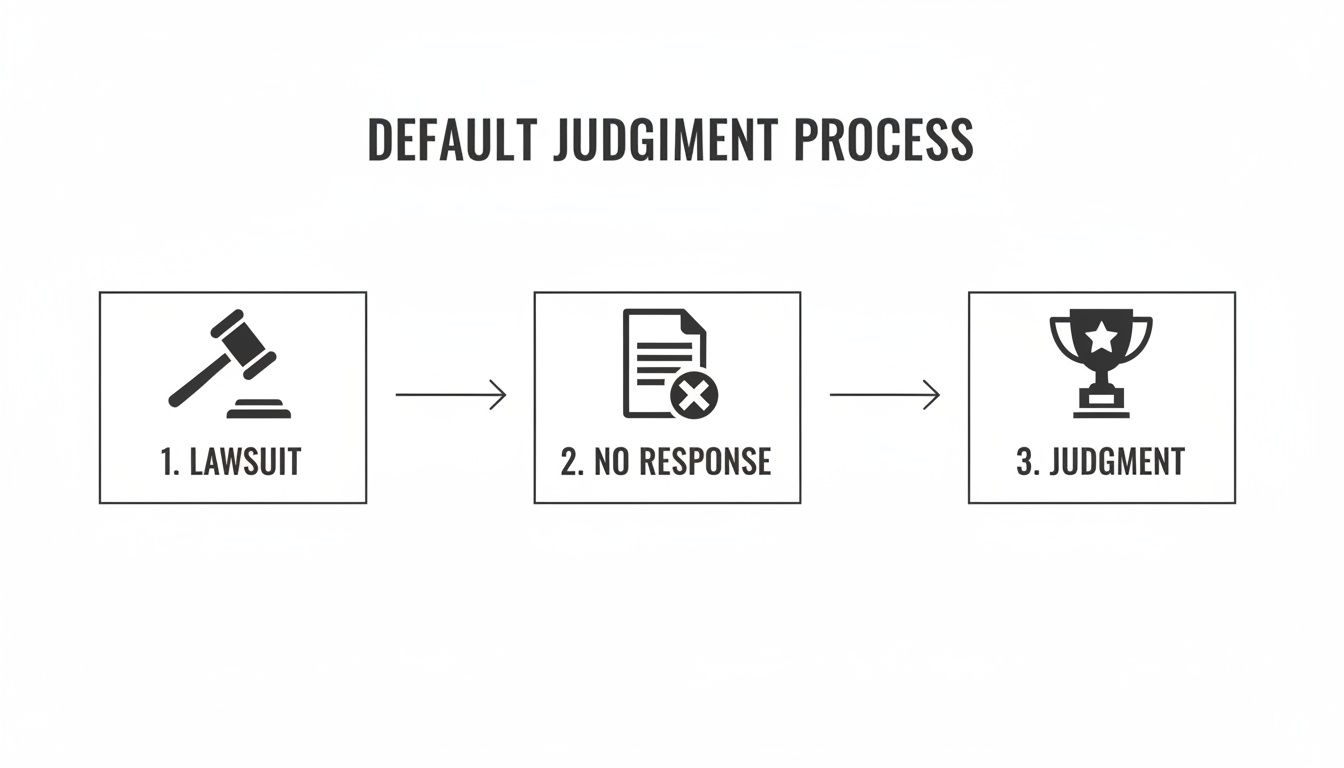
As you can see, the entire process hinges on the defendant's inaction. That silence empowers the plaintiff to move forward and, essentially, win the case by default.
Stage 1: Filing the Lawsuit and Service of Process
It all begins when the plaintiff files a complaint with the court. This is the document that officially kicks off the lawsuit, laying out the plaintiff's claims against the defendant and the legal grounds for them. But just filing it isn't enough.
Next comes the most critical phase: service of process. This is the formal, legally required procedure for delivering the lawsuit papers—the summons and complaint—to the defendant. Proper service is a cornerstone of due process; it’s the law’s way of ensuring the defendant is officially notified and gets a fair chance to respond.
Stage 2: The Defendant's Response Window
Once the defendant is properly served, a legal clock starts ticking. Every jurisdiction gives the defendant a specific deadline to file a formal response with the court. This response, usually called an answer, is the defendant's opportunity to admit or deny the allegations and raise any defenses.
In Connecticut, for example, this window is typically 30 days from the "return date" printed on the summons. Missing that deadline is what opens the door to a default.
A defendant’s failure to act within this prescribed time isn’t viewed as a minor slip-up by the court. It's seen as forfeiting their right to defend themselves, paving the way for the plaintiff to seek a judgment.
Stage 3: Requesting the Entry of Default
If the response deadline passes with nothing but crickets from the defendant, the plaintiff can make a key move. Their attorney will file a Request to Enter Default with the court. This motion officially tells the court the defendant failed to respond and asks the clerk to note the default in the case record.
This "entry of default" is a huge milestone. It essentially locks the defendant out, preventing them from filing an answer or defending the case from that point on—unless they can convince the court to set the default aside. It's a major win for the plaintiff, but it’s not the end of the road.
Stage 4: Securing the Final Default Judgment
An entry of default confirms the defendant is liable, but it doesn't say what they owe. To finish the job, the plaintiff must file another motion asking the court to enter a default judgment. This is the formal court order that grants the plaintiff the specific relief they asked for, like a monetary award.
Depending on the case, the judge might:
- Grant a judgment for a specific amount if the damages are a fixed sum, like the total on an unpaid invoice. This is known as a "sum certain."
- Schedule a hearing on damages to determine the amount owed if the damages aren't fixed, such as lost profits or pain and suffering in a personal injury case.
Once the judge signs the default judgment, it becomes a final, legally binding, and enforceable court order.
The Path to Default Judgment: A Procedural Timeline
To bring it all together, here is a breakdown of the key stages and timelines involved in the default judgment process, with a focus on Connecticut procedures.
| Stage | Plaintiff's Action | Defendant's Obligation | Typical Timeframe (Connecticut) |
|---|---|---|---|
| Lawsuit Initiation | Files Complaint & Summons with the court. | None at this stage. | N/A |
| Service of Process | Arranges for a marshal or process server to deliver lawsuit documents to the defendant. | None, but the clock starts upon successful service. | Typically within 30 days of filing. |
| Response Period | Waits for the defendant to respond. | Must file an Answer or other responsive pleading with the court. | 30 days from the "return date" on the summons. |
| Motion for Default | If no response, files a Motion for Default for Failure to Appear. | The deadline to respond has passed. | Can be filed on the 31st day after the return date. |
| Motion for Judgment | Files a Motion for Default Judgment, including an affidavit of debt for sum certain cases. | The opportunity to participate has effectively ended. | Can be filed immediately after the default is entered. |
| Final Judgment | The court reviews the motion and either enters judgment or schedules a hearing on damages. | None, unless moving to set aside the judgment. | Varies; can be days for a sum certain, or weeks/months if a hearing is needed. |
This structured process ensures that judgments are entered fairly and only after the defendant has been given a clear opportunity to participate. It's a powerful tool, but one that must be used correctly.
This process is quite different from other legal tools that can lead to a judgment without a full trial. For instance, you can learn more about what a confession of judgment is and see how it contrasts with the default process.
If you want to discuss your business law matter, contact Kons Law at (860) 920-5181.
What Happens After a Default Judgment Is Entered?
Once a judge’s signature hits the paper on a default judgment, the whole game changes. The debate about who’s right or wrong is officially over. The court has made its decision, and the plaintiff now has a powerful legal order in their hands. This is where the collection phase begins, and for the defendant—now called the "judgment debtor"—the financial risk becomes very real, very quickly.
For the plaintiff, who is now a judgment creditor with powerful collection rights, that judgment is far more than just a piece of paper. It’s a key that unlocks a whole toolbox of legal enforcement measures designed to get them the money they're owed. By not responding to the lawsuit, the debtor has left themselves completely exposed to aggressive collection actions.

The Power Shifts Entirely to the Judgment Creditor
A default judgment turns the plaintiff's original claim from a simple allegation into a legally binding, undeniable debt. The court has spoken, and the defendant has lost their only chance to tell their side of the story. This gives the creditor an incredible amount of leverage.
Armed with that judgment, the creditor can now legally start seizing the debtor's assets to satisfy the debt. We're not talking about sending another invoice or making a polite phone call. These are court-authorized actions that can cripple a business's operations or devastate an individual's financial stability. Suddenly, the consequences of ignoring that initial lawsuit become painfully clear.
A default judgment is not a negotiation. It is a final court order that gives the winning party the legal authority to use the power of the state to collect what they are owed, with or without the debtor's cooperation.
The Creditor's Enforcement Toolbox
The legal system gives judgment creditors several potent tools to collect what's owed. These methods are designed to be effective and can be put into motion swiftly, often catching the debtor completely off guard.
Here are the most common enforcement tools:
- Bank Levy: This allows a creditor to freeze and take funds directly from the debtor’s bank accounts. For a business, a bank levy can be catastrophic, instantly cutting off access to cash flow and making it impossible to pay employees, suppliers, or rent.
- Wage Garnishment: A court can order the debtor's employer to withhold a certain percentage of their paycheck and send it straight to the creditor. This creates a steady, involuntary payment stream until the entire debt is cleared.
- Property Lien: The creditor can place a legal claim, or lien, on the debtor's real estate—like a commercial building or a personal home. A lien clouds the property's title, making it impossible for the debtor to sell or refinance until the judgment is fully paid.
Real-World Stakes and Tangible Risks
To really grasp the severity, think about it in real terms. Imagine a small construction company that ignored a lawsuit from a parts supplier. After the supplier gets a default judgment, their attorney executes a bank levy. On payday, the construction company owner finds their entire business account frozen solid. They can't make payroll. The business grinds to a halt overnight.
Or what about a business owner planning to sell a commercial property to fund their retirement? They're shocked to discover during the title search that an old, forgotten default judgment has resulted in a lien on the property. The sale can't move forward until the judgment, plus years of accumulated interest, is paid in full—putting the entire deal in jeopardy. In one extreme case out of Washington, a defendant's failure to show up resulted in a staggering $16 million award.
These aren't just theoretical possibilities; they are the harsh realities of ignoring a lawsuit. For creditors, it's a reminder of the powerful tools at your disposal. For debtors, it's a stark warning about the immediate and severe danger of inaction.
If you want to discuss your business law matter, contact Kons Law at (860) 920-5181.
How to Challenge a Default Judgment
Getting a notice that a default judgment has been entered against you can feel like a knockout punch. But it’s not always the end of the fight. The legal system gives you a way to get back in the ring: filing a motion to set aside the judgment.
This is your formal request to the court, asking it to wipe the slate clean and let you defend your case on its merits.
You can't just ask for a do-over, though. Courts need a good, legally valid reason for your failure to respond to the lawsuit in the first place. Simply deciding to ignore it won't cut it. To succeed, you have to prove that your silence wasn't intentional but was the result of a legitimate problem that kept you from answering the call.
Valid Legal Grounds for Setting Aside a Judgment
A judge won't reopen a case without a compelling reason rooted in fairness. You need to show that the judgment was entered against you improperly or because of circumstances that weren't your fault.
Here are the primary arguments that hold weight in court:
- Improper Service of Process: This is often the strongest defense. If the plaintiff didn't follow the strict legal rules for serving you with the lawsuit, the court technically never had power over you. Any judgment entered without that power (called jurisdiction) is void from the start.
- Excusable Neglect: This one is common but tricky. It means your failure to respond was due to a genuine mistake, an accident, or events truly beyond your control—not just carelessness or a willful decision to ignore the deadline.
- Fraud or Misconduct: If you can show the plaintiff used lies, deceit, or other dirty tricks to get the judgment, the court can set it aside. This could be anything from faking proof of service to submitting false evidence.
The timing of these motions is a huge deal. On November 4, 2025, the U.S. Supreme Court heard arguments in Coney Island Auto Parts Unlimited, Inc. v. Burton, a case that drilled down on whether there's a hard deadline for challenging judgments that are void because of bad service. The case asks if a fundamental error like that can kill a judgment years down the road, which just goes to show how critical getting the procedure right is from day one. Discover more insights about this Supreme Court case.
What Excusable Neglect Looks Like for a Business
So, what does "excusable neglect" actually mean in the real world?
Imagine your company gets hit with a sudden, all-consuming crisis—maybe a massive data breach that pulls every single employee into damage control. In the middle of the chaos, a process server hands a lawsuit to a frazzled temp at the front desk, who misfiles it. The deadline to respond comes and goes, and no one in a position of authority ever even saw the papers.
In that situation, the failure to respond wasn't a strategic choice. It was an administrative breakdown caused by an extraordinary event. A court might very well see this as excusable neglect, especially if the company acts fast the moment it discovers the default.
The Two Pillars of a Successful Motion
To convince a judge to give you a second chance, your motion needs to stand on two strong legs. Think of it as a two-part test you absolutely have to pass.
- A Good Reason for Not Responding: First, you have to explain why you missed the deadline, citing one of the valid legal grounds we just covered.
- A Meritorious Defense: This is just as critical. You must also show the court that if the judgment is erased, you have a real, legitimate defense to the plaintiff's original claims.
Courts are busy. They won't bother reopening a case if the defendant doesn't have a plausible path to winning. You'll need to submit a sworn statement (an affidavit) that lays out your side of the story and shows there’s a genuine dispute worth litigating. This reassures the judge that giving you another shot isn't just wasting everyone's time.
Without a meritorious defense, your motion is dead on arrival, no matter how good your excuse is.
And you have to act quickly. Courts demand you file this motion promptly after learning about the judgment. Hesitating for even a few weeks can be seen as giving up your right to challenge it, so getting legal help immediately is non-negotiable.
If you want to discuss your business law matter, contact Kons Law at (860) 920-5181.
Proactive Strategies to Avoid Default Judgments
The best way to deal with a default judgment is to make sure it never happens in the first place. For any business, prevention is always far less expensive and disruptive than trying to undo a judgment after it’s already on the books. A few basic, proactive strategies can shield your company from these costly and entirely avoidable legal missteps.
Ignoring a lawsuit—no matter how small or frivolous it seems—is one of the most destructive mistakes a business can make. As we’ve seen, the consequences can be devastating, leading to frozen bank accounts and liens on your property. A proactive approach means treating every legal notice with the seriousness it deserves, turning a potential disaster into a manageable dispute.
Build a Bulletproof System for Legal Notices
Your first line of defense is a rock-solid internal process for handling any legal document that comes through your door. Lawsuits often go unanswered not out of defiance, but because of simple clerical errors. A notice gets lost on a messy desk, handed to the wrong person, or mistaken for junk mail.
To stop this from happening, you need a clear and consistent protocol.
- Designate a Point Person: Assign one specific, reliable person or department (like an office manager or in-house counsel) to be responsible for receiving and processing all legal mail.
- Create a Log: Keep a detailed log to track every legal notice. It should include the date received, the case name, the court, and, most importantly, the deadline for a response.
- Immediate Escalation: Train your entire team, especially anyone at the front desk, to recognize official court documents and get them to the designated point person immediately.
The Critical Role of a Registered Agent
For any formal business like an LLC or corporation, having a registered agent isn’t just a good idea—it's the law. A registered agent is your company’s official point of contact for being served with a lawsuit. This can be someone inside your company or, more often, a professional third-party service.
Using a professional registered agent service gives you a major advantage. They are experts at handling legal documents and are contractually obligated to get them to you without delay. This almost completely eliminates the risk of a lawsuit falling through the cracks because someone was out sick or on vacation when the process server showed up.
A reliable registered agent acts as your business's legal goalie. Their sole job is to catch every lawsuit served on your company and ensure it gets into the right hands immediately, preventing an easy score by default.
Keeping communication lines open can also be a powerful preventative tool. If you have a dispute with a vendor or creditor, talking it out before it escalates to litigation can often lead to a resolution without ever seeing the inside of a courtroom. Ignoring disputes just makes a lawsuit more likely.
Finally, if you're the one filing the lawsuit, perfecting service of process is absolutely essential. Making sure the defendant is served correctly according to all legal rules is the only way to get a default judgment that will hold up against a future challenge. If you want to discuss your business law matter, contact Kons Law at (860) 920-5181.
Bringing It All Together
So, what's the bottom line? A default judgment is a serious legal outcome with potentially devastating financial consequences, but it’s almost always avoidable. The single most important takeaway here is the absolute need for a quick, strategic response to any lawsuit you're facing.
Whether you're a creditor trying to enforce your rights or a business owner defending your company, going it alone is a massive risk. This isn't a situation you can ignore or hope will just go away. It demands proactive management and a crystal-clear understanding of your options from the very beginning.
Taking Control of the Situation
For a creditor, a default judgment is a powerful tool—but only if every single procedural step was followed to the letter. For a defendant, discovering a judgment against you can be a shock, but you might still have a path to challenge it. In either case, time is not on your side.
The moment a default judgment is in play, the clock starts ticking. For defendants, the window to challenge the judgment is incredibly tight. For creditors, the opportunity to start collection actions should be seized immediately to maximize the chances of actually getting paid.
Understanding where you stand is the first step toward a resolution. Creditors need a concrete strategy for collection. Defendants must immediately figure out if they have grounds to get the judgment set aside. This is about more than just paperwork; it’s about protecting your financial future and effectively asserting your legal rights. Waiting can slam doors shut that might have otherwise remained open.
Don't wait until it's too late to protect your business. If you are a judgment creditor, you can find valuable information on how to collect on a judgment to start the enforcement process.
If you want to discuss your business law matter, contact Kons Law at (860) 920-5181.
Frequently Asked Questions About Default Judgments
Even after you get the basics down, a few key questions always seem to pop up when a business gets hit with a default judgment. Let’s tackle some of the most common and critical concerns we hear from business owners and creditors.
What Happens If I Was Never Properly Served With the Lawsuit?
This is a big one. If the lawsuit papers never legally made it to you, the court technically doesn't have the authority—or jurisdiction—to rule against you. It's a fundamental breakdown of the legal process and a violation of your due process rights.
Improper service of process is probably the most powerful reason to file a motion to set aside a judgment. When a court lacks jurisdiction, the judgment it enters is considered void. That means it was legally invalid from the very beginning. But you have to act fast to bring this to the court's attention.
How Long Does a Creditor Have to Collect on a Judgment?
Don't make the mistake of thinking a default judgment just fades away. It's a long-term debt that can follow you for years, even decades. While the exact lifespan of a judgment varies from state to state, creditors can often renew them, extending their window to collect.
This gives the creditor a huge amount of time to pursue enforcement actions like wage garnishments, bank levies, or liens on your property. If you want to dig deeper, you can learn more about how long a judgment lasts and why it’s a problem that won’t solve itself. You have to confront it head-on.
Can Filing for Bankruptcy Stop a Default Judgment?
Yes, it can, and the relief is immediate. The moment you file for bankruptcy, a protection called the “automatic stay” kicks in by law.
The automatic stay is a legal injunction that immediately halts all collection activities by creditors. This includes stopping any ongoing lawsuits, preventing new ones from being filed, and freezing wage garnishments and bank levies related to the default judgment while the bankruptcy case is active.
This gives you some much-needed breathing room to get your finances in order under the court's protection. From there, the judgment debt can be managed or, in some cases, even discharged entirely as part of the bankruptcy.
Can a Default Judgment Affect My Business Credit Score?
Absolutely, and the impact is severe. A default judgment becomes a public record, and it does serious damage to both your personal and business credit reports. It’s a huge red flag for lenders, suppliers, and potential partners, signaling that your business failed to handle a legal financial obligation.
This can make it much harder and more expensive to do business. You might find it difficult to:
- Get approved for loans or lines of credit
- Lease a commercial space or necessary equipment
- Negotiate good payment terms with your suppliers
A judgment can sit on your credit report for years, acting as a major roadblock to your company's growth and financial stability. Taking proactive steps to resolve it is the only way to mitigate that long-term damage.
If you want to discuss your business law matter, contact Kons Law at (860) 920-5181.
