
You've received a FINRA arbitration award. The panel ruled in your favor, the written decision is in hand, and the case that consumed months of attention appears finished. Then the practical questions arrive. When must the respondent pay? What happens if the respondent files a motion to vacate? How do you turn an award into money if the firm delays, refuses, or lacks readily available assets?
Those questions define the post-award phase. A favorable decision has legal value, but collection, confirmation, compliance, and timing determine its business value. This guide explains what happens after FINRA arbitration awards are issued, including the payment rules, FINRA suspension process, court enforcement options, and collection risks that claimants and financial professionals should address immediately.
The Post-Award Moment That Brings You Here
A claimant receives a written award requiring a former broker-dealer to pay $312,000. The decision is signed. The arbitration is over. The claimant reads the operative paragraphs twice, then starts asking whether a check will arrive within thirty days, whether the losing side will seek to vacate the award, and whether FINRA can pressure the respondent to comply.
Those questions shouldn't wait. The award itself may state the amount due, interest, fees, costs, expungement relief, or other obligations, but the award doesn't automatically place collected funds in your account. The respondent's payment deadline, any motion to vacate, the award language, and the respondent's financial condition all affect the next move.
The first 48 hours
Start by preserving the complete award and recording the date you received it. Keep the FINRA transmission, envelope, email, or electronic notice showing receipt, because several deadlines run from receipt or issuance. Read every operative paragraph, not just the damages figure. A panel may order payment of interest, fees, costs, or a net amount after offsetting awards owed by both sides.
Then identify whether the respondent is a FINRA member firm, an associated person, or another party, and whether the award requires payment by one respondent or several. Those distinctions affect the available regulatory pressure and the practical collection target.
A losing party may threaten or file a motion to vacate. That filing isn't a second arbitration, and it doesn't give the court authority to reconsider ordinary factual disputes because a party dislikes the result. It can, however, affect payment analysis and may require a response in court.
Practical rule: Treat the award date and receipt date as collection dates, not administrative dates.
The post-award problem often resembles judgment enforcement. A useful overview of the broader process appears in this guide to collecting on a judgment. The immediate work is to preserve evidence, calendar payment and court deadlines, send a precise written demand, and investigate whether the respondent can satisfy the award.
Why leverage matters
FINRA's rules create consequences for certain industry respondents that fail to pay. That pressure can improve settlement terms, but it works only when the claimant follows the required notice and timing steps. A demand that merely says “pay immediately” is less useful than a demand that identifies the award, the amount due, the receipt date, the payment rule, and the consequences of noncompliance.
The award is the result of the merits phase. Enforcement is the business phase. A claimant who plans for collection before the panel rules is better positioned to evaluate payment proposals, challenge delay, and decide when court confirmation is necessary.
What a FINRA Arbitration Award Is
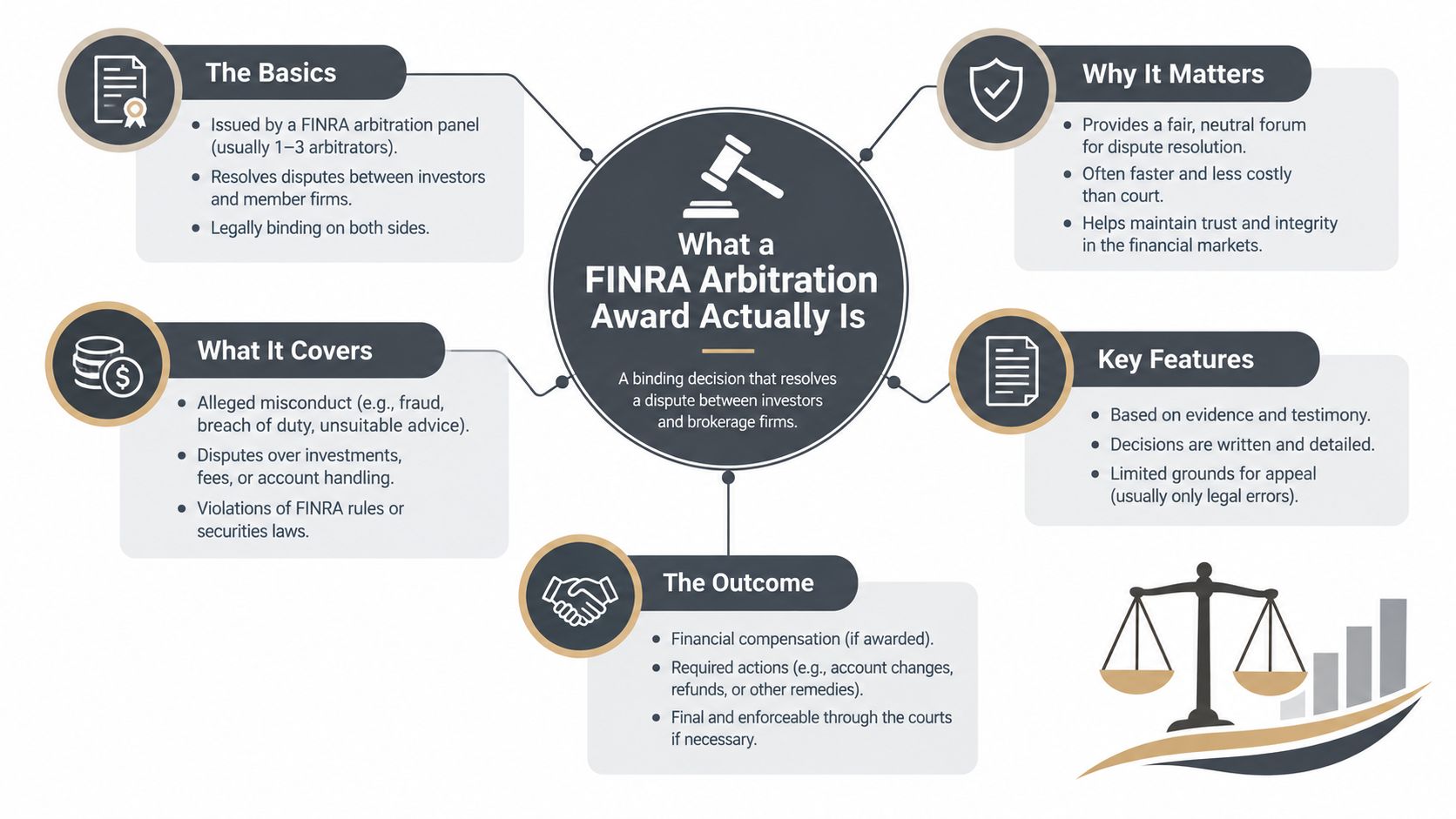
A FINRA arbitration award is the panel's written, signed final decision after the parties submit a dispute under FINRA's Code of Arbitration Procedure. Depending on the governing rules and case circumstances, the panel may have one arbitrator or three. The document controls what each party must do after the merits phase ends.
An award may grant monetary damages, deny claims, assign forum fees and costs, award interest, authorize attorney fees, or order nonmonetary relief such as expungement. The operative directives matter more than the narrative describing the parties' positions. A discussion of requested damages does not create a payment obligation unless the award's final language imposes one.
Final, interim, and partial decisions
A panel may issue an interim order addressing discovery, sanctions, or another preliminary issue without ending the case. A partial award may resolve liability or selected claims while leaving other matters for later determination. Before seeking confirmation or beginning collection work, confirm that the document is the final signed award.
A final award binds parties that agreed to arbitrate or otherwise became subject to the FINRA proceeding. Courts generally treat such awards as enforceable obligations, subject to limited statutory grounds for vacatur or modification. Once confirmed, the award becomes a court judgment that can support judgment-enforcement remedies.
That legal force makes the award more than a recommendation. It also makes informal payment arrangements risky. If the parties agree to installments, a discount, a release, or a delayed payment date, the written agreement should identify the amount due, deadlines, and the consequence of a missed payment. Otherwise, a claimant may face a new dispute over whether the original award remains immediately enforceable.
For a practical explanation of the proceeding that produces the decision, review this overview of the FINRA arbitration process. The proceeding and the award serve different purposes. After the panel issues its final decision, the work shifts to reading the directives precisely, preserving rights, demanding payment, and choosing whether court confirmation is needed. A claimant should begin that review promptly because payment and enforcement planning depend on the award's language and the date it was received.
How Awards Are Issued, Recorded, and Searched
FINRA's process typically produces a written award within 30 days after the hearing concludes, according to FINRA's arbitration-process guidance. That timeframe concerns issuance of the decision. It shouldn't be confused with the separate payment period that begins after the parties receive the award.
Once the panel signs the award, FINRA records it in the case file and makes the document available through its award-search resources when the applicable disclosure rules permit. The FINRA Arbitration Awards Online database provides free web access to FINRA awards and historical NASD arbitration awards seven days a week. Lexis-based coverage begins in February 1989, giving practitioners a record that spans decades of market cycles, regulatory changes, and changing customer and industry claim patterns.
How to locate and read the document
Use the search tools to identify the case by party name, case number, date, or other available fields. After locating the award, verify:
- Case identity: Confirm the claimant, respondent, case number, and award date.
- Panel composition: Note the arbitrators and whether the decision identifies chair or public and industry classifications.
- Claims resolved: Determine which causes of action were granted, denied, dismissed, or withdrawn.
- Operative relief: Read the paragraphs that state damages, interest, fees, costs, expungement, and payment obligations.
- Separate opinions: Check whether the award contains a dissent or other panel explanation.
Customer awards are often publicly searchable, while intra-industry matters and some expungement-related material may have different visibility rules. Public availability also doesn't mean every fact in the underlying case appears in the award. FINRA awards can be concise, so the award should be read alongside the pleadings, hearing exhibits, transcripts, and settlement documents.

Why the record matters after payment
The searchable record helps counsel compare recurring claim types, identify respondent history, and understand how remedies have developed. It can also support diligence when a dispute involves advisor termination, withheld compensation, a promissory note, or a Form U5 issue.
A claimant should download and preserve the award rather than rely on a search result remaining available in the same form. The award becomes a key exhibit for a payment demand, a FINRA compliance submission, a petition to confirm, and later enforcement proceedings. The broader securities-dispute context is discussed in this resource on securities arbitration.
Confirming, Vacating, and Modifying FINRA Awards
After an award is issued, the parties generally face three possible paths: confirmation, vacatur, or modification. They aren't equal alternatives. Confirmation is the ordinary enforcement route. Vacatur and modification are limited judicial remedies.
FINRA Rule 13905 provides a framework for court applications involving awards, while FINRA Rule 12904 addresses the award itself and payment obligations. A claimant seeking enforcement ordinarily asks a court to confirm the award under Section 9 of the Federal Arbitration Act. The resulting judgment can then be enforced through the court's collection procedures.
Comparing the available routes
| Pathway | Statutory Basis | Time Limit | Grounds | Practical Odds |
|---|---|---|---|---|
| Confirmation | FAA Section 9 and FINRA Rule 13905 | Within the applicable FAA and FINRA period | Valid award, proper jurisdiction, no successful vacatur or modification | Default route for an unpaid award |
| Vacatur | FAA Section 10(a) | Must be raised within the applicable statutory period | Evident partiality, arbitrator misconduct, excess of authority, or serious hearing or due-process problems | Reported vacate rates are under 5%, as discussed in FINRA's published award materials |
| Modification or correction | FAA Section 11 | Must be raised within the applicable statutory period | Evident material miscalculation, mistake in description, or imperfect award form | Narrow and fact-specific |
The FAA's vacatur grounds are narrow. A court may consider evident partiality, misconduct that prejudiced a party, an arbitrator exceeding the arbitrator's powers, or a hearing conducted in a way that denied a fair opportunity to present the case. A party usually can't obtain vacatur by arguing that the panel weighed evidence incorrectly or reached a debatable legal conclusion.
The Supreme Court's decision in Hall Street Associates v. Mattel reinforced the statutory character of FAA review and contributed to differences in how courts handle arguments such as manifest disregard. The practical lesson remains consistent. A motion to vacate isn't a trial appeal.
A pending motion doesn't end the collection plan
A respondent may argue that a vacatur motion should delay payment. FINRA Rule 13905 doesn't automatically turn every challenge into a stay of enforcement. The parties must analyze the filing, the court's orders, any bond or security issue, and the award's payment language.
Modification under FAA Section 11 addresses errors such as an evident material miscalculation or an imperfect description of a person, thing, or property. It isn't a mechanism for rewriting the panel's reasoning. Claimants should evaluate the motion's legal grounds promptly and continue preparing confirmation and collection steps unless a court orders otherwise.
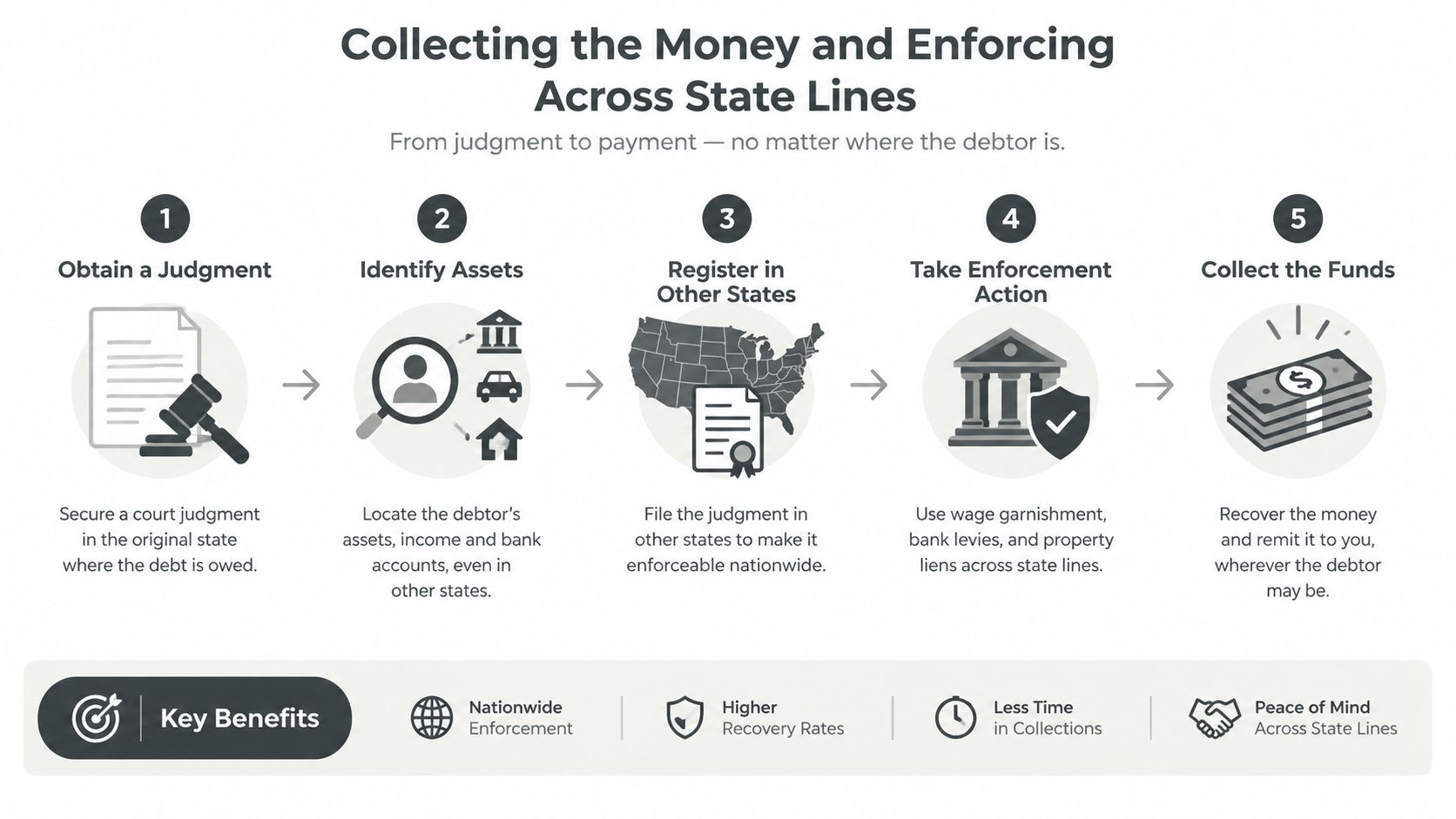
Collecting the Money and Enforcing Across State Lines
Collection should begin when the award is rendered, not after the respondent misses payment. FINRA Rule 12904(j) requires monetary awards to be paid within 30 days of receipt, unless the respondent has filed a motion to vacate in a court of competent jurisdiction. If the award remains unpaid after that period, interest begins to run from the award date. When both sides owe money, the amounts generally offset unless the award provides otherwise, and the party owing more pays the net difference. The governing language appears in FINRA Rule 12904.
A workable sequence
Send a written demand. Identify the award, receipt date, amount due, interest, payment instructions, and deadline. Preserve proof of delivery. FINRA's guidance also directs unpaid parties to notify the FINRA case administrator in writing, while member firms and associated persons must notify FINRA in writing that they paid, complied, or have a valid basis for nonpayment. The FINRA Party's Reference Guide explains this reporting step.
Use Rule 9554 pressure when it applies. FINRA's Rule 9554 enforcement mechanism can lead to suspension or cancellation consequences when a member or associated person fails to comply after written notice. FINRA's public award guidance states that an industry party that fails to pay a customer award within the applicable period may face expedited suspension proceedings, and the nonpaying party may remain suspended or barred until compliance is shown.
Confirm the award in court. A confirmed award supplies the judgment needed for conventional collection. The proper court depends on jurisdiction, the parties, the arbitration agreement, and the FAA or applicable state law.
Register and execute across jurisdictions. Once confirmed, counsel can evaluate registration under the applicable Uniform Enforcement of Foreign Judgments Act procedure and pursue remedies such as writs of execution, bank levies, or turnover orders. State procedures differ, so a judgment that is enforceable in one jurisdiction may require additional filings elsewhere.
Brokerage-specific risks
A brokerage respondent may have customer assets, restricted accounts, clearing relationships, or competing creditor claims. Customer-asset protections and priority disputes can complicate recovery, and a claimant shouldn't assume that visible business activity means unrestricted funds are available.
Individual brokers require separate analysis. If the award names an associated person, personal assets may provide another collection source. If it doesn't, counsel must examine the award, arbitration agreement, applicable law, and any basis for proceeding against a nonparty. A general demand often stops working here. Court confirmation, discovery into assets, supplementary proceedings, and coordinated filings may be necessary.
The practical mechanics of enforcing an arbitration award are also addressed in this guide to arbitration award enforcement.
Timelines, Fees, and the Statistics Behind the Numbers
FINRA's published statistics show why an award amount doesn't answer the most important client question. In 2024, FINRA reported 1,852 customer cases closed, including 1,302 settlements, or 70%, and 232 cases with awards issued. Only 61 cases involved customers awarded damages. These figures appear in FINRA's unpaid customer-award statistics.
The same FINRA data reported $59 million awarded in 2024 and $22 million unpaid, representing 37% of the dollars awarded. Among the cases in which customers were awarded damages, 15 award cases were unpaid, or 25% of those damage-award cases. The result is a sharp strategic point: winning the merits doesn't eliminate collection risk.
The numbers that change the advice
| Metric | Customer Cases | Industry Cases |
|---|---|---|
| Cases closed in 2024 | 1,852 | FINRA's cited unpaid-award data does not provide a corresponding industry-case total |
| Settled cases in 2024 | 1,302, or 70% | Not provided in the cited data |
| Cases with awards issued | 232 | Not provided in the cited data |
| Customer cases awarded damages | 61 | Not provided in the cited data |
| Total amount awarded | $59 million | Not provided in the cited data |
| Total unpaid award amount | $22 million, or 37% of dollars awarded | Not provided in the cited data |
FINRA's statistics also show unpaid customer damage awards across several years. The published counts were 24 in 2020, 23 in 2021, 30 in 2022, 14 in 2023, and 15 in 2024, with unpaid-award rates ranging from 21% to 39% of damage awards during those years. Those figures don't establish that every unpaid award is permanently uncollectible. They do establish that payment follow-through deserves early attention.
FINRA's broader 2025 statistics reported that 13% of customer cases closed by award, while its unpaid-award tracker reported that in 2024 1% of customer cases closed with unpaid awards. Those measures use different denominators, so they shouldn't be treated as contradictory. One describes the share of cases ending in an award, while the other isolates closed cases with unpaid awards.
Turning statistics into decisions
Settlement may be rational when the respondent offers reliable payment on written terms, especially if the alternative involves confirmation, discovery, and multi-state enforcement. It may be shortsighted when the discount is large, the payment schedule is vague, or the respondent's financial condition is deteriorating.
FINRA's public guidance also indicates that awards are typically issued within 30 days after the hearing concludes, while Rule 12904(j) supplies a separate 30-day payment period after receipt. Keep those clocks separate. The first concerns the panel's decision. The second concerns the respondent's payment obligation.
Practical Advice, Confidentiality, and When to Call Counsel
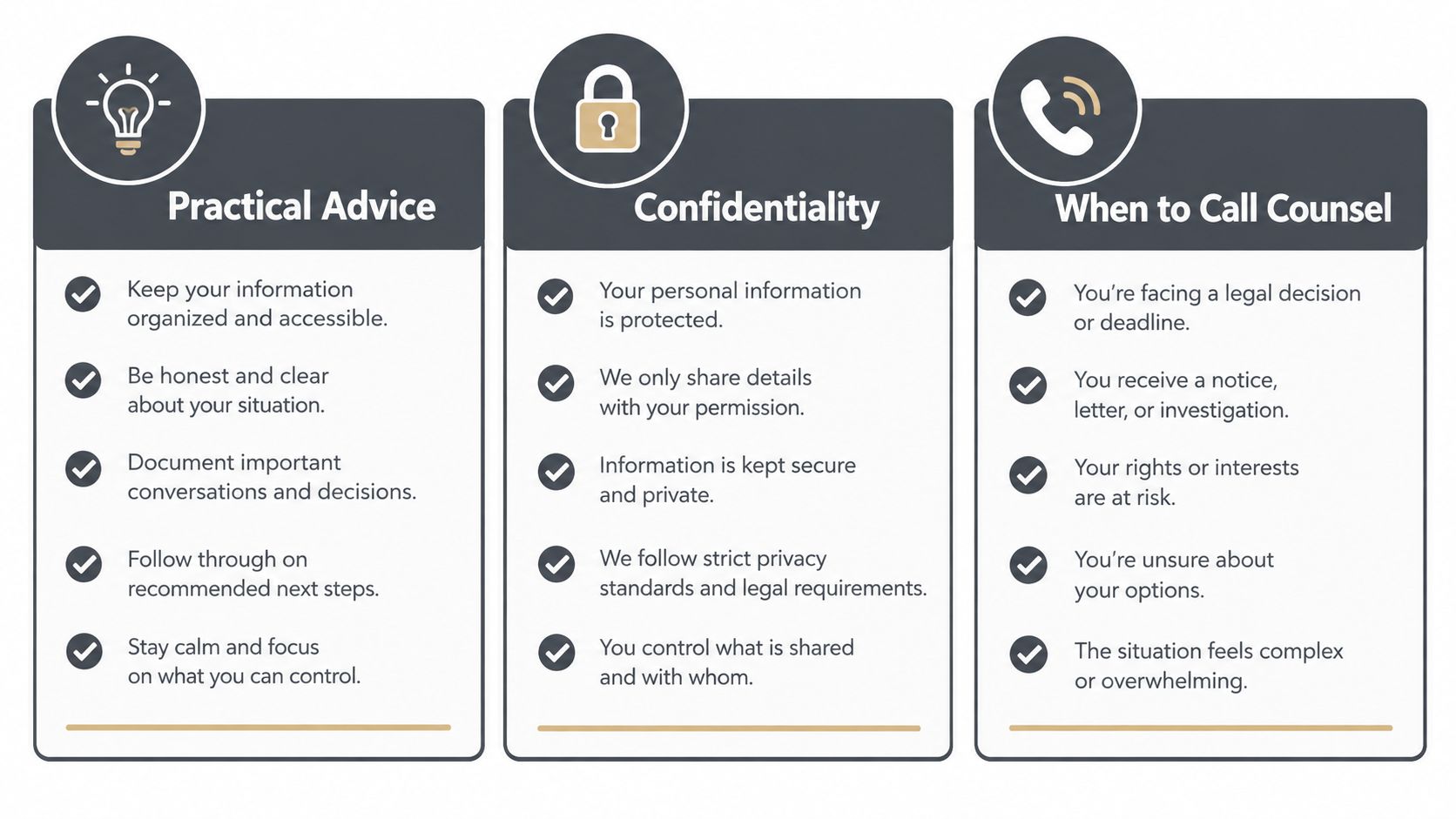
A post-award file should be organized as though it will become a court-enforcement file. Preserve the signed award, FINRA correspondence, pleadings, hearing exhibits, key testimony, settlement communications, witness contacts, and evidence relating to the respondent's assets. Witness memory fades, accounts move, and a collection lawyer may need to understand the merits record quickly if the respondent challenges the award.
Protect the information that still matters
Confidentiality depends on the wording of the parties' agreement and the award. A settlement clause may restrict disclosure of negotiation terms, while an award may be publicly searchable under FINRA's applicable rules. Don't assume that a public award permits unrestricted publication of every underlying document, and don't assume that a confidentiality clause removes every regulatory or legal disclosure obligation.
BrokerCheck treatment can also matter independently of the award amount. An award involving a financial professional may affect how customers, firms, regulators, or future employers evaluate the professional's record. Expungement relief, Form U5 language, and the public description of the dispute should be analyzed separately from payment collection.
Common mistakes include:
- Missing a deadline: Calendar receipt, payment, confirmation, and challenge dates as soon as the award arrives.
- Posting online: Public comments can complicate confidentiality, reputation, and later litigation.
- Accepting informal promises: Put installment terms, releases, interest, default rights, and security in writing.
- Treating vacatur as an appeal: Focus on statutory grounds, not disagreement with the panel's factual judgment.
- Ignoring respondent identity: Determine whether the award reaches the firm, an individual, or both.
A virtual legal assistant can help maintain the award file, organize correspondence, track deadlines, and prepare a document index. For firms that need administrative support without assigning those tasks to litigation counsel, a virtual legal assistant may provide a practical supplement. That support doesn't replace legal advice about confirmation, Rule 9554, asset discovery, or court filings.
When counsel becomes important
Counsel should be involved when the respondent refuses to pay, proposes a poorly documented discount, holds assets in another state, files a motion to vacate, or raises a jurisdictional objection. Legal guidance also becomes important when a non-signatory funder, affiliated entity, clearing firm, or individual broker may hold relevant assets or assert a competing position.
Kons Law represents investors and financial professionals in FINRA securities arbitration and handles related commercial litigation, collections, creditors' rights, and regulatory matters. The same counsel that understands the factual history of a termination, compensation, promissory-note, or Form U5 dispute can use that institutional context when the matter moves into confirmation and enforcement.
If you want to discuss your business law matter, contact Kons Law at (860) 920-5181. The firm can review your FINRA award, assess payment and confirmation deadlines, and develop a practical enforcement strategy. Visit Kons Law to request a confidential post-award strategy review.
