
You've received a draft commission sharing agreement, and the commercial team has already agreed on the split. Compliance is asking what the recipient does, operations wants to know where the money sits, and nobody has pinned down who handles a disputed payment after termination. Those questions matter more than whether the percentage looks competitive.
The split is usually the least important term. Actual exposure lies in what each payment buys, who recommended the investment, and whether the firm can produce records showing that compensation didn't steer client decisions.
What a Commission Sharing Agreement Does
Think of a restaurant bill with a service charge that goes into a separate tab, usable only for approved outside services. You still pay a single bill, but the recipient can't treat every dollar as unrestricted revenue. That's a useful analogy for a research-focused commission sharing agreement, although the actual arrangement involves client assets and regulatory controls.
An investment manager buys shares through an executing broker and pays a commission. The broker retains the execution component and credits the research component to a designated account, from which approved outside research providers are paid. The manager directs research spending within the applicable controls, rather than receiving cash to spend freely.
Identify the parties and their actual jobs
The core parties are the investment manager and executing broker. Some arrangements also involve an introducing broker, but its presence shouldn't obscure who executes trades, maintains the balance, approves providers, or sends payments.
A research provider may receive payment without being a party to the main agreement. The contract should therefore connect the manager's approval process to the broker's payment obligations, rather than assume the provider's invoice alone authorizes payment.
Why the regulatory history matters
The model became significant in UK and European markets as regulators pushed firms to separate research costs from bundled brokerage services. The original MiFID framework took effect in November 2007, and MiFID II became applicable on January 3, 2018, as described in the FCA's research-payment consultation.
MiFID II didn't abolish CSAs. It required research funding from firms' own resources or separately controlled Research Payment Accounts, with budgeting, disclosure, and governance requirements. That history explains why an old broker-administered form may not fit the framework governing a proposed arrangement today.
Practical distinction: A research CSA is a payment mechanism for eligible research, not a discount on trading.
How Commission Splits Are Structured
Commission split structures compared
| Structure | How the commission divides | Who controls the research balance | Main risk to check |
|---|---|---|---|
| Fixed-rate split | Set portion of each trade commission credited to research account | Investment manager through designated account | Balance may run ahead of or behind actual research spend |
| Research budget cap | Crediting stops at an annual budget; treatment of excess set by contract | Manager and executing broker jointly | Unused or excess balance handled inconsistently |
| Broker-held pool | Broker holds the balance and pays providers on instruction | Executing broker, on manager instruction | Weakest control over payment timing and reconciliation |
| Manager-directed credit | Each trade's credit assigned to a named research provider | Investment manager | Credit assigned to a provider not approved for research use |
These are drafting models, not interchangeable regulatory permissions. The parties still need to establish whether the proposed funding method is permitted for the relevant firm, clients, and jurisdiction.
Compare control, not just percentages
A fixed-rate split is straightforward to administer because the credit follows the trade. Its weakness is the connection to trading volume: more trading can produce more research credits even when the manager's research needs haven't changed. The agreement needs a process for identifying and resolving that mismatch.
A research budget cap puts the spending decision ahead of credit accumulation. That improves budget discipline, but the contract must explain what happens when the cap is reached. Continuing the same total charge without explaining the treatment of the excess leaves a material economic term unresolved.
A broker-held pool centralizes administration and provider payments. The trade-off is reduced direct control over payment timing, particularly if the manager must chase statements or cannot verify whether an instruction was completed. Require payment-status reporting, escalation contacts, and an accessible transaction history.
With manager-directed credit, each credit is assigned to a named provider. That creates clearer attribution, but it can also lock money into an outdated provider relationship unless the agreement permits reassignment and addresses rejected invoices.
Test what the recipient earns
The same total commission can appear inexpensive or costly depending on how the parties classify execution and research. Compare each component against what the recipient delivers, not against an attractive headline split.
In a separate insurance-distribution context, the FCA's broker-remuneration review found freeholders receiving as much as 30% of commission under some arrangements, with activities including collecting risk information, participating in claims, and collecting premiums. That isn't a securities pricing benchmark; it illustrates why a payment should correspond to identifiable services.
The more control the broker retains over the balance, the stronger the manager's evidence of authorized payments needs to be.
When comparing a proposed agreement with a standard form, read across each table row. Identify the service, locate the money, name the decision-maker, and test the failure scenario. An unexplained recipient share needs justification before signature.
Key Terms a Sound Agreement Must Define
A sound agreement translates commercial expectations into instructions that operations can follow. Under the FCA's joint-payment policy statement, relevant controls include separately identifying research costs, fairly allocating them, and maintaining information available to the regulator.

Put operational instructions in the contract
Eligible research. Identify permitted research categories and the process for reviewing mixed-service invoices. A definition covering anything useful to the manager leaves the payment boundary unclear.
Approval authority. Name the role authorized to approve providers and spending, including delegated limits. Approval by the investment team is weak drafting if nobody knows which team member can bind the firm.
Broker reconciliation. Specify the statement format, ledger fields, reconciliation owner, and exception process. Requiring periodic reconciliation without naming the records or responsible person isn't enough.
Payment timing. Set a payment schedule and identify what constitutes an approved, complete invoice. Payment when practicable gives neither operations nor the provider a dependable deadline.
Unused balances. Address carry-forward, return, or other permitted treatment, including the approvals needed. Silence shouldn't leave the broker free to decide who receives the remaining value.
Error correction. Establish a correction deadline, escalation route, and responsibility for losses or charges caused by mistakes. A general promise to cooperate doesn't resolve who funds a shortfall.
Audit rights. Give the firm access to supporting records and address regulator access where relevant. Access only to summary balances won't establish whether individual payments were authorized.
Termination effects. Specify final statements, pending invoices, balance disposition, and continuing record access. Immediate termination without transition mechanics can strand both credits and unpaid obligations.
Controls against subsidy. Prohibit research credits from paying unrelated service charges and require review of bundled invoices. A broad administrative-services category can otherwise conceal ineligible spending.
Allocation key. State how shared research costs are assigned across funds and mandates using documented use and relevance. Charging whichever account has available credits is not a defensible allocation method.
Make the records reproducible
Use at least monthly reconciliation as an operational benchmark, comparing broker-confirmed commissions, the internal research ledger, and approved provider invoices or payment instructions. Escalate unexplained differences before issuing client reports, rather than carrying an unidentified adjustment forward.
Keep execution charges and research amounts in separate fields. Preserve the original statement, approval, invoice, correction history, and payment confirmation so a reviewer can reconstruct the transaction without relying on someone's memory.
Where the document also covers advisor production credits or team compensation, distinguish those provisions from research funding. The considerations for a broker compensation agreement help identify those separate earning and payment questions.
The practical test is simple: could the firm produce the supporting records tomorrow?
Following One Trade Through an Agreement
Consider a hypothetical 10,000-share order with a $400 total commission. The figures below illustrate bookkeeping mechanics, not a market rate or a prescribed split. Assume the arrangement is permitted and the firm has approved its research budget and allocation policy.
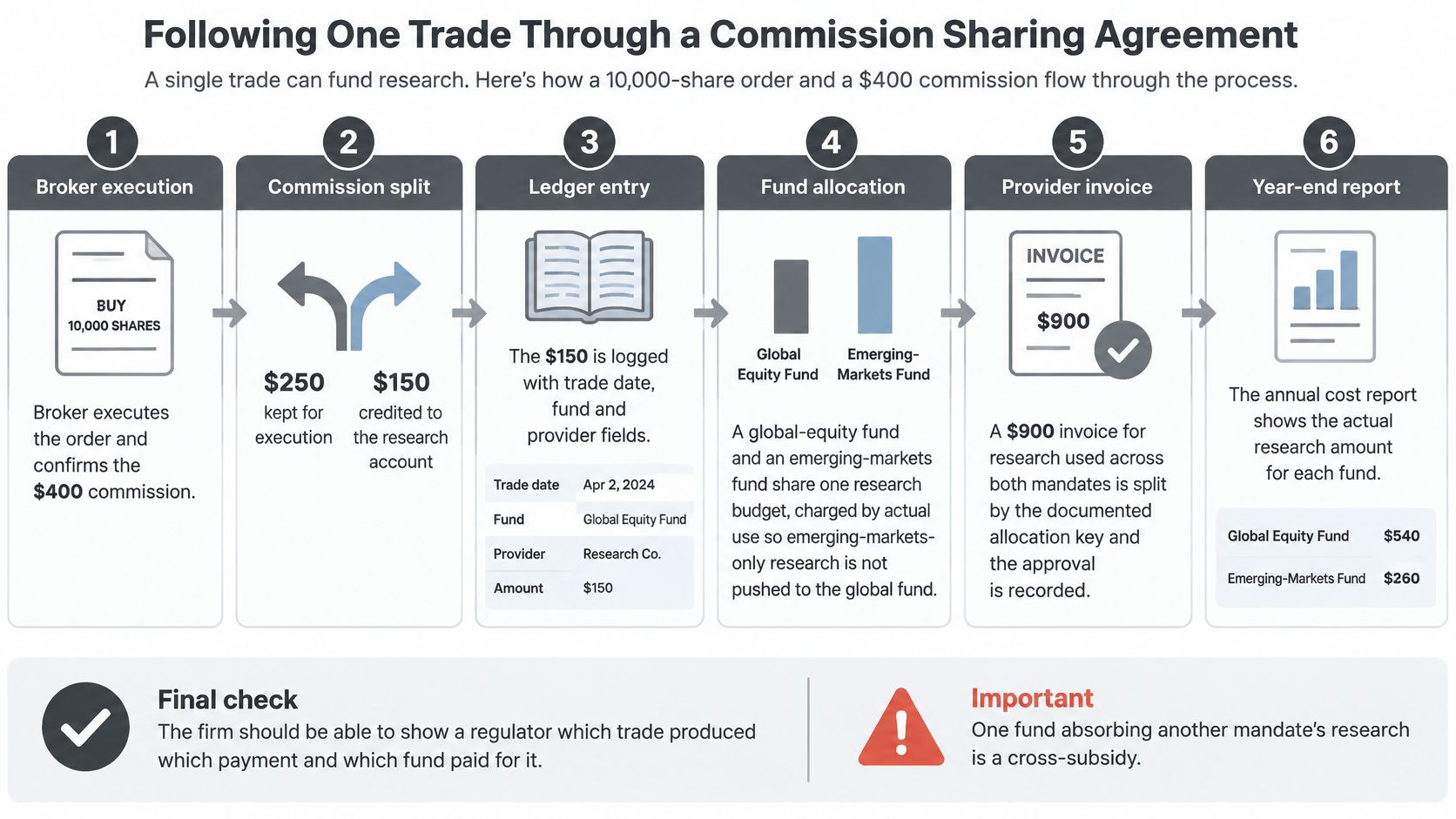
Trace the records from execution to reporting
Confirm execution. The broker executes the hypothetical order and confirms the $400 commission. Operations retains the trade identifier and confirmation so the charge can be matched to the correct account.
Apply the contractual split. The broker retains $250 for execution and credits $150 to research. The statement should distinguish those components rather than show only an undifferentiated commission.
Post the research credit. Record the $150 in the research ledger with the trade date, originating fund, and provider or allocation fields. If the provider hasn't yet been selected, preserve that status rather than inserting an unsupported attribution.
Apply the fund allocation policy. A global-equity fund and an emerging-markets fund share a research budget, but research used exclusively for the emerging-markets mandate belongs with that mandate. Don't charge the global fund merely because its trading generated available credits.
Approve and allocate the invoice. A hypothetical $900 provider invoice arrives for research used across both mandates. Apply the documented allocation key, record the reason for the allocation, and retain approval before issuing the payment instruction.
Report the actual cost. At year end, prepare the actual research amount for each fund from the reconciled records. Distinguish credit accumulation from research expenditure so the client report doesn't confuse money reserved with money spent.
Preserve the allocation evidence
For shared research, retain the provider, invoice, mandate, strategy, amount, approval, and payment-date fields. A general statement that both portfolio teams benefited is weaker than a documented explanation of the research's relevance to their respective mandates.
A pooled payment account doesn't justify pooled accountability.
The firm should be able to show a regulator which trade generated a credit, how that credit entered the payment balance, and which fund ultimately bore the research expense. That doesn't require pretending every invoice is funded by an isolated trade when credits are pooled; it requires a reliable audit trail through the pool.
A fund absorbing another mandate's research expense creates a cross-subsidy. Correct the allocation rather than treating an available balance as permission to spend it.
Regulatory Duties That Apply to the Split
Is the payment a commission, referral fee, administrative reimbursement, or impermissible compensation, and which entity must disclose or report it? Answer that before negotiating the percentage. A contract label doesn't establish the payment's regulatory character.
The analysis should identify the payer, recipient, underlying service, and recipient's role in recommending investments. An introducing broker, clearing firm, affiliated adviser, and platform may participate in the same commercial structure without having identical obligations.
Match the trigger to the responsible entity
Disclosure and notice requirements by rule
| Rule or guidance | Trigger | Required action |
|---|---|---|
| FINRA Notice to Members 03-63 | Broker-dealer expense-sharing agreement where expenses are not recorded on required reports | Notify designated examining authority with agreement date and all parties; provide agreement on request |
| SEC 2003 guidance | Third party pays or agrees to pay a broker-dealer's expense | Make, keep current, and preserve a written agreement |
| SEC Form ADV Part 2A | Non-client gives an investment adviser an economic benefit for advisory services | Disclose the arrangement, related conflicts, and mitigation measures |
The FINRA notification requirement is conditional, not a blanket notice rule for every agreement involving shared money. When the reporting trigger applies, the notification must identify the agreement date and all parties, and the examining authority must be able to obtain the agreement.
The SEC expense-sharing guidance addresses obligations moved outside the broker-dealer's own expense payments. Identify the covered expenses, responsible parties, and accounting treatment rather than relying on an affiliate's informal promise to pay.
Form ADV analysis concerns the adviser's economic benefit and resulting conflict. Contractual disclosure between commercial parties isn't a substitute for an appropriate client-facing explanation.
Apply the correct jurisdictional framework
For firms operating under the FCA joint-payment framework, the Legal 500 UK compliance update describes disclosure of the arrangement and research policy, expected annual client costs ex ante, actual research costs ex post in annual reporting, and fair allocation across affected mandates. European firms should separately confirm their applicable national requirements rather than assume UK permissions apply throughout Europe.
Business models involving proprietary trading require a separate perimeter assessment. The MyFundedCapital guide to prop firm regulation provides background for that distinct inquiry, not authority for treating a prop-firm payout as a research CSA.
Keep a regulatory file containing:
- Signed agreement. Include amendments and schedules.
- Classification memo. Explain each payment's purpose and responsible entity.
- Client disclosures. Preserve approved versions and delivery records.
- Notification record. Retain applicable submissions and regulator correspondence.
Assign ownership of that file within the firm's broader regulatory compliance requirements.
Conflicts Regulators Look Past the Split
In its action involving Commonwealth Equity Services, the SEC alleged that, from at least 2007, the firm received part of payments a broker received from mutual-fund companies when client assets were invested in specified share classes. The SEC's litigation release alleged receipts of more than $100 million between July 2014 and December 2018, and inadequate disclosure that less-expensive share classes or investments generating no revenue-sharing payments were available.
The allegations illustrate a conflict in product and share-class selection, not a finding that every research CSA creates the same problem. The relevant question is whether the recipient's compensation gave it a reason to recommend one investment over another.

A disclosed formula doesn't prove neutral selection
A contract can accurately describe the payment formula while leaving the recommendation process untested. Disclosure and supervision perform different jobs. Clients need an understandable explanation of the incentive; supervisors need evidence that recommendations satisfy the firm's standards despite it.
Retain evidence that addresses the decision itself:
- Product-neutral selection criteria. Document investment fit, costs, available share classes, and service needs without making participation in revenue sharing a qualifying criterion.
- Supervisory testing. Review recommendations for concentrations in participating products and investigate exceptions rather than merely counting completed disclosures.
- Alternative-selection records. Preserve the reasons lower-cost or nonparticipating choices were accepted or rejected.
The analysis should be specific enough to explain a recommendation without relying on the advisor's compensation arrangement. A checklist completed after a complaint is much less useful than contemporaneous notes.
Give supervisors enforceable contract rights
Define eligible products and prohibit steering based on the sharing payment. Require access to the recommendation, transaction, and compensation data needed to test compliance, subject to applicable confidentiality and privacy controls.
Address reconciliation, disputed payments, and clawbacks with clear triggers rather than unrestricted discretion. Provide termination rights after relevant regulatory findings, while preserving access to historical records.
A workable conflicts-of-interest disclosure should explain the economic incentive in language the client can understand. It should accompany a supervised selection process, not serve as permission to favor the paying product.
Confirm the Agreement Before You Sign
Use a go/no-go review during the final week before signature. A commercially attractive arrangement isn't ready if operations cannot administer it or compliance cannot explain its payments.
Run the signature gate
Mark every term. Classify each item in the ten-term checklist as agreed, blank, or disputed. Don't sign while a material term remains blank or an unresolved dispute is hidden in an unfinished schedule.
Test sample records. Request a month of sample broker statements and reconcile them to the research ledger and provider invoices. Require an explanation for every unmatched entry before accepting the reporting process.
Verify client disclosures. Confirm that applicable disclosures identify the research payment, expected annual cost, and allocation method. Compare them with the actual contract rather than an earlier proposal.
Obtain compliance sign-off. Approve the written classification memo and its reasoning for each payment. Approval should identify unresolved conditions rather than acknowledge receipt.
Arrange legal review. Send the draft to a business law attorney before signature. Resolve earning criteria, reversals, termination balances, and payment disputes before they become a compensation dispute.
Establish the relationship before sharing sensitive details
Kons Law is a business law firm whose Commercial Transactions practice drafts and reviews contracts and advises on sales agreements. Contract review should address both the commercial bargain and whether the written obligations match the proposed operating process.
Don't send confidential or sensitive information to us until you've spoken with an attorney and a written engagement letter establishing an attorney-client relationship is in place. Information sent without an attorney-client relationship is not privileged.
Our Commercial Transactions practice offers contract drafting and review to help clarify payment obligations, approval rights, and exit provisions in a proposed commission sharing agreement. Visit Kons Law to learn about the firm. If you want to discuss your business law matter, contact Kons Law at (860) 920-5181.
