
You're buying out a retiring partner, and the handshake is done. The price is agreed, the clients like you, and the lender says the money's available. Then the documents arrive, and the key questions start. Who's borrowing, you or a new LLC? What collateral secures the loan? If clients leave, if you leave, or if the platform sells, who still owes what?
That's where an Advisor Financing LLC earns or loses its keep. It's not magic protection, and it's not just a name on a loan. It's a container. What you put in it, how you allocate its debt for tax purposes, and how carefully you keep client assets out of it will decide whether the structure helps you or creates a second problem on top of the debt.
What an Advisor Financing LLC Holds and Who Repays It
Say two partners own a practice and one is retiring. The continuing partner doesn't want to borrow personally for the full buyout price, so she forms a new LLC to borrow the funds and acquire the departing partner's membership interest. The LLC now holds the loan and the acquired interest. The lender looks to the practice's fee revenue for repayment, but it may also require her personal guarantee.
That distinction matters in every version of this structure. The borrower is the LLC. The lender funds the purchase, buyout, refinance, or advance. The guarantor, if there is one, is usually the advisor personally. If you blur those roles in the documents, you'll blur them in a dispute too.

Common Advisor Financing LLC Uses
| Use | What the LLC holds | Who repays | Main risk |
|---|---|---|---|
| Practice acquisition loan | Purchased book of business or practice assets | The LLC, from advisory fees | Revenue decline after client attrition |
| Partner buyout | Membership interest of a departing partner | Continuing owners or the LLC | Valuation disputes and personal guarantees |
| Debt refinancing | Existing practice notes consolidated into one loan | The LLC | Higher total interest over a longer term |
| Receivables financing | Advisory fee receivables | The LLC, from collected fees | Fee timing and client attrition |
| Transition loan holding | Forgivable advance paid to an advisor | The advisor, if forgiveness conditions fail | Acceleration of the unforgiven balance |
Read the repayment column first. It tells you whether repayment depends on revenue the LLC controls or on a guarantee you sign personally. Before you sign anything, read our explanation of what a promissory note commits you to and compare its terms with the LLC's operating agreement, because those documents have to tell the same story about who's obligated.
Seller financing shows up in many buyouts, sometimes alongside bank debt. When the retiring partner takes part of the price over time, use practical guidance to spot seller financing red flags before you agree to subordination, default, or client transition terms that favor the seller.
Choosing Between Conventional and SBA Routes
A buyer LLC can use a conventional bank loan or an SBA backed loan for an acquisition. The right route depends on collateral, borrower eligibility, purchase price size, and how quickly you must close. Don't compare headline rates alone.
Ask the lender for written answers on collateral requirements, guarantee terms, prepayment limits, and total interest over the full term. A lower monthly payment can hide a guarantee or prepayment restriction that costs you far more if you refinance or sell early.
How to Form an Advisor Financing LLC Step by Step
Forming the LLC is the easy part. Forming it in the right order, with documents the lender and your tax advisor can both work from, is where most buyers rush and create clean up work later.
Define the purpose and borrower. State exactly which loan, buyout, or receivable the LLC will hold. The operating agreement and lender documents must match that purpose, and vagueness here lets a lender argue later that other assets were meant to be included. The common mistake is using a generic purpose clause borrowed from an unrelated business.
Choose the formation state and file articles of organization. The formation state often governs the operating agreement and member disputes. Pick it deliberately, not by habit. Filing in a state whose LLC Act doesn't fit your transfer or fiduciary provisions creates friction you won't notice until a partner exits.
Draft the operating agreement. Cover member contributions, liability allocation, distribution rules, transfer restrictions, and what happens when a member withdraws. This is the document lenders read closely. Signing a loan before the agreement addresses debt allocation is the most expensive shortcut in this process.
Obtain an EIN. Get the Employer Identification Number from the IRS before opening any bank account. Using a personal Social Security number or the practice's existing EIN undermines the separation you're trying to create.
Set the tax classification. A multi member LLC is generally taxed as a partnership by default. Confirm with a tax professional whether an election changes the analysis for your ownership and compensation plan. Guessing here can change how debt affects each member's basis.
Open a separate bank account. Open it in the LLC's name, apart from the advisory practice's client accounts and operating account. Commingling borrowed funds with practice cash makes lender audits and tax reporting harder from day one.
Build a liability schedule. List principal, interest, guarantors, collateral, and payment priority for every obligation. Update it at closing, not from memory months later. Lenders examine this schedule because it shows whether you understand your own stack of debt.
Model allocations before closing. Obtain a partnership tax analysis and model debt allocations under realistic cash flows. If the model only works at peak revenue, it doesn't work. Closing first and modeling later leaves you negotiating amendments with a lender who has no reason to agree.
Our overview of LLC formation in Connecticut covers state filing basics that sit alongside these financing steps. Use it for formation mechanics, then return to the lender and tax questions that are specific to an advisory practice.
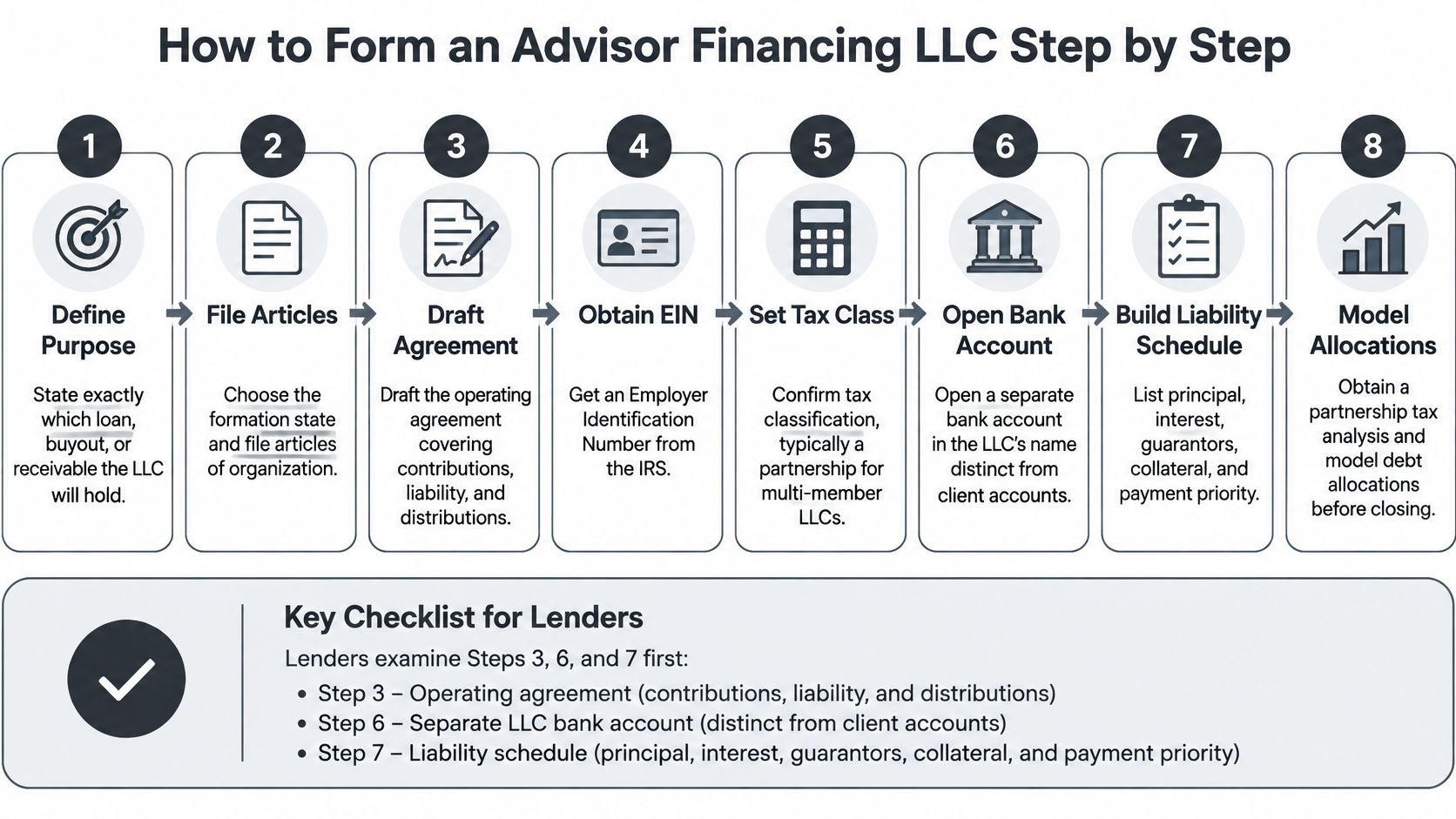
Lender focus: Steps 3, 6, and 7 are the ones lenders examine first. A clean operating agreement, separate account, and current liability schedule signal a borrower who will report accurately after closing.
Don't treat that checklist as paperwork. I would hold a closing over a missing liability schedule before I would hold it over a minor filing delay, because the schedule drives tax basis, covenants, and guarantee exposure for years. Get those three items right and the rest of the file usually falls into place.
Keeping Client Assets Out of the Financing Structure
Many advisors assume a lender's control rights are harmless because the lender never intends to touch client money. Intent isn't the test. Custody can arise from authority, not just possession, and a financing LLC that's affiliated with your advisory firm can pull custody obligations into a deal that was supposed to be about business assets only.
Under the principles in the SEC custody rule guidance, an investment adviser can have custody not only by physically holding client funds or securities, but also through direct or indirect authority to obtain possession or dispose of them, and custody can arise through a related person or affiliated entity. Where custody exists, that guidance generally requires use of a qualified custodian, client notifications, and, subject to exceptions, an annual surprise examination by an independent public accountant.
That means your financing LLC shouldn't receive client assets, control client account disbursements, or pledge client securities as collateral unless you've analyzed the arrangement under the Advisers Act custody framework. A cash sweep, lockbox, or default remedy that reaches the wrong account can be read as indirect access to client property.

What Collateral Should Say Instead
Financing documents should name collateral as the borrower's own business assets. That includes receivables, equity interests, equipment, and contract rights. The same documents should expressly exclude client funds, securities, and custodial accounts.
Don't rely on silence. If the security agreement grants a lien on all accounts and all general intangibles without a carve out, you've invited an examiner and a lender to argue about scope at the worst possible time. Write the exclusion into the grant clause, the account control agreement, and any lockbox instructions.
Separation That Holds Up in Practice
- Separate bank accounts: The LLC's accounts stay apart from the registered investment adviser's client account infrastructure, with no shared sweep instructions.
- Separate bookkeeping: Borrowed funds, operating cash, and client related flows get distinct ledgers and reconciliations.
- Distinct authorization matrix: The people who can move LLC money aren't automatically the people who can direct client disbursements.
- Separate payment controls: Loan payments come from business revenue after fees are properly earned and collected, not from client assets in transit.
Keep the lender's remedies pointed at the business you own, never at property you hold for clients.
This separation also produces a cleaner audit trail for Form ADV disclosures, compliance testing, and lender diligence. In a buyout, that clarity is especially valuable because the departing partner, the continuing owners, and the lender all have different interests in the same revenue stream. Clean accounts prevent a valuation fight from becoming a custody problem.
Partnership Tax Treatment and Debt Allocation
A retiring partner's buyout can look clean commercially and still produce a tax bill. The LLC borrows, pays the departing member, and a year later distributes cash to the continuing owners. If those owners' tax basis has not kept pace with the distributions, part of that cash is taxable gain.
When an LLC is taxed as a partnership, debt allocated to a member changes that member's outside tax basis. Basis sets how much loss the member can deduct and whether a distribution is tax free. The allocation, not the face amount of the loan, decides whether the financing helps or traps the continuing owners.
Partnerships report each partner's share of liabilities and capital on Schedule K-1 and related schedules, as described in the IRS Form 1065 instructions. Financing proceeds should be tracked by member and by purpose so the return matches those liability and capital figures. Related interest belongs in the same records. Reconstructing the trail after a buyout leaves the return position thin.
How Debt Events Change Member Basis
| Event | Effect on member basis | Action before it happens |
|---|---|---|
| Distribution exceeds member basis | Excess can create taxable gain | Model basis and distributions together before paying out |
| Debt allocated to a member | Basis increases | Document the allocation in the operating agreement and liability schedule |
| Debt repaid | Basis decreases | Track principal payments by member and recompute basis each year |
| Guarantee released | Basis decreases and future exposure ends | Record the release and confirm the allocation change with tax counsel |
| Member withdraws with unpaid debt share | Allocation shifts to remaining members | Address buyout terms and debt assumption in the operating agreement |
Every benefit from allocated debt reverses. A documented increase in allocated debt can raise basis now. Repayment, or a released guarantee, lowers it later. Members who spend distributions without watching that reversal can owe tax in a year when cash is already committed to the note.
The Document Set That Supports the Tax Position
The liability schedule should identify principal, interest, guarantors, payment priority, collateral, and each member's share of recourse and nonrecourse debt. The operating agreement should state how liabilities are allocated, who bears economic risk of loss, and how refinancing, capital calls, distributions, and withdrawals change those shares. Those documents, and the basis they support, carry more weight than the label on the LLC or the size of the advance.
Buyers assembling a diligence file can also use acquisition cost guidance from Dealmaker Wealth Society to organize purchase price and closing cost questions alongside the tax work. Keep that commercial checklist separate from the partnership analysis. A cost can be real for deal purposes and still be treated differently for basis.
Before closing, obtain a partnership tax analysis, model allocations under projected cash flows, and check the model against lender covenants and advisor compensation terms. If a covenant forces extra principal payments, basis falls faster. If compensation is paid as distributions, basis is tested sooner. I recommend modeling those interactions in one schedule rather than in separate spreadsheets owned by separate advisors.
Recruiting Advances and the Clauses That Trigger Repayment
The headline amount of a recruiting advance is rarely the whole risk. Advisors count the check they received and the years left on the schedule. Firms read the clauses. After a departure, the balance is whatever those clauses produce once acceleration, interest, and fees are applied.
A typical arrangement advances cash at hiring, then forgives portions over a multiyear period, often seven to ten years, while conditioning forgiveness on continued employment, good standing, and sometimes production requirements, as explained in Winthrop's guide to forgivable loans. Termination, resignation, production shortfalls, alleged policy violations, or disputed compensation may accelerate the entire unforgiven balance. A retention tool becomes a collection claim at that point.
If the advance sits in an advisor financing LLC, the loan size still is not the main risk. The operating agreement, the note, and the tax character of the advance decide who owes what. Ask who signed, whether the LLC or the advisor is the obligor, and whether forgiveness is earned compensation or a loan that remains unless conditions are met. Those answers control repayment, when income is recognized, and whether client assets stay outside the claim. A retiring partner's buyout can reopen the same exposure. The departing member treats forgiven amounts as closed. The firm, or the members who remain, treat a failed condition as a debt that follows the buyout and can pull custody questions and tax cost into a transaction that looked like a clean exit.
Before comparing offers, advisors do their own diligence on firms, books, and markets. Structured research habits like those in Bizbe's guide to market intelligence are useful for that business review, but they do not replace clause review. Market research tells you whether the move makes sense. The note tells you what leaving costs.
Clauses That Trigger Repayment of a Forgivable Advance
| Clause | What it typically says | What to test |
|---|---|---|
| Forgiveness schedule | Portions forgiven over seven to ten years | Balance owed on the actual departure date |
| Continued employment condition | Forgiveness ends on resignation or termination | Whether termination without cause still accelerates repayment |
| Production requirement | Minimum revenue or production each year | Whether shortfalls are measured by the firm's own figures |
| Acceleration clause | Entire unforgiven balance due on triggering event | Whether the trigger is defined and whether notice is required |
| Attorneys' fees and interest | Fees and interest added to the balance | Whether the contract authorizes them for the firm and for the advisor |
What a clawback provision does is a useful starting point for reading these terms as repayment rights, not as background boilerplate. Pay particular attention to whether forgiveness is described as earned compensation over time or as a loan that disappears only if conditions are met. Those labels drive tax, negotiation, and defense arguments.
Procedure Changes Your Leverage
FINRA arbitration may be required. An award must be paid promptly, and noncompliance can lead to suspension. That timetable compresses settlement. An advisor who waits for an award before arranging payment or a challenge has usually waited too long.
Use this decision sequence before departure. Distinguish true forgiveness from contingent compensation. Calculate the balance on your likely departure date, not today's date. Test whether acceleration and attorneys' fees are contractually authorized for the specific event the firm claims occurred. Then check whether firm conduct, such as withholding bonuses or changing production expectations, supports a defense or counterclaim.
Departure math: Calculate vesting, interest, fees, and any offsetting compensation in one number before you resign. If you can't produce that number, you don't yet know the price of leaving.
Recruiting bonus disputes follow a recurring pattern. The advisor treats forgiven portions as settled, the firm treats a condition as failed, and both sides fight over a balance neither calculated the same way. Documents, production records, and compensation statements usually decide more than anyone's memory of recruiting conversations.
Transition Financing When Advisors Move or Platforms Sell
An advisor signs a transition note at a wirehouse, builds a book, then moves to an independent RIA for ownership and control. The clients may follow. The note follows too, unless the new platform, the advisor, and the old firm have allocated it in writing. The question is no longer who recruited whom. It's who bears repayment and performance risk after the move.
Four instruments get confused in these deals. A personal recruiting note belongs to the advisor. Entity level acquisition financing belongs to the buying practice or platform. Seller financing with an earnout ties payment to retained revenue. Forgivable transition assistance paired with guarantees can look like platform support while still exposing the advisor personally. Name each instrument separately in the closing documents.

Public filings show why platforms treat these amounts seriously. In the SEC filing for LPL Financial Holdings, transition assistance loans tied to 2026 advisor transitions are referenced with their financing costs, and such loans can be amortized as transaction related assets and financed with associated interest and issuance costs. That's deal economics, not a perk, and platforms protect deal economics in their documents.
Questions to Resolve Before the Move
- Change in control: Does forgiveness survive if the platform is sold, or does a sale count as termination?
- Book reassignment: What happens if accounts are reassigned, a team splits, or client portability falls short of the valuation used at signing?
- Service changes: What happens if custody or technology services change in ways that affect production or client retention?
- Status change: What changes when the advisor becomes an owner rather than an employee?
- Conflicts: Does the note conflict with restrictive covenants or regulatory obligations at either firm?
Advisors planning the ownership side of a move should also read our guidance on succession planning for financial advisors, because transition debt and succession rights often collide at retirement. A note that accelerates on a status change can undermine a succession plan that depends on gradual ownership transfer.
Legal review has to cover corporate structure, tax and accounting treatment, employment status, and exit rights, not only the promissory note. I would not let a client sign platform financing until those four areas point in the same direction. If the accounting treats assistance as a recoverable asset and the employment documents treat departure broadly, expect the platform to act accordingly.
Confirm the Structure With Counsel Before You Sign
Two reviews catch problems the earlier document checks can miss. First, apply the state formation rules that govern your LLC's internal affairs, including member withdrawal, fiduciary duties, charging orders, and amendments. A financing structure that works under one state's LLC Act can produce different default rules under another's, especially when the operating agreement is silent.
Second, read lender covenants as operating instructions, not closing filler. Reporting deadlines, debt service coverage, limits on additional debt, owner compensation caps, and cross default clauses can force cash decisions that change tax basis, distributions, and guarantee exposure. Ask the lender what triggers a technical default, how cure rights work, and which financial statements must be delivered, then calendar those duties before funds arrive.
State law and covenants also intersect at exit. If a member withdraws, sells to an outside buyer, or defaults on a capital call, state defaults and lender consent rights may both apply. Resolve that overlap in the operating agreement and loan documents while everyone still wants the deal, not after a partner announces retirement.
Kons Law's Corporate and Business Law practice assists clients in forming and structuring their businesses, drafting and negotiating contracts, managing mergers and acquisitions, and ensuring ongoing compliance with complex regulations. If you want to discuss your business law matter, contact Kons Law at (860) 920-5181. Prospective clients can schedule a confidential consultation by calling the firm or filling out its online form, and reviewing your documents before you sign is the most efficient next step.
If you're forming an Advisor Financing LLC, buying out a partner, or facing repayment of a recruiting or transition advance, Kons Law can review the operating agreement, loan, guarantee, and transition documents as one connected structure. Call to schedule a confidential consultation so you can sign with the repayment, tax, and custody consequences mapped out in advance.
