You're staring at a ledger that doesn't match, a repair bill the other side says is yours, or a rent demand for space you can't fully use. The lease is long, the cure clock may already be running, and every email you send could help or hurt you. That's the normal starting point for commercial lease dispute resolution, and the lease wording, not who feels more wronged, will usually decide which route you're allowed to take first and how much negotiating power you have.
Compare the Four Routes to Resolve a Lease Dispute
Most leases don't give you a free choice between talking and suing. They force a sequence. Read the notice, cure, mediation, arbitration, and forum provisions before you pick a route, because skipping a required step can get a filing stayed or dismissed.
Resolution routes compared for commercial leases
| Route | Typical cost | Typical time | Confidential | Outcome | Your control |
|---|---|---|---|---|---|
| Negotiation | Low, mainly staff and counsel time | Weeks | Yes | Binding only once signed | High |
| Mediation | Low to moderate, neutral fee plus counsel | 1-3 months | Yes | Binding only once signed | High |
| Arbitration | High, arbitrator fees plus counsel | Several months | Usually yes | Binding award with limited appeal | Medium |
| Litigation | Highest, filing, discovery and expert fees | 1-3 years including appeals | No, public record | Binding judgment with full appeal rights | Low |
These ranges vary with lease size, county, and case complexity. A single CAM audit is not a build-out case with competing engineers.

What each row feels like in practice
Negotiation is direct talks, often through counsel. It's the cheapest and fastest route, it's private, and you can trade things a court can't order, such as a payment plan for a term extension. Nothing binds you until you sign, which is both the advantage and the risk.
Mediation adds a neutral facilitator who can restructure rent, repairs, or renewal terms but can't impose a decision. You keep control, and you can walk away. That also means one holdout ends the day with no result.
Arbitration produces a binding award with limited appeal, and it's available only when the lease or a separate written agreement requires it. It's usually private and faster than court, but arbitrator fees add up and a bad award is hard to undo. The trade-offs are explored in alternative dispute resolution compared with litigation.
Litigation gives you a public court process, full discovery, injunctive relief, and full appeal rights. You get the least control over timing and the highest cost.
Practical rule: I would start with the cheapest route the lease permits, and move to a more formal route only when the cure or escalation period has run out.
How to Preserve Rights and Build Your Record
Most power is lost before any route is chosen. A defective notice, a missing amendment, or an oral concession can undo a strong claim on the merits. Work in this order.
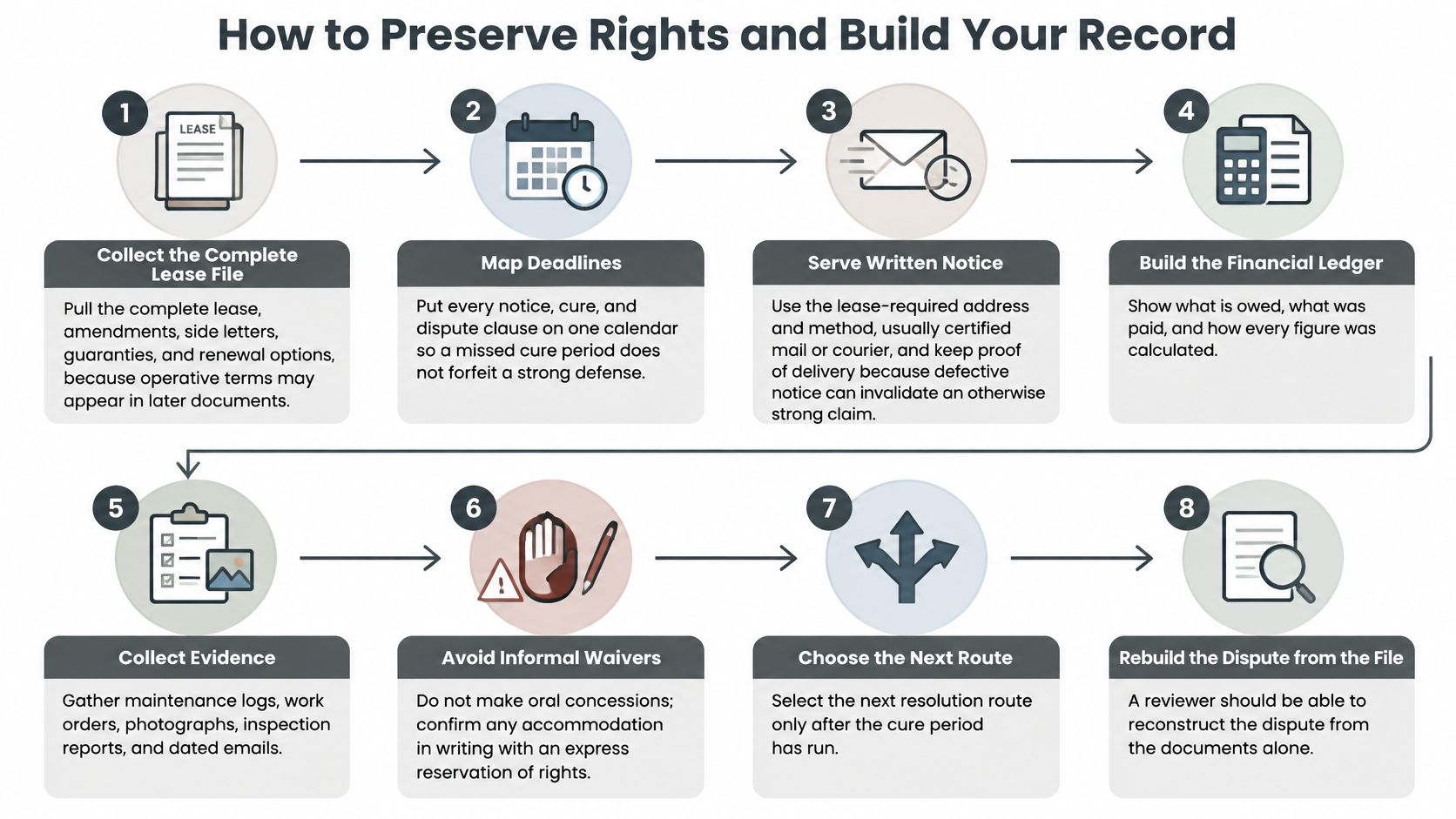
Collect the complete lease file. Pull the lease, amendments, side letters, guaranties, work letters, and renewal options. Operative terms often sit in a later document, and arguing from an incomplete file wastes your first, best demand.
Map every deadline on one calendar. List notice periods, cure days, audit windows, renewal notice dates, and escalation deadlines. A missed cure period can forfeit a strong defense even if the underlying bill was wrong.
Serve written notice exactly as the lease requires. Use the specified address and method, usually certified mail or courier, and keep proof of delivery. Courts hold commercial parties to the method they agreed to, so an email to a property manager may not count.
Build a ledger that shows its math. Show rent, CAM, taxes, late fees, credits, and payments by month, with the lease section behind each line. A mediator or judge can't credit a total you can't rebuild from invoices and operating statements.
Collect condition evidence while it still exists. Save maintenance logs, work orders, photographs, inspection reports, access logs, and dated emails. For service claims, utility data and building notices matter as much as testimony, because they show frequency, duration, and whether you gave notice and a chance to cure.
Don't make oral concessions. Confirm any accommodation in writing, state it's temporary if that's the intent, and add an express reservation of rights. Informal waivers create modification and estoppel arguments later.
Calculate damages under alternative interpretations. Run the numbers as you read the lease and as the other side reads it. That gives you a settlement range tied to auditable assumptions instead of a guess.
Choose the next route only after the cure period runs. Acting early can breach the escalation clause you need to enforce. Patience here preserves the forum you want.
The file test
Your file is ready when a reviewer who knows nothing about the property can rebuild the dispute from the documents alone. If the story depends on a phone call only you remember, it isn't ready.
Why Most Lease Disputes Settle Before Trial
More than 80% of commercial property disputes are resolved through negotiation, mediation, or arbitration rather than full litigation, according to RNC's commercial lease dispute overview. Mediators describe a similar pattern in their own caseloads, although mediated outcomes are private, so those reports reflect practitioner experience rather than a published tally.

Why settlement usually wins
The mechanics are simple. Each side exchanges numbers, a neutral tests the assumptions behind them, and the parties restructure rent, operating expenses, repairs, defaults, or renewal terms in ways a judgment can't. Before the first session, run your exposure both ways: what you recover if you win, and what the dispute costs if the space sits dark or the tenant walks. Landlords testing whether a settlement payment beats a vacancy sometimes sanity check the return using the best rental investment calculators for 2025, then replace the generic inputs with their actual ledger.
Say a tenant withholds part of its rent over repeated HVAC failures. In mediation, it agrees to cure arrears over three months, the landlord commits to a dated repair schedule with a defined rent credit if a milestone is missed, and both sign a five year extension at a reset rate. The tenant drops its offset claim. No court would have crafted that package in one order.
A soft market sharpens the same math on the landlord's side. When the alternative to a discounted settlement is months of vacancy and a reletting campaign, restructuring rent or repair obligations beats winning a judgment against a struggling tenant.
When settlement fails
Mediation can't force a result. Settlement also stalls when one side wants a precedent for other tenants, the lease gives no clear remedy for the condition claimed, or a landlord needs possession quickly and can't wait for staged talks. Fraud and guarantor disputes can harden positions too. In a market slump, the tenant's operational claim and the landlord's distress claim often collide, and the deal that emerges depends less on who is right than on which route the lease has already left open.
Settlement is most likely when both sides face costs larger than the amount truly in dispute and a neutral can reframe a breach argument as a future operating deal.
Prepare a settlement number tied to auditable assumptions before the first session. Bring the ledger, the cure notice, and your walk away alternative. If your number is just a discount off the demand, a good mediator will find that out in the first caucus.
Drafting Dispute Clauses and Connecticut Forum Rules
Draft the dispute clause before any conflict, because it decides which routes are open and how fast they move. A clause that says only that the parties will act in good faith, with no deadlines and no forum, invites a procedural fight before anyone reaches the merits.
A working clause specifies the sequence, the days allowed at each step, how notice is delivered, where the case will be heard, which law governs, how decision makers are chosen, and who pays fees. For Connecticut leases, coordinate that language with Connecticut commercial lease laws rather than copying a form from another state.
Dispute clause elements and the risk of leaving them out
| Clause element | What to specify | Risk if missing |
|---|---|---|
| Escalation ladder | Negotiation period, then mediation, then arbitration or court | Parties jump straight to litigation |
| Notice and cure | Delivery method, address and cure days | A default is found invalid |
| Forum and seat | Court or arbitration seat, and governing law | Fights over where the case is heard |
| Arbitrator selection | Number of arbitrators, appointment method and qualifications | Delay and appointment disputes |
| Injunctive carve-out | Possession, nonpayment and urgent relief stay in court | Tenant holds over while arbitration runs |
| Fee allocation | Prevailing-party fees and cost recovery | Each side pays its own costs regardless of outcome |
| Expert determination | Narrow issues such as CAM or fair-market rent | Technical disputes drag through full proceedings |
Match the forum to the technical issue
Mediation keeps the outcome in the parties' hands; arbitration hands it to a decision maker. Appeal rights, confidentiality, discovery scope, emergency relief, and fee recovery all turn on the clause language, as Askews Legal's guide to commercial property litigation explains, so draft for the dispute the lease is most likely to produce.
- Mediation fits future-facing deals. Rent recharacterization, lease extensions, payment plans, repair schedules, and negotiated surrender terms need consent, not a verdict.
- Expert determination fits narrow fact questions. Send fair market rent or a CAM reconciliation to a named appraiser or accountant within a short deadline, with the data set and standard defined in advance.
- Arbitration or court fits broad liability fights. Competing breach, damages, guaranty, and offset claims need testimony, document discovery, and enforceable relief.
Name the technical expertise required for valuation, construction, HVAC, environmental, or operating expense issues. A retired judge may be excellent on contract interpretation and the wrong choice to decide whether a chiller met the lease service standard without expert input.
Test the clause against a live default
Run two scenarios on paper. First, the tenant stops paying rent on the first of the month. Can the landlord serve notice that day, when does cure expire, can it seek possession in court despite an arbitration clause, and who pays fees if the tenant pays on the courthouse steps?
Second, the landlord fails to provide a promised service. Can the tenant claim an offset, must it keep paying rent into escrow, and does the clause force mediation before any rent claim? If the answers aren't in the text, fix the text while the parties still want the deal.
Add an injunctive carve-out for possession, nonpayment, waste, and ongoing damage. Without one, a holdover tenant can argue the landlord must arbitrate while occupying the space, and a landlord can argue a tenant must arbitrate while a lockout destroys its business.
Connecticut mitigation changes the damages math
In Dewart Building Partnership v. Union Trust Co., the court stated that Connecticut law generally imposes no obligation on a lessor of commercial property to mitigate damages in an action for rent after the lessee fails to pay. That default position shapes both future rent exposure and offsets based on a landlord's failure to find a replacement tenant.
Don't rely on that position without checking the lease wording, the type of claim, and later statutory or case law developments. A lease can impose a reletting duty by contract even if the default rule doesn't, and a damages claim may be treated differently from an action for rent.
Other states differ, which matters if your lease picks another governing law. A Harvard Law School faculty analysis of Resilience Code, LLC, 535 P.3d 1005 (Colo. Ct. App. 2023) notes Colorado applied mitigation principles to a commercial lease, while Massachusetts does not apply the same mitigation and liquidated damages principles. The forum clause can therefore change recoverable damages, not just the courthouse.
Answer the forum questions from the lease first
Ask four questions in order. Which law governs? Does the forum clause point to a Connecticut court or somewhere else? Is arbitration mandatory and enforceable for this claim type? Is mediation a condition precedent to filing, and when is it deemed failed?
That last question decides real cases. If the clause makes mediation a condition precedent but never says when the attempt ends, one side will argue the filing was premature and the other will argue the condition was waived. Give the mediation step a fixed window and a defined trigger for failure.
Say a Hartford landlord leases to an out of state tenant under a Connecticut forum clause and Connecticut governing law. The tenant may prefer its home court, but the forum fight will likely be decided on that clause before rent is ever discussed. Budget for that motion if the clause is ambiguous.
Other states impose their own presuit steps, and they do not all look like Connecticut's. Some require a mediation attempt before filing and treat the impasse as complete on a fixed statutory clock, while others let the parties arbitrate possession and rent claims and docket the resulting award in court. The only safe assumption is that your home state's deadlines do not travel with you. I would calendar the governing state's presuit steps on day one, before drafting the demand.
Drafting check: If your clause doesn't say who decides a CAM audit, where a possession case goes, and when mediation is deemed failed, it will decide those questions later at motion prices.
What Litigation Costs and How Long It Takes
Costs are driven by stages, not by the name of the route. You pay for letters, then for preparation, then for other people's time, and finally for experts and appeals. For background on how court cases move, see civil cases in Connecticut.
Cost and time by dispute stage
| Stage | Main cost driver | Cost pattern | Time added |
|---|---|---|---|
| Demand and notice | Drafting and sending formal letters | Low | Days to weeks |
| Mediation session | Neutral fee and preparation time | Low to moderate | One day to a few weeks |
| Arbitration hearing | Arbitrator time and hearing days | High | Several months |
| Court filing and discovery | Document production and depositions | High | Several months to over a year |
| Expert witnesses | Valuation, construction or HVAC reports | Often high | Adds several months |
| Appeal | Appellate briefs and trial record | High | Adds one to two years |
All figures in that table are illustrative patterns, not quotes. Document volume, expert needs, and whether claims can be split into economic, legal, and repair categories so discovery stays narrow will move the budget more than the caption on the filing.
Run the stakes test before each stage
For example, a $40,000 CAM reconciliation dispute may not justify a full arbitration hearing with an accounting expert on each side. Expert determination or mediation with an agreed audit sample is usually the rational buy.
By contrast, a $400,000 build-out claim with competing construction reports often does justify a hearing, because the expert work is the case. There, cutting the expert budget usually cuts your recovery, not just your bill.
Fee shifting changes the math. A prevailing party clause can make a strong claim worth pursuing at higher cost, and a weak claim dangerous, because you may pay both sides' fees. Read whether fees cover negotiation and mediation or only a filed action.
Match the stage you enter to the stakes. Stop escalating when the remaining cost exceeds what's realistically recoverable after fees, collectibility, and lost management time.
Market Slumps and Operational Failures Change the Strategy
A weak market gives a tenant more negotiating power. It doesn't give the tenant a legal right to abatement, frustration of purpose, or termination.
Moody's reported that office vacancy reached 20.4% nationally in Q1 2025, a record high, and NAR reported vacancy at 14.1% and annual rent growth of only 0.6% when office absorption turned negative again in Q2 2025, figures summarized in J.P. Morgan's midyear commercial real estate outlook. Different data sets measure vacancy differently, but the bargaining point is the same. Landlords competing with concessions would often rather restructure than relet.
Convert market leverage into a signed restructuring
Workable options include a temporary rent reset, percentage rent, a shortened term, a surrender agreement, an expanded permitted use clause, assignment or sublease cooperation, and a documented workout. For Connecticut businesses and investors, align any deal with the lease's notice, cure, guaranty, collateral, and forum provisions so a guarantor isn't accidentally released and a default isn't accidentally waived.
Don't do it informally. Say a landlord grants a six month reduction in a friendly letter that never says without waiver or reservation of rights. The tenant later argues the course of dealing replaced the original rent. The landlord then litigates its own letter. Paper every concession as an amendment with a reinstatement date and default consequences.
Operational failures are allocation fights
Disputes over partial use, hybrid work, HVAC hours, security, elevators, common areas, construction delays, promised amenities, insurance, and casualty turn on who assumed the operational risk in the lease. A tenant can have a real commercial grievance and still have no right to withhold rent. A landlord can preserve a rent claim and still face offset or quiet enjoyment exposure.
Separate lease remedies from tort or statutory claims, decide whether the failure is material and curable, and prove it with service records, work orders, access logs, utility data, photographs, and insurance correspondence. Then escalate in order: notice, inspection, interim operating protocol, mediation, and only then arbitration or court.
Decide Whether to Bring in a Commercial Lease Attorney
Engage counsel before any notice that could end the lease, and before any route that's mandatory under the lease. By the time a cure period expires, your best arguments should already be preserved.
- Termination or possession is threatened. Deadlines are short and defective notice is hard to fix.
- A mandatory mediation or arbitration clause applies. Filing in the wrong forum wastes fees and bargaining power, a risk discussed for those looking for a commercial litigation attorney near me.
- Arrears are large relative to rent. Guaranty, collateral, and fee shifting need analysis before you concede a number.
- Mitigation or abandonment is in play. Connecticut's default rule and your lease language may point in different directions.
- A restructuring could waive default rights. A short amendment review is cheaper than litigating a waiver.
Bring the complete file you built to preserve your rights, including the lease, amendments, notices, ledger, and maintenance records, plus a one page summary of your goal. Ask for a route recommendation, a cost estimate by stage, and a candid view of whether the clauses support your strategy. If you're comparison shopping, reviewing typical business lawyer costs from Olson & Sons can help you frame fee questions, but ask for a stage budget for your lease, not a generic hourly quote.
Our Commercial Litigation practice handles contracts, partnerships, business torts, and other commercial matters, from negotiation to trial, and our Hartford based team represents businesses throughout Connecticut. Don't send confidential or sensitive information until you've talked to an attorney and a written agreement letter establishing an attorney-client relationship is in place.
If you want to discuss your business law matter, contact Kons Law at (860) 920-5181.
If your lease forces a route you're not ready for, or a market or service problem is turning into a default notice, Kons Law can review the lease, calendar the cure and escalation deadlines, and map a negotiation, mediation, arbitration, or litigation strategy that fits the stakes. Call to schedule a confidential consultation and bring the complete lease file so the first conversation produces a plan, not just a list of missing documents.
