
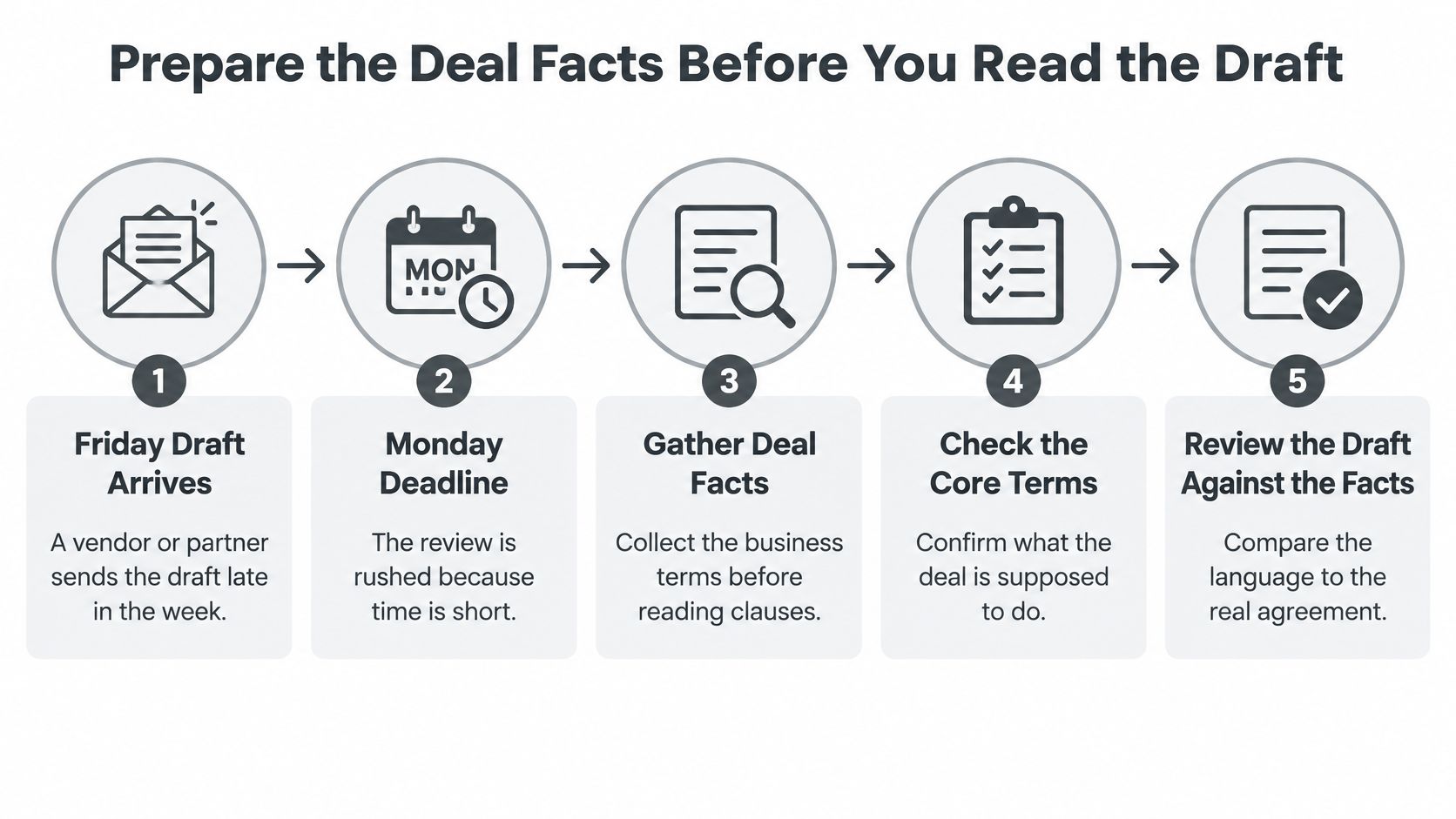
The vendor's draft arrived Friday afternoon, and your contact wants it signed Monday. The price looks right, the relationship matters, and you're tempted to skim the legal language and move on. But the draft may require you to pay after termination, surrender rights to work you've already created, or send a renewal notice long before anyone expects to revisit the deal.
A useful business contract review answers more than whether you can sign. It establishes what you're buying, what you're risking, who can approve the trade-offs, and who must act on the agreement afterward. The redline is only part of the work.
Prepare the Deal Facts Before You Read the Draft
That Friday deadline becomes harder to manage when the reviewer starts with definitions instead of asking what the business agreed to. A lawyer can improve a payment clause without knowing that the proposed billing schedule makes the project unaffordable. An operations manager can approve a delivery schedule without realizing the contract promises results the team can't control.
Start by separating the commercial facts from the proposed legal terms. World Commerce & Contracting's 2023 benchmark report found that 42% of respondents lacked clear responsibility for contract-management oversight. Your review should resolve that ownership problem before anyone starts making concessions.
Build the review around the deal
Write down the objective and authority. Identify the commercial objective, total transaction value, proposed governing law, exact contracting entities, and person authorized to approve the agreement. Include committed spending, implementation costs, and exit charges, not just the headline price, so the approver understands the full commitment.
Classify the risk. A small annual software renewal doesn't need the same review as a multi-year partnership involving a shared client list. Look beyond price to sensitive information, operational dependence, regulatory exposure, and how difficult replacing the counterparty would be.
Pull the approved playbook and clause library. Compare the draft against established positions rather than personal preferences. Record both your preferred wording and acceptable fallback, so a routine concession doesn't require a fresh internal debate.
Identify the terms that determine success. For a service agreement, those may be acceptance criteria, payment milestones, and transition assistance. For a financial-advisory arrangement, compensation, client information, supervision responsibilities, repayment provisions, and departure restrictions may deserve priority.
Assign reviewers by subject. Finance checks pricing and payment mechanics; operations tests deliverability; compliance and security examine regulated activities and data access; legal evaluates risk allocation and enforceability. Give each issue an owner and escalation route rather than circulating an unstructured request for comments.
Separate the deadline from the pressure
Ask what requires Monday execution. A scheduled launch, expiring offer, and salesperson's preference call for different responses. If important exhibits are missing, identify them as unresolved inputs rather than treating an incomplete draft as signature-ready.
Practical rule: Attach a one-page deal sheet to the draft with the value, approver, deadline, business objective, and unresolved decisions.
That sheet saves reviewers from reconstructing the transaction through email. It also gives the final approver a clear record of what the business intended to accept.
The Clauses That Carry Most of the Risk
| Clause | What to Check | Common Red Flag |
|---|---|---|
| Scope of work | Deliverables, acceptance criteria, change-order process | Vague services as needed language with no acceptance test |
| Payment terms | Amount, due date, late fees, invoice dispute window | Payment conditioned on client satisfaction with no invoice deadline |
| Limitation of liability | Cap amount and whether confidentiality or IP claims are excluded | No cap at all, or a cap that binds only your side |
| Indemnities | Who indemnifies whom, for which third-party claims | One-way indemnity covering the other party's own negligence |
| Termination | Notice period, cure period, termination for convenience, exit fees | One side can terminate on short notice with no cure period while you still owe fees |
| IP ownership | Ownership of work product and pre-existing materials, plus license scope | Vendor owns all deliverables without preserving your rights to pre-existing materials or granting necessary usage rights |
| Confidentiality | Definition, duration, return or destruction of information | Perpetual duty with no exclusion for information that becomes public |
| Non-compete and non-solicit | Restricted activities, duration, geography, who is bound | A hypothetical nationwide restriction lasting three years and covering all employees |
| Governing law and disputes | Governing state, venue, court or arbitration | Venue in a distant forum chosen by the other side |
Read for structure before marking language
Read the complete agreement once before editing. Identify the order of precedence among the main contract, statement of work, exhibits, purchase order, and incorporated policies. An acceptable sentence in the main agreement won't help if another document overrides it.
Then mark every table row acceptable, negotiate, or escalate. Record the relevant clause reference and your reason. A useful comment explains the commercial problem, such as an acceptance process that lets the customer postpone payment indefinitely, rather than merely calling the provision unreasonable.
Use a focused commercial contract clause checklist to organize that pass. If you're considering document-analysis software, BromeAI's tools for working with documents are a resource to evaluate alongside your review process. Check confidentiality and data-handling terms before uploading anything, and verify each material finding against the actual draft.
Test clauses together, not in isolation
The liability cap and its carve-outs must be read together. If you're buying services, a cap with no exclusions for confidentiality or IP claims may limit recovery for losses that matter most to you. If you're supplying services, broad exclusions can leave substantial exposure uncapped despite an apparently protective limit.
Check whether the cap applies in the aggregate or separately to each claim. Also examine whether the exclusion of consequential damages could bar a category of loss you expect to recover. A higher cap doesn't necessarily solve an exclusion that prevents recovery altogether.
Payment and termination need the same reading. Say an invoice becomes overdue while you're disputing defective work, and the contract permits immediate termination for any unpaid amount. The supplier could assert an exit right before the acceptance dispute is resolved. A written dispute process and protection for disputed amounts address different risks than a longer payment deadline.
Confidentiality duration also requires judgment. Continuing protection for genuine trade secrets may be appropriate, while an indefinite restriction on every piece of information exchanged is harder to administer. Don't treat the existence of a long obligation as the only issue; examine its definition and exceptions.
No row should remain unread. As an internal screening rule, send any row with multiple red flags to the escalation list, even if each issue looks manageable alone.
Red Flags That Should Stop the Signature
Don't assume you remain uncommitted until someone signs a PDF. For transactions governed by the applicable sales-of-goods rules, Nebraska's enactment of UCC § 2-207 provides that a definite and seasonable expression of acceptance, or a written confirmation sent within a reasonable time, can operate as acceptance despite additional or different terms, unless acceptance is expressly conditional on assent to those terms.
Between merchants, that provision generally makes additional terms part of the contract unless the offer limits acceptance to its own terms, the additions materially alter the agreement, or a timely objection applies. Don't automatically apply this sales-of-goods rule to employment, advisory, or other service agreements. Counsel should determine the governing framework.
Pause for terms that exceed your authority
These provisions warrant a hold for legal and business approval, not necessarily an automatic rejection of the deal:
- Uncapped liability. Identify which losses could exceed the transaction's economic value and whether insurance responds.
- Unilateral changes. Flag language permitting the counterparty to revise pricing, policies, or material obligations without meaningful consent.
- Automatic renewal. Examine lengthy notice requirements and whether the renewal creates another substantial commitment.
- Broad representations. Don't promise future business results or certify facts outside your knowledge and control.
- Restrictive covenants. Pause restrictions affecting employees, client relationships, recruiting, or future business activity.
- Change-of-control consequences. Check whether a sale, restructuring, or ownership transfer triggers consent, termination, or repayment.
- Distant forum selection. Consider whether pursuing or defending a claim there is commercially realistic.
- Unusual payment or clawback provisions. Test repayment triggers, calculation methods, offsets, and obligations that survive departure.
Respond to conflicting forms deliberately
When purchase orders and confirmations conflict, collect the full exchange, including attachments and standard terms. Determine whether both parties are merchants, identify additions or differences, and have counsel assess whether the forms created obligations already.
A written objection should identify the disputed language and state the proposed treatment. Preserve evidence of delivery, and don't assume sending an objection alone settles the contract's terms or legal effect.
Create a short list of the current draft's most serious issues. Mark each as blocks signing, requires approval, or acceptable with a documented concession. Stop and call counsel when the counterparty demands performance while those formation or authority questions remain unresolved.
Sample Clause Revisions to Propose
Start with liability rather than leaving broad exposure untouched because the clause looks standard. The language below illustrates negotiating positions, not ready-to-use provisions for every agreement. Defined terms, insurance, applicable law, and the rest of the contract can change their effect.
Liability and termination
Weak liability wording: Each party is liable for all damages arising from the agreement.
Illustrative revision: Except for breaches of confidentiality and indemnity obligations, each party's total liability will not exceed the fees paid in the twelve months before the claim.
This proposed cap creates a measurable limit, but its exceptions leave confidentiality and indemnity exposure outside that limit. Early in the relationship, a fees-paid formula may also produce a very low cap. A fallback is a negotiated minimum cap or separate higher limits for specified risks, rather than unlimited exceptions.
Weak termination wording: The provider may terminate at any time, and all remaining fees remain payable.
Illustrative revision: Either party may terminate on 30 days' written notice. The customer will owe only fees earned through the effective termination date.
That proposal avoids paying for unperformed services. A supplier's defensible fallback may include documented, noncancelable commitments approved in advance, with no charge for avoided costs. Address refunds, work in progress, and transition assistance separately.
IP and indemnity
Weak IP wording: The vendor owns all deliverables and incorporated materials.
Proposed revision: Each party retains ownership of its pre-existing materials. The vendor grants the customer a perpetual, royalty-free license to use vendor pre-existing materials incorporated into the deliverables as necessary to use those deliverables.
The license prevents retained vendor ownership from making the purchased work unusable. A fallback can limit the license to internal business purposes, provided permitted affiliates, successors, and service providers receive the access the business needs.
Weak indemnity wording: The customer indemnifies the provider against all claims, including claims caused by the provider's negligence.
Proposed revision: Each party will indemnify the other against third-party claims to the extent caused by the indemnifying party's negligence or breach of this agreement.
Add defense control, notice, cooperation, and settlement protections. A fallback is mutual indemnity subject to the same liability limit, reconciled expressly with any cap exceptions.
Negotiate the consequence, not the style
- Defend the edit in writing. Explain which business risk it addresses.
- Trade deliberately. Exchange low-value concessions for protections that affect actual exposure.
- Accept harmless wording. Preserve credibility for material disagreements.
Our Commercial Transactions practice drafts and reviews contracts and advises on sales agreements. A disciplined commercial contract negotiation approach connects each requested revision to the outcome the business needs.
Version Control and Records After Signature
The contract remains an operating responsibility after signature. Someone must request the credit, deliver the report, maintain the insurance, or send the notice. Negotiated rights provide little practical benefit when the responsible team can't find them.
World Commerce & Contracting reports average contract-value erosion of 8.6%, with causes including invoicing errors, delayed delivery, scope disputes, missed entitlements, and avoidable disputes. That finding supports a practical conclusion: finishing the legal edits doesn't finish the review workflow.
Preserve the agreement people actually approved
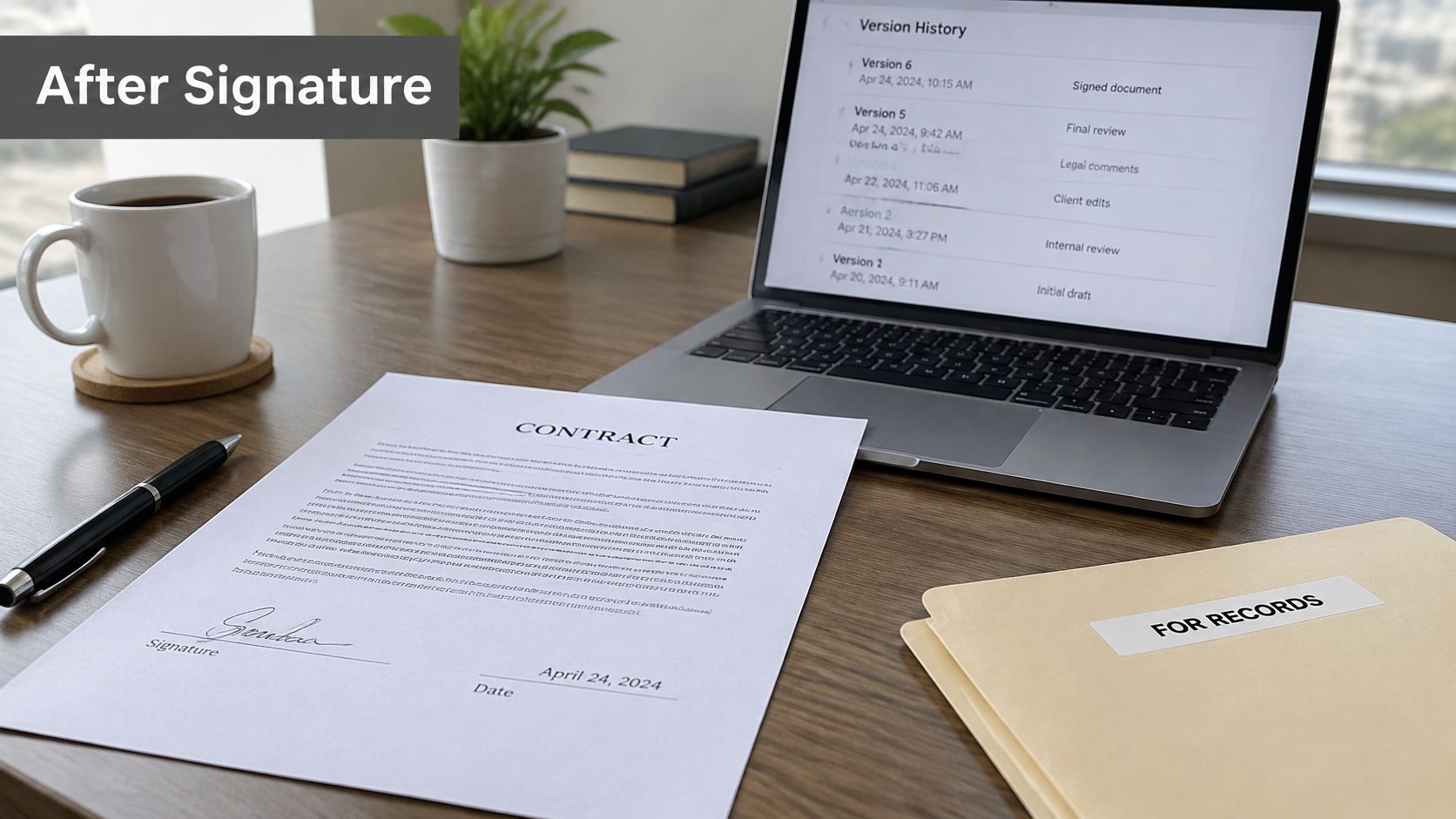
Use a controlled shared folder or contract-management repository, dated filenames, and a clearly designated executed version. Save tracked-change history separately from the clean signing copy, and maintain a deviation log identifying who approved material concessions. Restrict editing permissions on executed records.
Electronic execution doesn't eliminate recordkeeping responsibilities. The SEC's guidance on electronic signatures and records explains that contracts can't be denied legal effect solely because they're electronic and that required retained electronic records must accurately reflect the original information and remain accessible and reproducible for the applicable retention period.
Keep the signature audit trail with the executed PDF, exhibits, amendments, and incorporated terms. Test retrieval rather than assuming the signing platform will remain your permanent archive.
Turn the signed terms into assigned work
Extract obligations into a searchable obligation register. For each entry, record the required action, owner, backup, deadline, evidence of completion, escalation trigger, and contractual remedy.
Calendar notice, renewal, price-adjustment, insurance, audit, cure, and termination dates. Include the delivery method and recipient required for notices, not just the due date. A reminder to terminate is incomplete if nobody knows where the notice must go.
For high-value or regulated agreements, establish quarterly exception reviews. Financial-advisory businesses should also flag books-and-records, regulatory cooperation, communications retention, incentive compensation, and dispute-escalation duties.
Records to keep for every signed agreement
| Record | Why It Matters | Owner |
|---|---|---|
| Executed agreement with all exhibits | Proves the terms both sides actually signed | Legal |
| Redline history with approval notes | Shows which deviations were accepted and by whom | Deal owner |
| Electronic signature audit trail | Shows execution details and supports accurate reproduction | Legal operations |
| Obligation register | Tracks deadlines, notice periods, insurance and renewals | Contract owner |
| Amendment and side-letter log | Prevents conflicts between signed text and later changes | Legal |
| Written objections to conflicting terms | Documents timely objection to unfavorable forms | Legal |
Give each role a named person, even if the business has no separate legal-operations department. These contract-management practices should make performance verifiable without depending on someone's inbox or memory.
Decide When to Bring In Outside Counsel
A draft with uncapped liability, employee restrictions, unfamiliar governing law, or conflicting forms can expose a business to obligations it has not priced or planned for. Bring in counsel when a material concern remains after a counter-draft or written objection. An existing dispute, regulated financial-services activity, or cross-border obligation also calls for early legal review.
A small-business contract lawyer can assess how the agreement's clauses work together, rather than treating each disputed sentence as a separate editing problem.
Match the engagement to the work
Ask for a written scope and estimate before work begins. A defined review and issue list differs from ongoing negotiations, specialist advice, or implementation support.
- Hourly work can fit open-ended negotiations when the number of exchanges is uncertain.
- A flat fee can fit a defined review of an identified agreement.
- A hybrid arrangement may suit a predictable initial review followed by uncertain negotiations.
Kons Law offers traditional hourly billing, flat fees for defined services, and contingency or hybrid fee structures where appropriate. Confirm in the engagement letter what the fee covers, what falls outside scope, and whether later negotiation work is included.
Administrative support can help organize exhibits and maintain registers. Businesses considering whether to hire virtual paralegals should distinguish supervised document support from legal advice and set access controls before sharing files.
Before sending the draft: Talk with an attorney and establish the attorney-client relationship through a written agreement letter.
Do not send confidential or sensitive information to Kons Law before those steps are complete. Information sent without an attorney-client relationship is not privileged. For the initial conversation, prepare your clause checklist, red-flag list, deadline, and a general description of the deal. Share documents only as counsel instructs.
Kons Law's Commercial Transactions practice drafts and reviews contracts and advises on sales agreements. To discuss a business law matter, contact the firm during business hours, Monday to Friday, 9:00 am to 5:00 pm ET. Have your checklist and red-flag list ready so the conversation starts with the decisions that matter.
