You open the mail after a long workday and find a collection notice for an account you don't recognize. The balance looks familiar enough to create doubt, but the creditor's name is different, the payment history isn't attached, and the letter warns that the debt may be treated as valid unless you respond. For a Connecticut consumer or business owner, panic and silence are both poor strategies. The better response is to preserve the record, test the claimant's proof, and use the federal and state rules that govern collection activity.
Debt collection defense isn't about avoiding a legitimate obligation. It's about requiring the party demanding payment to prove who owes the debt, who owns it, how the balance was calculated, and whether the collection process complied with law. Those questions matter because disputes often arise from mistaken identity, identity theft, inaccurate balances, incomplete assignments, or procedural failures.
Understanding Debt Collection Defense in Connecticut
A collection letter is an allegation, not a judgment. That distinction matters when the account belongs to another person, the debt was paid, the collector lacks authority, or the amount includes charges that can't be supported by the contract. A disciplined defense begins by treating the notice as evidence that needs examination rather than as an instruction to pay immediately.
The scale of the dispute environment explains why these problems recur. The Consumer Financial Protection Bureau reported approximately 207,800 debt-collection complaints in 2024, representing 7% of all complaints it received that year. That was nearly twice the approximately 109,900 complaints reported in 2023, and 45% of the 2024 debt-collection complaints involved attempts to collect debts consumers said they didn't owe. The CFPB sent approximately 159,700 complaints, or 77% of the total, to companies for review and response, while referring 18% to other regulatory agencies and classifying 5% as not actionable. CFPB annual report on debt-collection complaints

Defense starts with facts
Suppose a Connecticut contractor receives a demand addressed to a former business entity. The contractor may recognize the original transaction but not know whether the account was assigned, whether a personal guaranty applies, or whether the stated balance includes fees the agreement never authorized. Paying immediately may resolve the contact, but it can also surrender the opportunity to challenge an unsupported claim. Ignoring it may allow the collector to sue without receiving the documents needed to evaluate the dispute.
A useful first resource is this guide for Connecticut borrowers, particularly for organizing basic questions about state collection practices. For more Connecticut-specific legal context, review Connecticut debt collection laws, then gather the documents before making substantive admissions.
Practical rule: A collector should be able to connect the defendant to the specific account and prove the amount claimed. A demand without that foundation deserves careful scrutiny.
Debt collection defense usually involves four factual inquiries:
- Identity: Does the account belong to the person or entity named?
- Ownership: Can the claimant show it owns the account or has authority to enforce it?
- Amount: Do statements, credits, payments, interest, and fees support the balance?
- Procedure: Did the collector provide the required notice and handle a dispute correctly?
That approach is more useful than reacting to the tone of a letter. It turns an intimidating demand into a document review and helps determine whether negotiation, litigation, or another response makes sense.
Federal and Connecticut Debt Collection Laws
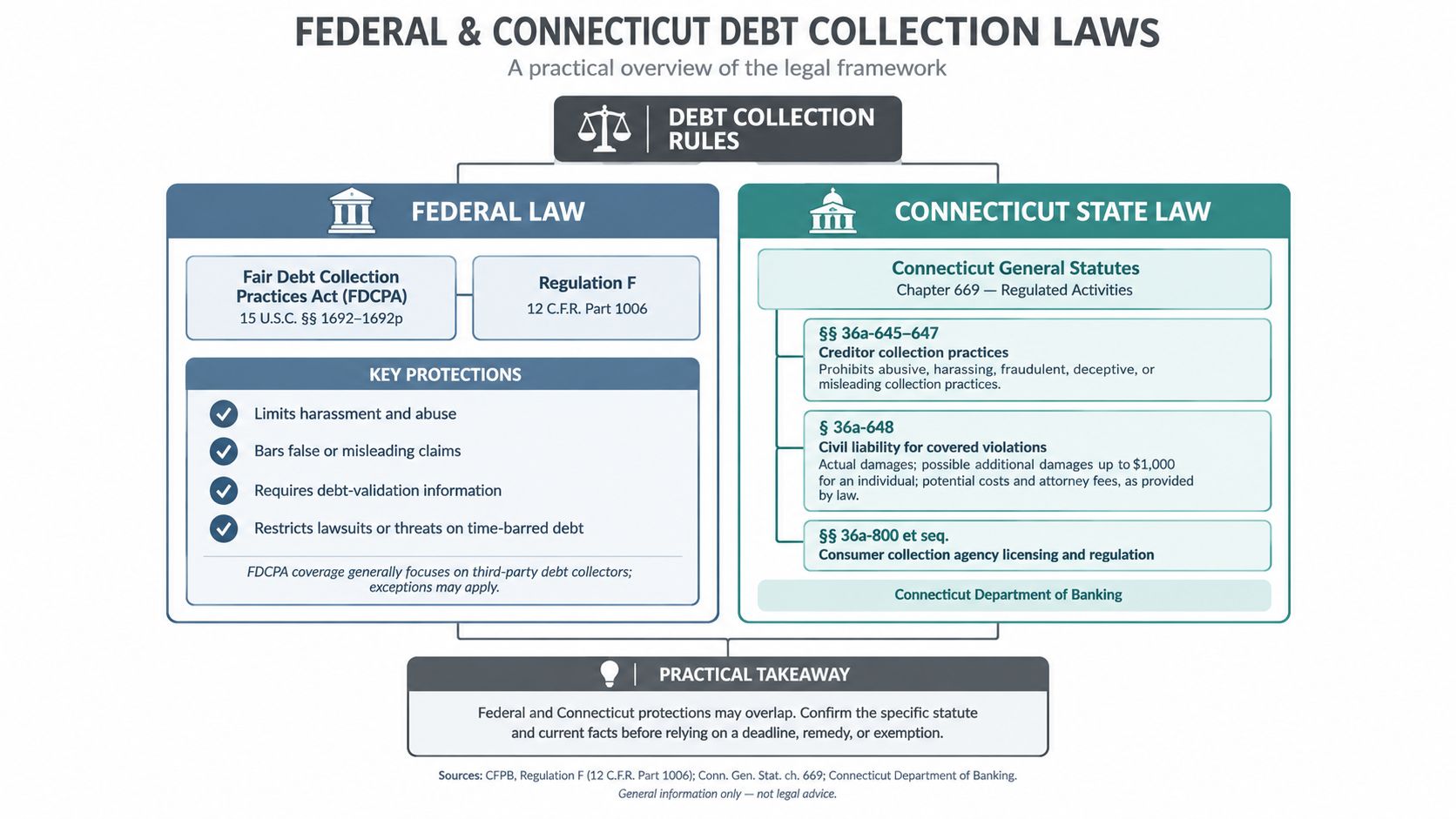
Federal and Connecticut law overlap, but they don't perform exactly the same function. The Fair Debt Collection Practices Act, or FDCPA, regulates covered debt collectors and addresses validation, communications, misleading conduct, and remedies. Connecticut rules add state-specific notice requirements and provide a state-law pathway for claims arising from collection violations.
Under federal Regulation F, the validation period generally lasts 30 days after the consumer receives, or is presumed to receive, the required validation information. The notice must identify the creditor, provide account information, state the current balance, and itemize interest, fees, payments, and credits since a specified date. If the consumer submits a written dispute during that period, the collector must pause collection of the disputed amount until it responds adequately. The CFPB Regulation F validation provisions provide the governing federal framework.
Connecticut adds a concrete notice structure
The Connecticut Department of Banking states that a collection agency must send written notice within five days after first contact. The notice must state the debt amount and explain that the debt will be assumed valid unless the consumer disputes it within 30 days. If the consumer disputes the debt in writing during that period, the agency must mail proof that the consumer owes it. Connecticut also permits a consumer to sue within one year from the date of the violation and seek actual damages, up to $1,000 in additional damages, court costs, and attorney's fees. See the Connecticut consumer collection practices guidance.
The practical overlap is important. A notice can fail because it omits required information, arrives late, obscures the dispute rights, or conflicts with other collection language. A collector may also create exposure by continuing to pursue a disputed amount without providing adequate verification. Connecticut's rules don't eliminate the need to analyze the FDCPA, and federal compliance doesn't necessarily answer every Connecticut-law question.
The deadline deserves separate attention. Readers evaluating potential claims should review Connecticut's statute of limitations on debt with counsel because the applicable deadline depends on the nature of the claim and the facts. A limitations argument can be lost if a defendant treats it as an automatic defense without pleading and proving the necessary facts.
Immediate Steps After Receiving a Collection Notice
The first response should be methodical. Save the letter, envelope, email headers, electronic-delivery records, attachments, caller identification, voicemails, and every later communication. A collector's proof may depend on when notice was received, which version was delivered, what balance appeared, and whether the consumer disputed the claim before the collector continued collection activity.
Build the record before arguing the merits
Start with a dated chronology. Record the first contact, the date the notice arrived, the method of delivery, any telephone calls, the date of a written dispute, and the collector's response. Keep account statements, contracts, invoices, payment confirmations, canceled checks, bank records, assignment documents, credit-report entries, and identity-theft reports together rather than scattering them across email folders.
Then audit the notice itself:
- Identify the claimant: Write down the creditor named in the notice, the current collector, the account reference, and any stated owner or assignee.
- Test the balance: Compare the stated amount with statements and the contract. Separate principal from interest, fees, payments, credits, and unexplained adjustments.
- Check delivery: Preserve the envelope and electronic metadata. The validation period depends on receipt or presumed receipt, so delivery evidence can become significant.
- Dispute precisely: If the debt, ownership, amount, or documentation is wrong, submit a written dispute that identifies the problem and keeps proof of delivery.
- Stop informal admissions: Don't guess about an account on a recorded call or agree that a balance is correct before reviewing the records.
A consumer who needs a starting point for challenging an older account can review a resource on how to dispute old collections with this template. A template isn't a substitute for legal analysis, especially when a lawsuit has already been filed, but it can help organize a written request for verification.
Preserve the original notice before responding. A scan is useful, but the envelope, delivery record, and complete attachment set may answer questions that a copied letter can't.
The same discipline applies to a business demand. Gather the purchase agreement, guaranty, promissory note, amendments, invoices, payment ledger, and communications with the creditor. If litigation appears likely, follow a deliberate response process rather than sending an angry explanation. Guidance on responding to a demand letter can help frame the issues without making unnecessary concessions.
Common and Technical Defenses in Debt Disputes
The strongest defense often combines a factual challenge with a procedural one. Saying “I don't owe this” may be correct, but the case improves when the defendant can show the account belongs to someone else, the collector can't prove an assignment, the balance conflicts with the statements, or the validation notice omitted information required to test the claim.
Match the evidence to the defense
Mistaken identity requires account-level comparison. Names, addresses, dates of birth, business entities, signatures, account numbers, and transaction histories can distinguish the defendant from the actual account holder. Identity-theft disputes need a different file, including identity-theft reports, account-opening records, correspondence, police or agency materials when available, and proof that the collector received the dispute.
An already-paid debt should be supported with payment confirmations, bank records, settlement documents, receipts, or creditor correspondence. The argument isn't just that the consumer remembers paying. It is that the available records show how much was paid, when it was applied, and whether the collector's current balance ignores those credits.
Other defenses focus on the claimant's legal and procedural position:
- Ownership and authority: The plaintiff must connect the account to an enforceable assignment, contract, guaranty, or other instrument.
- Balance calculation: The collector should reconcile principal, interest, fees, payments, and credits rather than rely on a conclusory ledger.
- Validation defects: Missing creditor information, inadequate itemization, unclear rights, or contradictory language can undermine the collection effort.
- Dispute handling: Continuing to seek a disputed amount without adequate verification can create a separate procedural problem.
- Limitations issues: The dates of default, last payment, suit, and any relevant acknowledgment must be examined before relying on a limitations defense.
Litigation changes the posture
Once a complaint is filed, the goal isn't merely to send another dispute letter. The defendant must preserve objections, answer on time, respond carefully to requests for admission, review discovery, and avoid statements that unintentionally establish ownership or liability. A request for admission that asks whether the defendant signed a contract, received funds, or owes a stated amount can have consequences if answered casually or ignored.
The contrarian point is practical: a statutory technicality may matter, but proof of the underlying obligation often decides the case. A claimant that can't connect the defendant to the specific debt or can't explain the amount may have a more serious problem than a claimant that made a minor notice error. Counsel should therefore develop the factual record and procedural defenses together.
Litigation, Settlement, and Bankruptcy Options
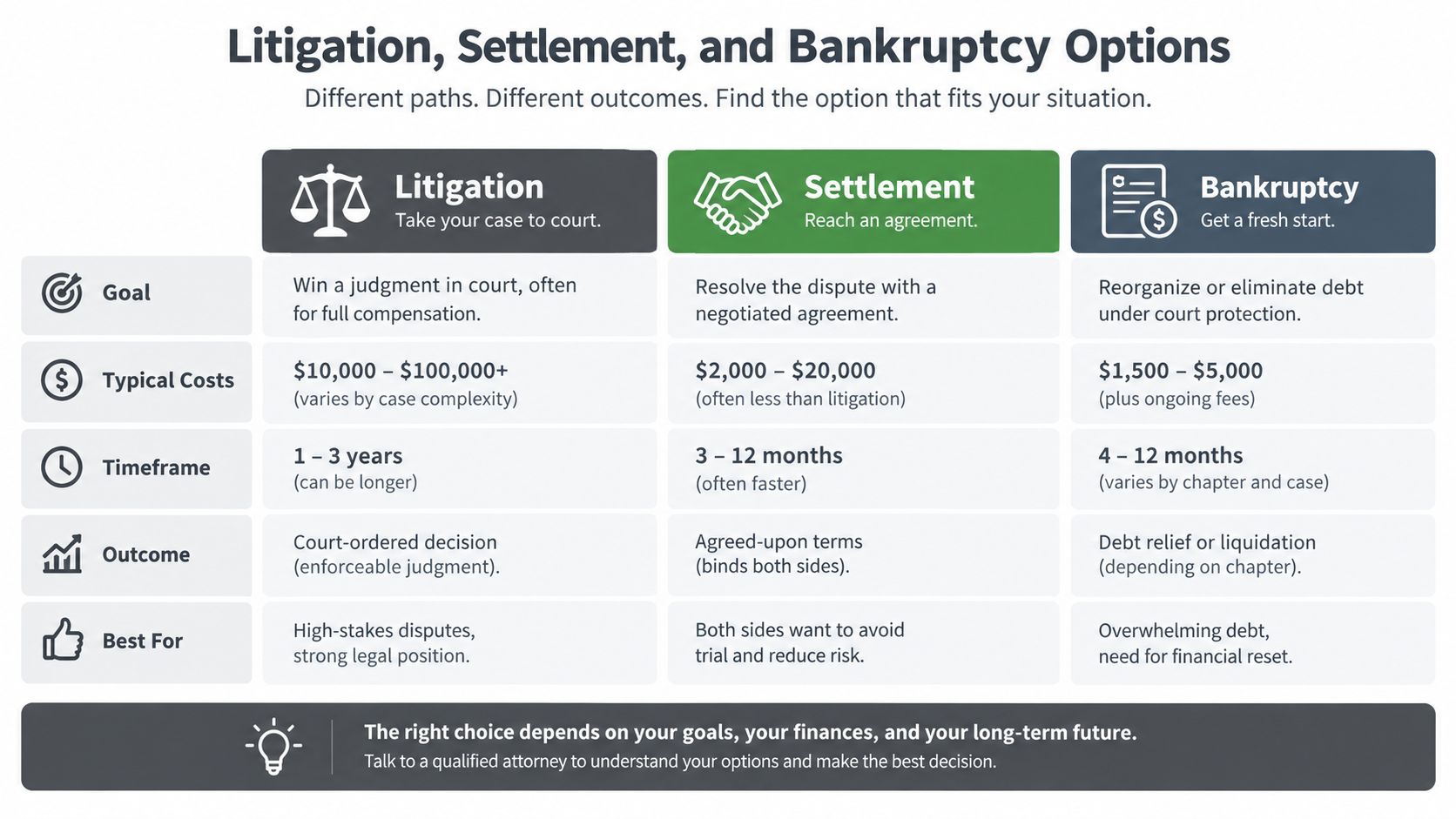
A disputed collection matter can move in different directions, and the right path depends on the evidence, urgency, financial position, and consequences of each choice. Litigation contests the claim formally. Settlement trades certainty and speed for an agreed resolution. Bankruptcy can halt collection activity through the automatic stay, but it carries broader financial and legal consequences.
Litigation preserves the challenge
Litigation makes sense when the collector's evidence is weak, the amount is significant, a counterclaim may exist, or a judgment would cause serious harm. The trade-off is time, legal expense, discovery obligations, and the possibility that the court finds the debt enforceable. A defendant who chooses this route must treat deadlines, pleadings, discovery, and settlement discussions as parts of one strategy.
Settlement may be appropriate when the records establish some obligation but leave room to dispute the amount, when the parties need a quick resolution, or when defense costs exceed the practical value of trial. Payment on a contested claim is the central drawback. The written agreement should address the amount, release, dismissal, credit reporting where relevant, confidentiality if requested, and whether the payment resolves all related claims. Review the mechanics of a Connecticut settlement agreement before signing.
Bankruptcy addresses a wider problem
Bankruptcy is not just a collection-defense tactic. It can stop covered collection efforts through the automatic stay and create a structured process for qualifying debts, but it affects credit, property, business operations, and other obligations. It also doesn't make documentation irrelevant. The debtor still needs accurate schedules, account records, contracts, and information about disputed debts.
| Path | Main advantage | Main trade-off |
|---|---|---|
| Litigation | Tests the claimant's proof in court | Requires time, preparation, and expense |
| Settlement | Provides a negotiated endpoint | May require payment on a disputed claim |
| Bankruptcy | Addresses broader collection pressure through a formal process | Creates lasting financial and legal consequences |
A careful evaluation starts with the question the chosen path must solve. If the problem is a false account, litigation or a documented dispute may be central. If several creditors are pursuing collection and repayment is impossible, bankruptcy analysis may be more appropriate. If the balance is partly valid but commercially unmanageable, settlement can be considered without abandoning review of the claimant's proof.
When to Engage a Connecticut Debt Collection Attorney
Self-representation may be reasonable for a simple notice that clearly identifies a valid creditor and leaves no sign of litigation. It becomes risky when the account involves a lawsuit, a guaranty, a promissory note, a successor entity, disputed ownership, identity theft, or a balance that changes without explanation.
Recognize the escalation signals
Contact counsel promptly when:
- Court papers arrive: A summons, complaint, motion, or discovery request creates deadlines that a letter dispute doesn't address.
- The obligation is commercial: Business accounts, personal guaranties, production advances, and successor-entity issues require contract and entity analysis.
- The balance is contested: A lawyer can compare the contract, ledger, assignments, payments, and interest calculations without relying on the collector's summary.
- The collector threatens enforcement: A judgment can affect accounts, wages, property, or business operations, so waiting for enforcement is usually the wrong time to begin planning.
- A counterclaim may exist: Misleading communications, improper collection conduct, or notice failures may create claims that need preservation and pleading.
- Bankruptcy is under consideration: Bankruptcy counsel can evaluate whether the automatic stay and discharge rules fit the broader financial situation.
Early advice changes the quality of the evidence. Counsel can send a targeted response, preserve objections, coordinate document collection, and prevent a client from making an admission that later narrows the available defenses. Early intervention also leaves room to negotiate before both sides incur litigation expense.
Kons Law's collections and creditors' rights practice handles commercial debt matters, including agreement review, responses to aggressive demands, negotiation, and litigation defense. That kind of representation is one option for a business owner or financial professional whose collection dispute involves more than a straightforward consumer account.
The cost-benefit analysis should be concrete. Compare the amount at issue with the risk of judgment, the value of business assets or credit access, the strength of the claimant's documents, and the cost of a poorly timed settlement. A lawyer may not make every dispute worth litigating, but can help identify which issues deserve investment and which resolution protects the client best.
Common Misconceptions About Debt Collection Defense
Ignoring a notice is not a defense. Silence can leave the claimant free to file suit, seek a judgment, and pursue available enforcement remedies. A written, documented response gives the defendant a chance to identify errors before the dispute becomes harder and more expensive to manage.
Every collection claim is not automatically enforceable. A collector may lack proof of ownership, rely on an inaccurate balance, miss required validation information, or pursue the wrong person. That doesn't mean every debt disappears. It means enforceability depends on the contract, records, parties, dates, and applicable law.
A dispute isn't the same as refusal to pay. A consumer or business can request proof while remaining open to resolving a legitimate obligation. That distinction matters in negotiation because a carefully drafted response can challenge the claim without making unnecessary accusations or admissions.
Settlement doesn't have to mean surrender. A negotiated agreement can address dismissal, releases, payment terms, and treatment of the disputed claim. It should be written clearly, and the person signing it should understand whether it resolves only the account at issue or broader claims connected to the transaction.
The opposite misconception is that every notice error guarantees victory. Courts evaluate the facts and legal requirements, and a procedural defect may not eliminate an otherwise well-supported claim. Effective defense uses notice problems as part of a complete record, not as a substitute for examining the debt itself.
Taking the Next Step in Your Debt Collection Defense
The person at the kitchen table with an unfamiliar collection notice has more than two choices. Paying immediately and ignoring the problem are not the only options. A stronger course is to preserve the notice, identify the parties, reconstruct the account, dispute specific defects, and determine whether the matter calls for negotiation, litigation, or broader financial advice.
The most useful file will contain the agreement, account statements, payment records, correspondence, delivery evidence, call history, assignment documents, and a dated chronology. Those materials help answer the questions that decide many disputes: Is this the right defendant? Is this the right creditor? Is this the right balance? Did the collector follow the right process?
The answer can differ for an individual and a business. A consumer may be dealing with identity theft or an account already paid. A business owner may face a guaranty claim, a promissory note, or an allegation against a successor entity. Financial professionals may also encounter repayment demands tied to production advances or employment transitions, where contract language and arbitration provisions can control the strategy.
Debt collection defense works best when factual accuracy, procedural vigilance, and timing reinforce one another. The objective isn't to create delay for its own sake. It is to ensure that a claimant proves an enforceable obligation and that any resolution reflects the actual evidence.
If you want to discuss your business law matter, contact Kons Law at (860) 920-5181. An attorney can review the demand, underlying agreements, account records, and litigation posture before you make a decision that affects your business or personal finances.
Kons Law advises businesses and financial professionals on disputed debt demands, agreement review, negotiation, and collection litigation. To discuss your matter and choose a practical response, visit Kons Law or call (860) 920-5181.
