A decline in enforcement volume doesn't necessarily reduce regulatory exposure. In fiscal year 2024, the SEC obtained approximately $8.2 billion in financial remedies despite filing 26% fewer enforcement actions, showing that compliance risk is measured by severity, not case volume.
For financial advisors, broker-dealers, and practice owners, regulatory compliance issues rarely remain confined to one rulebook. An unapproved messaging app can become a recordkeeping problem, a supervision problem, a cybersecurity concern, an employment dispute, and evidence in a FINRA or SEC inquiry. A disputed Form U5 can affect registration, future employment, and litigation strategy at the same time.
The practical question isn't whether a firm has policies. It's whether the firm can prove that people followed a repeatable process, identified red flags, escalated concerns, preserved records, and made decisions based on reliable information.
Why Compliance Risk Is Measured Differently Now
The SEC filed 583 enforcement actions in fiscal year 2024, a 26% decrease from fiscal year 2023, yet it obtained approximately $8.2 billion in financial remedies, the highest total in the agency's history. The amount included approximately $6.1 billion in disgorgement and prejudgment interest and approximately $2.1 billion in civil penalties. These figures appear in the SEC's fiscal year 2024 enforcement results.
That contrast changes how a financial professional should assess risk. Counting investigations can create false comfort. A smaller number of matters can still produce substantial consequences when regulators identify widespread investor harm, misleading disclosures, inadequate controls, or weak supervisory systems.
The issue is particularly important for errors that initially look narrow. An unreported outside business activity may reveal that a representative bypassed firm approval procedures. An incomplete Regulation Best Interest disclosure may expose weaknesses in product review or compensation oversight. A late Form U5 filing may create a separate procedural problem while the firm is still investigating the underlying termination.
Practical rule: Assess the potential severity and connectivity of a compliance failure, not merely the likelihood of an investigation.
From isolated mistakes to concentrated exposure
Regulators can concentrate resources on matters that show systemic weakness or meaningful harm. That means a clean disciplinary history doesn't eliminate risk if current communications, customer complaints, or supervisory records show poor judgment.
A firm should therefore ask four questions whenever a concern arises:
- Who was affected? Identify customers, representatives, counterparties, and other people whose interests may have been involved.
- What controls failed? Separate an employee's conduct from the firm's approval, monitoring, escalation, and training systems.
- What records exist? Preserve communications, recommendation files, conflict reviews, complaint materials, and supervisory responses.
- What remains unresolved? Assign ownership for remediation instead of treating a policy update as the end of the matter.
A useful starting point is the broader explanation of what regulatory compliance means in practice. Compliance is not a binder stored for an examiner. It's an operating process that must withstand scrutiny after facts become disputed and memories become incomplete.
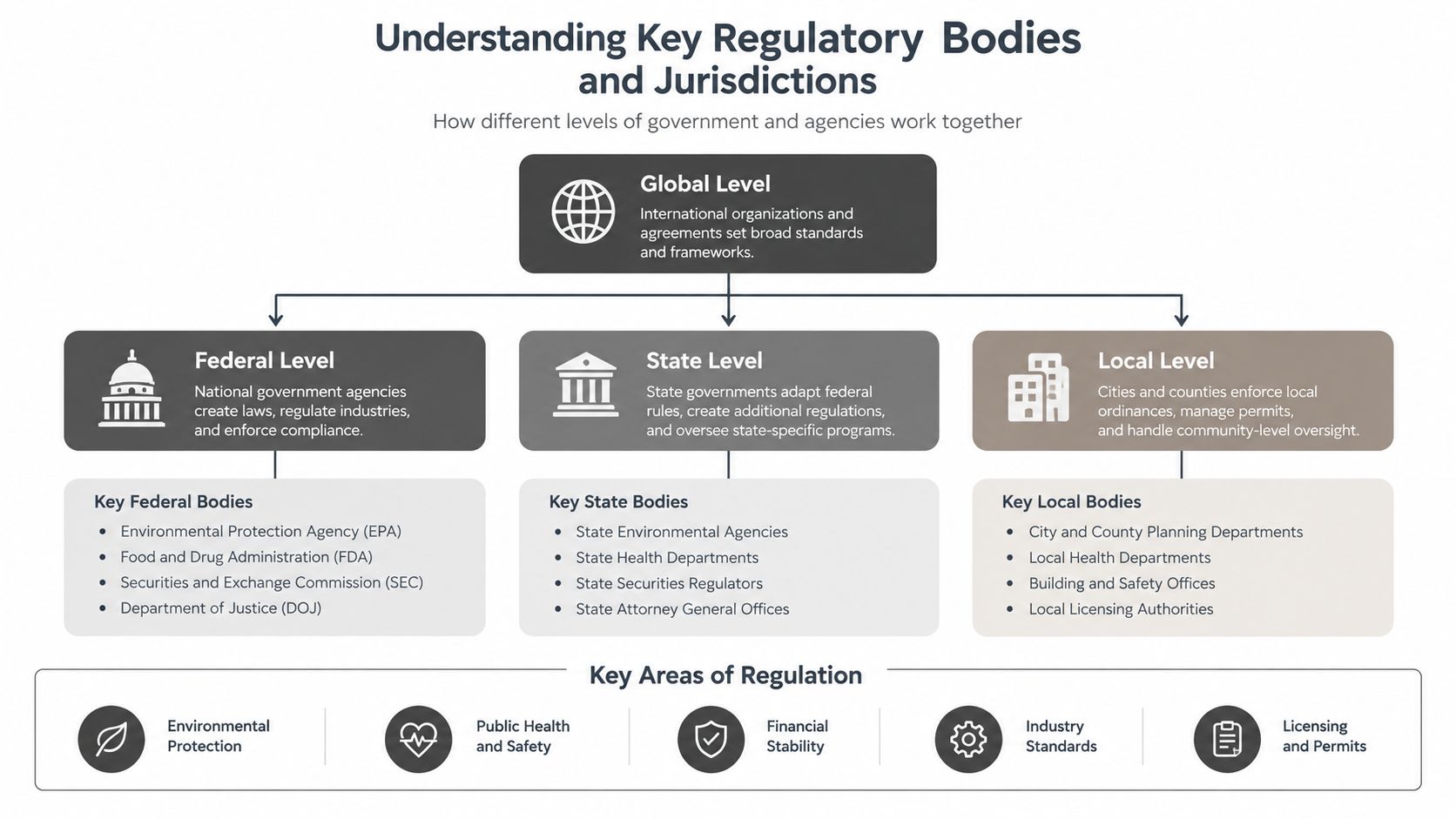
Understanding Key Regulatory Bodies and Jurisdictions
The regulator with authority over a professional depends on the person's registration, the firm's business model, the conduct at issue, and the source of the obligation. A broker-dealer representative may face FINRA discipline, SEC scrutiny, employment consequences, and a Form U5 dispute arising from one event. A CFP professional may also face a separate ethics process involving the CFP Board.
The first step is to identify the applicable forum before responding informally. A response that may be appropriate for an internal human resources inquiry can create problems in a FINRA investigation or a CFP Board proceeding.
FINRA and broker-dealer supervision
FINRA reported 730 new disciplinary actions filed in 2024, compared with 610 in 2023, 743 in 2022, and 782 in 2021. It also reported $75.6 million in fines and disgorgement ordered during 2024. Those figures and the range of possible sanctions appear in FINRA's 2024 Annual Regulatory Oversight Report.
FINRA consequences can include censures, heightened supervision, suspensions, termination, restitution, and remediation certifications. The focus may fall on the individual's disclosure, the firm's written supervisory procedures, or the firm's response to warning signs.
The SEC and federal securities obligations
The SEC addresses federal securities law violations through enforcement actions, administrative proceedings, examinations, and other oversight activity. Its concerns may include misleading disclosures, investor harm, gatekeeper failures, inadequate supervision, and individual accountability.
An SEC examination can also test whether a firm's policies work in practice. A policy that exists only on paper won't establish that representatives received training, supervisors reviewed exceptions, or the firm corrected recurring deficiencies.
The CFP Board and professional standards
The CFP Board's disciplinary system can impose sanctions ranging from private or public censure to suspension or permanent revocation of the right to use the CFP marks. The board announced 135 public sanctions in 2022 and reviewed events involving 1,266 CFP professionals in its historical investigations project. The CFP Board ethics report describes those figures and its increased recommended sanctions for certain reporting and ethics-declaration failures.
The practical distinction matters. FINRA may focus on registration and supervision, the SEC may focus on securities-law obligations and investor harm, and the CFP Board may focus on professional conduct and reporting. Those proceedings can overlap without being interchangeable.
A broader overview of regulatory compliance requirements can help identify the obligations that apply before a dispute reaches one of these forums.
How One Investigation Can Trigger Multiple Compliance Failures
Consider a representative who uses an unapproved messaging application to communicate with clients, relies on a generative AI tool to draft an investment recommendation, and fails to disclose an outside business activity. The conduct may look like three separate policy violations. During an investigation, however, each fact can provide evidence about the others.
The messages may show what the representative recommended, what fees or risks were discussed, and whether the customer's profile supported the recommendation. The AI-generated draft may raise questions about who reviewed the recommendation, whether product comparisons were performed, and whether the firm's supervisory procedures address the tool. The undisclosed outside activity may create a conflict issue and explain why the representative used a communication channel outside the firm's monitoring system.
The same facts can serve different inquiries
Under Regulation Best Interest, a broker-dealer must satisfy Disclosure, Care, Conflict-of-Interest, and Compliance Obligations and act in the customer's best interest without placing the firm's or representative's financial interests ahead of the customer. The SEC's Regulation Best Interest examination risk alert emphasizes that examiners assess whether policies are reasonably designed and operationally effective, not merely whether the documents exist.
That creates several possible lines of inquiry:
- Recommendation evidence: Can the firm show the customer profile, product rationale, costs, risks, and recommendation limitations?
- Conflict evidence: Did the outside activity or compensation arrangement influence product selection or transaction frequency?
- Communication evidence: Were messages retained, monitored, and available for supervisory review?
- Technology evidence: Did the firm approve the AI tool, assess its data use, and define who was responsible for reviewing its output?
- Supervision evidence: Did anyone identify the red flags, document the assessment, and escalate the issue?
FINRA's 2026 oversight materials describe an integrated regulatory-operations model involving member supervision, market oversight, and enforcement, with attention to cyber-enabled fraud, generative AI, third-party risk, and off-channel communications. The FINRA 2026 regulatory oversight report reflects why a siloed policy library may not answer the central question: who knew what, when did they know it, and what did they do?
A policy library proves that someone wrote a rule. A functioning compliance system proves that someone applied it.
The firm should preserve the messages, identify the AI workflow, review the recommendation file, investigate the outside activity, and document the supervisory reasoning. It shouldn't delete the tool output or let the representative provide an improvised explanation before counsel establishes the facts.
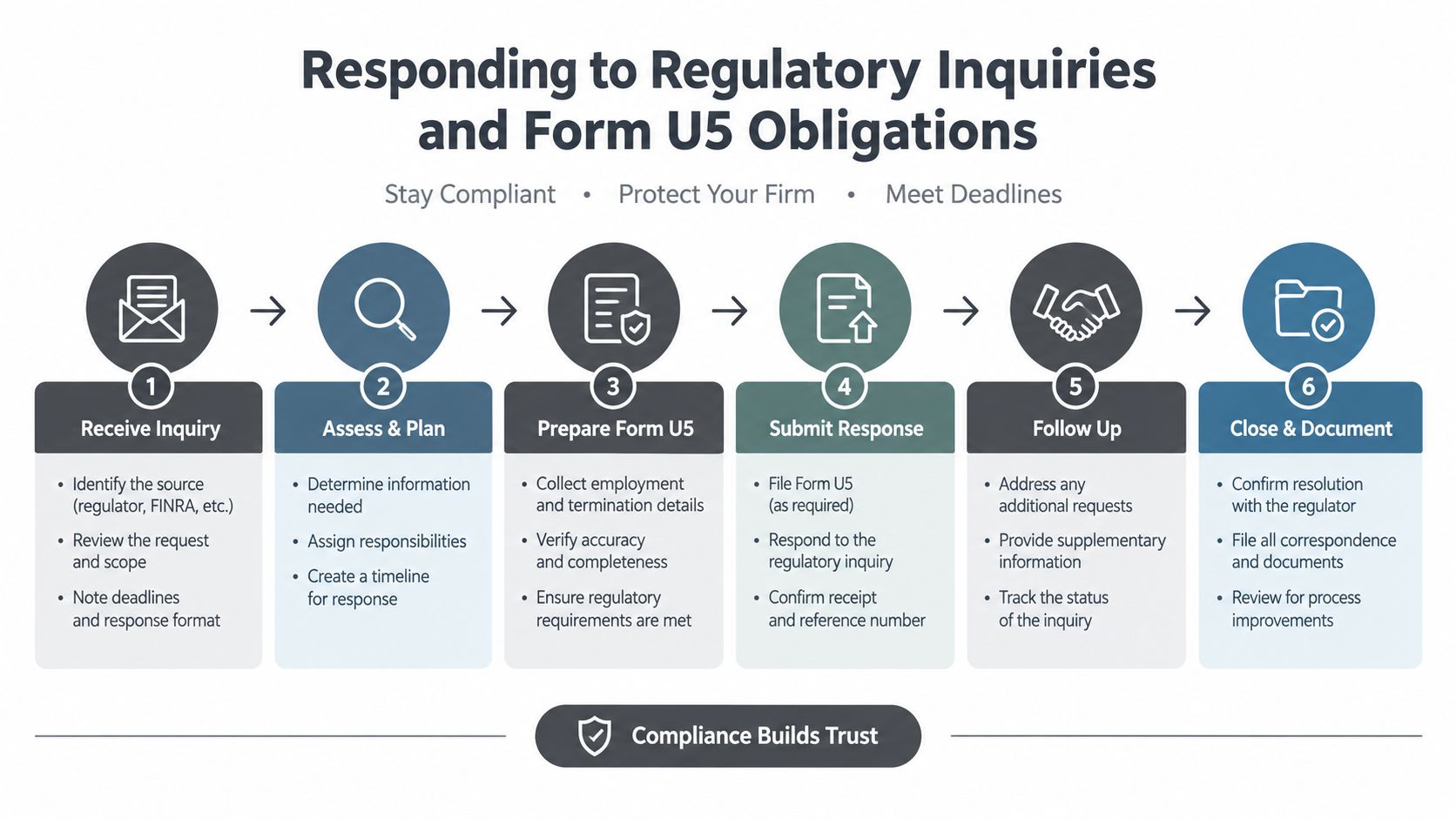
Responding to Regulatory Inquiries and Form U5 Obligations
A regulatory inquiry can create obligations beyond the request itself. A single oversight failure may require coordinated responses to FINRA, the SEC, the CFP Board, and an employment dispute, with each forum examining different records, conduct, and decision-makers.
Under FINRA Rule 8210, member firms and associated persons must provide requested information or testimony and permit inspection and copying of books, records, or accounts. FINRA states that sanctions can include firm expulsion or an individual bar when a response is missing, incomplete, or untruthful. The response process should begin before anyone drafts a substantive answer.
A defensible inquiry response
The first call should be to counsel, not to the drafter of the response. Counsel and senior compliance personnel should identify the conduct at issue, related complaints, possible employment claims, and whether any individual needs separate representation. That early assessment helps prevent an explanation prepared for one forum from creating problems in another.
Preserve data across every relevant channel. This may include email, firm messaging systems, text messages, collaboration platforms, approved archiving tools, and records held by vendors. Preservation should cover potentially exculpatory material, not only documents that appear unfavorable.
A controlled collection should identify custodians, date ranges, systems, and search terms. Counsel should conduct privilege review before production. The business team should maintain a response matrix showing each request item, responsible owner, deadline, production status, and any objection or limitation.
Before submission, reconcile the produced documents against the request. Individuals giving testimony should avoid speculation and keep their answers accurate, complete, and consistent with the records. If the same facts may affect an SEC review, a CFP Board matter, or an employment dispute, coordinate those positions rather than treating each inquiry as isolated.
Form U5 timing and accuracy
A member firm must file an initial Form U5 within 30 calendar days after terminating an associated person's registration. If the firm later learns facts that make the filing inaccurate or incomplete, it must submit an amended Form U5 within 30 days after learning those facts and provide the terminated individual a copy at filing. FINRA explains these continuing duties in Notice to Members 10-39.
FINRA also requires firms to continue updating Section 7 disclosure questions until final disposition. The initial filing carries a $50 fee, while a late initial filing can trigger a $100 fee. A late new disclosure event or status change may result in $100 on the first day and $25 for each subsequent day, capped at $1,575, as described in FINRA's Form U5 filing guidance.
Investigate before writing the narrative, but do not let fact development delay a filing deadline. Counsel can separate verified facts, allegations, unresolved questions, and information requiring amendment. A practical discussion of Form U5 and FINRA obligations can help when a termination disclosure may affect future registration or employment.
Distinguishing Violation Types and Their Consequences
A missing record, a defective supervisory system, and conduct that harms an investor shouldn't receive the same defensive response. Treating them as identical can waste resources on a technical correction or understate a matter that requires immediate legal intervention.
Technical failures
A technical failure involves a defined procedural obligation. Examples include a late filing, a missing amendment, an incomplete record, or a missed approval. The absence of documented harm doesn't make the issue irrelevant, but the response should focus on chronology, cause, correction, and whether similar failures occurred elsewhere.
The useful evidence includes filing receipts, approval records, written explanations, training history, and proof that the firm corrected the process. A quick policy edit without root-cause analysis won't answer why the failure occurred or whether it remains possible.
Supervisory-process failures
A supervisory failure concerns the system designed to prevent, detect, and address misconduct. The underlying transaction may appear reasonable, yet the firm may still face scrutiny if it can't show appropriate product review, conflict testing, surveillance, escalation, and remediation.
This category often requires broader review. Counsel and compliance personnel should determine whether the issue was isolated, whether supervisors received warning signs, whether written procedures matched actual practice, and whether the firm treated comparable representatives consistently.
The defensive question changes: Was the conduct wrong, or did the firm fail to build a process capable of detecting and managing it?
Investor-harm conduct
Conduct involving actual or potential investor harm demands the most urgent response. The firm should identify affected customers, preserve relevant records, assess disclosure and restitution obligations, and avoid making employment decisions that compromise the regulatory investigation.
The SEC's 2024 results demonstrate why harm, scale, and control failures can produce consequences far beyond the apparent size of the original event. A technical classification should never become a reason to delay customer-impact analysis.
Building a Cohesive Compliance Posture
A cohesive compliance posture connects recommendation files, communications monitoring, training, escalation, employment decisions, and regulatory responses. It should let a firm reconstruct who assessed the risk, which information they reviewed, what decision they made, and why that decision was proportionate.
The most reliable systems create evidence during ordinary operations rather than after an inquiry begins. For a recommendation, that evidence may include customer-profile data, product comparisons, fee and conflict review, exception approval, training completion, and supervisory surveillance.
Build around decisions, not documents
Policies matter, but they don't operate themselves. A firm should assign a decision owner for each material risk and specify when that person must involve compliance, human resources, senior management, or outside counsel.
A practical operating model includes:
- Contemporaneous records: Document reasoning while facts are available, rather than reconstructing it after a complaint.
- Consistent treatment: Compare similarly situated representatives before imposing discipline or preparing a termination narrative.
- Preserved evidence: Retain records that support and undermine the firm's preferred account.
- Controlled escalation: Define what happens after a complaint, off-channel message, disclosure concern, or supervisory exception.
- Coordinated responses: Align regulatory, employment, customer, and litigation strategies without allowing one response to contradict another.
Firms can use a compliance gap analysis guide to organize a review of obligations, controls, owners, and evidence. The value of that exercise isn't a longer checklist. It's identifying where the firm has a rule but lacks testing, where it has monitoring but no escalation path, or where different departments maintain conflicting records.
Coordinate employment and regulatory decisions
A termination may lead to a Form U5, an employment claim, a customer complaint, and a regulatory inquiry. Each forum has different purposes, but the facts must remain consistent. A rushed internal memo can later become evidence in an employment dispute or a regulatory proceeding.
Legal counsel should be involved before the firm finalizes a disputed narrative, interviews a key witness, or destroys routine data under an ordinary retention schedule. Early coordination helps preserve flexibility without turning every operational question into a legal event.
Getting Legal Counsel Before Issues Escalate
Early counsel is most useful before positions harden. A FINRA Rule 8210 request, CFP Board inquiry, Form U5 dispute, internal termination, or customer complaint can change quickly once a statement is made or records are lost.
Counsel can help define the issue, preserve evidence, separate business decisions from legal conclusions, and coordinate communications among compliance, management, human resources, and the affected professional. A firm may also use a virtual legal assistant for administrative support, but support staff shouldn't replace legal judgment about privilege, testimony, preservation, or regulatory strategy.
The right regulatory compliance attorney can also evaluate related employment claims, arbitration rights, compensation disputes, and registration consequences instead of treating each problem as a standalone event.
If you want to discuss your business law matter, contact Kons Law at (860) 920-5181. The firm advises and represents financial professionals in regulatory inquiries, FINRA investigations, CFP Board matters, Form U5 disputes, and related business and employment conflicts.
Kons Law helps financial advisors and brokerage professionals assess regulatory compliance issues, respond to investigations, and protect their professional interests when employment or registration consequences are involved. Visit Kons Law to discuss your matter with counsel.
