
A supplier misses a delivery, a customer rejects a batch, or a software platform fails to meet the performance level your team thought it had purchased. The contract says one thing to the sales team, another to operations, and something different again to finance. By the time executives recognize the pattern, invoices are unpaid, margins are shrinking, and the business relationship is already difficult to repair.
That is how a commercial contract dispute usually begins. Not with a dramatic act of fraud, but with a gap between what the parties intended, what the contract says, and what the business delivered. The most effective response combines legal analysis with operational discipline: preserve the evidence, identify the disputed obligation, quantify the business impact, and choose a resolution path that fits the company's objectives.
What a Commercial Contract Dispute Actually Looks Like
A mid-size manufacturer has a fixed-price supply agreement with a component vendor. For two quarters, the vendor ships parts that technically resemble the agreed specifications but fail the manufacturer's production tolerances. The manufacturer accepts some shipments to avoid stopping the line, reworks others, and absorbs rising labor and scrap costs. The supplier insists the parts meet the written description and argues that the buyer never issued a timely rejection notice.
Neither side sees itself as the wrongdoer. The manufacturer believes the supplier delivered defective components. The supplier believes the buyer changed its expectations without updating the contract. The dispute now involves quality standards, inspection procedures, notice requirements, payment obligations, mitigation, and damages.
A commercial contract dispute is a contested disagreement between business entities over the formation, performance, interpretation, or termination of an agreement. It may involve a straightforward failure to pay, but it can also concern whether a deliverable was accepted, whether a change was authorized, or whether one party had the right to end the relationship.
The operational problem beneath the legal claim
Businesses often describe these matters as breach disputes. That label can be too narrow. A contract can fail to define the measurement method, identify who approves a change, explain how a delay affects payment, or distinguish a required outcome from a reasonable effort.
That distinction matters because a legal claim depends on facts that happened inside the business:
- Quality control records show whether products met agreed specifications.
- Project management records show whether milestones were achieved and accepted.
- Finance records show invoices, credits, payment timing, and disputed amounts.
- Executive communications reveal whether the parties waived strict performance or agreed to a temporary workaround.
Commercial disputes have a significant place in business litigation. A Lex Machina report found that 44% of commercial cases involved a breach-of-contract claim, while another 38% combined breach of contract with a business-tort claim. The report is available through this commercial litigation analysis.
The practical work is to separate the legal theory from the operating history. A strong assessment asks what the contract required, what each party did, what changed, and which records prove the answer. That approach also clarifies whether negotiation, mediation, arbitration, or litigation offers the most sensible route.
Common Causes Behind Most Commercial Contract Disputes
Most contract conflicts don't begin with a deliberate plan to breach. They begin when a business relationship changes faster than the agreement. A sales team promises flexibility, operations builds an informal process, finance applies a strict payment rule, and the written contract remains frozen in its original form.
Ambiguity turns ordinary friction into a claim
Consider a SaaS agreement with a service-level commitment but no definition of uptime, scheduled maintenance, measurement period, or remedy. The customer sees repeated outages as a service failure. The provider points to a general disclaimer and argues that the platform remained available for most users.
A supply agreement can create the same problem when it says nothing about raw-material indexation. If input costs rise, the supplier may request a price adjustment while the buyer relies on the fixed price. Without a formula, notice process, or renegotiation trigger, a commercial decision becomes a contract argument.
A reseller agreement may grant territory rights without addressing online sales, house accounts, affiliates, or overlapping channels. Both parties can believe they have exclusivity because the contract never defines the commercial boundary.
Practical rule: If an operations manager can't measure compliance from the contract and the attached schedules, the agreement probably isn't governing the relationship effectively.
Recurring triggers
The most common pressure points include:
- Scope and specifications: The parties disagree about deliverables, exclusions, tolerances, or acceptance.
- KPIs and service levels: The agreement lacks a measurable threshold, reporting method, cure period, or service credit.
- Payment and pricing: Invoices, escalation clauses, change orders, currency movement, and disputed credits create competing calculations.
- Delivery and supply chains: Delays, shortages, substitutions, inspection failures, and allocation decisions disrupt performance.
- Intellectual property and confidentiality: The parties differ over ownership of work product, permitted data use, or post-termination restrictions.
- Exclusivity and competition limits: The contract doesn't define channels, territories, customers, or permitted exceptions.
- Change of control and termination: A transaction, ownership change, convenience termination, or alleged material breach activates conflicting exit rights.
Dispute outlooks identify unclear terms, poorly defined KPIs, misaligned expectations, procurement friction, and payment-term problems as important sources of commercial conflict. The commercial disputes landscape for 2026 also reflects the practical lesson that legal action often follows failed executive dialogue and unsuccessful efforts to stabilize operations.
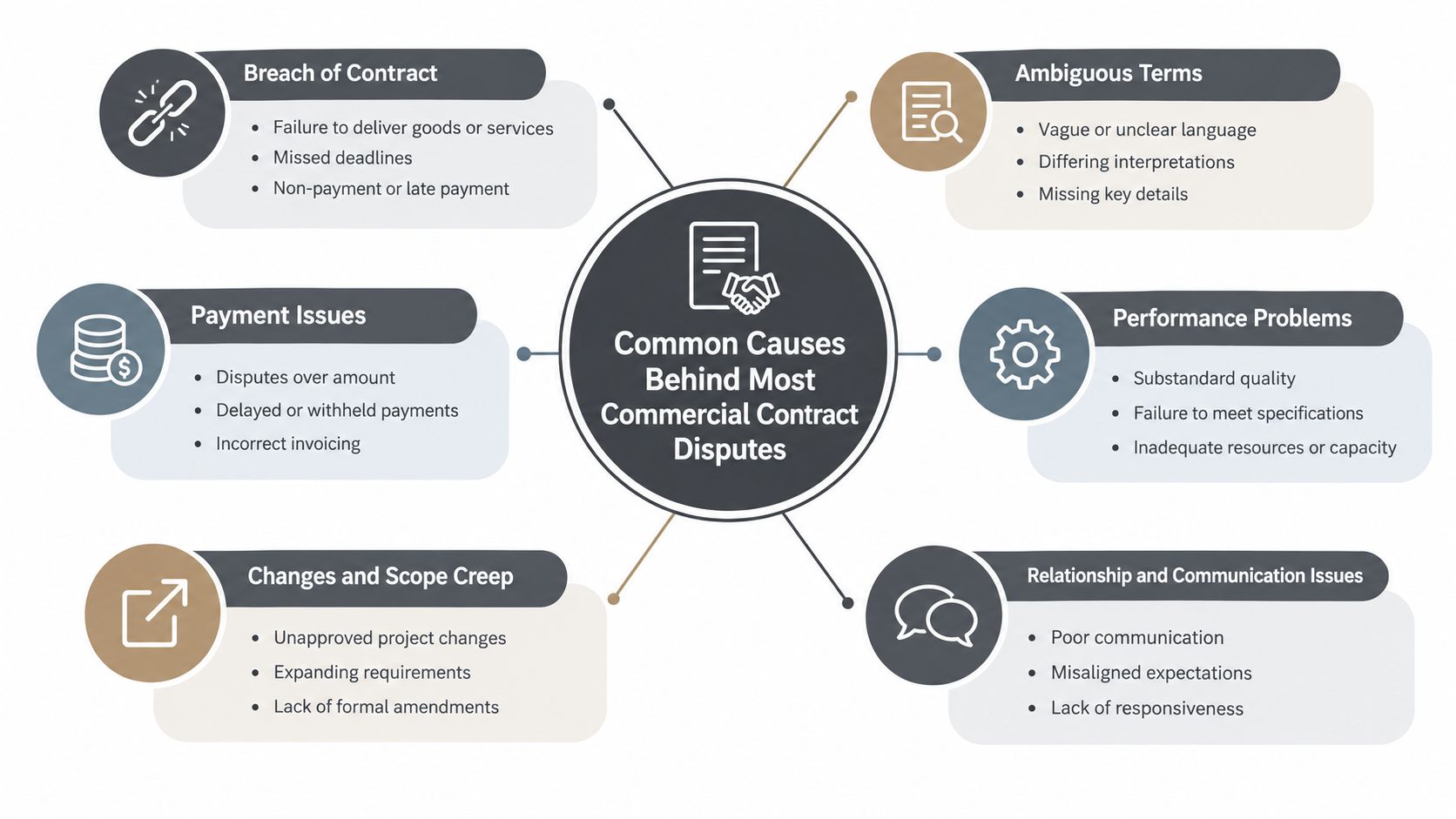
The better diagnosis is often governance failure, not bad faith. A contract needs owners, review meetings, escalation contacts, written change control, and records that show how the parties applied the terms. Without those controls, even a cooperative relationship can produce an expensive disagreement.
Legal Theories and Remedies Businesses Encounter
The legal theory organizes the dispute, but the business records determine whether the theory can succeed. A claimant may allege that the other party failed to perform a material obligation. A defendant may respond that performance was adequate, the claimant accepted the work, or the contract allowed the conduct.
Claims and defenses in plain English
A material breach is a serious failure that defeats an important purpose of the agreement. A minor breach may support damages without giving the other party a right to end the entire contract. Anticipatory breach arises when a party clearly indicates, before performance is due, that it won't perform. Repudiation is the stronger form of that refusal, often requiring the other party to decide whether to demand performance or treat the contract as ended.
A court may order specific performance when money doesn't adequately replace the promised performance, although this remedy is more practical for unique assets or obligations than for ordinary services. Rescission unwinds the agreement. Reformation asks the court to correct the written document when it fails to reflect the parties' actual agreement. Tortious interference may apply when a third party intentionally disrupts a contract or business relationship, but it requires facts beyond an ordinary contract breach.
Defenses can be equally important. Force majeure may excuse performance covered by the clause. Impracticability addresses extraordinary difficulty, while frustration of purpose concerns the loss of the agreement's expected commercial objective. Waiver may arise when a party knowingly accepts nonconforming performance. Estoppel can prevent a party from taking a position inconsistent with its prior conduct. Unconscionability challenges terms that are unfair in formation or substance.
For a practical overview of monetary and equitable relief, review breach of contract remedies.
Legal theories and remedies at a glance
| Legal Theory | Typical Remedy | Key Evidence Needed |
|---|---|---|
| Breach of contract | Compensatory damages, contract remedies, or termination rights | Executed agreement, performance records, notices, and payment history |
| Anticipatory breach or repudiation | Cover damages, acceptance of repudiation, or an election to continue | Clear refusal, deadline communications, replacement transactions |
| Specific performance | Order requiring performance | Contract language, uniqueness of the subject matter, proof money is inadequate |
| Rescission | Cancellation and restoration of exchanged benefits | Formation records, material misrepresentation or fundamental failure |
| Reformation | Correction of the written terms | Negotiation drafts, correspondence, drafting history |
| Force majeure or impracticability | Excuse, suspension, or limited relief | Causation records, notices, mitigation efforts, affected operations |
| Tortious interference | Economic damages and possible equitable relief | Third-party conduct, intent, contractual relationship, resulting loss |
Damages may include expectation loss, which aims to provide the benefit of the bargain; reliance loss, which addresses expenditures made in reliance on the contract; and restitution, which focuses on returning a benefit improperly retained. Consequential damages, liquidated damages, injunctive relief, and attorneys' fees depend on the agreement, applicable law, proof, and enforceability.
Pathways to Resolve a Commercial Contract Dispute
The right forum depends on what the business needs, not on which process sounds most formal. A company seeking to preserve a supplier relationship may choose a different path from one seeking a confidential exit, emergency relief, or a binding ruling.
Many agreements use an escalation ladder. Executives negotiate first, then the parties attempt mediation, and only afterward proceed to arbitration or litigation. AAA commercial language commonly routes disputes to arbitration under its Commercial Arbitration Rules, while some clauses place mediation before a binding process. Businesses comparing cross-border options may also benefit from this overview of handling contract disputes globally.
| Pathway | Process Formality | Enforceability | Typical Cost | Typical Timing |
|---|---|---|---|---|
| Direct negotiation | Low | Binding only if documented in an agreement | Usually the lowest, but internal time can be substantial | Often the fastest |
| Mediation | Moderate, guided by a neutral | Voluntary unless the parties sign a settlement | Moderate, with professional and preparation costs | Often faster than a contested adjudication |
| Arbitration | Formal, but generally more streamlined than court | Arbitrator issues a binding award | Can be significant, including arbitrator and forum fees | Depends on the clause, rules, and complexity |
| Litigation | Highest formality, with public court procedures | Court judgment, subject to procedural rights and appeal | Potentially extensive discovery, motion, trial, and enforcement costs | Can vary widely by court and scheduling order |
What each path gives up
Negotiation preserves flexibility and lets the parties redesign the relationship. It fails when one side needs information the other won't provide, when decision-makers lack authority, or when delay benefits the party withholding performance.
Mediation uses a neutral person to help the parties reach their own resolution. It doesn't impose a result. That makes it useful for preserving relationships, but unsuitable when a party needs a binding determination and the other side won't compromise.
Arbitration provides a binding award and can offer privacy and procedural efficiency. It may involve narrower discovery than federal litigation, which reduces burden but increases the importance of organized documents and credible experts. Litigation provides court-supervised discovery, established procedural rules, and a precedent-rich public record. It can also expose sensitive information and consume substantial management attention.
The contract's forum clause, governing law, emergency-relief carve-outs, and seat of arbitration can matter as much as the underlying breach. For a broader comparison of process design, see alternative dispute resolution versus litigation.
Procedural Steps and Realistic Timelines
A dispute can become expensive before anyone files a claim. The first practical task is to determine what failed operationally: an unclear obligation, a missed KPI, an ineffective approval process, or a breakdown in governance. Counsel then reviews the agreement, amendments, notices, communications, performance records, forum clause, governing-law provision, and likely damages. The business should preserve relevant files before employees delete messages or routine systems overwrite data.
A demand letter should identify the alleged breach, request a cure, reserve rights, and leave room for a business solution. Its wording also carries risk. Exaggerated facts, accidental admissions, or failure to follow a notice provision can weaken the sender's position. A business preparing a response should consult this guidance on how to respond to a demand letter.
The process after a filing
Once litigation begins, the case usually develops through these stages:
- Pleadings and jurisdiction: The complaint and answer define the claims, defenses, parties, and forum.
- Early motions: A party may challenge jurisdiction, venue, service, or the legal sufficiency of the pleading.
- Discovery: The parties exchange documents, written responses, and testimony.
- Expert work: Damages, accounting, technical performance, and industry standards may require expert disclosure.
- Summary judgment: The court may decide issues where the material facts are not materially in dispute.
- Trial and judgment: Witnesses, documents, and expert opinions are presented before a decision.
- Appeal and collection: A judgment may be challenged, but a successful ruling still requires enforcement against available assets.
In U.S. federal courts, commercial breach-of-contract disputes resolve in a median of 273 days, based on 308,088 cases in the public federal record. The same record reports 35% settle, 33% are dismissed, 20% reach judgment, 8% are transferred or stayed, and 5% are remanded. These figures come from the federal breach-of-contract benchmarks.
A filing date therefore cannot predict a trial date by itself. A case may settle early, end on a motion, move to another forum, or continue through discovery and trial. Arbitration uses different milestones, including document exchange, an evidentiary hearing, and a challenge period governed by applicable law and rules. Treat any timeline as a planning budget, not a promise.
Evidence, Documentation, and Damages Strategy
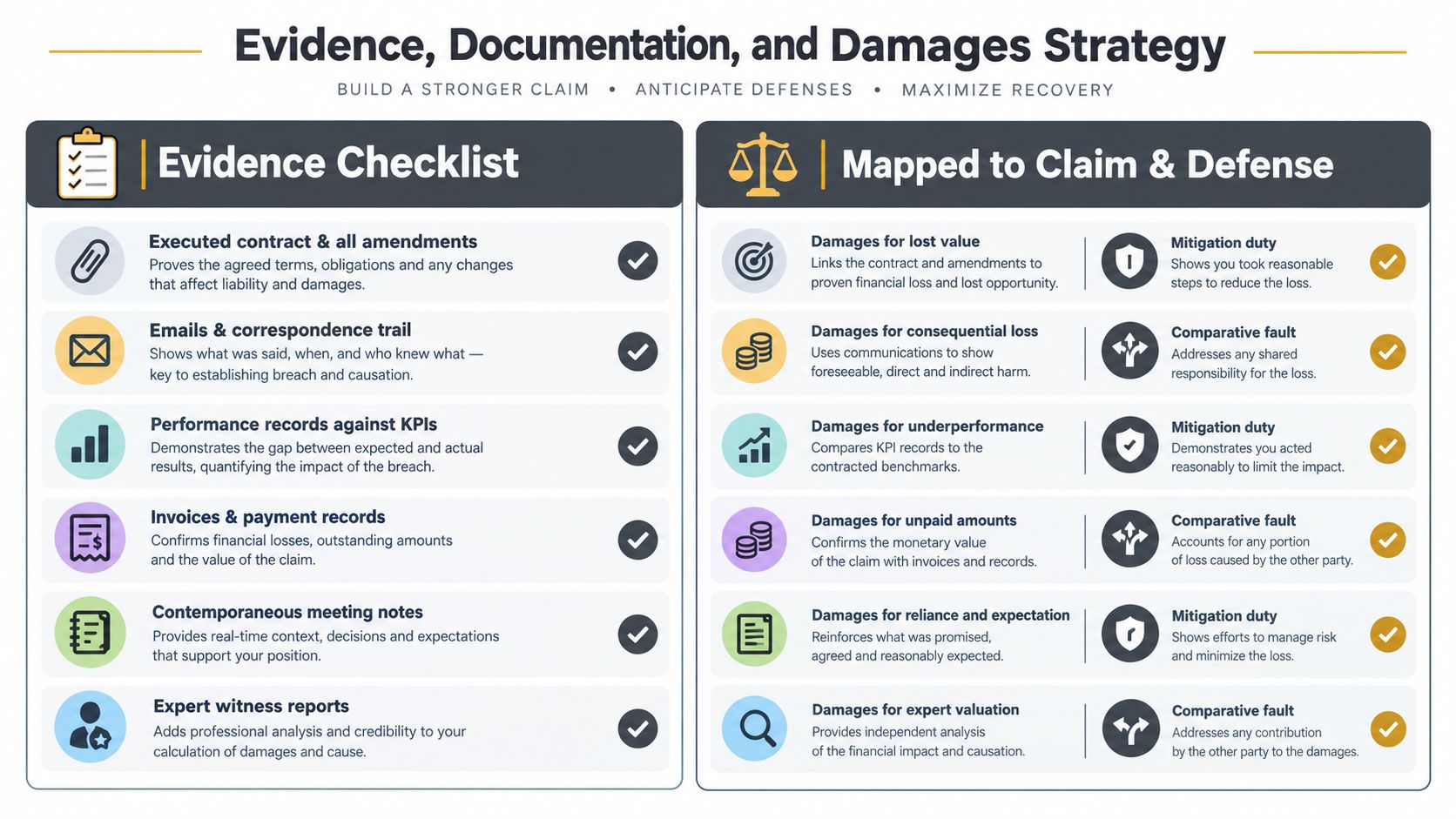
A credible damages case begins with an operational question: what should the business have received, and what records show the difference? Start with the contractual obligation, define the counterfactual result, and collect evidence linking the alleged failure to the claimed loss. Asking accounting for every available file before deciding what must be proved creates volume without a theory.
The executed agreement is only the beginning. Preserve amendments, statements of work, purchase orders, renewals, side letters, and written change approvals. Keep the negotiation record as well. Draft language, implementation discussions, and later explanations may show how the parties understood an ambiguous term.
Operational evidence should answer specific questions:
- KPI dashboards and acceptance records show whether a deliverable met the agreed threshold.
- Invoices and payment histories establish what was billed, paid, withheld, credited, or disputed.
- Quality, delivery, and inventory records connect supplier performance to rework, delay, replacement sourcing, or lost production.
- Emails, meeting notes, and internal memoranda may establish notice, knowledge, waiver, mitigation, and shifting expectations.
- Expert reports and forensic accounting turn underlying records into a defensible loss calculation.
A damages model is only as persuasive as its supporting records. Commercial damages analysis commonly draws on contracts, invoices, payment histories, transactional records, and operational data. Forensic accountants may use those materials to quantify economic loss and present a report or testimony. The commercial disputes and general damages guidance explains why the calculation should connect contemporaneous records to a clear counterfactual baseline.
The remedy determines what the evidence must establish. Expectation damages require proof of the promised economic position. Reliance damages focus on expenditures made because of the agreement. Consequential damages require a defensible causal chain. Liquidated damages depend on an enforceable contractual formula, while restitution focuses on the benefit transferred to the other party.
Sparse records weaken claims and defenses alike. They also expose governance failures, including unclear metrics, undocumented changes, weak audit rights, uncertain reporting ownership, and poor record retention.
Drafting to Prevent the Next Dispute
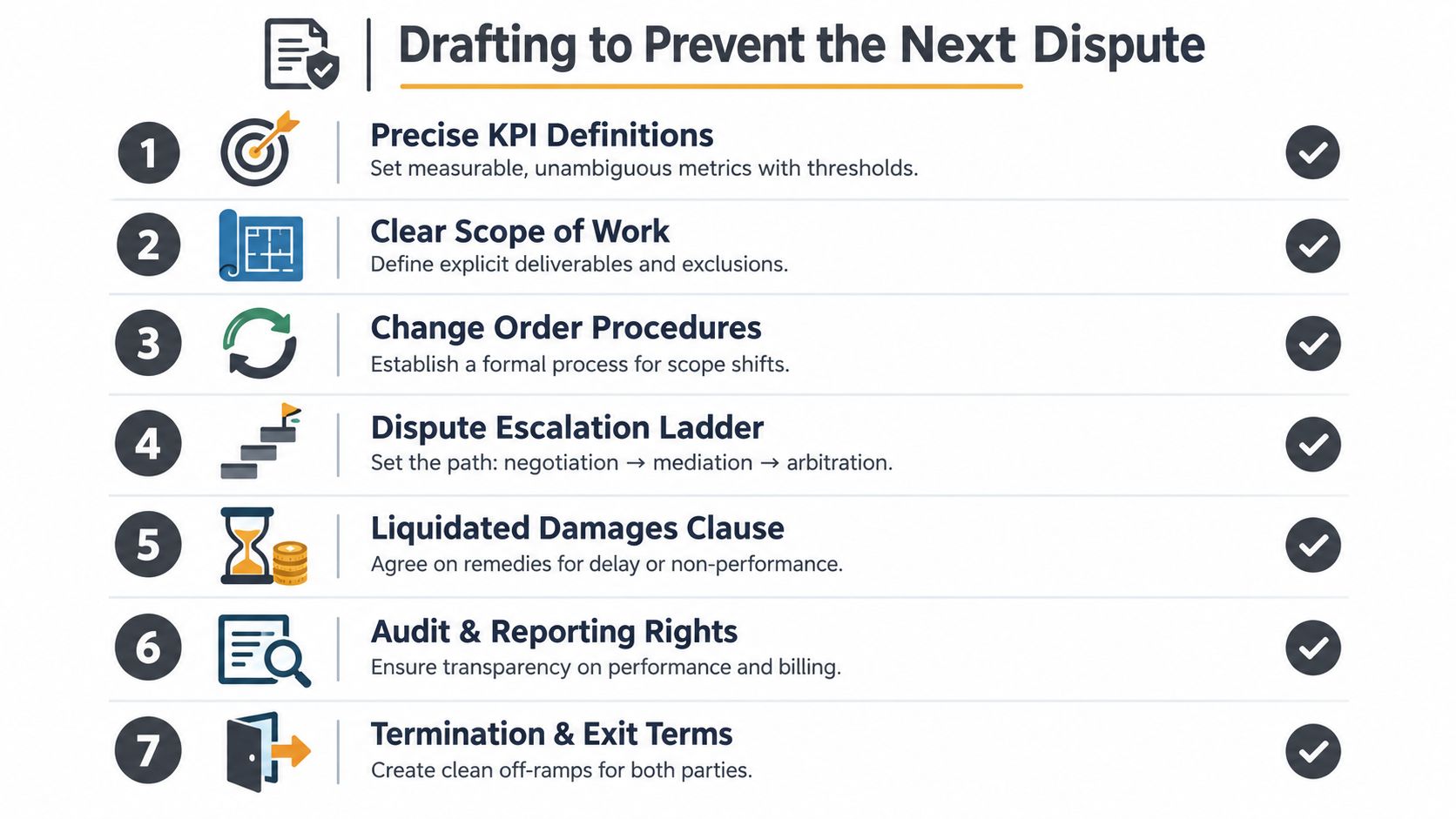
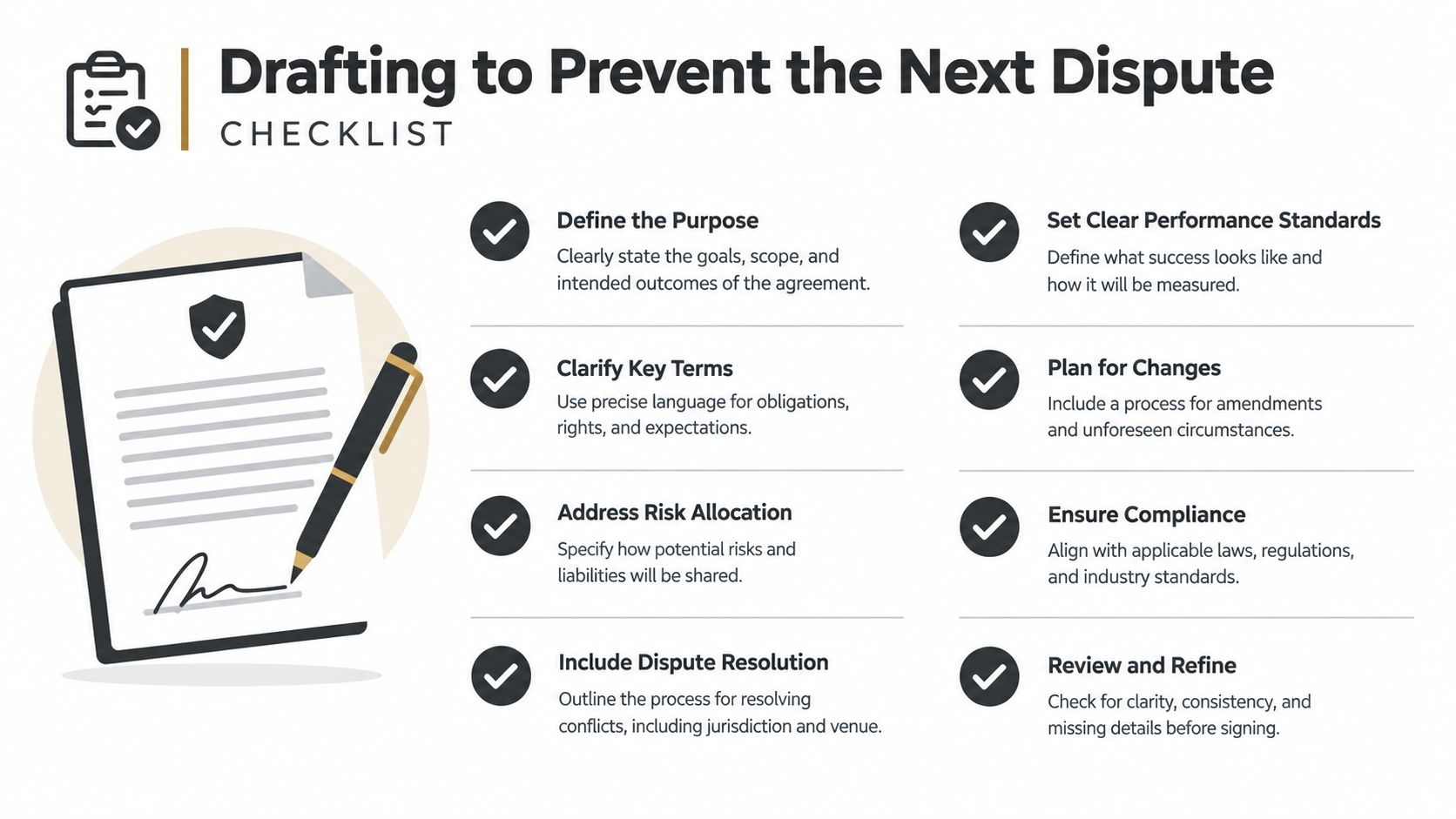
The cheapest time to solve a commercial contract dispute is before signature. A practical review asks whether managers can operate the agreement under pressure, not merely whether its clauses sound legally familiar. Ambiguous responsibilities, unmeasurable KPIs, and weak governance often create the dispute before anyone alleges breach.
Start with the operating model. The contract should identify:
- Measurable KPIs: Define each metric, data source, testing method, threshold, reporting frequency, cure period, and remedy.
- A bounded scope: Separate required deliverables from optional services, list exclusions, and distinguish an outcome obligation from a reasonable-efforts obligation.
- A usable change-order process: Name the approver, require a written record, address price and schedule effects, and explain performance while approval remains pending.
- Escalation ownership: Identify business contacts, establish executive escalation, and set a steering committee schedule that matches the project's risk.
- Verification rights: Audit and reporting rights should let a party test payment, usage, and performance data in practice.
- An executable exit plan: Address termination for cause and convenience, cure, transition assistance, data return, inventory, and continuing confidentiality duties.
- Defined disruption rules: Force majeure and hardship provisions should cover events, notice, mitigation, suspension, payment treatment, and termination consequences.
- Remedies that work together: Liquidated damages, service credits, indemnities, liability caps, and carve-outs should allocate risk without conflicting formulas.
These controls only help if the governance process keeps them current. Assign ownership for KPI reporting, require written approval of material changes, preserve decision records, and set a route for resolving disputed measurements before invoices or service credits accumulate.
Force majeure does not automatically excuse difficult performance. Courts and tribunals generally examine the clause's wording, causation, notice, and mitigation. Hardship and material-adverse-change provisions need comparable precision when supply, tariff, sanctions, or financing conditions shift.
The same discipline applies to real estate arrangements. A review focused on reading a lease before signing should test operating obligations, notice rules, pass-through costs, renewal rights, and exit conditions.
For agreements that allocate third-party risk, guidance on indemnification clauses in contracts helps decision-makers examine notice, defense control, exclusions, and insurance coordination.
Emerging risks make operational drafting more demanding. AI-related disputes may concern proprietary data and model-training rights. Sanctions, tariffs, and geopolitical payment disruptions can raise questions about force majeure, cost allocation, modification, and halted operations. A general promise to comply with applicable law may leave the commercial burden unresolved.
When and How to Engage a Commercial Law Firm
Internal teams should involve counsel before the dispute becomes irreversible. A failed demand letter, a threatened termination, a missed notice deadline, a need for emergency injunctive relief, or a material exposure to revenue or operations can justify an early assessment.
Time limits depend on jurisdiction, contract language, claim type, and governing law. Don't assume the business has ample time because negotiations are continuing. Counsel can assess limitation periods, contractual notice requirements, arbitration deadlines, preservation duties, and the risk that continued performance will be treated as waiver.
Prepare for the first consultation
Bring a concise factual package:
- The contract file: Include the signed agreement, exhibits, amendments, purchase orders, renewals, and incorporated policies.
- A dated chronology: List key promises, deliveries, failures, notices, meetings, payments, and attempted fixes.
- The financial impact: Identify unpaid invoices, replacement costs, lost margin, rework, credits, and mitigation efforts.
- The communications record: Preserve relevant email, messaging, meeting, and project-management materials.
- The business objective: Decide whether the priority is continued performance, a negotiated exit, recovery, injunctive relief, or a binding decision.
The initial engagement may involve a conflict check, preliminary merits assessment, preservation guidance, and a discussion of fees. Hourly, flat-fee, contingency, and hybrid structures each allocate risk differently. A low initial fee doesn't necessarily mean a low total cost, and a contingency arrangement may not fit a matter requiring substantial injunctive or advisory work.
Counsel should also examine prevailing-party provisions, attorneys' fees, arbitration costs, liability caps, indemnities, and collection prospects. Winning a judgment doesn't automatically produce payment. Enforcement may require locating assets, pursuing post-judgment remedies, or negotiating a structured resolution.
Businesses looking for regional perspective can review this resource on selecting a California business dispute lawyer. The same selection questions apply elsewhere: Does counsel understand the industry, the contract mechanism, the evidence, the forum, and the company's commercial objective?
Kons Law handles business contract disputes through negotiation, mediation, arbitration, and litigation, alongside contract drafting and other commercial work. The firm's broader practice also addresses collections and creditors' rights, which can matter when a favorable resolution still requires recovery efforts.
If you want to discuss your business law matter, contact Kons Law at (860) 920-5181. The firm can help assess the contract, preserve the evidence, evaluate resolution options, and plan a practical response to a commercial contract dispute. Visit Kons Law to request a confidential case review.
