A contractor wins a $48,000 default judgment and assumes the hard part is over. Fourteen months later, the debtor has refinanced his house, moved the equity, and stopped answering calls. The judgment is valid, but the money is no longer sitting where a simple execution can reach it.
That scenario captures the central reality of judgment enforcement. Winning establishes liability. It doesn't identify the debtor's assets, preserve those assets, select the correct remedy, or put funds in your account. Collection starts after judgment, and delay gives a debtor time to sell property, change banks, redirect income, or place assets beyond practical reach.
The most effective strategy treats enforcement as a tool-selection problem. A wage execution fits steady payroll income. A bank execution fits a known account. A judgment lien fits real estate with meaningful equity. A charging order fits distributions from an LLC interest. The right sequence depends on what the debtor owns, where it is located, what exemptions protect it, and whether the expected recovery justifies the cost.
What Happens After You Win the Judgment
A judgment is not a check waiting at the courthouse. It gives the creditor legal authority to pursue collection, but the creditor still has to convert that authority into a reachable asset and a procedurally valid remedy.
In the contractor's case, the first missed opportunity was time. Had the creditor promptly investigated the property and docketed the judgment, the judgment lien might have affected the debtor's refinancing or at least preserved a claim against available equity. Instead, the debtor completed a transaction before the creditor had selected a tool.
Practical rule: Treat the judgment date as the beginning of the collection campaign, not its conclusion.
The creditor should first confirm that the judgment is final, calculate the current balance, docket it correctly, and review any post-judgment motion or appeal. In Connecticut, motions to open, set aside, reargue, or vacate can change the practical collection process under Practice Book §§ 14-9 through 14-15. A creditor who begins execution without checking the judgment's procedural status may spend money enforcing an order that remains vulnerable to modification or reopening.
Connecticut law provides a long enforcement runway. Under Connecticut General Statutes § 52-598, a judgment may generally be enforced within 20 years, with a 15-year renewal mechanic that requires careful calendaring and procedural compliance. That window matters, but it shouldn't encourage passivity. A long statutory life doesn't protect assets that disappear before a lien is recorded or a garnishment is served.
Post-judgment interest also changes the balance over time. Federal law, under 28 U.S.C. § 1961, ties interest to the weekly average one-year constant maturity Treasury yield for the calendar week preceding judgment, computes it daily, and compounds it annually. A published reference reported a federal post-judgment rate of about 4.02% for July 20 through July 26, 2026, illustrating why the applicable rate depends on timing and market conditions, not a fixed nationwide figure (federal post-judgment interest calculation reference).
The working premise is simple: every remedy reaches a different asset class. A judgment creates the opportunity. Asset investigation and tool selection determine whether that opportunity produces payment. Creditors who want a plain-language explanation of the underlying status can review what it means to be a judgment creditor.
Finding the Assets Before You Seize Them
No execution can collect from an asset you haven't located. Asset identification should begin with inexpensive public records and become more targeted only when the first layer reveals a plausible collection path.
Start with the public record
For Connecticut real estate, search town land records and the Connecticut Superior Court system. Look for current ownership, recent transfers, mortgages, tax liens, prior judgment liens, and recorded instruments that may reveal refinancing or related-party transactions. A property with substantial senior liens may look valuable but offer no practical recovery.
For business and personal property, review Connecticut Secretary of State filings, UCC records, ERS information where applicable, and vehicle records. These searches can identify operating entities, secured lenders, equipment financing, and business relationships. Federal court records through PACER may reveal other lawsuits, bankruptcy activity, settlements, or claims that point to assets or competing creditors.
The state judgment lien docket also deserves attention. Prior encumbrances often decide whether recording another lien is economically sensible. A lien that sits behind mortgages, tax claims, and earlier judgments may preserve a legal position without producing meaningful near-term money.
Use discovery to force answers
The harder layer is post-judgment discovery under Practice Book § 13-26. In Connecticut, the Cite and Examine process under Conn. Gen. Stat. § 52-148a can require the debtor to appear, disclose assets, and answer under oath. That procedure can expose bank accounts, employment, ownership interests, transfers, and liabilities that don't appear in public filings.
A deposition may be appropriate where the debtor has complicated business affairs. Document subpoenas can target banks, employers, brokerages, payment processors, or other third parties, subject to applicable procedure and objections. A subpoena to major credit bureaus may help map addresses, reported liabilities, and creditor relationships through credit-header information.
The useful question isn't “Does the debtor have assets?” It's “Which asset can produce net recovery after priority claims, exemptions, fees, and delay?”
Skip tracing can make the investigation more disciplined when addresses, aliases, entities, or related parties are unclear. For a practical framework on evaluating the economics of that work, review skip tracing ROI insights from BatchData.
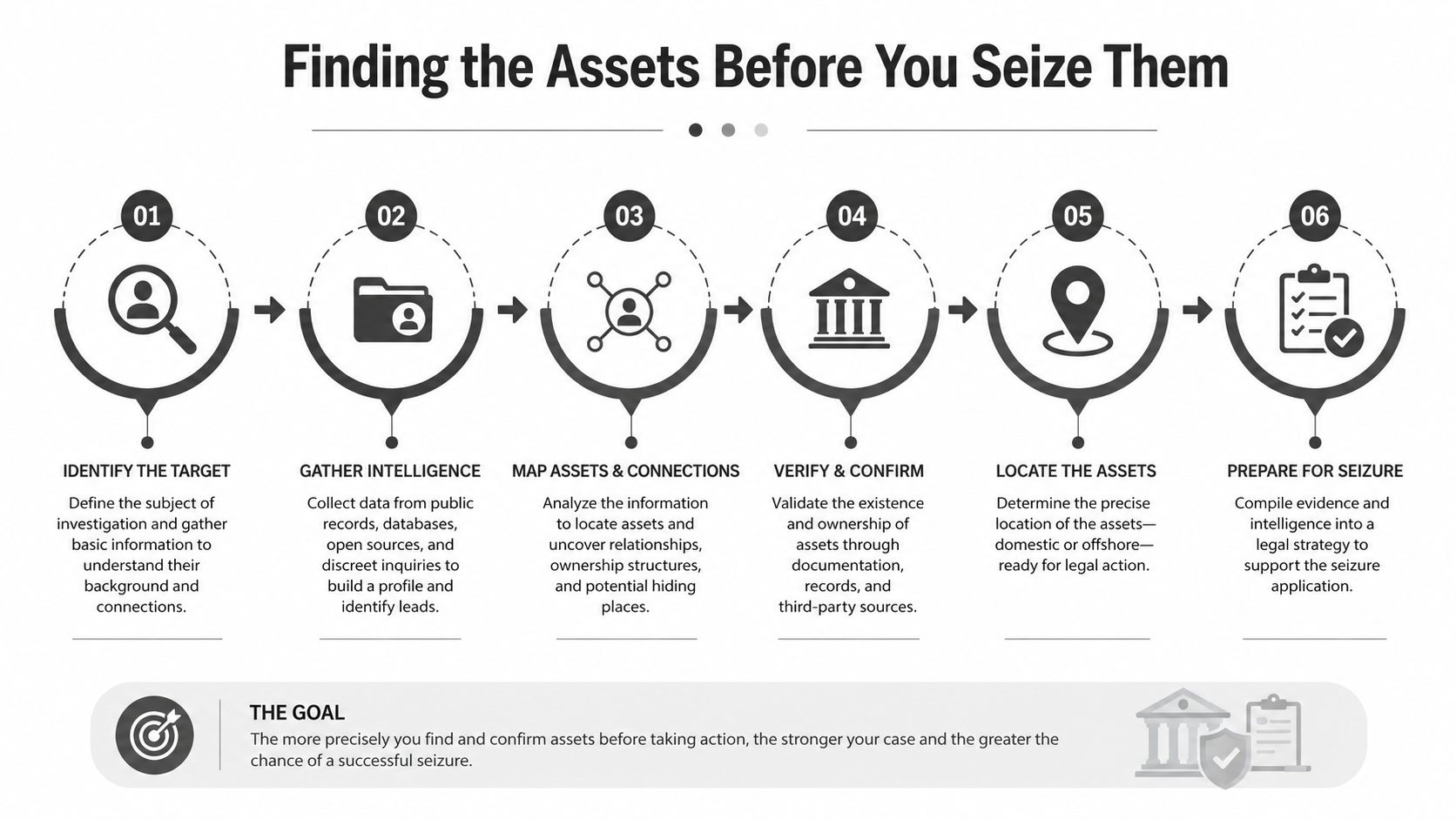
Finding an asset is only half the assignment. The next decision is whether the asset supports a garnishment, execution, lien, charging order, turnover request, or a more aggressive claim involving asset concealment.
Enforcement Tools and What Each One Reaches
The collection menu is not a glossary. Each remedy has a target, a pace, a cost profile, and a predictable failure mode.
| Tool | Asset Class Reached | Speed to Money | Recovery Outlook |
|---|---|---|---|
| Wage execution or garnishment | Non-exempt disposable earnings | Recurring, but limited by payroll processing | Steady income can produce gradual recovery |
| Bank execution | Funds held in a bank account | Fast when the correct account is identified | Strong for available non-exempt balances, weak after funds move |
| Personal-property execution | Vehicles, equipment, inventory, and other tangible property | Depends on levy and sale logistics | Often poor unless equity and a buyer are clear |
| Judgment lien | Non-exempt real estate equity | Usually at sale or refinance | High leverage when equity exists |
| Charging order | Distributions from an LLC or partnership interest | Dependent on distributions | Useful where the entity generates owner distributions |
| Domestication or foreign enforcement | Assets located outside the original court's jurisdiction | Depends on recognition and local procedure | Highly dependent on the target jurisdiction |
| Fraudulent-transfer or Civil RICO claims | Assets moved through concealment or qualifying misconduct | Litigation-driven | Potentially significant, but expensive and fact-intensive |
A wage execution under Conn. Gen. Stat. § 52-362 reaches non-exempt disposable earnings and works best when the debtor has a stable employer. Federal consumer-credit limits generally cap garnishment at 25% of disposable earnings, as reflected in the Federal Trade Commission's wage garnishment guidance. The remedy becomes largely performative when the debtor is self-employed, paid in cash, or receiving income through a business rather than payroll. For Connecticut-specific mechanics, see how wage garnishment works.
A bank execution under § 52-356a can be powerful when the creditor knows where the debtor banks. It can also fail quickly because exemptions protect certain funds and debtors can move balances between accounts. The writ has to reach the right institution at the right time.
A writ against personal property is inexpensive relative to complex litigation, but seizure doesn't equal cash. The creditor must account for ownership, senior liens, storage, sale expenses, and whether a levying officer can locate and sell the property. Hong Kong enforcement data illustrates the difference between remedies. In 2008, bailiff success was 36% for warrants of distress, 12% for writs of fieri facias and related money-enforcement orders, and 93% for possession writs (Civil Justice Council civil enforcement report). The same record identifies common failures, including a debtor with no money, insufficient value in the items found, or an unlocated debtor.
A judgment lien on realty is passive, inexpensive, and frequently underused. It may not generate an immediate payment, but it can become decisive when the debtor sells or refinances property. A charging order under Conn. Gen. Stat. § 34-171 targets distributions from an LLC or partnership interest rather than the entity's assets. It preserves the business while redirecting qualifying distributions.
For assets in another state or country, domestication and local enforcement procedures matter. The Hague Convention on the Recognition and Enforcement of Foreign Judgments in Civil or Commercial Matters, concluded on 2 July 2019 and entering into force on 1 September 2023, applied by 2026 between 7 parties covering 32 states, creating a more standardized framework after negotiations dating back at least to the 1970s (Hague Convention analysis). Recognition still must be tested in the actual asset jurisdiction.
Discovery is also an enforcement tool. A credible Cite and Examine proceeding can produce payment faster than a writ when the debtor wants to avoid sworn testimony, document production, or contempt exposure.
Procedure and Timelines in Connecticut and Beyond
Connecticut enforcement usually begins with a current judgment balance and a decision about the asset to be reached. The creditor then obtains the appropriate writ of execution or garnishment summons, prepares service, and coordinates with a state marshal.
For a wage remedy, the employer receives the execution and the debtor has a 15-day response window. Bank garnishments generally involve a 30-day period before funds are paid out, subject to the statutory process, notices, objections, and exemption issues. State marshal fee schedules can run from $50 to $150 plus mileage, so the creditor should calculate likely net recovery before issuing process.
A real estate lien follows a different path. The creditor records the judgment in the town clerk's office where the debtor owns property, confirms indexing, and monitors later sale or refinance activity. The lien can operate as a 20-year encumbrance under the Connecticut framework described above, but it doesn't create immediate liquidity. An execution sale requires additional work, including levy, notice, valuation, sale administration, and resolution of priority issues.
Federal and interstate variations
Federal money judgments generally follow Federal Rule of Civil Procedure 69. Under that rule, the default mechanism is a writ of execution, and the procedure usually follows the law of the state where the federal court sits unless a federal statute applies (Cornell Law School explanation of a writ of execution). A federal judgment therefore doesn't create one uniform national collection process. The creditor must match the federal judgment to the enforcement mechanics of the state where the property is located.
Garnishment has its own federal mechanics. Under 28 U.S.C. § 3205, a federal garnishee must answer within 10 days of service and withhold covered non-exempt property pending further court order (federal garnishment statute). That short response period can make garnishment more targeted than ordinary execution when a bank, employer, or other intermediary holds the debtor's property.
California may use a 10-day earnings withholding order, while Connecticut uses its own longer statutory sequence. New York may require a CHOICE filing for certain out-of-state debtors. The Uniform Enforcement of Foreign Judgments Act can provide a route for recognizing and enforcing an out-of-state judgment, but filing alone doesn't eliminate local notice, exemption, service, or execution requirements. Connecticut creditors considering that route can review the Uniform Enforcement of Judgments Act.
Typical elapsed time from filing to first payment may be 60 to 120 days for bank and wage garnishments, while real estate execution sales generally take longer. Prejudgment remedies are different. They typically require a bond and probable-cause findings, whereas post-judgment enforcement generally doesn't require a bond once the judgment is final.
Exemptions and Defenses the Creditor Must Anticipate
Exemptions create a counter-map to the asset search. A property record may show ownership, but ownership alone doesn't establish collectibility. Before spending on a levy or sale, the creditor should determine whether the asset is protected, subject to a superior lien, jointly owned, or worth less than the enforcement expense.
Connecticut recognizes protections that can affect a creditor's options, including a homestead exemption, tools-of-trade protection, protection for qualifying motor vehicles, and a substantial wild-card personal-property exemption. ERISA-qualified retirement accounts generally receive strong protection, while IRAs and self-directed plans can require a more careful federal-preemption analysis.
| Asset Class | Exemption | Creditor Implication |
|---|---|---|
| Primary residence | Connecticut homestead protection | A judgment lien or execution may not reach protected equity |
| Tools of trade | Statutory protection for qualifying work equipment | A levy may produce little or no recoverable value |
| Motor vehicle | Protection subject to the applicable value threshold | Vehicle equity must be measured after liens and the exemption |
| Personal property | Wild-card protection may shield qualifying property | A household levy may cost more than it returns |
| Retirement accounts | ERISA protections and federal rules may apply | Account type and governing law require review |
| LLC interest | Charging-order analysis may apply | Distributions, rather than entity property, become the target |
The debtor may move to quash a garnishment for improper service, request an exemption hearing, challenge ownership, or invoke the automatic bankruptcy stay. Bankruptcy can halt collection activity even when the judgment is valid. A debtor may also shift from wages to non-wage income or move funds into protected accounts.
Certain behavior deserves immediate investigation rather than speculation:
- Employment changes: A sudden move away from payroll may make wage execution ineffective.
- Related-party transfers: Transfers to relatives or affiliated entities may indicate an attempt to separate ownership from control.
- Retirement contributions: Large, new contributions can change the asset profile and raise questions about timing and purpose.
- New entities: A fresh LLC that mirrors the old business may warrant discovery into operations, receivables, contracts, and transfers.
Creditor responses must remain asset-specific. Connecticut's treatment of homestead property differs from issues involving tenancy by the entirety. Practice Book § 13-2 discovery can test the factual basis for claimed exemptions, ownership, and transfers. Where the debtor owns an LLC interest, a charging order may reach distributions even when direct execution against the entity's property would be improper.
Cost, Speed, and Realistic Recovery by Remedy
The cheapest remedy isn't always the fastest, and the fastest remedy isn't always the most productive. A bank execution may be efficient when the account is known, while a real estate lien may be the better choice when immediate liquidity is absent but equity appears substantial.
| Remedy | Typical Cost to Creditor | Time to First Recovery | Realistic Recovery |
|---|---|---|---|
| Wage garnishment | Modest filing and service expense, recurring processing costs | Usually tied to payroll cycles and statutory notice periods | Gradual recovery limited by disposable-earnings rules |
| Bank execution | Filing, service, and possible objection costs | Often the quickest single-shot option when the account is identified | Depends on the balance, exemptions, and competing claims |
| Real estate lien | Relatively low recording expense | At sale or refinance | Can preserve substantial leverage, but may produce no immediate cash |
| Execution sale | Marshal, appraisal, storage, and sale expenses | Longer and procedurally intensive | Often reduced by senior liens, exemptions, and sale discounts |
| Charging order | Filing and monitoring expenses | Depends on business distributions | Can be the only practical route to owner-level value |
| Post-judgment discovery | Attorney time, service, deposition, and subpoena costs | Can produce voluntary payment or identify the next remedy | Indirect at first, but essential where assets are unclear |
Wage garnishment generally costs less to start and can recur, but it won't quickly satisfy a large judgment when only a limited portion of earnings is reachable. Bank execution can produce funds sooner, but it becomes a poor investment if the creditor doesn't know the bank or the debtor maintains only exempt balances.
A lien is a preservation strategy, not a liquidity strategy. An execution sale should be reserved for property with enough non-exempt equity to survive priority claims and sale costs. Charging orders can be slow because the creditor depends on distributions, but they may create pressure against an owner who has little personal property.
Post-judgment interest should be calculated through the expected collection date, with credits and payments applied correctly. A Connecticut creditor evaluating the effect of delay can review how interest accrues after judgment.
The practical sequence is usually bank and wage investigation first, lien recording to preserve advantage, charging-order analysis where business interests exist, and aggressive discovery before expensive execution activity. That sequence changes when the asset profile changes.
A Practitioner Checklist and When to Call Counsel
A creditor should approach enforcement like a triage exercise. Start with the judgment file, not with the remedy form.
Confirm the foundation
Verify that the judgment is final, properly entered, and served. Check for motions to open, set aside, reargue, vacate, or appeal. Recalculate principal, costs, payments, credits, and post-judgment interest through the anticipated enforcement date.
Then refresh the asset search. Public records change, employers change, businesses reorganize, and bank accounts close. A current search should occur within 30 days of the enforcement decision when the creditor is preparing to spend money on process.
| Step or Trigger | Action or Threshold | Output or Decision |
|---|---|---|
| Final judgment confirmed | Review motions, appeals, service, and balance | Proceed, wait, or address a procedural defect |
| Fresh asset search completed | Check real estate, entities, liens, vehicles, litigation, and addresses | Identify the strongest target |
| Asset appears non-exempt | Compare equity with senior claims and enforcement expense | Select execution, garnishment, lien, or charging order |
| Debtor appears judgment-proof | Use Cite and Examine, subpoenas, and targeted discovery | Confirm whether collection is viable |
| Assets cross state lines | Test recognition and local enforcement rules | Domesticate or retain local counsel |
| Expected recovery is uncertain | Calculate fees, interest, delay, and litigation budget | Enforce, negotiate, or write off |
| Debtor shows concealment signals | Preserve records and investigate transfers | Consider fraudulent-transfer or other claims |
Outside counsel becomes economically rational when identifiable assets exceed the exemption cushion, when the debtor appears judgment-proof but controls a business, when assets cross state borders, or when the principal owed justifies a litigation budget. Counsel can also help avoid the common mistake of spending on a remedy that reaches property but produces no net recovery.
Kons Law handles collection strategy, commercial litigation, and judgment enforcement for businesses, lenders, and creditors. The firm can help evaluate whether to pursue a garnishment, record or enforce a judgment across jurisdictions, negotiate a structured resolution, investigate concealed assets, or stop when the projected cost exceeds the likely return.
If you want to discuss your business law matter, contact Kons Law at (860) 920-5181. Kons Law can assess the judgment, identify practical enforcement options, and help you choose between collection, settlement, and a supported decision to write off the loss. Visit Kons Law to start the conversation.
