
You may still be showing up at the office, answering clients, and producing, but the message from the firm is obvious. Your accounts are being reassigned. Meetings happen without you. Compliance objections that used to be discussed now become write-ups. A manager starts pushing sales expectations that don't fit the book, the client base, or the rules.
For financial professionals, that pressure lands differently than it does in many other industries. A resignation can affect your Form U5, your reputation with recruiters, your transition options, and any later dispute over deferred compensation, promissory notes, or client ownership. In the right circumstances, the law doesn't treat that resignation as voluntary at all. It treats it as a firing.
That is the core of a constructive discharge claim. The label matters, but the practical question matters more. Did the firm make continued employment so intolerable, and for unlawful reasons, that a reasonable professional would feel forced to leave? If the answer may be yes, your next steps should be deliberate, not emotional. The same planning discipline that applies to a client transition applies here. Timing, records, and forum selection can decide the outcome.
Professionals dealing with this kind of pressure often also have overlapping concerns about retaliation and wrongful termination. A broader overview of those issues appears in this discussion of wrongful termination laws in Connecticut.
When Quitting Feels Like Being Fired
A financial advisor rarely wakes up one morning and decides, without context, to abandon a book of business and start over. More often, the exit is engineered through pressure. The branch manager stops supporting your team. Internal referrals dry up. You're told to push products you've already flagged as unsuitable for certain clients. Then, when you object, the scrutiny starts.

That pattern is why constructive discharge law exists. It recognizes that some resignations are resignations only on paper. If the working conditions were effectively impossible, and those conditions flowed from unlawful conduct such as discrimination, retaliation, or pressure tied to a public-policy violation, the law may treat the departure as an employer-driven termination.
Why this hits harder in financial services
In securities industry disputes, the resignation itself is only part of the problem. A representative may also face:
- Form U5 fallout that shapes how future firms, regulators, and counterparties view the separation
- Compensation disputes involving trailing commissions, bonuses, deferred compensation, or transition pay
- Recruiting damage because a forced exit can look voluntary to outsiders who don't know what happened inside the branch or region
- Regulatory risk if the same events lead to internal reviews, customer complaints, or a FINRA inquiry
A bad workplace is one thing. A forced resignation in a regulated industry can become a career event.
What usually does not work
Many professionals use the phrase “I had no choice” loosely. Legally, that isn't enough. Being frustrated with leadership, disliking a payout change, or clashing with a supervisor typically won't convert a resignation into a claim.
Practical rule: If you can't identify the unlawful conduct, the intolerable conditions it created, and the point where staying stopped being realistic, you likely don't yet have a strong constructive discharge case.
What works is a disciplined look at the facts. Who did what. When they did it. What rule, right, or protected activity is involved. And what evidence shows that the firm either created the conditions or knowingly let them continue.
The Legal Definition of a Constructive Discharge Claim
The legal standard is narrower than most employees expect. The Equal Employment Opportunity Commission defines constructive discharge as a resignation caused by unlawful employment practices, and its guidance explains that when the resignation is directly related to the employer's unlawful conduct, it is treated as a foreseeable consequence of that conduct, as described in the EEOC's guidance on discharge and discipline.
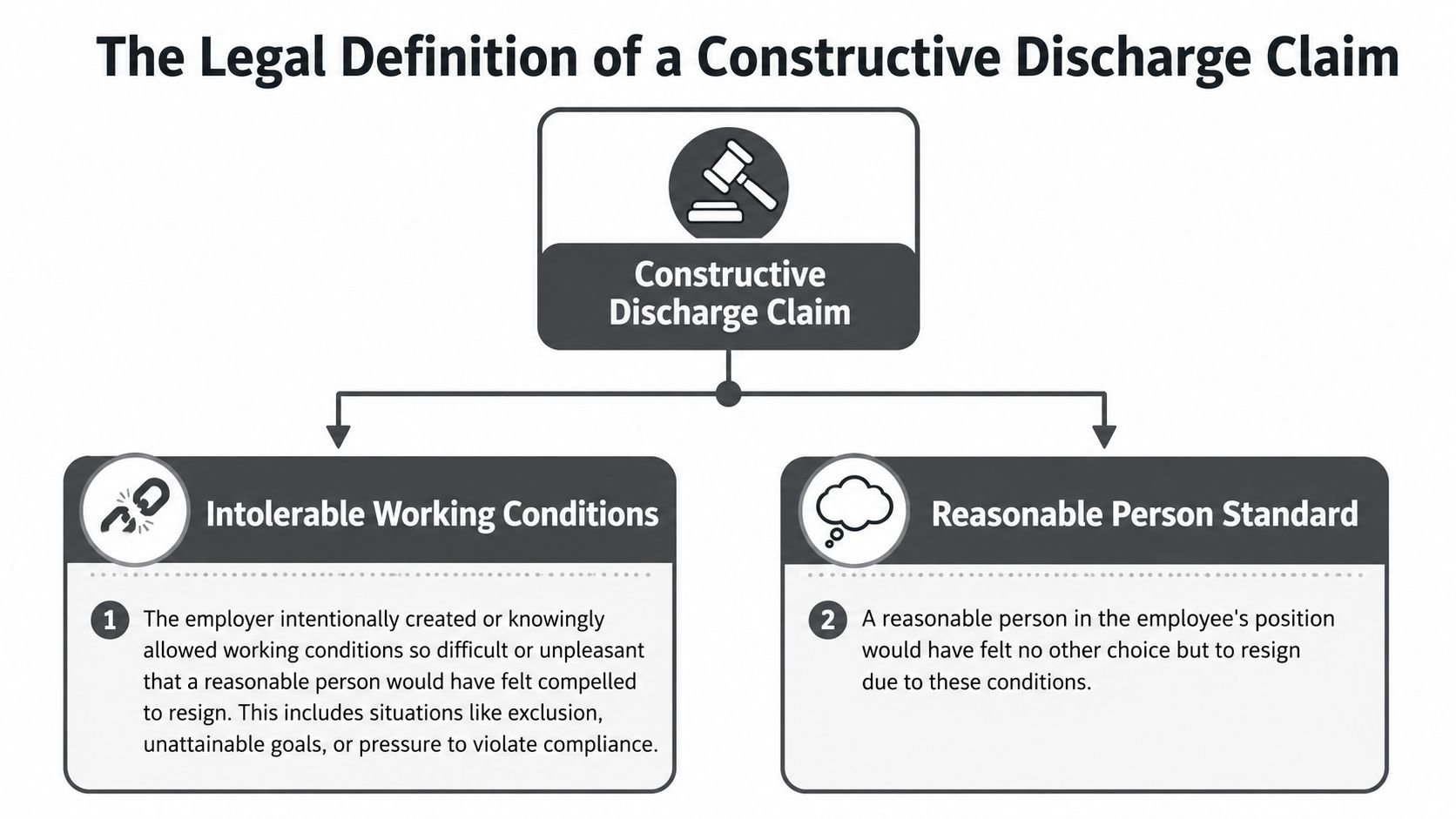
Federal and state authorities commonly apply an objective standard. The employee must show working conditions were so difficult or unpleasant that a reasonable person would feel compelled to resign. Wisconsin's administrative digest, as quoted in that guidance, also states that proof of employer intent to force the resignation is not necessary.
The two issues decision-makers focus on
A court or arbitration panel usually wants to resolve two core questions.
First, were the conditions objectively intolerable? Not annoying. Not unfair in the ordinary workplace sense. Intolerable.
Second, is the employer legally responsible for those conditions? That can mean management created them directly, ratified them, or knew about them and failed to correct them.
What intolerable conditions can look like
In a financial services setting, intolerability often appears in combinations rather than a single dramatic event. Examples can include exclusion from core meetings, discipline that escalates after protected complaints, stripping of duties, or demands that put a registered professional in conflict with compliance obligations.
A useful way to think about the standard is this. The law doesn't ask whether this workplace became unpleasant. It asks whether a reasonable advisor, analyst, supervisor, or principal in that same role would conclude that remaining employed was no longer a realistic option.
The reasonable person standard is what keeps constructive discharge from swallowing every hard resignation.
What the claim is not
A constructive discharge claim is not a remedy for every toxic office or every poor manager. It usually depends on a link to unlawful conduct. That may be discrimination, harassment, retaliation, or pressure tied to another legal violation.
Here is the practical filter:
| Issue | Usually not enough | Potentially significant |
|---|---|---|
| Workplace conflict | Personality clash with a manager | Retaliatory exclusion after protected reporting |
| Performance pressure | Tough goals applied evenly | Targets imposed to punish objections or protected conduct |
| Role changes | Ordinary restructuring | Stripping duties to force an exit |
| Compliance friction | Disagreement over business strategy | Pressure to bend rules, then punishment for refusing |
The strongest claims don't rely on labels. They rely on a clean causal story. Unlawful conduct led to conditions a reasonable person could not endure, and that led to the resignation.
Proving Your Case The Critical Evidence Trail
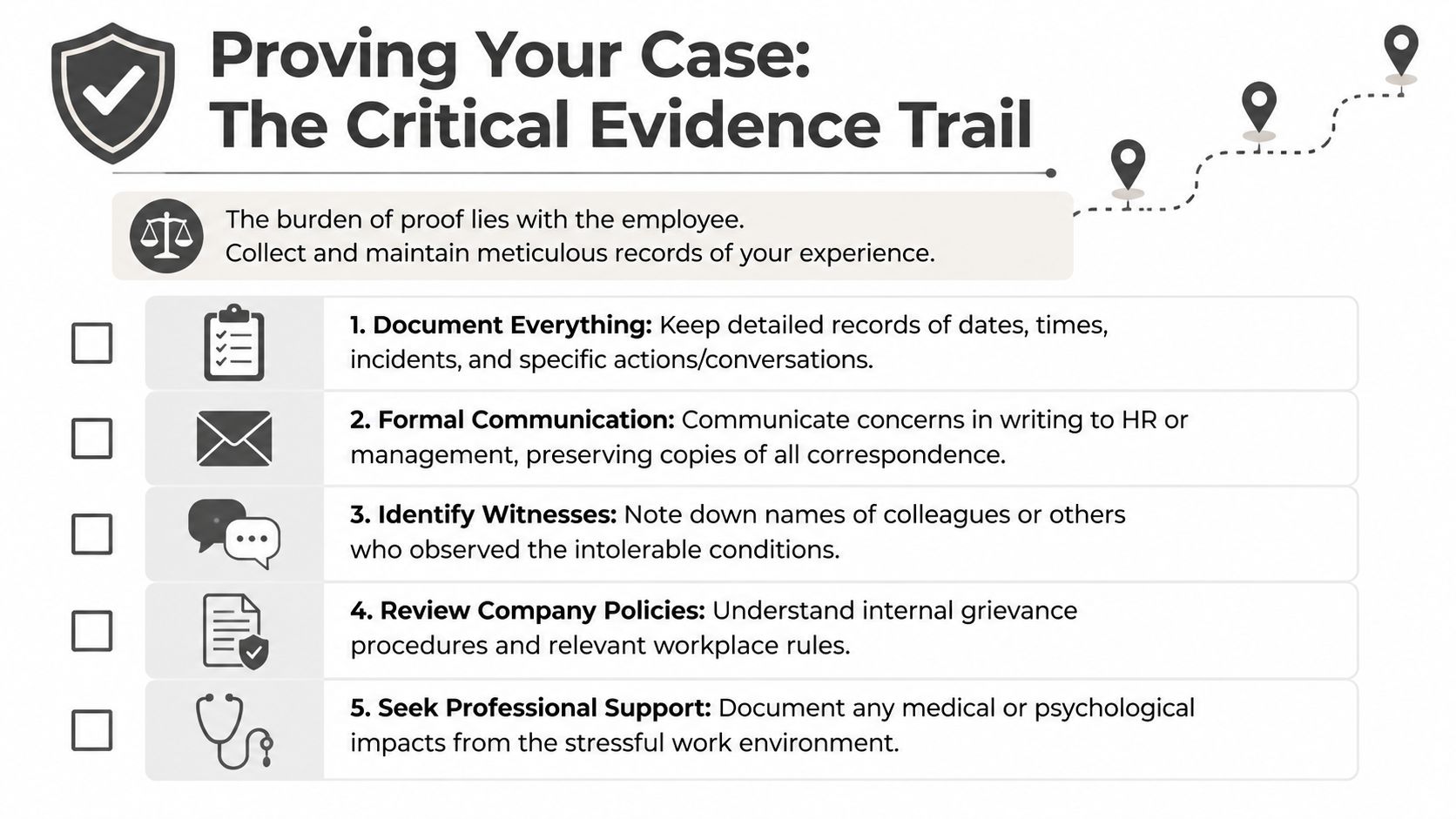
Constructive discharge cases are often won or lost on documents created before the resignation. Recent practitioner coverage emphasizes that the paper trail matters most, including timestamps, schedule changes, write-ups, transfers, meeting exclusions, medical or accommodation emails, HR responses, badge logs, and text messages. That same discussion also notes that a hostile environment claim does not automatically become constructive discharge, as explained in this article on constructive discharge cases and documentation strategy.
The records that usually matter most
In financial industry disputes, vague recollections are weak. Contemporaneous records are stronger because they show chronology, notice, and motive.
- Written complaints: Emails to a branch manager, HR, legal, supervision, or compliance can show the firm knew about the problem.
- Performance records: Sudden negative reviews after years of stable production or after a protected complaint can become important context.
- Access and exclusion evidence: Meeting invites removed, calendar changes, branch access records, and distribution lists can show isolation.
- Compensation and account data: Reassigned households, altered production credit treatment, changed territories, or support withdrawals can show pressure.
- Texts and messaging platforms: Many critical facts never appear in formal memoranda. They appear in short messages sent after hours.
Build a timeline before you build a theory
Lawyers can argue from facts. They can't argue from a blur.
Create a chronology that includes each incident, who was involved, what happened, how you responded, and what happened next. In many cases, the timeline reveals the case theory by itself. The retaliation starts after a complaint. The exclusion begins after a refusal to do something improper. The discipline intensifies after a protected leave request or accommodation issue.
Evidence habit: Don't just save documents. Add context while events are fresh. A timestamp without an explanation may prove less than you think.
A practical way to organize this is to separate your timeline into categories:
- Protected activity or triggering event
- Adverse changes in treatment
- Complaints and internal reporting
- Management response or inaction
- The point where resignation became unavoidable
What people do wrong
The biggest mistake is resigning first and organizing later. Once access is cut off, key communications may be harder to retrieve, and the sequence of events becomes fuzzier.
The second mistake is sending an emotional resignation letter loaded with accusations you can't yet support. A short, accurate, carefully drafted notice is usually better than a manifesto.
If litigation or arbitration is likely, it also helps to think early about testimony quality. A witness who can explain dates, documents, and decisions clearly is far more effective than one who only repeats conclusions. That same discipline matters in any sworn testimony, including the preparation issues discussed in this guide on how to prepare for a deposition.
Common Fact Patterns in the Financial Industry
The financial industry creates pressure points that don't always appear in ordinary employment cases. The conduct may look subtle from the outside, but inside a branch, complex, or regional structure, it can make continued employment impossible.
The advisor who refuses a compliance shortcut
A producing advisor objects to a sales push involving products that don't fit certain clients. The objection is framed professionally. After that, management stops treating the advisor as part of the team. Support staff changes. Internal referrals disappear. Supervisory scrutiny increases for routine issues that were previously handled informally.
That fact pattern can matter because the resignation may stem not from disagreement alone, but from retaliation for refusing conduct the advisor believed violated rules or suitability obligations.
The file-building campaign
This shows up often in disputes involving experienced representatives. A firm starts layering write-ups, counseling memos, and unrealistic expectations into the personnel record. Standing alone, each event looks manageable. Together, they create a narrative the firm may later use to justify a U5 entry, defend a compensation holdback, or attack credibility in arbitration.
What makes this pattern dangerous is its cumulative force. The representative isn't formally terminated, but the file is being built to make staying untenable.
The disappearing book
Another recurring scenario involves reassignment of valuable relationships after a dispute with management. The firm may say it is protecting clients or restructuring coverage. The advisor may see something different: profitable accounts move away, branch resources shrink, and the role becomes commercially unworkable.
This can be especially serious where the advisor's compensation model depends heavily on retained relationships, internal referrals, or platform support.
In this industry, “you still have a job” can be technically true and economically false.
The exclusion pattern
Not every forced exit is loud. Some are administrative. The professional is left out of strategy meetings, transition planning, recruiting conversations, or product discussions that are central to the role. Colleagues stop copying them on client-sensitive developments. Decisions that affect their households or team happen without notice.
A panel may view this as ordinary office friction. It may also view it as evidence that management cut the professional out of the job in everything but name.
The message behind the conduct
The recurring theme in these cases is not mere unpleasantness. It is the systematic removal of a viable path to remain employed with professional dignity and legal safety. In financial services, that often happens through account economics, supervision tactics, compliance pressure, and reputational influence rather than shouted abuse.
Filing Deadlines and the Statute of Limitations
A broker gives notice on Friday after months of pressure from management, then spends the next month dealing with client transitions, deferred compensation questions, and anticipated U5 language. By the time counsel reviews the file, the timing issue is already on the table. That is how otherwise strong constructive discharge cases get weakened.
For federal discrimination claims, the timing rule matters. In Green v. Brennan, the U.S. Supreme Court held that a constructive discharge claim under Title VII accrues when the employee gives notice of resignation, not on the date of the last discriminatory act and not on the final day of employment, as summarized in this discussion of the Green v. Brennan timing rule.
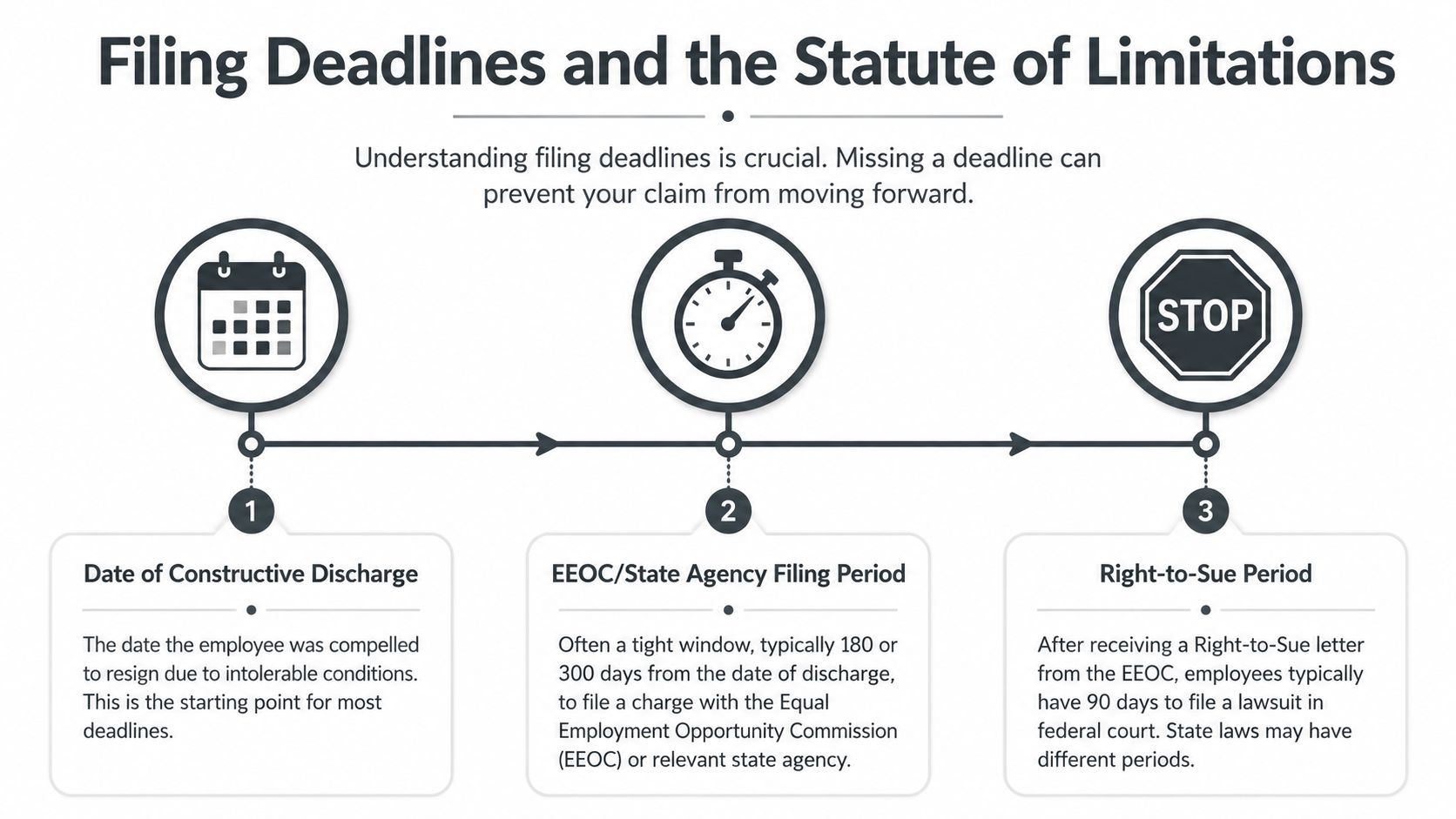
That rule changes the analysis in financial services because resignation often unfolds in stages. A representative may first signal an intent to leave, then negotiate separation terms, then work through transition logistics, and only later stop servicing accounts. Those dates are not interchangeable. The notice date can control whether an agency charge is timely.
The practical mistake is predictable. Registered professionals focus on the business exit first. They are trying to preserve client relationships, address promissory note exposure, manage restrictive covenants, and anticipate what the firm will say on Form U5. Meanwhile, the filing clock does not pause for those business problems.
A short delay can turn the case into a limitations fight. In arbitration or court, that is a bad trade. Counsel should be arguing over coercive conditions, discriminatory motive, and economic pressure, not trying to rescue a late filing.
Use a disciplined timeline review as soon as resignation is under consideration:
- Fix the notice date: Identify the exact date, time, and method of the resignation notice, including any oral notice later confirmed by email or text.
- Separate resignation from departure: The day you announced you were leaving may matter more than your last day on payroll.
- Map each claim and forum: EEOC or state agency deadlines, FINRA arbitration deadlines, contract notice provisions, and state-law limitations periods may all run differently.
- Preserve the resignation record: Keep the resignation message, drafts, calendar entries, and communications showing why continued employment had become untenable.
- Check state-specific rules early: State law claims can follow different limitation periods and procedural steps. For a general reference point, review this overview of the statute of limitations in Connecticut.
One more point matters in this industry. Professionals sometimes delay because they hope to negotiate a cleaner U5, protect a future recruiting move, or avoid triggering immediate retaliation. Those are real business concerns. They do not extend statutory deadlines.
In constructive discharge cases, timing is often litigated as hard as the underlying misconduct. Get the resignation chronology pinned down early, and treat it like evidence, not administration.
Pursuing a Claim FINRA Arbitration vs Court Litigation
Most registered representatives don't get to choose freely between court and arbitration. Their agreements often channel employment-related disputes into FINRA arbitration. That changes strategy immediately.
A constructive discharge claim in arbitration is still a constructive discharge claim. But the way you prove it, the amount of discovery available, and the way decision-makers evaluate the facts can differ from court practice. For an overview of that forum, see this explanation of the FINRA arbitration process.
The practical differences
A financial professional should think less in abstract terms and more in operational ones. What can you obtain? Who decides the case? How public is the process? How fast does the matter move relative to your licensing and recruiting reality?
Here is a side-by-side view.
| Aspect | FINRA Arbitration | Court Litigation |
|---|---|---|
| Decision-maker | Arbitrator or panel of arbitrators | Judge or jury |
| Procedure | Contract-driven, forum-specific rules | Formal civil procedure and evidence rules |
| Discovery | More limited and targeted | Broader tools, including extensive motion practice |
| Privacy | Less public than court filings, though not invisible | Public docket in most cases |
| Speed | Often more streamlined | Can involve longer timelines and more procedural layers |
| Industry context | Decision-makers may be accustomed to securities disputes | Court may be less familiar with branch and U5 dynamics |
| Appeal options | Very limited | Broader appellate review, depending on posture |
Why forum affects case strategy
In court, lawyers may have more opportunities to force document production, test legal theories through motion practice, and strengthen their position through public filings. In FINRA arbitration, the presentation often has to be tighter and more document-driven from the start.
That can cut both ways.
If your case has a strong paper trail, arbitration may be efficient. If your case depends on wide-ranging discovery into regional practices, comparator treatment, or extensive internal communications, limited discovery can be a constraint.
Form U5 issues complicate everything
For securities professionals, a constructive discharge dispute is often only one piece of the conflict. The separation may also involve contested Form U5 language. If the firm characterizes the departure in a way that is misleading or defamatory, the professional may need to address that issue alongside the employment claim.
That overlap changes settlement dynamics. Some claimants care as much about the separation language as they do about compensation. Others will prioritize compensation, deferred pay, or note exposure. Good strategy starts by ranking those objectives early rather than treating every claim as equally important.
What tends to work in FINRA
Arbitrators usually respond well to a disciplined factual record. The strongest presentations often have:
- A clean chronology that ties unlawful conduct to the resignation
- Focused exhibits instead of a bloated document dump
- Industry-specific explanation of why the conditions made continued employment unrealistic
- A coherent damages theory tied to actual career impact and separation consequences
What doesn't work is assuming that “everyone knows how firms push people out.” Arbitrators need proof, not industry folklore.
Potential Remedies and Strategic Next Steps
A successful constructive discharge claim can open the door to the remedies that would have been available had the employer fired the employee outright. Depending on the legal claims involved and the forum, those remedies may include back pay, front pay, emotional distress damages, attorney's fees, and industry-specific relief tied to the separation itself.
For financial professionals, that last category often matters a great deal. The practical target may include correcting or removing harmful language associated with the departure, resolving compensation disputes that followed the resignation, and reducing the reputational drag that comes from a forced exit dressed up as a voluntary one.
The defenses firms usually raise
Employers rarely say, “Yes, we forced the resignation.” They usually argue one of three things.
- Personal choice: The employee left for better opportunities, compensation reasons, or ordinary stress.
- No intolerable conditions: The firm may admit conflict but deny that conditions crossed the legal line.
- Reasonable alternatives existed: The employer may argue the professional should have used internal channels, accepted a transfer, or waited for review.
Those defenses are why contemporaneous complaints matter. Constructive discharge is legally treated as a formal firing, but the claim is not based on discomfort alone. The causal chain must connect unlawful employer conduct to objectively intolerable conditions and then to the resignation, which is why contemporaneous complaints to supervisors or HR are often central evidence in proving employer notice and foreseeability, as discussed in this explanation of constructive discharge and employer notice.
The best move is often before you resign
In practice, the strongest cases are usually built before the exit, not after it. That doesn't mean everyone should stay longer. Sometimes leaving promptly is the only sound decision. It does mean you should understand the trade-offs before sending the resignation email, signing a separation package, or reacting to a draft U5.
A constructive discharge claim can be strong. It can also fail if the timing, record, or forum strategy is mishandled.
If you want to discuss your business law matter, contact Kons Law at (860) 920-5181.
