
A business owner usually finds out about a trademark problem at the worst possible time. The new packaging has already been printed. The website is live. Customers are starting to recognize the name. Then someone forwards a screenshot, a demand letter arrives, or a sales rep says a competitor is using something uncomfortably close to your brand.
At that point, clients aren't asking for a lecture on trademark doctrine. They want to know three things. Do I have a real problem, how urgent is it, and is this worth fighting over? Those are the right questions. Trademark disputes are legal matters, but for small and mid-sized businesses in Connecticut, they're also business decisions about risk, timing, cash flow, and long-term brand value.
The role of trademark litigation lawyers is to help you make that decision with clear eyes. Sometimes the right move is aggressive enforcement. Sometimes it's a negotiated coexistence agreement. Sometimes the most disciplined answer is to rebrand early, before the dispute becomes more expensive than the mark is worth.
Your Brand Is Under Attack What Now
You open your laptop on a Tuesday morning and see two messages waiting. One is from a customer who asks whether your company has opened a second location. The other is from your marketing manager, attaching a screenshot of a competitor using a name and logo that look far too close to yours. You don't know yet whether it's infringement, sloppy branding, or a problem that could grow into litigation. You do know that customer confusion has started.

That moment creates two kinds of pressure at once. First, you worry about lost sales, reputational damage, and whether the other company is taking advantage of the goodwill you built. Second, you worry about making the wrong first move. A harsh letter sent too soon can escalate a dispute. Silence can weaken your position. A rushed public response can create evidence that later hurts you.
If you're dealing with that situation now, it helps to understand the basics of what trademark infringement means in practice. But business owners need more than a definition. They need a plan.
The first decisions matter
In the opening days of a trademark dispute, facts disappear quickly. Product listings change. Social media posts get edited. Marketplace pages vanish. Employees speak to customers before anyone has coordinated a response. That's why experienced trademark litigation lawyers start with investigation, not outrage.
A useful first pass usually includes:
- Capturing the evidence: Save screenshots, webpages, product images, marketplace listings, packaging, and dates of first discovery.
- Checking your own rights: Confirm who owns the mark, how it's being used, whether registrations exist, and whether those registrations match the actual branding.
- Measuring the business impact: Identify where confusion is happening, which products overlap, and whether the issue is local, regional, online, or cross-border.
- Preventing internal mistakes: Tell staff not to contact the other side casually, not to debate the issue online, and not to destroy or alter relevant records.
Practical rule: Treat a trademark dispute like a commercial dispute with a branding component, not like a marketing spat. Early discipline usually improves your options.
Your trademark is an asset, not just a label
For many Connecticut businesses, the name on the sign carries years of customer trust. That's why trademark disputes often feel personal. But the better approach is to treat the brand as a business asset that needs to be protected, valued, and sometimes defended with restraint rather than emotion.
A good lawyer doesn't just tell you whether you're angry for a reason. A good lawyer helps you decide what response protects the business.
The Full Scope of a Trademark Lawyer's Role
Many business owners assume trademark litigation lawyers show up only after a lawsuit is filed. That's too narrow. In real practice, the job starts much earlier and often determines whether a dispute becomes manageable or expensive.
It's a lifecycle role, not just courtroom work
Trademark disputes are procedure-heavy because lawyers often have to manage two tracks at the same time: federal court litigation under the Lanham Act and administrative opposition or cancellation proceedings before the USPTO's Trademark Trial and Appeal Board. Latham describes trademark work as a full lifecycle function, from filing and prosecuting applications through claims involving infringement, dilution, and unfair competition, as noted in its overview of trademark litigation and TTAB practice.
That matters because a courtroom claim doesn't arise in a vacuum. The strength of a case often depends on what happened years earlier.
A trademark lawyer may need to evaluate:
- Clearance: Was the mark vetted properly before launch?
- Registration history: Were the applications drafted well, and do they support the business's actual use?
- Policing efforts: Did the company ignore similar uses for too long?
- Portfolio maintenance: Are renewals, specimens, ownership records, and related filings in order?
Businesses looking at broader brand strategy often benefit from understanding how patent and trademark lawyers handle brand protection work before the dispute stage begins.
What these disputes actually involve
Not every trademark conflict is the same. The legal label matters because it shapes both evidence and remedies.
Here is a practical breakdown:
| Claim type | What it usually means for a business |
|---|---|
| Infringement | Another party's branding is allegedly likely to confuse customers about source, sponsorship, or affiliation |
| Dilution | A distinctive mark may be weakened even without classic confusion |
| Unfair competition | The dispute may involve broader marketplace conduct, not just the name itself |
| False advertising | The conflict may focus on misleading product claims rather than branding alone |
| Cybersquatting | A domain name is being used to exploit or interfere with brand rights |
A lawyer's role is to identify which claims fit. Overclaiming doesn't help. If the case is really about a narrow naming conflict in one product line, turning it into a sprawling accusation list can make settlement harder and credibility weaker.
Good trademark counsel builds leverage before the hearing
The strongest trademark litigation lawyers aren't just drafters of complaints. They build records. They make sure the client's use is consistent, the ownership documents are clean, and the marketplace evidence tells a coherent story.
A weak brand file can turn a decent legal claim into a settlement discount.
For Connecticut companies, that's especially important because many disputes start locally but don't stay local. A company may sell from Hartford, Stamford, or New Haven and still face issues involving marketplaces, national competitors, or registration challenges that stretch beyond one state.
When to Engage Trademark Litigation Counsel
The best time to involve trademark litigation lawyers is usually before you think you need litigation. That's not because every brand issue turns into a lawsuit. It's because early legal work often prevents avoidable damage and strengthens your position if a dispute does happen.
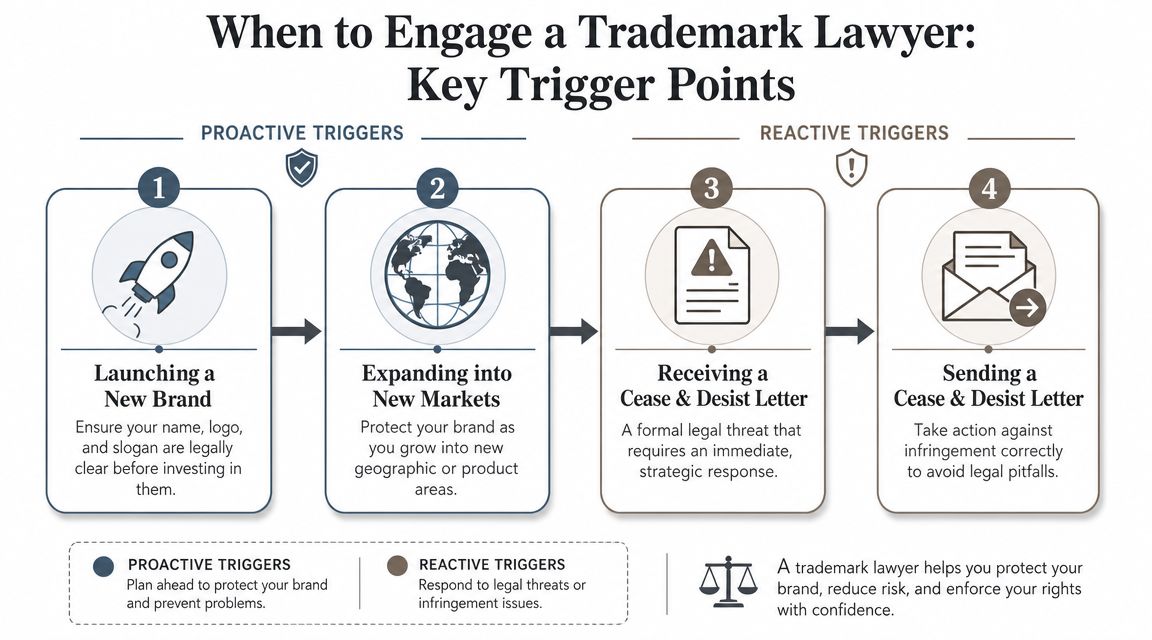
Proactive trigger points
Some calls should happen before there's any conflict on the table.
The most important examples are:
- Launching a new brand: You want to know whether the name, logo, or slogan creates avoidable risk before you invest in signage, packaging, ads, and search visibility.
- Expanding into a new market: A name that works in one channel or region can create problems in another.
- Filing an application: Counsel can often spot problems in identification, classification, specimens, ownership, and strategy that non-lawyers miss.
- Buying a business or product line: Trademark ownership and goodwill don't always transfer cleanly just because the deal documents say they do.
The value of attorney involvement isn't theoretical. According to Stokes Law's summary of practitioner data, applications handled by counsel achieved an 80% publication rate, compared with 63% for self-filed applications, and 60% registration success compared with 46% for pro se filings, as discussed in its review of trademark application outcomes with experienced counsel.
Reactive trigger points
Other situations require fast legal review because the risk changes immediately.
Those include:
- Receiving a cease-and-desist letter
- Learning that a competitor filed for a similar mark
- Discovering lookalike branding online
- Getting platform complaints, takedown notices, or domain-related problems
- Planning to send your own demand letter
If a letter has already landed on your desk, don't answer it casually. Even a well-intentioned response can concede facts, create admissions, or lock you into a position before the evidence is sorted out. A more disciplined starting point is to understand how to respond to a demand letter without making the dispute worse.
Waiting usually narrows your options
Small businesses often delay legal review because they hope the issue will disappear or they don't want to spend money too early. Sometimes that instinct is understandable. It's rarely strategic.
By the time a dispute hardens, you may be dealing with inventory commitments, customer confusion, public reviews, revised website content, and a factual record created without counsel. That doesn't make the case unwinnable. It just means you're playing defense sooner than you needed to.
The cheapest trademark dispute is often the one addressed before the business fully commits to the brand or the response.
Navigating the Trademark Dispute and Litigation Process
Once a dispute is active, business owners want to know what happens next. The answer depends on the facts, but most cases follow a recognizable pattern.
Stage one starts before the complaint
A sound dispute begins with investigation and positioning. That may lead to a cease-and-desist letter, a response letter, negotiated standstill terms, or direct settlement talks. In some matters, filing immediately is the right move. In others, pre-suit communication reveals enough about the other side's use, intent, or flexibility to make court unnecessary.
At this point, counsel usually focuses on documents and proof, not rhetoric.
That means collecting:
- Use evidence: packaging, labels, webpages, ads, domain records, and sales channels
- Timeline evidence: first use dates, registration dates, notice dates, and any expansion history
- Confusion evidence: misdirected emails, mistaken customer inquiries, distributor confusion, or marketplace mix-ups
- Damage evidence: lost opportunities, pricing pressure, chargebacks, negative reviews, or diverted traffic in a qualitative sense
Emergency relief can change the economics
Some cases need immediate court action. Others don't. That's one of the first hard judgments trademark litigation lawyers have to make.
Cozen notes that the economics of these cases often turn on whether temporary restraining orders and preliminary injunctions are realistically available, because the worst harm, including confusion from counterfeits or false advertising, can happen before final judgment. The same discussion emphasizes the importance of prompt evidence preservation in trademark and brand protection disputes involving injunctive relief.
If you may need an injunction, don't wait for perfect information. Preserve the evidence you have while it's still available.
A court won't grant emergency relief because a business owner feels wronged. Counsel has to show urgency, likely harm, and a factual basis strong enough to justify immediate intervention.
After filing, procedure takes over
Once a complaint is filed, the process becomes more structured and more demanding. The case may involve pleadings, motions to dismiss, injunctive hearings, discovery, expert issues, summary judgment briefing, and potentially trial.
A simplified roadmap looks like this:
- Initial pleadings set out claims and defenses.
- Early motions may challenge jurisdiction, venue, or the adequacy of the complaint.
- Discovery forces both sides to exchange documents, communications, and testimony.
- Settlement or mediation often happens after each side understands the strengths and weaknesses better.
- Trial preparation becomes necessary if no practical resolution emerges.
Don't overlook ADR and platform enforcement
Not every trademark dispute belongs in a courtroom through verdict. Mediation can be effective when both sides need a business solution, such as revised branding, channel restrictions, disclaimers, phased transitions, or coexistence terms. Arbitration may matter if the parties have a contract. TTAB proceedings may matter if the registration itself is under attack. Platform takedowns and domain procedures may matter if the harm is concentrated online.
That mix is why practical lawyers don't ask only, "Can we sue?" They ask, "Which forum solves the actual problem fastest and at an acceptable business cost?"
Understanding the Costs and Business Risks
Trademark disputes are expensive in more ways than one. Legal fees matter, but they aren't the only cost, and they often aren't even the cost that does the most damage to a small or mid-sized business.
Start with the value of the mark
The U.S. Patent and Trademark Office received 899,786 trademark applications in fiscal 2024 and registered 443,589 marks, as reflected in the discussion of trademark volume and business triage in the International Trademark Association's practical resources. That volume means disputes are part of modern commerce, not a rare anomaly.
The harder question for an SMB isn't whether trademark conflicts exist. It's whether this particular fight makes commercial sense.
A useful internal checklist asks:
| Business question | Why it matters |
|---|---|
| How much revenue depends on this mark? | A core house brand deserves a different response than a short-lived campaign name |
| How expensive would a transition be? | Rebranding may be painful, but sometimes still cheaper than prolonged litigation |
| Can the conflict be narrowed? | Product carveouts, geography, channels, or modified design elements may reduce risk |
| Will management get pulled off operations? | Owner and executive time spent on litigation has real opportunity cost |
The hidden costs are often larger
Owners usually focus first on legal bills. In practice, the more disruptive costs may be internal.
Consider the business drag that comes from:
- Leadership distraction: The owner, sales head, and marketing team may spend months gathering documents, preparing declarations, and attending strategy calls.
- Delayed growth decisions: Expansion plans, packaging updates, and product launches may pause while the dispute remains unresolved.
- Brand uncertainty: Customers, distributors, and investors don't like ambiguity around the identity of the business.
- Settlement pressure from fatigue: A party with a decent case can still accept poor terms if the process starts to exhaust management.
For some businesses, a negotiated result through alternative dispute resolution rather than full litigation is the most rational answer, even when emotions push toward a harder fight.
Fight, settle, or rebrand
There's no universal rule, but the options usually come down to three paths.
- Fight when the mark is central, the evidence is good, and letting the other side continue would materially weaken the business.
- Settle when the conflict is real but manageable through coexistence, restricted use, phased transition, or limited corrective steps.
- Rebrand when the legal risk is stubborn, the mark is still early in its life, or the expected cost of conflict is out of proportion to the commercial benefit.
Good legal advice doesn't always validate the instinct to battle. Sometimes it protects the business by telling you when not to.
Choosing the Right Trademark Counsel in Connecticut
The right lawyer for a trademark dispute isn't just someone who knows trademark vocabulary. You need counsel who can assess risk quickly, manage procedure cleanly, and understand that your brand problem sits inside a larger business problem.

Look for dual-track capability
Some lawyers are comfortable with federal court but less experienced with TTAB matters. Others know prosecution well but don't regularly handle injunctions, discovery disputes, or trial strategy. In trademark disputes, businesses often need both.
That matters even more because the enforcement environment is broader than a single courthouse. A 2024 Clarivate report described trademark conflict as a cross-jurisdictional issue spanning six major registers, with the U.S. and E.U. standing out as major hubs of activity in its review of global trademark filing and litigation trends. Even Connecticut businesses can run into online sellers, parallel filings, or conflicts that don't stop at state lines.
Ask business questions, not just legal questions
A strong trademark lawyer should be able to answer more than "Can we win?" You also want to hear clear thinking on questions like:
- What does success look like for this business? An injunction, a redesign, a coexistence agreement, a takedown, or a clean exit are not the same outcome.
- How fast do we need to move? Some matters require immediate action. Others benefit from a quieter information-gathering phase.
- Who on our team will need to be involved? A practical lawyer limits unnecessary disruption.
- What would make this dispute not worth pursuing? If counsel can't discuss downside candidly, that's a problem.
Local knowledge still matters in Connecticut
For Connecticut companies, local counsel can add practical value beyond black-letter law. Familiarity with the District of Connecticut, local practice expectations, business communities, and the pace of regional litigation can affect strategy. So can proximity. When the business owner, marketing lead, and operations team need to sit down with counsel and sort through packaging, customer emails, contracts, and screenshots, local access helps.
That doesn't mean local counsel should think only locally. The right Connecticut lawyer should understand when a dispute has federal, online, or international dimensions and when to coordinate accordingly.
Communication style is part of the skill set
Trademark disputes produce anxiety fast. You need a lawyer who can translate risk into business terms. That includes giving clear budget expectations, identifying key forks in the road, and avoiding performative aggression that impresses no one except the sender of the letter.
Businesses also often need help managing external messaging while a dispute is active. If your company needs to communicate carefully with customers, partners, or media, resources like these law firm press release templates can help illustrate how to structure a professional statement without turning a legal issue into a public relations mistake.
What good counsel should deliver
At minimum, trademark litigation lawyers handling Connecticut business disputes should offer:
- A realistic merits assessment: not salesmanship
- A forum strategy: court, TTAB, platform process, ADR, or a combination
- An evidence plan: what to preserve, gather, and stop saying
- A commercial framework: fight, settle, coexist, or rebrand
- A clear explanation of next steps: with timing and likely pressure points
A trademark case can protect a valuable asset. It can also drain a business if handled without discipline. The right counsel helps you tell the difference early.
If you want to discuss your business law matter, contact Kons Law at (860) 920-5181.
