You built the company with someone you trusted. Now every decision turns into an argument, key information feels harder to access, and ordinary business conversations carry a legal edge. That shift is what makes partnership disputes so destabilizing. You’re not only dealing with a business problem. You’re dealing with a breakdown in control, trust, and future planning at the same time.
In Connecticut, the right response is rarely a dramatic one. It’s a disciplined one. Business partnership dispute resolution works best when the owners stop reacting, preserve the facts, and choose the next move with a clear objective in mind. Sometimes that means using the agreement you already have. Sometimes it means mediation or arbitration. Sometimes it means filing suit early to gain an advantage before the dispute gets more expensive.
The Cracks Begin to Show Recognizing a Partnership in Crisis
A partnership usually doesn’t collapse in one day. It starts with smaller changes that owners often explain away. One partner starts making decisions alone. Financial reports arrive late. Access to records becomes inconsistent. Routine disagreements about hiring, spending, or strategy turn personal. At that point, many business owners still hope the tension will pass on its own.
That hope is expensive.

A useful reality check comes from a documented overview of failed partnerships. Approximately 70% of business partnerships fail within the first five years, and those failures often lead to legal disputes. The same discussion describes a dispute between two brothers over company direction that turned into a 14-month legal battle costing $340,000 in attorney fees, expert witnesses, and business valuation costs, according to Legal GPS on why business partnerships fail and how to succeed.
Signs the dispute has moved beyond a normal disagreement
When a conflict reaches the point where legal planning matters, the pattern usually looks familiar:
- Decision-making stalls: Major choices can’t get approved, or one partner acts without authority.
- Financial friction grows: Questions about draws, reimbursements, vendor payments, or missing documentation stop getting clear answers.
- Communication turns strategic: Emails become guarded, meetings get canceled, and verbal conversations become less reliable.
- The business absorbs the impact: Employees notice the tension, customers feel the inconsistency, and vendors start asking questions.
Practical rule: If you’ve started thinking, “I need to document this,” you’re already in a stage where strategy matters more than reassurance.
What doesn’t work
Owners in this position often try one of three things. None is a real plan.
First, they avoid the issue and hope revenue or a busy season will smooth it over. Second, they confront the other partner emotionally and create statements that later become exhibits. Third, they take unilateral action, such as blocking access, moving funds, or making structural changes, without understanding the legal effect.
A partnership in crisis can still be managed. But it won’t be managed by instinct. It needs a sequence: preserve the company, preserve the evidence, identify the governing rules, and choose the forum that gives you the best chance of a controlled resolution.
Immediate Triage What to Do Right Now to Protect Yourself
The first phase of business partnership dispute resolution is not about “winning.” It’s about preventing avoidable damage. A few rushed moves can make settlement harder, increase personal exposure, and complicate the story you’ll need to tell later.

Stabilize access without creating a new problem
Start by identifying what you can lawfully access right now. That usually includes company accounting records, bank information available to you in your role, internal communications, governing documents, tax records, contracts, insurance policies, payroll records, and customer or vendor files.
Do not delete anything. Do not alter records. Do not try to “clean up” messages that look bad in hindsight.
Use this initial checklist:
- Preserve records: Save copies of key business documents in an organized, secure format.
- Secure credentials you’re authorized to use: Confirm you still have access to company email, accounting software, shared drives, and core systems.
- Create a timeline: Write down dates, decisions, disputed events, and who was involved.
- Separate business and personal communication: If conversations have become volatile, stop using informal channels for substantive business issues.
- Review recent transactions: Look for unusual payments, unexplained reimbursements, abrupt vendor changes, or transfers that need explanation.
Move communication into a format you can prove
If discussions are happening by text, hallway conversation, or late-night calls, you’re inviting confusion. Shift to written communication for important topics. The goal is clarity, not aggression.
A short message often works best:
“Given the current disagreement, I’d like us to handle business decisions and requests for records in writing so there’s a clear record and fewer misunderstandings.”
That kind of language doesn’t accuse anyone. It creates a reliable trail.
If you’ve received a hostile written demand, don’t improvise a response. A poor reply can concede facts, escalate the tone, or lock you into a position before you’ve assessed the issue. This overview of how to respond to a demand letter is a useful starting point for thinking about timing, tone, and what should be preserved before anything goes out.
Avoid the common self-inflicted mistakes
The worst early decisions usually come from anger, fear, or an urge to “show strength.” Be careful with all of the following:
- Freezing accounts without advice: It may feel protective, but it can disrupt payroll, taxes, or vendor obligations and expose you to new claims.
- Accusing your partner of theft before you have proof: Sometimes there is misconduct. Sometimes there is a bookkeeping explanation. The wrong accusation can harden the dispute immediately.
- Talking to employees loosely: Staff conversations spread fast and often become evidence.
- Taking company property home “for safekeeping”: If you’re authorized to preserve records, do so carefully and transparently. Don’t create a possession fight.
Put differently, your first job is to stop the conflict from becoming messier than it already is.
Set a near-term objective
Don’t try to solve the entire breakup in one conversation. Decide what needs to happen first. That may be access to financial records, agreement on who can approve expenses, a hold on major business changes, or scheduling a formal meeting under the governing documents.
A focused short-term objective keeps the matter from spiraling. It also makes counsel more effective if you need to involve a lawyer quickly.
Using Your Partnership Agreement for Internal Resolution
Most owners treat the partnership agreement like a filing cabinet document. In a dispute, it becomes your operating manual. If it’s well drafted, it tells you who has authority, what requires consent, how profits are allocated, what happens during a buyout, and whether mediation or arbitration must happen before anyone files in court.

Read the agreement like a dispute lawyer reads it
When business owners pull out the agreement, they often jump straight to the buyout section. That’s important, but it’s usually not enough. Start with the clauses that control bargaining power before exit becomes final.
Look for these categories:
- Management authority: Who can bind the business, approve expenses, sign contracts, or hire and fire.
- Voting rules: Which matters require majority approval, unanimous consent, or manager approval.
- Capital obligations: Whether either partner can be required to contribute more money and what happens if one refuses.
- Books and records rights: What each owner can inspect and when.
- Deadlock provisions: Whether there is a tie-breaker, referral mechanism, or mandatory process for impasse.
- Exit and valuation language: Whether there is a formula, appraisal procedure, notice requirement, or buy-sell mechanism.
If you’re reviewing a real estate venture or another deal-driven entity, many disputes trace back to weak planning at formation. This practical piece on negotiating real estate partnership terms is helpful because it focuses on the kind of operational and exit details that owners often skip when everyone is getting along.
Internal resolution works when the process is structured
A useful internal approach is simple. Put the dispute topics in writing, tie each one to the controlling agreement language, and ask for a defined meeting or response deadline. That changes the conversation from “you’re being unreasonable” to “section X requires Y, and we need to address it.”
A short written framework might include:
| Issue | Agreement clause to review | Immediate ask |
|---|---|---|
| Expense approvals | Management authority | Pause non-routine spending pending joint review |
| Access to records | Books and records | Provide current accounting access and recent statements |
| Strategic disagreement | Voting or deadlock | Schedule formal vote or invoke deadlock procedure |
| Exit discussion | Buy-sell terms | Exchange positions on valuation process |
That approach is especially useful when the conflict still has a chance of being contained without outside intervention.
For owners operating through an LLC, the governing document may be an operating agreement rather than a traditional partnership agreement. This explanation of what is an operating agreement helps clarify why that document matters so much when authority and decision-making are under pressure.
The overlooked problem of the 50/50 deadlock
Generic advice often fails here. A 50/50 structure sounds fair on day one. In a dispute, it can freeze the company. No one has majority control. No one can force movement. Customers, employees, and lenders are left dealing with a business that can’t decide.
One of the more practical tools for this problem is the Russian roulette buy-sell clause. One partner sets a price for the other’s interest, and the receiving partner chooses either to buy at that price or sell at that price. That mechanism pressures both sides toward a fair valuation because the party naming the number could end up on either side of the transaction.
According to Sierra Crest Law’s discussion of partnership disputes and deadlocks, using Russian roulette buy-sell clauses has shown practitioner success rates of 70% resolution without court.
In a true 50/50 impasse, the best clause is often the one that makes indecision more expensive than resolution.
What if the agreement is silent or badly drafted
That happens often. Silence on deadlock, vague compensation language, and sloppy valuation provisions are common. When the document doesn’t answer the core issue, internal resolution still matters, but it has to be built around practical business terms instead of relying on a missing clause.
That’s usually the point where owners need outside counsel to translate the existing document into a negotiating advantage. In Connecticut, firms handling commercial disputes, including Kons Law, often do that by turning unclear governance language into a concrete proposal for standstill terms, buyout procedure, or ADR positioning.
ADR vs Litigation Choosing the Right Battleground
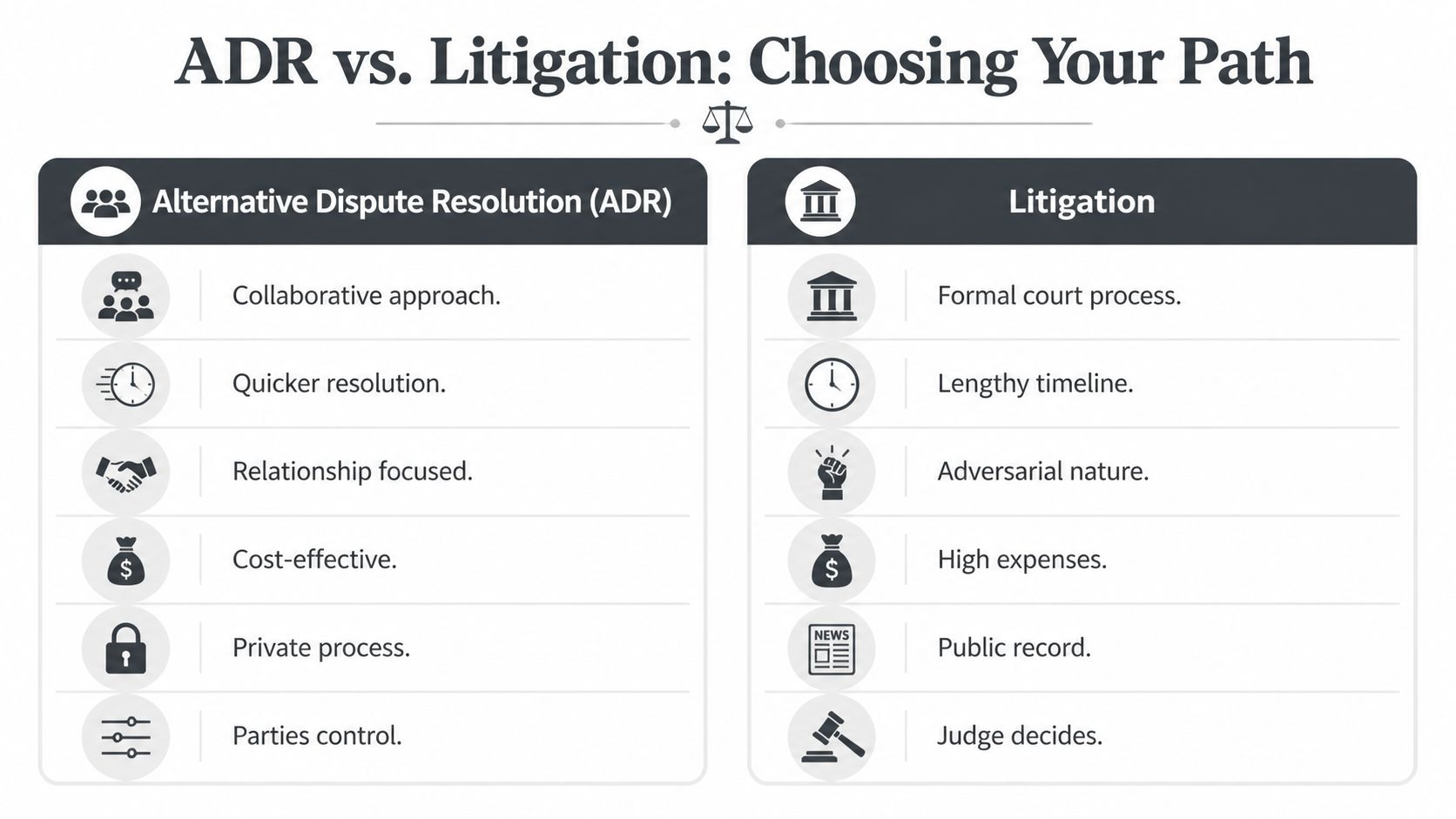
Once direct negotiations stall, the dispute moves into a forum decision. That choice matters because the forum shapes cost, speed, privacy, advantage, and who decides the outcome. In business partnership dispute resolution, the right venue depends on what you need most. Fast movement. Confidentiality. A binding result. Pressure toward settlement. Access to court remedies.
Why businesses keep turning to arbitration and negotiated outcomes
For many commercial disputes, arbitration is no longer a niche option. It is a mainstream one. The AAA and ICDR handled 10,273 cases in 2022, and that represented an increase from the prior year. For large business-to-business cases, the average dispute resolution cycle was 2.3 months. In the financial services context, 49% of cases resolved without an arbitrator decision were settled directly by the parties, according to ResolvePay’s summary of dispute resolution cycle statistics.
Those figures matter because they reflect something practitioners see constantly. Even in formal proceedings, many cases resolve through negotiation once the process creates enough structure and pressure.
Dispute Resolution Paths at a Glance
| Factor | Mediation | Arbitration | Litigation |
|---|---|---|---|
| Decision maker | Neutral facilitator helps parties negotiate | Arbitrator or panel decides | Judge, and sometimes a jury, decides |
| Result | Non-binding unless parties sign settlement terms | Usually binding | Binding court judgment |
| Privacy | Generally private | Generally private | Usually public |
| Speed | Can be scheduled quickly | Often faster than court | Often slower and more procedural |
| Relationship impact | Best if parties want to preserve a working relationship | More formal, but less public than court | Often the most adversarial |
| Flexibility | High | Moderate | Lower |
| Best use case | Narrowing issues and testing settlement | Getting a private binding result | Injunctive relief, broad discovery, or when court leverage is needed |
How to choose among them
The decision usually turns on a few practical questions.
When mediation makes sense
Mediation works best when both sides still have some economic reason to compromise and enough trust to negotiate through a neutral. It’s especially effective when the underlying disagreement is valuation, transition terms, post-exit restrictions, or how to unwind shared obligations without damaging the business.
Mediation is not ideal when one side is hiding records, violating clear restrictions, or using delay as a tactic.
When arbitration is the better fit
Arbitration makes sense when the parties want a private and more controlled process, especially if the agreement already requires it. It can also be useful where the dispute involves technical financial issues, valuation fights, or sensitive business information that owners don’t want in a public court file.
For Connecticut businesses, arbitration can be a strong choice if speed and confidentiality matter more than expansive court procedures.
When litigation is the smarter move
Court becomes the better battleground when you need immediate orders, broader discovery, influence from a filed case, or a judge to resolve a governance emergency. If your partner is locking you out, diverting assets, violating fiduciary obligations, or taking unilateral action that threatens the company, a lawsuit may be the only process with enough force.
A common mistake is treating ADR as “good” and litigation as “bad.” They are just different tools. The right one depends on the problem you need solved.
For a side-by-side look at how these options differ in practice, this discussion of alternative dispute resolution vs litigation is a useful complement to the forum analysis business owners need during an active dispute.
Connecticut-specific trade-offs
In Connecticut, local business owners often benefit from experienced mediators and arbitrators who understand commercial disputes and ownership conflicts. But that doesn’t mean ADR is automatically superior. If one side needs formal discovery, emergency relief, or a court-supervised path to force action, litigation may move the matter more effectively even if the end goal is still settlement.
The key is to choose the battleground that serves the business objective, not the one that sounds less confrontational.
Navigating a Connecticut Business Lawsuit
Litigation feels like the point of no return to many owners. In practice, it’s often a tool for forcing order into a chaotic situation. A business lawsuit in Connecticut doesn’t always mean a trial is coming. It often means the parties have reached the stage where formal deadlines, enforceable procedures, and court authority are needed to move the matter toward resolution.
What the case usually looks like
A partnership dispute lawsuit commonly begins with a complaint that identifies the parties, the business relationship, the governing documents, the wrongful conduct alleged, and the relief requested. That relief may include damages, access to books and records, injunctions, declarations about governance rights, or orders tied to dissolution or buyout issues.
After filing and service, the defendant responds. The case then moves into the procedural work that determines the balance of power:
- Pleadings and early motions: These define the legal claims and test weak positions.
- Discovery: The parties exchange documents, written questions, and testimony.
- Interim applications: If there is urgent harm, one side may ask the court for immediate relief.
- Settlement discussions: These often happen repeatedly, not just once.
- Trial preparation: Only the cases that prove impossible to settle reach this stage.
Why early filing can be a strategic move
Business owners often assume filing suit is an emotional escalation. Sometimes it is. But used correctly, an early filing can improve settlement posture rather than destroy it.
Research summarized in a Connecticut-focused discussion of business partner disputes states that 70-80% of mediated business disputes settle before trial, and that those outcomes often result from deliberate early litigation positioning. The same source states that filing early can gain an advantage and, for Connecticut businesses, reduce total dispute costs by 40-60% compared to delayed intervention by creating a stronger path to negotiated resolution, according to Thomas Law’s analysis of how most business partner disputes are resolved.
That matches what experienced litigators see. Delay often helps the party already benefiting from disorder. Early filing can change that dynamic.
The best commercial lawsuits are often filed with a settlement objective, not a trial fantasy.
Connecticut practical realities
For Connecticut businesses, the right court strategy depends on the nature and complexity of the dispute. Some matters require a straightforward commercial filing. Others involve more layered issues about ownership structure, fiduciary duties, accounting, or injunctive relief that call for more specialized handling.
Owners should also understand a basic truth. The court process rewards disciplined conduct and punishes improvisation. Judges respond better to organized facts, clean requests, and parties who can show they acted reasonably before asking the court to intervene.
That means your conduct before filing matters. Preserved records matter. Written communications matter. So does refraining from rash self-help.
What clients should expect emotionally and operationally
Litigation creates pressure. It also creates paperwork, deadlines, and distraction. The business still needs to function while the case is pending. Management authority may remain contested. Employees may need direction. Customers may sense instability.
The businesses that handle this best usually do two things well. They separate legal strategy from daily operations, and they define the litigation goal clearly. Some want a buyout. Some want injunctive relief. Some want a clean split. Some want to protect enterprise value long enough to negotiate a deal.
If you don’t define the goal, the case can start running you instead of the other way around.
Partnership Dispute FAQ High-Stakes Questions Answered
What if I think my partner is stealing money or committing fraud
Treat that as a legal and evidentiary issue, not a shouting match. Preserve the records you can lawfully access, review account activity, save communications, and get legal advice quickly. Don’t make public accusations until counsel has assessed the facts and the available remedies.
What happens if we never signed a partnership agreement
That usually means default law will have a larger role in the dispute. The problem is that default rules often don’t reflect what the owners intended. Without a written roadmap, fights over authority, profit allocation, exit rights, and dissolution become harder to resolve and more expensive to prove.
Can I be personally liable for debts my partner created
Possibly, depending on the entity structure, the nature of the obligation, any guarantees signed, and who had authority to act. This is one reason owners should review not just formation documents, but also loan papers, vendor contracts, leases, and credit applications early in the dispute.
Can I just walk away from the business
Walking away physically is easy. Walking away legally usually isn’t. Your ownership interest, fiduciary obligations, guarantees, tax issues, and rights under governing documents may still bind you. A casual exit can leave you exposed while giving up the advantage you needed for a proper resolution.
Should I keep talking directly to my partner
Yes, sometimes. But the form matters. If communication is still productive, direct discussions can save time and cost. If every conversation leads to threats, denials, or manipulation, move important issues into writing and involve counsel before more damage is done.
Is mediation always required before court
Only if your governing documents require it, or if the parties agree to it after the dispute arises. Even when mediation isn’t mandatory, it can still be useful. But it should happen at the right time, with the right information available, and with a clear understanding of the business objective.
When should I involve a Connecticut business litigator
Sooner than most owners think. The right time is usually when control of records, money, governance, or company direction has become contested. Early advice helps avoid mistakes that are hard to unwind later.
Conclusion Charting Your Path to Resolution
A partnership dispute feels personal because it is personal. You built something with another owner, and now the same relationship that once drove the business forward may be putting it at risk. The way through it is not panic, public accusations, or improvised self-help. It’s a measured sequence of protection, analysis, and controlled pressure.
Start by preserving records and stabilizing communication. Then test the dispute against the governing documents. If internal resolution is possible, use structure instead of emotion. If it isn’t, choose the forum that fits the problem. Mediation, arbitration, and litigation each have a role. The right one depends on what you need the process to accomplish.
For some businesses, the end point is a negotiated buyout. For others, it’s a formal split, a court order, or a mediated transition that preserves value while ending the conflict. If the dispute is moving toward separation, it also helps to understand the mechanics involved in how to dissolve a business partnership.
What matters most is timing and discipline. Early action usually preserves more options. Clear strategy usually reduces avoidable damage. And experienced counsel can often turn a disorderly dispute into a process with deadlines, influence, and a realistic business outcome.
If you want to discuss your business law matter, contact Kons Law at (860) 920-5181.
