A business owner usually sees the problem before anyone can prove it. The books stop making sense. Inventory turns don’t match purchasing. A customer insists payment was sent, but the ledger shows an unexplained credit reversal. A partner’s explanations get thinner as the questions get better.
That moment matters. Fraud claims are rarely won by instinct alone, but they’re often lost when a company waits too long, asks the wrong people to investigate, or treats a fraud problem as an ordinary contract dispute. The legal and business consequences can spread fast through cash flow, lender relations, insurance issues, employee morale, and regulatory exposure.
Specialized business fraud attorneys exist for that reason. They don’t just file lawsuits. They help preserve evidence, shape the investigation, decide whether the matter belongs in court or arbitration, and push toward a recovery plan that makes economic sense.
When Business Operations Go Wrong
Business fraud is a broad label for several kinds of intentional wrongdoing inside or around a company. It can involve an employee stealing funds, a vendor paying kickbacks, a manager falsifying financial records, or a counterparty lying to induce a deal. The legal theory changes depending on the facts, but the practical problem is the same. Someone used deception to move money, hide risk, or shift losses onto your business.
The financial impact is not abstract. Businesses worldwide lose an average of 5% of their annual revenue to fraud, a figure consistently reported by the Association of Certified Fraud Examiners, as summarized in this discussion of corporate fraud cases and business dispute litigation.
The three categories that show up most often
Most business fraud disputes fit into three operational buckets:
- Asset misappropriation: Money, inventory, receivables, payroll, or company cards are diverted.
- Corruption: A person inside the business manipulates decisions through kickbacks, undisclosed conflicts, or self-dealing.
- Financial statement fraud: Records are altered to mislead owners, buyers, lenders, investors, or regulators.
A fourth issue often overlaps with all three. A company enters a transaction because someone misrepresented material facts. That becomes a deal-fraud or inducement case, not just an accounting problem.
Why companies mishandle the first response
Leaders often make one of two mistakes. They either confront the suspected person immediately, or they minimize the issue and call it a bookkeeping discrepancy. Both approaches can destroy evidence, harden defenses, and limit recovery options.
Practical rule: The first job is not to win the argument. It’s to secure the facts before they disappear.
Good fraud counsel approaches the matter like a business crisis with legal consequences. That means controlling information flow, preserving privilege, identifying the right records, and deciding whether the endgame is internal discipline, negotiated recovery, civil litigation, FINRA arbitration, or referral to law enforcement.
Identifying Common Types of Business Fraud
A fraud case usually starts as a pattern, not a confession. The right question isn’t “What is the label?” It’s “What conduct explains these facts, and what proof can establish it?”

Asset misappropriation
This is the category owners recognize fastest because the loss is often direct. Cash disappears. Inventory shrinks. Payroll contains employees no one can identify. Reimbursements rise without corresponding business activity.
Common examples include:
- Embezzlement through accounts payable: False vendors, duplicate invoices, or altered payment instructions.
- Skimming before revenue is recorded: Cash receipts or customer payments diverted off-book.
- Expense abuse: Personal charges disguised as business expenses.
- Collections manipulation: A staff member posts false credits or write-offs to hide theft.
The red flags are usually operational before they become legal. Bank reconciliations lag. Supporting documents are missing. One employee resists oversight. The person who controls the process also controls the explanation.
For business owners trying to tighten prevention, practical systems matter as much as legal rights. A good primer on internal controls to prevent fraud is useful because weak approval chains and poor segregation of duties often create the opening.
Corruption and conflict-driven fraud
Corruption cases can be harder to spot because the money doesn’t always leave through a simple theft. Instead, someone warps business judgment for personal gain.
That might look like a purchasing manager steering work to a favored vendor. It might be a partner using a related company without disclosure. It might be a sales executive approving concessions in exchange for side payments or benefits.
Watch for these signs:
- Unusual vendor loyalty: The same vendor keeps winning despite poor pricing or performance.
- Opaque relationships: Decision-makers won’t explain how a vendor was selected.
- Terms that don't fit market reality: Long commitments, odd payment structures, or unexplained waivers.
- Resistance to audit: Especially where one person claims the relationships are too sensitive to review.
A lawyer handling this kind of matter focuses on contracts, approval histories, email traffic, and payment pathways. The issue is often less “Was this a bad business decision?” and more “Was the decision intentionally distorted by hidden personal incentives?”
Financial statement fraud
Business disputes become more technical and more dangerous with financial statement fraud. The company may have inflated revenue, understated liabilities, manipulated reserves, or booked assets that don’t hold up under scrutiny.
The legal exposure expands quickly because more people may have relied on the numbers. Owners, lenders, buyers, investors, and tax professionals all may be affected. A false books case can turn into a merger dispute, a lender liability problem, a shareholder action, or a securities claim.
When records are manipulated, the damages usually reach beyond the missing dollars. They affect valuation, credit capacity, and decision-making across the business.
Fraudulent inducement in a transaction
Not every fraud case comes from inside the company. Sometimes the fraud happens at the deal table. A seller, broker, vendor, or business partner provides false information to get the transaction done.
Under commercial fraud principles, fraudulent inducement generally requires proof that a false statement of material fact was justifiably relied upon, causing pecuniary loss, and can support rescission and damages under principles such as UCC §2-313, as discussed in this overview of commercial fraud litigation and fraudulent inducement.
That matters in acquisitions, supply contracts, private placements, and partnership disputes. The central fight is often over whether the statement was fact, opinion, future promise, or omission, and whether the reliance was justified in light of diligence materials.
In securities-related matters, the venue can change the strategy. This background on what is securities fraud is a useful starting point if the misrepresentation involved brokerage accounts, investment recommendations, or sales of securities products.
The Attorney's Role in a Fraud Investigation
Once fraud is suspected, business leaders face an immediate choice. Treat it as an internal personnel issue, or treat it as a legal investigation. The wrong choice usually shows up later in the form of missing emails, overwritten devices, bad witness interviews, and unhelpful internal memos that become exhibits.
The first forty-eight hours
A strong response starts with containment. Counsel typically directs a litigation hold, preserves email and messaging platforms, secures accounting files, and restricts unnecessary access to financial systems. If there’s a real risk of document destruction, the company may need to suspend routine deletion practices right away.
At the same time, attorneys manage who speaks to whom. That’s not theatre. It protects witness integrity and helps preserve attorney-client privilege where appropriate. An uncontrolled internal inquiry can create conflicting accounts before anyone has reviewed the source documents.
Some companies try to save money by asking their regular finance staff to “figure out what happened” first. That can work for a bookkeeping error. It usually doesn’t work for fraud. Employees may lack independence, technical depth, or the legal framework needed to build admissible proof.
Why forensic accounting matters
In business fraud litigation, forensic accounting is a cornerstone. It uses tools such as Benford's Law analysis to detect anomalies in financial data and layered transaction mapping to uncover commingled assets, as described in this overview of fraud claims and forensic accounting methods.
That work isn’t just about proving theft. It helps answer business-critical questions:
- What happened: Which transactions are legitimate, altered, or fabricated.
- Who touched the money: Which accounts, entities, or individuals were involved.
- How large the exposure is: Direct loss, downstream loss, and potentially recoverable amounts.
- What remedy makes sense: Injunction, attachment, negotiated repayment, termination, insurance claim, or formal proceedings.
If you're evaluating the accounting side of a suspected scheme, a practical reference on Forensic Accountants can help frame what those professionals do and when their involvement becomes necessary.
Investigation paths compared
Different response models produce very different outcomes. Here’s the practical comparison.
| Approach | What it does well | What it does poorly | Best use |
|---|---|---|---|
| Internal management review | Fast access to people and systems | Weak privilege protection, inconsistent evidence handling | Minor discrepancies that may not involve intentional misconduct |
| Accountant-led review without counsel | Strong on records and reconciliation | Can miss legal claims, preservation issues, and witness strategy | Quantifying losses after legal strategy is set |
| Attorney-directed investigation | Preserves evidence, aligns facts with claims and remedies, manages risk | More planning upfront | Matters involving fraud, likely disputes, or regulatory exposure |
A broader discussion of what does a business lawyer do is helpful here because fraud matters demand more than drafting pleadings. They require strategic control over evidence, procedure, and business risk.
Operational insight: The best fraud investigations don’t start by accusing someone. They start by locking down records and testing explanations against documents.
What works and what usually fails
What works:
- Early document preservation
- Targeted witness interviews
- A single investigation lead
- Parallel analysis of legal claims and business objectives
What usually fails:
- Confronting the suspect too early
- Delegating the issue to the person closest to the process
- Assuming a repayment promise solves the problem
- Waiting for year-end accounting to “clean it up”
Fraud cases are built, not discovered whole. The attorney’s role is to make sure the evidence, legal theory, and recovery path develop together instead of drifting apart.
Navigating Litigation Arbitration and FINRA Proceedings
Venue is strategy. A fraud claim may be legally strong and still belong in the wrong forum. Court, private arbitration, and FINRA arbitration each reward different approaches, and the best choice depends on the contract, the parties, the urgency of relief, and the kind of proof the case needs.
Court litigation
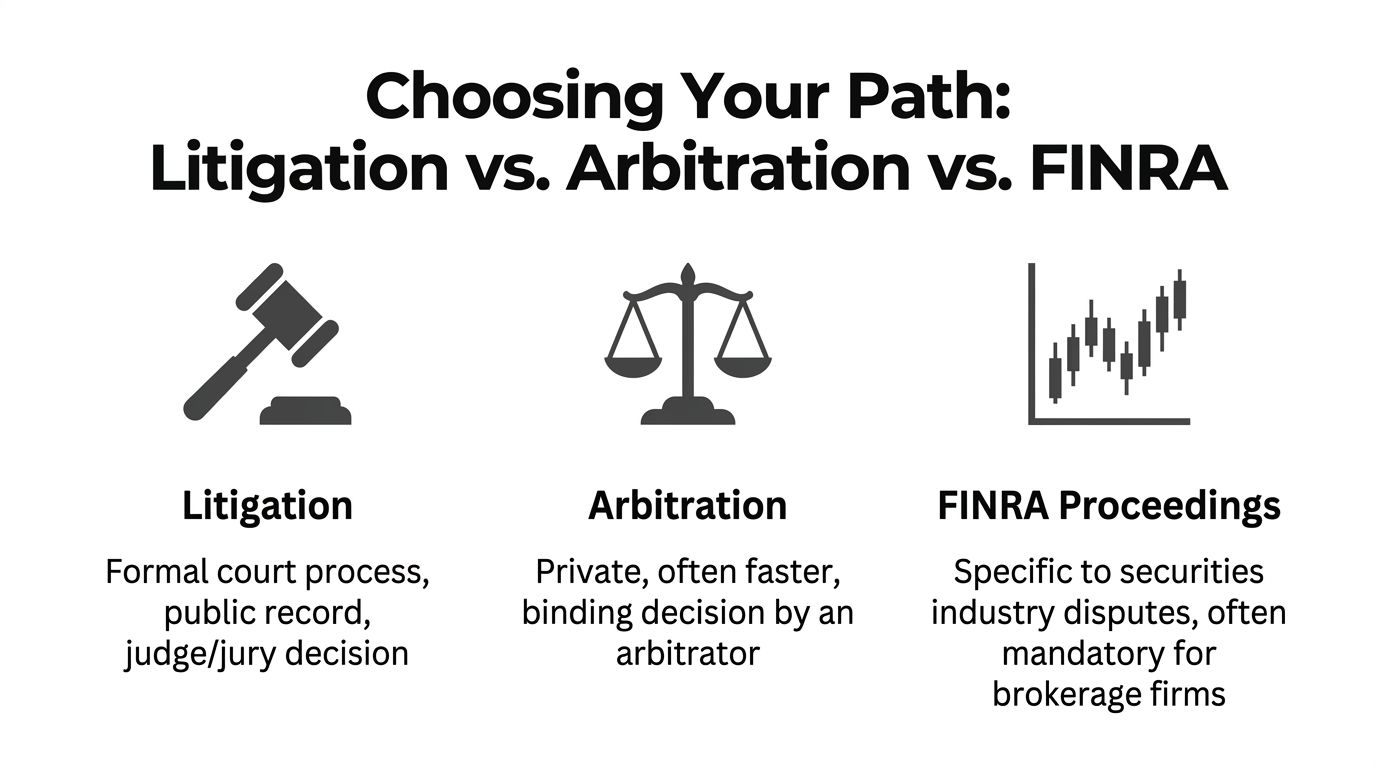
Court remains the default forum for many business fraud disputes. It’s public. It follows formal procedural rules. It offers broad discovery tools, motion practice, and, where available, access to emergency remedies such as prejudgment relief or injunctions.
That structure can be an advantage when the case depends on third-party discovery, hostile witnesses, or records scattered across multiple actors. It can also be the best setting when one side needs judicial power quickly.
The trade-off is friction. Court cases tend to move with the docket, not with the business timetable. Public filings can also matter if reputation, customer confidence, or financing relationships are already under pressure.
Private arbitration
Arbitration through forums such as AAA or JAMS often appears in commercial contracts, operating agreements, and investment documents. It’s private, generally more efficient, and usually decided by an arbitrator rather than a judge or jury.
That can help when confidentiality matters or when the parties want a decision-maker comfortable with commercial accounting issues. But arbitration isn’t automatically cheaper. Filing fees, arbitrator compensation, and limited appeal rights can cut both ways.
Businesses often underestimate one important point. Limited discovery can be a feature or a problem. If you already have the core proof, arbitration may move efficiently. If the evidence sits with reluctant third parties, litigation may be more effective.
FINRA proceedings
FINRA arbitration is a specialized forum for many securities industry disputes. Investors, financial advisors, broker-dealers, and associated persons often find themselves there because account agreements or industry rules require it.
The process is distinct from ordinary commercial litigation. The panel structure, discovery framework, industry context, and motion practice all affect how a fraud theory should be presented. Claims involving unsuitable recommendations, misrepresentations, unauthorized trading, supervision issues, or Form U5-related consequences need a strategy built for that venue.
For a closer look at procedure, this overview of the FINRA arbitration process is a useful reference point.
Comparing dispute resolution forums for business fraud
| Characteristic | Court Litigation | Private Arbitration (AAA/JAMS) | FINRA Arbitration |
|---|---|---|---|
| Decision-maker | Judge or jury | Arbitrator or panel | FINRA panel |
| Public or private | Public record | Typically private | Generally not handled like public court litigation |
| Discovery | Broadest | Usually narrower | Structured under FINRA rules |
| Appeal rights | Available, though limited by standard of review | Very limited | Very limited |
| Best fit | Complex fraud with third-party evidence needs | Contract-based disputes where privacy matters | Securities industry and investor disputes |
| Main trade-off | More procedural burden | Less judicial oversight | Forum-specific rules and industry context |
A Connecticut business owner's decision points
If you’re running a Connecticut company, start with the contract. Many disputes never present a clean forum choice because the agreement already mandates arbitration or selects a venue. Then look at the remedy. If you need immediate court intervention to freeze conduct or secure records, that may shape the path even when arbitration is ultimately required.
A good business fraud attorney won’t choose the forum by habit. The decision should come from four questions:
- Where is the claim required to go
- What evidence will be hard to obtain
- How important is confidentiality
- What outcome matters most: speed, influence, injunctive relief, or finality
Connecticut-Specific Rules for Fraud Claims
Connecticut law changes the analysis in ways out-of-state summaries often miss. Deadlines matter. Pleading choices matter. Statutory remedies matter. A fraud case that looks strong on paper can lose force if counsel ignores the local framework.
Start with the limitation period
One of the first questions in any Connecticut fraud matter is whether the claim is timely. That sounds basic, but it drives nearly everything else, including negotiating advantage, forum selection, and settlement posture.
The problem is that business owners often measure time from the day they became certain fraud occurred. The legal analysis may be more complicated. Different causes of action can involve different timing rules, and related claims may not all rise or fall together.
This is one reason early legal review matters. A detailed primer on Connecticut statutes of limitations is a good starting point, but the actual analysis depends on the claim being asserted and the facts supporting it.
CUTPA and business fraud claims
Connecticut businesses should also consider whether the facts support a claim under the Connecticut Unfair Trade Practices Act, commonly called CUTPA. In the right case, CUTPA can materially change the economics of the dispute because it may offer remedies beyond ordinary contract damages.
That doesn't mean every bad act qualifies. Courts look closely at whether the conduct occurred in trade or commerce and whether it rises above a simple breach of contract. Fraudulent sales practices, deceptive inducement, and certain unfair collection or vendor practices may fit. Straight commercial disappointment often won’t.
A recurring mistake is pleading every possible claim without thinking about how they interact. In Connecticut, the better approach is usually a disciplined set of claims tied to a clear recovery theory.
Venue and practical court considerations
Where a case is filed also matters. A Hartford-based dispute has a different practical profile than one spread across multiple Connecticut judicial districts or mixed with out-of-state parties and arbitration clauses.
The local issues aren’t glamorous, but they affect outcomes:
- Witness access: Key employees, bookkeepers, and counterparties may all be local.
- Records location: Physical files, server access, and banking relationships can affect speed.
- Related proceedings: Probate, collection, or injunctive matters may overlap.
- Enforcement posture: A judgment is only useful if it can be located, enforced, or converted into actual recovery.
Fee structure should influence legal strategy
Connecticut businesses also need to discuss economics early, not after the case is underway. Some fraud matters justify aggressive litigation because the recoverable assets are clear. Others require a narrower strategy focused on quickly gaining advantage, targeted claims, or negotiated resolutions.
That conversation belongs at the front end. The legal objective isn’t to produce the most paper. It’s to secure a practical result without letting procedure consume the value of the claim.
Understanding Legal Fees in Business Fraud Cases
Legal fees shape fraud strategy more than many clients expect. The right fee arrangement can support a disciplined recovery plan. The wrong one can push a client into over-litigating a weak case or under-investigating a strong one.

A useful warning comes from this discussion of fraud-related litigation costs, which notes that a 2024 PwC survey reported that 46% of fraud victims recover less than 50% of their losses, often because legal costs exceed the recovery, underscoring the need for transparent fee structures and efficient representation in business fraud matters.
The common fee models
The right structure depends on the type of matter, the proof available, and the likely recovery source.
- Hourly billing: Common where facts are disputed, emergency work may be needed, or the case requires substantial investigation and motion practice.
- Contingency arrangements: More likely in matters with a defined monetary recovery path, such as collections-adjacent fraud or certain investor claims.
- Flat fees: Useful for contained tasks, such as a focused review, demand letter package, or a specific regulatory or Form U5-related project.
- Hybrid models: A reduced hourly rate combined with a success component can align risk where both sides want efficiency.
What clients should ask before signing
Fee transparency isn’t just about the rate. It’s about case design.
Ask questions such as:
- What work is essential in the first phase
- Which tasks can be deferred unless the facts justify them
- Will forensic experts be needed immediately or later
- Is the likely recovery collectible
- Does the contract or statute create any fee-shifting opportunity
Those questions often separate a practical fraud case from an expensive grievance.
What usually produces value
A cost-effective fraud strategy usually has three traits.
| Trait | Why it matters |
|---|---|
| Early merits review | It prevents spending heavily before confirming proof and collectability |
| Clear phase budgeting | It lets the client decide whether to escalate after each stage |
| Recovery-focused planning | It keeps attention on actual assets, insurance, counterparties, and enforcement |
“The cheapest legal strategy on day one can become the most expensive by month six if it doesn’t move the case toward recovery.”
What doesn't work
Clients sometimes assume a contingency fee solves everything. It doesn’t. If the claim is hard to prove, the defendant is insolvent, or the remedy is mainly injunctive, contingency may not fit.
Hourly billing also fails when no one defines the objective. If counsel is told only to “investigate everything,” costs will follow the size of the suspicion rather than the value of the claim.
The better discussion is candid. What are you trying to recover, from whom, by what process, and at what expected cost? Good business fraud attorneys should be comfortable answering that in plain terms.
What To Do If You Suspect Fraud
When fraud is on the table, delay is rarely neutral. Records change. Stories harden. Assets move. Routine system activity can erase the very evidence needed to prove the claim.
The risk is widespread, not limited to failing companies or careless operators. According to Haywood Hunt & Associates, 52% of large companies with revenues over $10 billion experienced fraud in the past two years, which underscores how pervasive the problem is and why businesses need a proactive legal strategy, as discussed in these 2023 business fraud statistics.
The immediate checklist
If you suspect fraud, take these steps first:
- Preserve records: Secure emails, accounting files, messages, invoices, approvals, and device access before normal deletion or alteration occurs.
- Limit internal discussion: Tell only the people who need to know. Broad internal chatter contaminates witness accounts and tips off the suspected actor.
- Document the trigger event: Write down what raised concern, when it happened, and who observed it.
- Protect systems: Review permissions, banking authority, vendor controls, and remote access without creating unnecessary drama.
- Call counsel early: Legal strategy should shape the investigation before the investigation shapes the evidence.
What not to do
These mistakes appear constantly in fraud matters:
- Don't confront the suspect prematurely: You may trigger deletion, flight, retaliation, or a coordinated defense.
- Don't rely on verbal explanations: Fraud disputes are document cases first.
- Don't assume insurance or law enforcement will handle the problem: Civil recovery, internal governance, and regulatory exposure often require separate action.
- Don't frame it too narrowly: What looks like embezzlement may also involve fiduciary breach, inducement, records manipulation, or securities issues.
Turning suspicion into a recoverable claim
A useful fraud response asks three practical questions early.
Can the conduct be proved
Suspicion is not enough. You need records, witness testimony, transaction history, and a theory that ties them together. In many cases, the quality of preservation in the first days determines whether the proof ever becomes strong enough.
Is there someone worth pursuing
An excellent claim against an insolvent defendant may have limited value. Counsel should assess not only liability, but also where recovery may come from. That could include the primary wrongdoer, a business entity, a control person, an insurer, or a third party that received funds.
What forum and remedy fit the facts
Some cases need emergency court relief. Others belong in arbitration because the contract requires it. Securities-related disputes may point to FINRA from the outset. The right path depends on where the advantage lies.
The strongest fraud strategy is usually narrow at first. Secure the evidence, define the claim, identify the recovery source, then escalate with purpose.
Why early legal advice changes outcomes
Fraud matters punish improvisation. By the time a company is certain what happened, it may already be late to preserve decisive evidence or secure useful remedies. Early advice doesn't guarantee a lawsuit. Sometimes the right answer is a confidential internal review, a demand backed by proof, or a negotiated separation tied to repayment and access to records.
But that decision should be made from strength, not from uncertainty. That’s where experienced business fraud attorneys add value. They help separate anger from proof, proof from advantage, and advantage from an actual result.
If you want to discuss your business law matter, contact Kons Law at (860) 920-5181.
