
As a business owner, one of the most critical decisions you'll make is how you classify the people who work for you. Deciding between an employee and an independent contractor isn't just about paperwork—it's a foundational piece of your company's risk management strategy. Getting it wrong can expose your business to staggering financial and legal liabilities that threaten its stability and future growth.
The High Stakes of Worker Classification
Navigating contractor employment law often feels like a high-wire act. On one side, you have the flexibility and potential cost savings that come with an independent workforce. On the other, you have the severe penalties for misclassification. Simply calling a worker a "1099 contractor" and having them sign a boilerplate agreement won't protect you if the relationship looks and functions like employment.
Regulators and courts are trained to look past titles and contract clauses. They analyze the actual nature of the working relationship using specific legal frameworks, like the federal "economic reality" test or Connecticut's much stricter "ABC test," to gauge the real level of control and dependence. An incorrect classification can set off a chain reaction, turning what seemed like a straightforward working arrangement into a complex and costly legal fight.
Understanding the Financial and Legal Risks
The financial exposure from misclassifying workers is immense. It's a common red flag that can trigger audits and lead to sudden, crippling liabilities—especially for businesses expanding into new states or going through a sale. To put it in perspective, the Department of Labor recovered over $259 million in back wages for wage and hour violations alone in fiscal year 2026, which shows just how aggressively the government is targeting this issue.
A misclassification finding can unleash a flood of expensive consequences:
- Back Taxes and Penalties: You could be on the hook for years of unpaid federal and state payroll taxes, including the employer's share of Social Security and Medicare.
- Wage and Hour Claims: Reclassified workers can sue for unpaid overtime, minimum wage violations, and meal breaks they were entitled to as employees.
- Benefit Plan Liabilities: Your business may be ordered to pay for retroactive health insurance, retirement plan contributions, and paid time off.
- Insurance Premiums: Expect to owe back payments for workers' compensation and unemployment insurance coverage you should have been carrying.
Proactive Compliance is Your Best Defense
Think of this guide as your toolkit for navigating these complexities with confidence. We’ll demystify the legal tests, break down the risks in plain English, and give you actionable steps for auditing your workforce and drafting compliant contracts. The first step is always understanding the core principles of regulatory compliance.
By taking a proactive approach, you can build a flexible workforce while managing your legal obligations effectively. If you want to discuss your business law matter, contact Kons Law at (860) 920-5181.
Understanding the Legal Tests for Worker Status
Deciding whether a worker is an employee or an independent contractor isn't just about what you call them or what their contract says. It’s a legal determination, and getting it wrong is one of the most common and costly mistakes a business can make.
Courts and agencies like the Department of Labor and the IRS will look past titles and agreements to scrutinize the actual nature of the working relationship. They use specific, multi-part tests to figure out if a worker is truly in business for themselves or if they are economically dependent on your company.
The Federal Economic Realities Test
At the federal level, the go-to standard is the economic realities test. This isn't a simple checklist; it's a holistic review that weighs several factors together to get the full picture. The core question is whether the worker is economically dependent on the business, which would point to an employee relationship.
No single factor decides the outcome. Instead, it’s a balancing act where agencies consider the "totality of the circumstances." The key factors usually include:
- The degree of control the business has. This is often the most revealing factor. Who dictates the schedule, the location, and the methods used to perform the work? The more control the business has over how the work gets done, the more the person looks like an employee.
- The worker’s opportunity for profit or loss. A real contractor can increase their profits through their own management skills or suffer a loss if things go poorly. If their pay is simply tied to hours worked for one company, they have little of this entrepreneurial risk or reward.
- The worker's investment in their own tools and equipment. Contractors typically provide their own significant tools and resources. If your company provides everything needed to do the job, that’s a strong indicator of an employment relationship.
- The amount of skill and initiative required. Work demanding highly specialized skills and independent judgment is more likely to be considered independent contract work. Routine tasks requiring little initiative point the other way.
- The permanence of the relationship. Is the engagement for a single, defined project, or is it a long-term, ongoing relationship? Indefinite or continuous work often suggests employment.
- How integral the work is to the business. If the services provided are a core part of what your company does, it becomes much harder to argue that the worker is truly independent.
This flowchart helps visualize the decision-making process and the serious consequences of getting it wrong.
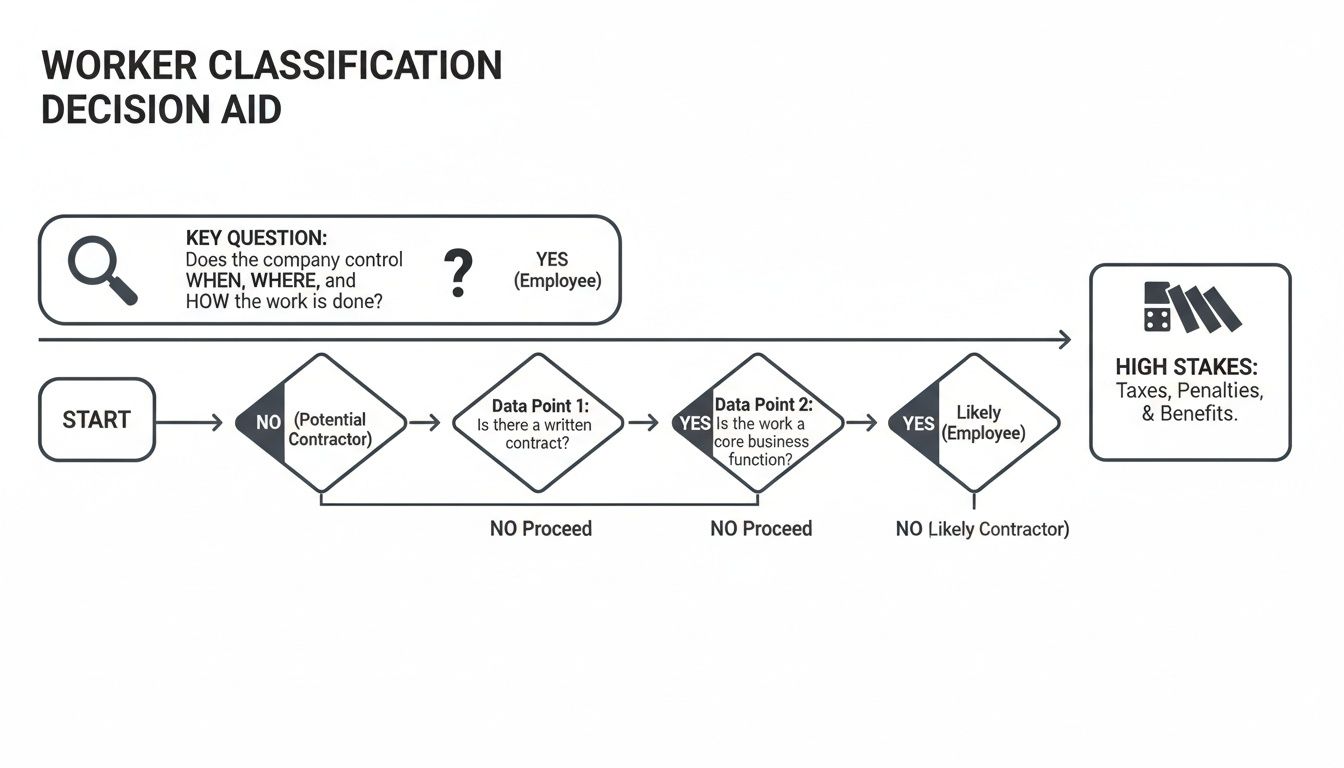
As you can see, correctly answering these fundamental questions is the first step to avoiding the significant financial penalties of misclassification.
Connecticut's Stricter ABC Test
While the federal test is a balancing act, Connecticut uses a much tougher standard for state wage and unemployment law: the ABC test. To classify a worker as an independent contractor here, your business must prove that the relationship meets all three parts of the test.
Fail just one part, and the worker is automatically considered your employee. There’s no partial credit.
Federal Economic Realities Test vs. Connecticut ABC Test
This table highlights the key differences between the flexible federal standard and Connecticut's rigid, all-or-nothing approach. Understanding both is crucial for any business operating in the state.
| Factor | Federal Economic Realities Test (Totality of Circumstances) | Connecticut ABC Test (Must Pass All Three) |
|---|---|---|
| Control | One of several factors weighed. Considers who controls the how, when, and where of the work. | Part A: Worker must be free from control and direction in both contract and practice. A strict pass/fail. |
| Business Scope | Considers how integral the work is to the business as part of the overall picture. | Part B: Work must be outside the usual course of the hiring business’s operations. Non-negotiable. |
| Independent Business | Examines investment and opportunity for profit/loss to see if the worker operates like a business. | Part C: Worker must be customarily engaged in an independently established trade or business. |
| Overall Approach | A flexible, multi-factor balancing test. No single factor is decisive. | A rigid, three-pronged test. The business must prove all three parts are met. |
Let's walk through what each part of the ABC test means in the real world:
- (A) The worker is free from control and direction. The worker must truly be their own boss. If you tell a freelance writer they must work in your office from 9 to 5 using your computer, you’ve likely failed Part A.
- (B) The work is outside the usual course of the business. The service must be separate from your company's core function. A tech startup hiring an electrician to wire the office easily passes. But if that same startup hires a "freelance" software developer to work on its main product, it almost certainly fails Part B.
- (C) The worker is customarily engaged in an independently established trade. The worker must have a real, functioning business of their own. They should have other clients, market their services, and have their own business identity (like an LLC). If you are their only source of work, you will fail Part C.
For any business in Connecticut, navigating these rules is complicated. You have to satisfy the stringent state ABC test while also staying compliant with the federal economic realities test. Getting an employment agreement review can provide critical clarity for your specific situation.
If you want to discuss your business law matter, contact Kons Law at (860) 920-5181.
The Domino Effect of Misclassification Risks
Thinking that a worker misclassification penalty is just a simple fine is a dangerous mistake. It’s actually the first domino in a long line of legal and financial problems that can seriously threaten your business. The consequences go far beyond a slap on the wrist, setting off a cascade of liabilities that can drain your finances, attract more government scrutiny, and leave your company in a state of damaging uncertainty for years.

This chain reaction starts the second a court or agency reclassifies one of your independent contractors as an employee. All at once, every law designed to protect employees applies retroactively to that person—and quite possibly to every other worker in a similar role. This is the real danger of misclassification: it’s rarely about a single individual but about a business practice that regulators can unravel, piece by painful piece.
The Immediate Financial Shockwave
The first and most direct hit comes in the form of demands for back pay and unpaid payroll taxes. This isn’t a small accounting error you can just fix in the books; it’s a major financial blow that catches most businesses completely unprepared. The liabilities stack up fast and come from several directions at once.
- Unpaid Wages and Overtime: Under the Fair Labor Standards Act (FLSA), the newly reclassified employee is now owed minimum wage and overtime for all hours worked. An audit by the Department of Labor can mean you’re on the hook for years of back pay, often at time-and-a-half, plus liquidated damages that can double the total amount owed.
- Back Payroll Taxes: Suddenly, your business is liable for the employer's share of FICA taxes (Social Security and Medicare) that you never paid. The IRS can, and will, add steep penalties and interest for the failure to withhold and remit those funds.
- Unemployment and Workers' Compensation: State agencies will also come knocking, demanding back payments for unemployment insurance (UI) and workers' compensation premiums. This can add up to a substantial amount, especially if the misclassification has been happening for several years with multiple workers.
This sudden financial pressure can be devastating, particularly for small and mid-sized businesses running on tight margins. It's not uncommon for a single reclassification case to spiral into a six-figure liability before any other legal claims even surface.
A common myth is that you’re protected if a worker agrees to be a contractor. The reality is that federal and state agencies completely ignore those agreements. What matters is the economic reality of the working relationship, and a single complaint from a disgruntled worker can trigger an audit, regardless of what they signed.
Expanding Legal Exposure and Full-Scale Audits
The initial financial shock is often just the opening act. A misclassification finding throws the door wide open to a host of other legal headaches that can be even more complicated and costly to handle. One worker’s complaint frequently becomes the trigger for a much broader investigation.
Regulators work on the principle of "where there's smoke, there's fire." If they find one misclassified worker, they will assume there are others. This can quickly escalate into a full-scale audit of all your 1099 workers, forcing you to justify and defend every single contractor relationship you have. This expanded scrutiny puts you at risk in a few key ways:
- Retroactive Employee Benefits: Under the Employee Retirement Income Security Act (ERISA), reclassified workers can sue you for the value of benefits they should have received, like health insurance, 401(k) matching contributions, and paid time off.
- Anti-Discrimination Lawsuits: Once a worker is legally an employee, they gain the full protection of laws like Title VII of the Civil Rights Act. This exposes your business to potential lawsuits for discrimination, harassment, or retaliation—claims that simply wouldn’t apply to a legitimate contractor.
The ripple effect is clear: what starts as one person's wage claim can easily explode into a multi-front legal battle with the DOL, the IRS, and private lawsuits. Understanding the full scope of these risks is the first step toward building a compliant business.
If you want to discuss your business law matter, contact Kons Law at (860) 920-5181.
How to Draft Bulletproof Independent Contractor Agreements
Your independent contractor agreement is more than just a formality—it’s a critical piece of evidence that can make or break your case in a misclassification dispute. But here’s the catch: a contract is only valuable if it accurately reflects the real-world working relationship. If your day-to-day practices don't align with the words on the page, that agreement can quickly become a roadmap for regulators to prove you have an employee, not a contractor.
Think of your agreement as the foundation for a legitimate business-to-business engagement. When drafted correctly, it sets clear expectations, defines the project scope, and locks in the contractor's independent status before any work ever begins. Getting this right from the start is your first and best line of defense.

Essential Clauses to Include
A strong independent contractor agreement needs to be built with specific clauses that clearly demonstrate the worker’s independence, control over their work, and entrepreneurial opportunity. These aren’t just suggestions; they are the core components that courts and agencies look for.
Make sure your agreement always includes these five elements:
- A Clear, Project-Based Scope of Work: Define the exact project, the specific deliverables, and the final deadlines. The key is to avoid open-ended duties that look like a job description. Focus on the what (the outcome), not the how (the process).
- Affirmation of the Contractor's Control: Your contract must explicitly state that the contractor has sole control over the methods and means they use to get the job done. This confirms you hired them as an expert, not as an employee to be managed.
- The Right to Work for Others: The agreement must clearly state that the contractor is free to provide services to other clients, including your competitors. This is a powerful signal that they run an independent business and aren't economically dependent on you.
- Provision of Their Own Tools and Equipment: The contract should clarify that the contractor is responsible for providing their own tools, software, and supplies. This shows they have made a real investment in their own business operations.
- No Employee Benefits: Be crystal clear that the contractor is not eligible for any employee benefits, such as health insurance, retirement plans, or paid time off. This clause prevents any ambiguity about their classification.
Red Flag Language to Avoid at All Costs
What you leave out of your agreement is just as critical as what you put in. Many businesses make the mistake of borrowing language from their employment contracts, which can be a disaster. These phrases act as bright red flags for auditors and can seriously undermine your position.
A contract is only as strong as the reality it represents. If your agreement says the contractor has full control, but in practice you dictate their hours and methods, the contract will be deemed worthless. Consistency between your documentation and your daily operations is paramount.
Be vigilant about removing any language that even hints at an employer-employee relationship. Watch out for these common mistakes:
- Setting Specific Work Hours: Never dictate a 9-to-5 schedule. True contractors have the flexibility to set their own hours to complete the agreed-upon project.
- Requiring Exclusive Service: Non-compete clauses are a major red flag. An independent business owner must be free to pursue other clients and projects.
- Mandating Specific Training: Forcing a contractor to attend company-specific training sessions suggests you are controlling their methods—a hallmark of employment.
- Using Employee-Centric Titles: Avoid job titles like "Marketing Manager" or "Project Lead," which imply a role within your company’s hierarchy. Stick to neutral terms like "Consultant" or "Contractor."
- Reimbursing Expenses: Contractors should build their business expenses into their project fees. Asking them to submit expense reports for reimbursement is an employee practice.
Pay transparency is another area to watch. While focused on employees, the European Union's Pay Transparency Directive, effective by 2026, will likely influence pay equity conversations for all workers. To stay ahead and ensure your agreements are clear and compliant, using a well-vetted freelance contract template can be a good starting point.
By carefully crafting your agreements, you establish a solid foundation for a compliant relationship. For more guidance on what to include in your contracts, check out our guide on creating a small business contract template. To discuss your specific business law matter, contact Kons Law at (860) 920-5181.
A Practical Compliance Checklist for Your Contractor Workforce
Waiting for a government audit or a worker complaint is a reactive, and often costly, mistake. The best way to protect your business from the significant financial and legal penalties of worker misclassification is to conduct a thorough internal review of your contractor relationships yourself.
This practical checklist provides a step-by-step process for getting it done. Think of it as an internal audit designed to find and fix potential red flags before they escalate into a crisis. It’s about ensuring your daily operations truly match the strict legal standards for independent contractors.
Step 1: Conduct an Inventory and Initial Screening
The process begins with a clear, comprehensive view of everyone you pay as an independent contractor. You need to know who you’re working with before you can evaluate the risk.
- Create a Master List: First, compile a complete list of every individual paid on a 1099 basis. This should include their name, the specific services they provide, their start date, and their total compensation over the past year.
- Perform an Initial Risk Triage: With your list in hand, do a quick scan for obvious red flags. Are any of these "contractors" actually long-term workers performing tasks that are essential to your business? Do any hold titles that sound like employee positions (e.g., "Contractor Marketing Manager")? Highlight these individuals for a much closer look.
Step 2: Apply the Legal Tests to High-Risk Roles
Now it’s time to zero in on the individuals you flagged as high-risk. For each one, you must methodically apply the relevant legal tests, documenting your analysis as you go. Remember, in Connecticut, the standard is the rigid ABC test, and you have to satisfy all three parts.
- Analyze Control (Part A): Is the worker truly free from your control and direction in how they perform their service? Look closely at the reality of the situation. Who sets the work hours? Who dictates the methods? Who provides the essential tools and equipment? If you are managing their process, you will fail this part of the test.
- Evaluate Business Scope (Part B): Is the service they provide outside the usual course of your company’s business? This is often a sticking point. A law firm that hires a plumber to fix a leak easily passes. However, if that same law firm brings on a "freelance" paralegal, they will almost certainly fail this part.
- Confirm an Independent Business (Part C): Does the worker operate their own genuinely independent business? You need to confirm this. Ask for proof they have other clients, a registered LLC or corporation, a business website, and their own liability insurance. If your company is their only or primary source of income, they are not running an independent business.
For each high-risk individual, you must document specific, factual examples that support or contradict each part of the ABC test. Vague notes won't help you in an audit. You need concrete evidence of their independence, such as their freedom to decline projects or proof they actively work for your competitors.
Step 3: Review Contracts and Take Corrective Action
After completing your analysis, the final step is to take decisive, corrective action. This means aligning your contracts with the reality of the relationship and, in some cases, making tough decisions about how to move forward.
Your review will likely lead to one of three outcomes:
- Low Risk: The worker clearly passes all legal tests, and your written agreement accurately reflects an independent contractor relationship. No immediate action is required, though periodic reviews are always wise.
- Moderate Risk: You’ve found some inconsistencies where your practices don't quite match the contract. This is your opportunity to restructure the engagement—modifying the working relationship to strengthen their independence and updating the contract to match.
- High Risk: The worker is almost certainly misclassified under the law. The only safe course of action is to transition them to W-2 employee status. Taking this step proactively is the best way to eliminate the risk of future claims, back taxes, and penalties.
Conducting this internal audit gives you the clarity needed to make informed, protective decisions for your business. If you want to discuss your business law matter, contact Kons Law at (860) 920-5181.
Protecting Your Business and Knowing When to Seek Legal Counsel
Getting your contractor relationships right isn't just a one-time task; it's an ongoing commitment. To stay compliant, you have to consistently make sure your practices line up with the latest legal standards. This means understanding the different tests for classification, knowing the steep risks of getting it wrong, and keeping your contracts airtight.
But just as crucial is knowing when you’re out of your depth. Certain situations carry so much complexity and legal risk that calling in a professional isn't just a good idea—it's a fundamental business necessity. Seeing legal counsel as a proactive partner, rather than a last-ditch emergency call, can shield your business from devastating financial and legal fallout.
Recognizing the Triggers for Legal Intervention
Some business moves automatically raise the stakes and should be a clear signal that it’s time to consult an expert. Delaying action when these triggers appear can quickly lead to audits, lawsuits, and crippling penalties that could have been avoided.
These are the moments when you should pick up the phone and call an attorney:
- Preparing for an Audit: If you get a notice from the IRS, Department of Labor, or a Connecticut state agency, your first move should be to contact a lawyer. They will help you organize your documents, handle all communications, and defend your position.
- Structuring Complex Service Agreements: A generic contract template won’t cut it for a high-value, long-term, or business-critical project. An attorney can draft a custom agreement that truly protects your intellectual property and is built to stand up in court.
- Acquiring a Business with Contractors: When you’re looking to buy another company, you have to dig into how they’ve been classifying their workers. If you accidentally inherit a misclassification problem, it can sink the deal or leave you with a massive, unexpected liability after the papers are signed.
- Facing a Worker Complaint: Any formal complaint or lawsuit from a worker claiming they were misclassified is a serious threat. You need immediate legal advice to build a defense strategy and contain the damage before it spirals.
Think of a business law attorney as a strategic partner in risk management. Just as you consult an accountant for tax planning, you should consult an attorney for workforce planning to ensure your growth is built on a solid legal foundation.
Successfully navigating these scenarios demands specialized knowledge that goes beyond standard business operations. Understanding what a business lawyer does clarifies how their value extends far beyond the courtroom, helping you build a more resilient and compliant company from the ground up. The goal is always to act preemptively and turn a potential crisis into a manageable business decision.
The law surrounding independent contractors is complex, but with the right guidance, it’s entirely manageable. If you want to discuss your business law matter and ensure your company is protected, contact Kons Law at (860) 920-5181 for a consultation.
Common Questions About Contractor Law
Business owners often run into the same practical questions when navigating contractor law. Here are clear, direct answers to help you understand the real-world risks and avoid some very expensive mistakes.
Can a Signed Agreement Prevent Misclassification?
A signed agreement is absolutely a critical first step, but it is not a "silver bullet" that guarantees protection. Courts and government agencies will always look past the paper to the “economic reality” of the relationship.
If you exert significant control over the worker, their tasks are integral to your core business, and they are economically dependent on you, they will almost certainly be deemed an employee—no matter what the contract says. The agreement must accurately reflect a genuinely independent business relationship in practice.
What Is the Biggest Mistake Businesses Make with Contractors?
The most frequent and dangerous mistake is what I call “creeping control.” This happens when a business starts an engagement correctly, but over time, begins treating the contractor more and more like an employee.
This slow erosion of independence is what creates the most significant legal risk. It might involve dictating work hours, closely managing their methods, providing all the necessary tools, or integrating them into your internal team. In a legal dispute, it's the day-to-day reality that truly matters, not the initial agreement.
What Are the Penalties for Misclassification in Connecticut?
The consequences in Connecticut are severe and can come from multiple agencies at once. A finding of misclassification can make you liable for:
- Back Wages: This includes any unpaid overtime owed to the worker, often going back years.
- Tax Liabilities: You could be on the hook for years of unpaid federal and state payroll taxes, plus steep penalties and interest.
- Insurance Premiums: Expect demands for back payments for workers' compensation and unemployment insurance you should have been carrying.
- DOL Fines: The Connecticut Department of Labor has the authority to impose its own significant fines for misclassification.
On top of all that, misclassified workers can file civil lawsuits to recover damages and attorneys' fees. If the misclassification is found to be intentional, the penalties can even escalate to include criminal charges.
Do My State’s Laws Apply to a Remote Contractor?
This is an incredibly complex area of the law where getting professional legal advice is essential. As a general rule, the laws of the state where the work is physically performed will govern the relationship. For example, if your Connecticut-based business hires a remote contractor who works from California, California's strict ABC test will likely apply to that relationship.
A key part of protecting your business involves understanding contractor insurance requirements, which can shield both you and the contractor from unexpected liabilities. Managing different state laws is a primary reason to seek expert counsel when building a distributed workforce.
If you want to discuss your business law matter, contact Kons Law at (860) 920-5181.
