
When a legal threat looms over your business, a business litigation lawyer is your seasoned strategist and frontline defender. They're the ones who navigate the high-stakes commercial conflicts that can put your revenue, reputation, and day-to-day operations at risk. Their job is to champion your company’s interests, whether that’s in a courtroom, an arbitration hearing, or at the negotiation table.
Understanding Your Legal Strategist in Business Disputes
Think of a business litigation lawyer less like a generic attorney and more like the general contractor on a complex construction project—your legal case. A good contractor doesn't just show up and swing a hammer. They scrutinize the blueprints, coordinate specialized teams of plumbers and electricians, manage the timeline, and solve every unexpected problem that pops up to make sure the final building is solid.

In the same way, a litigator builds and executes your legal strategy from the ground up. They dive into the "blueprints" of your dispute, whether it's a fractured contract or a soured partnership agreement. From there, they bring in the right resources—like expert witnesses or forensic accountants—and manage the entire process to construct the strongest case possible for you.
More Than Just Courtroom Appearances
While arguing in court is a vital part of the job, much of a litigator’s most crucial work happens long before a judge ever sees the case. Their responsibilities are broad, all strategically aimed at protecting your company’s interests at every single turn.
A truly skilled business litigation lawyer is always focused on a few core functions:
- Case Analysis and Strategy Development: They’re poring over contracts, emails, and financial records to get a 360-degree view of your position’s strengths and weaknesses.
- Risk Mitigation: It's their job to spot potential legal landmines and advise you on how to minimize the damage, often by finding a way to settle and avoid a drawn-out, expensive court battle.
- Evidence Management: They run the complex discovery process, which means systematically gathering documents, conducting depositions, and making sure every critical piece of information is preserved.
- Negotiation and Advocacy: They are your voice in settlement talks, mediation, and arbitration, fighting to secure the best possible terms for your business.
Navigating a Competitive Legal Field
In today's environment, having specialized expertise is more critical than ever. The United States has over 1.3 million practicing lawyers, which makes for an intensely competitive field. This is especially true in commercial litigation, where firms like Kons Law in Hartford guide businesses through thorny disputes across Connecticut and the nation.
With projections showing that nearly half of corporate counsel expect to see more lawsuits in the coming year, having a dedicated legal advocate isn't a luxury—it's a necessity. This landscape demands an attorney who not only gets the big picture of business law but also knows the specific, tactical moves of litigation.
For a deeper dive into how this role fits into the broader legal world, you might find our article on what a business lawyer does helpful. Ultimately, a litigator's goal is to resolve your dispute efficiently while protecting your bottom line and the long-term health of your business. If you want to discuss your business law matter, contact Kons Law at (860) 920-5181.
The Common Battles a Business Litigator Fights
A business litigation lawyer gets the call when a commercial relationship sours and turns into a formal dispute. These aren't just abstract legal theories playing out in a textbook; they're real problems that can threaten a company’s bottom line, its daily operations, and even its reputation in the marketplace.
Knowing the most common battlegrounds helps you spot the warning signs and understand when it’s time to bring in a legal advocate. The issues that land on a litigator’s desk almost always trace back to a broken promise, a violation of trust, or someone playing unfairly in the market.
Breach of Contract Disputes
At the core of almost every business relationship is a contract—a legally binding promise. When one side doesn't hold up their end of the bargain, you have a breach of contract. This is, by far, one of the most common reasons businesses find themselves needing a litigator.
A breach isn't always a dramatic, outright refusal to pay an invoice. It can show up in more subtle, but equally damaging, ways:
- Failure to Deliver: Your key supplier simply doesn't provide the goods you paid for, bringing your production line to a screeching halt.
- Non-Payment: A client takes the work you delivered but ignores the invoice, throwing your cash flow into chaos.
- Subpar Performance: A vendor delivers work so shoddy it doesn’t meet the clear standards in your agreement, forcing you to spend more time and money to get the job done right.
The fallout from a broken contract can be severe. To get a deeper understanding of this, you can learn more about what constitutes a material breach of contract in our article.
Partnership and Shareholder Disputes
When business owners fight, the conflict strikes at the very heart of the company. These disputes are especially dangerous because they come from within, often stemming from disagreements over the company’s future, how money is being managed, or who is responsible for what.
Common triggers for these internal battles include one partner making huge decisions without telling anyone, arguments over how profits are split, or even accusations that someone is misusing company funds for personal gain. Once communication breaks down, you need a litigator to step in, enforce the partnership or shareholder agreement, and protect your stake in the business.
Business Torts and Unfair Competition
Not every fight is about a contract. Sometimes, the damage is caused by another party’s deliberate and wrongful actions designed to interfere with your business. These actions are called business torts.
A business tort is a wrongful act committed against a company that causes financial harm. Unlike a contract breach, this often involves a party you don't have a formal agreement with.
This area covers a few specific kinds of wrongdoing:
- Tortious Interference: This happens when a third party intentionally convinces someone to break a contract they have with you. Think of a competitor poaching your star salesperson, knowing full well they have a non-compete agreement.
- Trade Secret Theft: An ex-employee walks out the door with your confidential client list or proprietary software code and takes it straight to a competitor, giving them an instant—and illegal—advantage.
- Business Defamation: A rival starts spreading false, damaging rumors about your products or services, hurting your reputation and scaring away customers.
These situations demand a swift, strategic legal response to stop the bleeding and recover your losses. This landscape is only getting tougher, too. Corporate counsel see a more challenging litigation environment on the horizon, with a recent survey showing nearly 50% expect an increase in lawsuits and regulatory scrutiny. This is being driven by an aggressive plaintiffs' bar and new regulations, making experienced legal counsel more crucial than ever. You can explore the full 2025 litigation trends survey from Norton Rose Fulbright for a closer look at the forecast.
If you want to discuss your business law matter, contact Kons Law at (860) 920-5181.
Choosing Between the Courtroom and the Conference Room
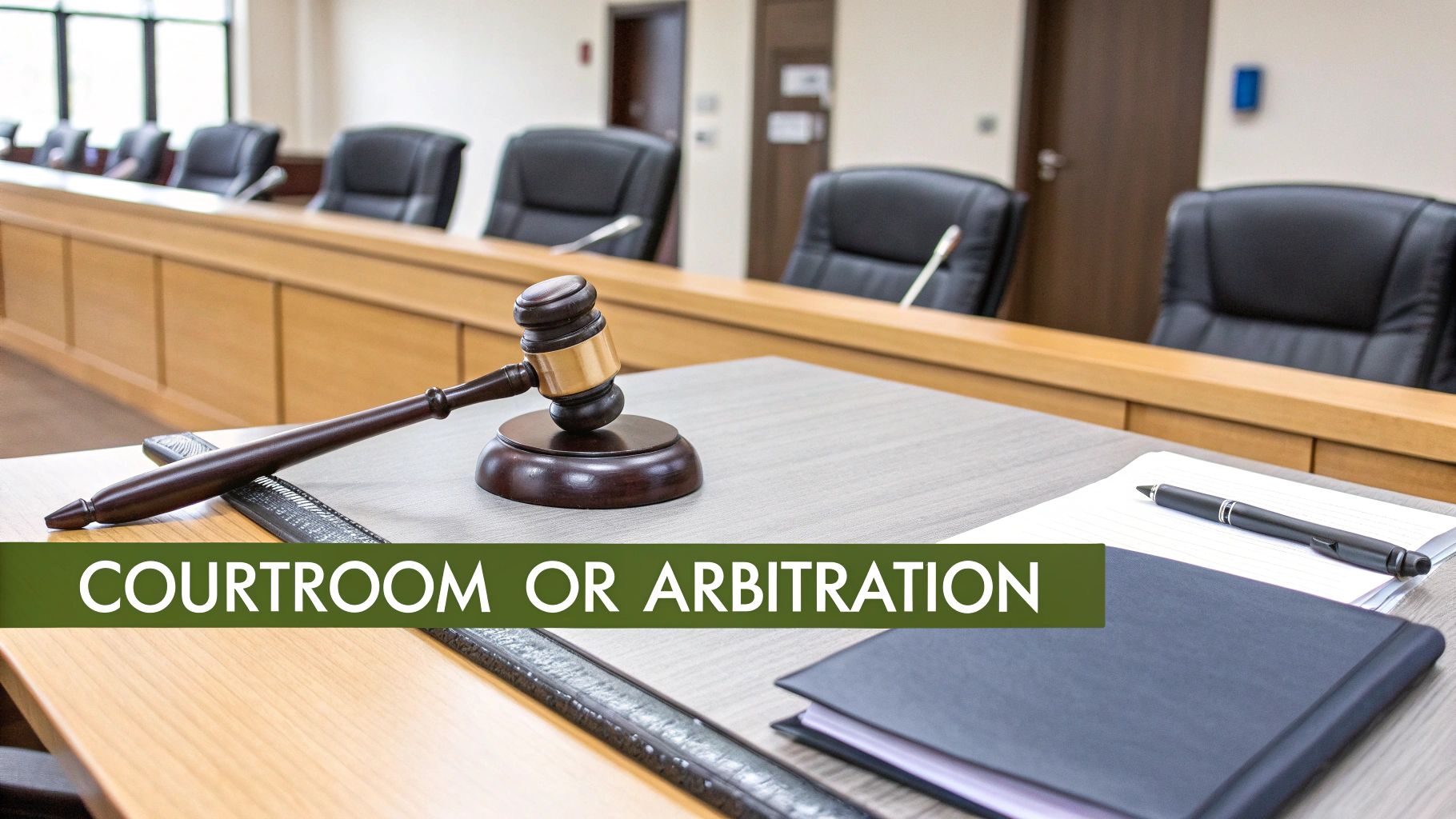
When a serious business dispute kicks off, the path to a solution isn’t always a straight line to the courthouse steps. You really have two main arenas to resolve the fight: the traditional courtroom, known as litigation, or a private setting, known as arbitration. Understanding the real-world differences between them is the first step in making a smart, strategic decision for your company.
Litigation is the public, formal process everyone imagines when they hear the word "lawsuit." It involves judges, sometimes juries, and operates under very strict rules of procedure and evidence. Everything filed becomes a public record, and the outcome is decided by a judge or jury based on the law, with well-defined routes for appeal.
Arbitration, on the other hand, is a form of alternative dispute resolution (ADR). It’s a private affair where both sides agree to let a neutral expert—the arbitrator—act as a private judge. The entire process is confidential, far more flexible, and the arbitrator's decision is usually final and binding, with very few options for an appeal.
A Head-to-Head Comparison: Litigation vs. Arbitration
Choosing the right path means weighing the trade-offs. What works for one business could be a huge mistake for another. The best choice often comes down to what you value most—speed, cost, privacy, or the need to set a public precedent.
To make the choice clearer, it helps to see how the two stack up side-by-side.
Comparing Litigation and Arbitration for Business Disputes
This table breaks down the key differences between traditional court litigation and private arbitration to help businesses understand their dispute resolution options.
| Feature | Litigation (Court System) | Arbitration |
|---|---|---|
| Publicity | Public record. Filings and proceedings are open to the public, which can impact company reputation. | Private and confidential. The dispute and its outcome are kept out of the public eye. |
| Decision-Maker | A publicly appointed judge and potentially a jury of peers. | A neutral arbitrator or panel of arbitrators, often chosen by the parties for their industry expertise. |
| Speed | Generally slower. Court dockets are crowded, leading to a process that can take years to conclude. | Typically faster. The process is more streamlined with fewer formal requirements, leading to quicker resolutions. |
| Cost | Can be very expensive due to lengthy discovery processes, extensive motions, and formal trial procedures. | Often more cost-effective due to its speed and simplified procedures, though arbitrator fees can be substantial. |
| Flexibility | Highly structured. Parties must follow strict, formal rules of civil procedure and evidence. | More flexible. Parties can agree on the rules that will govern the process, creating a more customized approach. |
| Finality | Decisions can be appealed through the court system, which can add significant time and cost. | Decisions are generally final and binding with very limited grounds for appeal, providing a conclusive end. |
Ultimately, a skilled business litigation lawyer can help you analyze your specific situation and determine which forum is truly the best fit.
Why Experience in Both Arenas Matters
The choice between litigation and arbitration is more than just logistics—it’s pure strategy. A business litigation lawyer with deep experience in both the courtroom and the conference room gives you a serious advantage. They can see the subtle angles in your case and guide you to the venue that best protects what's important.
For instance, if your main goal is to keep sensitive trade secrets away from prying competitors, the confidentiality of arbitration is a game-changer. But if you need to set a legal precedent or feel a jury would be more sympathetic to your story, the public stage of litigation might be the smarter play.
An attorney who is comfortable in both worlds can also use the threat of one to gain leverage in the other. For a deeper dive into these options, you can read more about alternative dispute resolution vs litigation in our detailed guide. Their ability to navigate either path ensures your business is set up for the best possible outcome, no matter where the battle is fought.
If you want to discuss your business law matter, contact Kons Law at (860) 920-5181.
Recognizing the Right Moment to Hire a Lawyer
In any business dispute, timing is everything. If you hesitate, you can back yourself into a corner, limiting your options and watching the potential costs climb. But move too fast, and you might feel like you’re overreacting. The key to knowing when to call a business litigation lawyer isn’t about gut feelings—it’s about recognizing the clear red flags that a simple disagreement is turning into something more serious.
Think of it like seeing smoke in your building. You wouldn’t wait for the fire to be raging before calling for help. You act on the first sign of danger to keep a small problem from becoming a total disaster. In the world of business, certain events are the legal equivalent of that smoke alarm blaring.
Critical Triggers Demanding Legal Attention
Too many business owners wait until they're served with a lawsuit. That’s often too late. By that point, the other side has already fired the first shot and set the terms of the fight. The real advantage comes from being proactive. A sharp business litigation lawyer can do far more for you when they’re brought in early, often extinguishing the problem before it ever gets near a courtroom.
There are a few moments that should immediately have you reaching for the phone to get legal advice:
- Receiving a Demand Letter: This isn't just an angry email. A formal demand letter, especially one from another attorney, is a clear signal that the dispute has gone from informal to serious. It’s a direct threat of legal action, and it demands a strategic, professional response—not a hastily written email.
- Discovering a Breach of Trust or Contract: The second you learn a partner is violating your shareholder agreement, a key supplier has completely failed to deliver, or a former employee is walking away with your trade secrets, the clock starts ticking. Fast legal intervention can help you contain the damage before it spirals.
- Serious Payment Disputes: When a major client simply refuses to pay a large invoice, it stops being a simple collections issue. This is a potential breach of contract that could wreck your cash flow. It needs a formal legal strategy, not just another reminder notice.
- Any Formal Threat of a Lawsuit: Whether someone says it to your face or puts it in writing, an explicit threat to sue you is the line in the sand. It's time to get your own advocate in your corner, right away.
The Strategic Advantage of Early Engagement
Bringing a lawyer in early isn’t a sign of weakness—it's a power move. That initial consultation gives you a clear roadmap and unlocks strategic advantages that simply vanish over time. When you act fast, your attorney can get out in front of the conflict, helping to control the story and lock down your rights.
An early consultation with a business litigation lawyer shifts your position from reactive defense to proactive offense. It allows you to explore resolutions like negotiation or mediation from a position of strength, often avoiding the immense cost and stress of a formal lawsuit.
An attorney can immediately start preserving critical evidence—emails, texts, internal notes, and witness memories that might otherwise get lost or deleted. They can also open a professional line of communication with the other side, which sends a strong signal that you’re taking this seriously while also exploring off-ramps before the conflict escalates. Taking this proactive step can save you an incredible amount of time, money, and headaches down the road. For many business owners, finding the right local counsel is a priority; understanding when to search for a commercial litigation attorney near me is the first step in protecting your interests.
If you want to discuss your business law matter, contact Kons Law at (860) 920-5181.
How to Select the Right Legal Advocate for Your Business
Choosing a business litigation lawyer isn't like picking a vendor from a catalog. You're bringing on a strategic partner for what is often a high-stakes, stressful journey. The right choice can genuinely be the difference between a favorable outcome and a costly, damaging defeat. This decision demands a clear-eyed approach.
Your goal is to find a firm that truly aligns with your specific needs, your communication style, and your business objectives. It's about much more than just credentials on a wall; it's about finding a trusted advisor who can guide you through the fog of a commercial dispute with skill and clarity.
Verifying Experience and Track Record
The first step is to look past the slick website and marketing promises. You need to confirm they have direct, relevant experience with your exact type of problem. An attorney who is a wizard in real estate disputes might not be the right fit for a complex shareholder conflict.
During your initial conversations, be direct. Ask them about their history with cases just like yours. A confident and experienced business litigation lawyer will have no trouble discussing past scenarios (without breaking confidentiality) that mirror your own, explaining the strategies they used and the outcomes they achieved.
You should also press them on their experience in the specific venue where your case might be heard, whether that’s a Connecticut state court, a federal court, or a FINRA arbitration panel. Deep familiarity with local court rules, procedures, and even the judges themselves is a significant tactical advantage.
Critical Questions for Your Consultation
Think of the initial consultation as your interview of the attorney. This is your chance to determine if they are the right partner for your business. Don't be passive. Go in prepared with a list of specific questions designed to uncover their approach, how they communicate, and how they would actually handle your case.
This isn't just about gauging expertise. It's about seeing if you can build a strong working relationship. Consider asking questions like these:
- Who will be my primary point of contact? Are you going to be working directly with the senior partner you're meeting, or will your case be passed down to a junior associate?
- How do you approach communication with clients? Will they provide regular, proactive updates, or will you constantly have to chase them for information? What’s their policy on returning calls and emails?
- What is your initial, honest assessment of my case? A good lawyer won't make guarantees, but they should be able to give you a candid evaluation of your strengths, weaknesses, and the potential outcomes.
- Based on your experience, what are the likely costs and timeline? This is crucial for setting realistic expectations and budgeting for the fight ahead.
Selecting a legal advocate is a two-way street. You are evaluating their competence and fit, while they are assessing the merits of your case. A productive partnership is built on this foundation of mutual confidence and clear communication.
Demystifying Legal Fees
Understanding how you will be billed is absolutely essential to avoiding ugly surprises down the road. It ensures the legal strategy is financially sustainable for your business. Any reputable firm will be completely transparent about their fee structures from the very first conversation.
Most business litigation matters fall into one of three common arrangements:
- Hourly Rate: You are billed for the actual time the attorneys and paralegals spend working on your case. This is the most common structure for complex litigation where the total time commitment is hard to predict.
- Flat Fee: A single, predetermined fee is charged for a specific, well-defined legal task, like drafting a contract or responding to a formal demand letter. This is less common for full-blown litigation but may be used for certain stages.
- Contingency Fee: The lawyer is paid a percentage of the amount recovered if you win the case. If you lose, you don't owe attorney fees (though you might still be on the hook for costs). This is often used in cases where you are suing to recover a large sum of money.
Making a sound decision means carefully weighing all these factors. You need to find a business litigation lawyer who not only has the right skills but also operates in a way that aligns with your company's needs and goals.
If you want to discuss your business law matter, contact Kons Law at (860) 920-5181.
Navigating the Stages of a Business Lawsuit
So, you’ve hired a business litigation lawyer. What happens next? The legal process can feel like a labyrinth, but once you understand the roadmap, it becomes a lot less intimidating. A lawsuit isn't just one big event; it’s a series of structured stages, each with a specific purpose designed to bring clarity and fairness to the dispute.
Think of it like a multi-act play. Each act builds on the last, moving the story toward a final resolution. Your lawyer acts as the director, guiding you through every scene and making sure your part is played effectively.
The Opening Act: Investigation and Pleadings
The real work starts long before anyone steps into a courtroom. Your attorney will kick things off with an initial investigation—gathering facts, talking to witnesses, and digging through documents to build the foundation of your case. This is the blueprinting phase, and it’s absolutely critical.
Once that initial strategy is mapped out, the lawsuit officially begins with the pleadings. This is where the legal battle lines are formally drawn.
- The Complaint: If you're the one suing (the plaintiff), your lawyer files a formal document called a "complaint." It lays out your claims, the facts supporting them, and what you’re asking the court to do.
- The Answer: The other party (the defendant) then has to file an "answer." In it, they’ll respond to your allegations—admitting some, denying others—and raise any legal defenses they plan to use.
This is the point you arrive at after a careful selection process with your legal advocate.
As you can see, the work of finding and hiring the right counsel is a deliberate journey that happens well before the first court document is ever filed.
The Core of the Lawsuit: Discovery
After the initial back-and-forth of the pleadings, the case moves into what’s called discovery. This is usually the longest and most work-intensive part of the entire process. It’s the official evidence-gathering stage, where both sides are required to share information relevant to the case. The whole point is to avoid a "trial by ambush," making sure everyone knows the facts and can see the strengths and weaknesses of the arguments.
Discovery is simply the structured process of exchanging information between the parties in a lawsuit. It’s governed by strict rules designed to uncover the facts that will ultimately decide the case.
Lawyers use a few key tools to get this done:
- Interrogatories: These are written questions that the other side must answer in writing, under oath.
- Requests for Production: Think of this as a formal demand for documents, emails, and any other tangible evidence.
- Depositions: This is out-of-court testimony where a witness is questioned under oath by the opposing attorney, with a court reporter transcribing everything.
Reaching a Conclusion: Trial or Settlement
Once discovery wraps up, things start moving toward a resolution. Your attorney might file some pre-trial motions, asking the judge to rule on specific issues or even decide the whole case without a trial.
But most cases end in one of two ways. Believe it or not, over 90% of business lawsuits are resolved through a settlement before they ever see a trial verdict. Negotiations can happen anytime, but they usually get serious after discovery has laid all the cards on the table.
If the two sides just can’t agree, the case proceeds to trial. This is the final act. Both parties present their evidence, question witnesses, and make their closing arguments to a judge or jury, who then makes a final, binding decision.
If you want to discuss your business law matter, contact Kons Law at (860) 920-5181.
Common Questions About Business Litigation
When you're facing a commercial dispute, a million questions can run through your mind. Business owners under pressure need clear, direct answers to make the right moves. Here are some of the most frequent questions we hear about the world of business litigation.
How Long Does a Business Lawsuit Typically Take?
The timeline for a business lawsuit can swing wildly. A relatively straightforward contract dispute that gets resolved through negotiation might be over and done within a few months.
But a more tangled case—one involving deep-dive discovery, multiple motions, and a full-blown trial—can easily stretch on for one to three years, and sometimes even longer. A seasoned business litigation lawyer can look at the specifics of your situation and give you a much more realistic time estimate.
Can I Handle a Small Business Dispute Without a Lawyer?
While you're technically allowed to represent your business in small claims court for minor issues, it's rarely a good idea once the stakes are higher. The rules of civil procedure and evidence are a minefield for the uninitiated, and one procedural misstep can do serious, sometimes irreparable, harm to your case.
Think of a lawyer as your guide and protector. Their job is to make sure you navigate the legal system correctly, which is the surest way to maximize your odds of a good outcome.
What Is the Difference Between a Litigator and a Transactional Lawyer?
It’s like the difference between an architect and a firefighter.
A transactional lawyer is the architect. They’re the one who designs and builds the legal foundation for your business. They draft contracts, structure deals, and set up your company to prevent fires from starting in the first place.
A business litigation lawyer is the firefighter. They are the specialist you call in to manage the crisis and put out the fire when a dispute has already broken out. Both are absolutely vital to the long-term health of a company, but they bring very different skills to the table.
How Much Does It Cost to Hire a Business Litigation Lawyer?
The cost really depends on the lawyer's experience and just how complex your case is. You'll generally see a few common fee structures:
- Hourly Rates: You’re billed for the time the attorneys and their staff put into your case.
- Flat Fees: A single, agreed-upon price for a specific task.
- Contingency Fees: The lawyer takes a percentage of the money recovered, but only if you win the case.
Always have a frank discussion about fees upfront. You should get a clear, written agreement before you officially hire any firm.
If you want to discuss your business law matter, contact Kons Law at (860) 920-5181.
