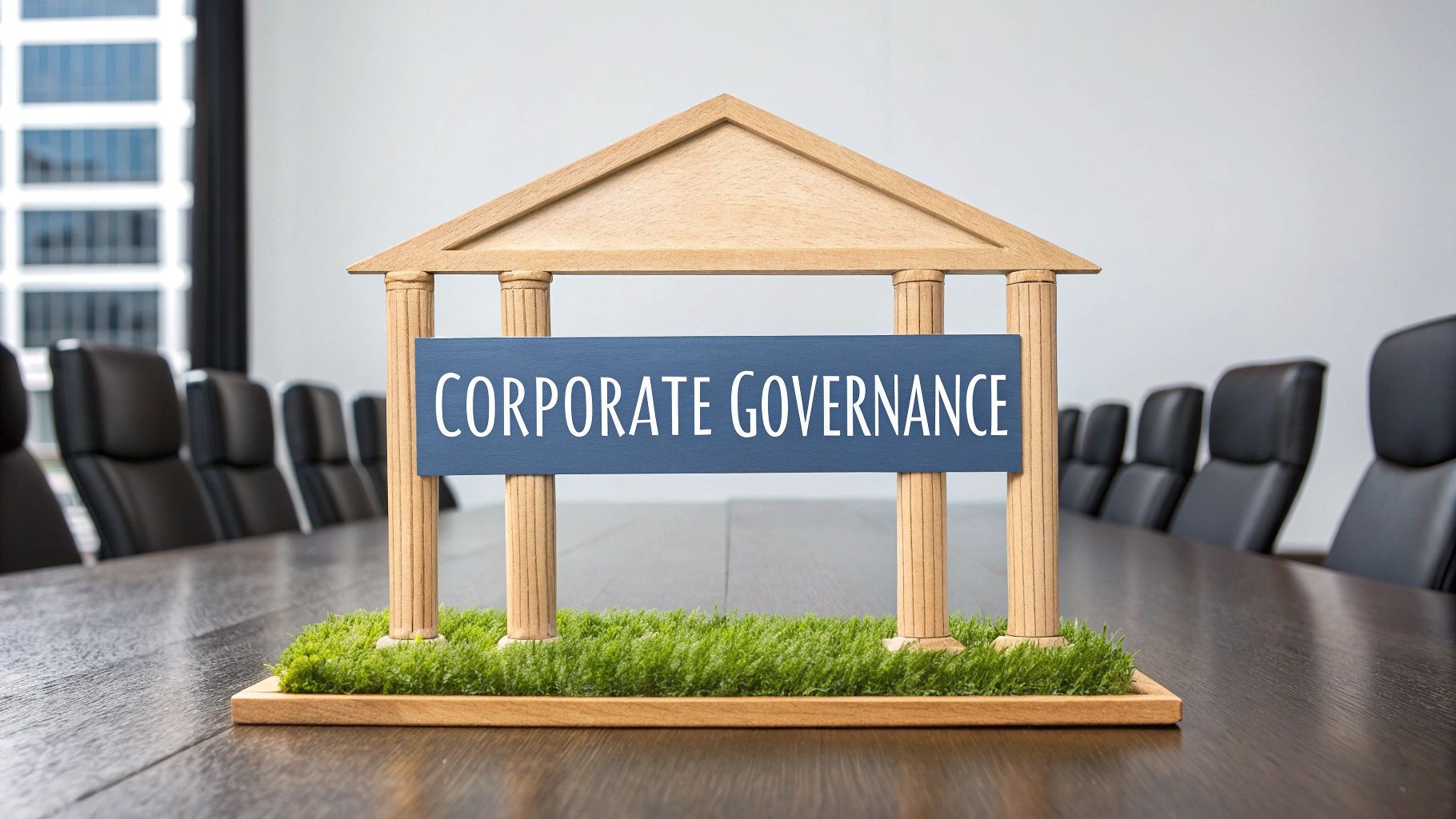
Corporate governance is essentially the rulebook that a company lives by. It's the system of practices, policies, and processes that guides how a business is directed and controlled from the top down. Think of it as the company's internal constitution—it spells out who holds the authority, how big decisions get made, and who is ultimately accountable for the company's performance and integrity.
Demystifying Corporate Governance
So, what is corporate governance when you strip away the jargon? At its heart, it's the framework that makes sure a company runs efficiently, fairly, and transparently while working toward its goals. This isn't just about ticking boxes and following regulations; it’s about building a solid structure that balances the often-competing interests of everyone involved with the company.
Let's use an analogy. When you build a house, you need a strong foundation, sturdy walls, and a solid roof to create a stable, safe structure. Corporate governance provides that exact same framework for a business, ensuring all the different parts—from the boardroom to the front lines—work together as they should.
The Blueprint for Business Success
Just as no one would build a house without a detailed blueprint, a company can't thrive without a clear governance structure. This "blueprint" defines the roles and responsibilities of all the key players, establishing a vital system of checks and balances. This prevents any single person or group from wielding too much power without oversight.
When this structure is well-defined, operations run more smoothly and strategic goals are pursued in a responsible way. This clarity is crucial for preventing internal disputes and creating a clear path for decision-making, which is essential for both day-to-day tasks and long-term planning.
Balancing Diverse Interests
Any business is a hub of different groups, each with its own stake in the company's success. Effective governance is the mechanism that manages these relationships and aligns their interests. The main groups involved are:
- Shareholders: These are the owners who provide the capital and, naturally, expect a healthy return on their investment.
- Management: This team includes the executives in charge of the company's day-to-day operations and performance.
- Board of Directors: Elected by the shareholders, their job is to oversee management and steer the company’s overall strategy.
- Other Stakeholders: This is a broad but critical category that includes employees, customers, suppliers, and even the local Connecticut community—all of whom are affected by the company's decisions.
To make these concepts even clearer, the table below breaks down the fundamental components of a strong corporate governance system.
Key Elements of Corporate Governance at a Glance
| Component | Primary Function |
|---|---|
| Board of Directors | Provides oversight, strategic guidance, and accountability. |
| Management Team | Executes strategy and manages daily business operations. |
| Shareholders | Provide capital and elect the board to represent their interests. |
| Internal Controls | Establishes processes to ensure operational efficiency and financial accuracy. |
| Transparency & Disclosure | Ensures clear, timely, and accurate communication with stakeholders. |
| Ethical Conduct | Defines the company's values and commitment to integrity. |
This table serves as a quick reference, highlighting how each piece fits into the larger puzzle of guiding a successful and responsible enterprise.
Good governance ensures that the board of directors effectively oversees management on behalf of shareholders while also considering the legitimate interests of other stakeholders. It is the bedrock of sustainable corporate success and long-term value creation.
Ultimately, this entire framework is designed to build an environment of trust, accountability, and ethical behavior. For any business in Connecticut looking to build a lasting reputation and achieve resilience, getting corporate governance right is non-negotiable.
The Four Pillars of Good Governance
Think of strong corporate governance not as a stuffy rulebook, but as the foundation of a well-built house. It’s a practical framework built on four essential pillars that support everything a company does. These principles guide leadership, shape the company culture, and ultimately decide whether the business thrives for years to come.
For any business in Connecticut, from a tech startup in Stamford to a family-owned manufacturer in Waterbury, getting these pillars right is the first step toward building a company that people trust and want to invest in.
The four core pillars are Accountability, Fairness, Transparency, and Responsibility. When they work together, they create a powerful system of checks and balances. This system protects everyone involved—from investors and employees to customers—and paves the way for sustainable growth. Let's break down what each of these really means on the ground.
Accountability: The Bedrock of Trust
At its core, accountability means the buck stops somewhere. It's the obligation of a company's management and board of directors to answer for their decisions and the company's performance. It ensures there are real consequences for missteps and clear rewards for success.
Imagine a Connecticut-based biotech firm. Accountability means the board doesn't just celebrate a successful clinical trial; they also have to clearly explain to shareholders why a promising new drug failed to get FDA approval. This isn't about finger-pointing. It’s about owning the outcome, sharing the lessons learned, and detailing the plan to move forward. That’s how you build trust.
Fairness: Protecting Every Single Shareholder
Fairness is all about the equitable treatment of every stakeholder, especially the company's owners. This principle demands that the rights of all shareholders—whether they're a massive investment fund or an individual with just a handful of shares—are respected equally.
Think of a family-owned business in Hartford where some relatives are minority shareholders. A fair governance structure ensures that huge decisions, like selling the company or issuing new stock that waters down everyone's ownership, are made with the interests of all shareholders in mind, not just the few who hold the most power or sit in the corner office.
Good corporate governance demands that the interests of minority shareholders are protected from the potential self-serving actions of majority owners or management. This commitment to equity is fundamental to a company’s integrity.
This pillar is about creating a level playing field. It's the guardrail that prevents insiders from enriching themselves at the expense of others, fostering a deep sense of trust that holds the company together.
Transparency: The Mandate for Clarity
Transparency is simply the commitment to being open, honest, and clear about how the company is doing. It’s about providing timely and accurate information on everything from financial health and strategic plans to operational risks and executive decisions. Without it, stakeholders are flying blind.
True transparency isn't just a vague promise. It looks like this:
- Clear Financial Reporting: Publishing quarterly and annual financial statements that an average person can understand and that genuinely reflect the company's condition.
- Honest Disclosure of Risks: Openly communicating the real challenges the business is up against, whether it's new competition, looming regulations, or internal operational hurdles.
- Timely Communication: Making sure that major corporate news and decisions are shared with shareholders and the public without delay.
Responsibility: An Ethical Compass
Finally, responsibility is the pillar that extends beyond the boardroom and the balance sheet. It's about a company’s deep-seated awareness of its ethical duties and its role in the wider community. This is where corporate citizenship comes to life.
A responsible company acts with integrity, follows the law, and carefully considers the social and environmental ripple effects of its operations. It understands that its success is tied to the well-being of its employees, customers, suppliers, and the community it calls home.
If you want to discuss your business law matter, contact Kons Law at (860) 920-5181.
Understanding the Key Players and Their Roles
To really get a handle on corporate governance, you have to understand the people involved. It’s not just some abstract concept; it’s a living, breathing relationship between different groups, each with a critical job to do. I often think of it like a well-run theater production: you have the producers who put up the money (the shareholders), the director who shapes the vision (the board), and the actors and crew who execute that vision every night (the management).
Each one plays an indispensable part. The success of the whole show depends on them working together seamlessly within a defined structure. This framework creates a natural system of checks and balances, ensuring no single group has too much power and that the company stays on course.
Let's break down who these key players are and what they're responsible for.
The Shareholders: The Owners
At the foundation of it all are the shareholders, sometimes called stockholders. They are the legal owners of the company. By buying stock, they provide the capital that fuels everything—from daily operations to ambitious growth plans. In exchange for that investment, they expect a return and have a say in the company's biggest decisions.
Their role isn't to get bogged down in the day-to-day grind. Instead, their most important job is electing the guardians of their investment: the board of directors. Shareholders vote on major corporate moves like mergers, acquisitions, or fundamental changes to the company's charter. The rules governing how shareholders interact are usually laid out in a foundational document; you can get the full story in our guide on what is a shareholders agreement.
The Board of Directors: The Strategic Guardians
Elected by and accountable to the shareholders, the board of directors acts as the high-level oversight committee. Their job is all about strategy and direction, not daily management. Think of them as the crucial link between the company's owners (shareholders) and its operators (management).
Here's what falls on their plate:
- Hiring and Overseeing Management: The board's top priority is appointing the Chief Executive Officer (CEO) and other key executives. They monitor their performance and make sure the company's strategy is being carried out effectively.
- Setting Strategic Direction: They collaborate with management to map out long-term goals and give the green light to major policies and big-ticket initiatives.
- Ensuring Financial Integrity: The board is ultimately responsible for the accuracy of financial reporting and the strength of internal controls, all to protect the company's assets.
We're seeing a major trend in the U.S. toward greater board independence to really strengthen this oversight role. In fact, as of 2025, the prevalence of independent board chairs in S&P 500 companies hit a five-year high at 38.6%. This shift, combined with a rise in shareholder activism, shows that investors are more engaged than ever and are demanding higher standards of governance. You can explore more findings on evolving U.S. governance priorities on corpgov.law.harvard.edu.
Management: The Daily Operators
Finally, we have the management team. Led by the CEO, these are the people running the business day in and day out. They’re on the ground, tasked with turning the board’s strategy into tangible results. It’s their job to manage resources, lead employees, and push the company toward its operational and financial goals.
If the board sets the "what" and the "why," management figures out the "how." They feed the board the critical information needed for smart strategic decisions and are held accountable by that same board for the company's overall performance.
This three-part structure—shareholders, board, and management—forms the very core of corporate governance. The system is designed so that shareholders empower the board, the board oversees management, and management runs the business. This creates a clear line of accountability from the front lines all the way up to the owners.
Getting a firm grasp of this dynamic is the key to understanding how a well-run organization really works. It’s the framework that protects the interests of the owners while ensuring the company is steered effectively toward lasting success.
The Real-World Benefits of Strong Governance
Putting a solid corporate governance framework in place isn't just about ticking boxes for compliance. Far from it. For any Connecticut business, it's one of the smartest strategic moves you can make to secure your company's future and genuinely boost performance. Think of it as a competitive advantage that pays real, tangible dividends.
When a company operates with clear rules and open communication, it signals something powerful to the outside world, especially to investors. It tells them their capital will be managed responsibly and professionally. This simple fact can dramatically improve your ability to get the funding you need to grow, innovate, or expand.
Sharpening Decision-Making and Managing Risk
A strong governance system brings much-needed structure to how you make decisions. It clarifies who is responsible for what, which cuts down on internal confusion and allows leaders to act with confidence. It’s about creating a roadmap for smart choices.
More importantly, it forces you to look ahead. With defined processes for risk oversight, the board and management can spot potential threats—financial, operational, or even to your reputation—before they spiral into full-blown crises. This foresight protects the company’s assets and, ultimately, shareholder value.
Boosting Valuation and Operational Efficiency
It’s no secret that markets reward well-run companies. Strong governance is directly tied to a higher business valuation because it minimizes the risk of scandals, internal power struggles, and poor management that can tank a company's reputation and value.
Internally, that same structure makes everything run smoother. Clear roles and transparent processes reduce waste and foster a culture where everyone takes ownership. Employees know the goals and see how their work contributes, which lifts performance across the entire organization. A clear framework also helps define the legal boundaries of company actions, which is a critical piece in understanding the liability of corporations when things go wrong.
A well-governed company isn't just seen as more ethical; it's seen as a better-run, less risky, and more valuable investment. This reputation is a priceless asset that builds trust with every stakeholder.
This commitment to good governance snowballs. It strengthens your brand, which helps you attract top talent, loyal customers, and confident investors. By treating governance as a fundamental part of your strategy, you’re setting your business up not just to survive, but to succeed for the long haul.
If you want to discuss your business law matter, contact Kons Law at (860) 920-5181.
How Global Trends Are Reshaping Governance
If you think of corporate governance as a dusty rulebook sitting on a shelf, it’s time for a new perspective. Governance isn’t static—it’s a living, breathing framework that has to adapt to what’s happening in the world. Right now, a few major forces are completely changing the game for how companies are run.
Two of the biggest drivers of this change are the explosion of Environmental, Social, and Governance (ESG) criteria and the relentless pace of technology. These aren't just buzzwords anymore; they’re fundamentally shifting the conversations happening in boardrooms across Connecticut and the world.
The Spotlight on ESG and Stakeholder Demands
Not too long ago, a company’s success was measured almost entirely by its bottom line. That’s no longer the case. Today, investors, customers, and even your own employees expect businesses to be good corporate citizens.
This shift has pushed ESG from a “nice-to-have” PR talking point into a critical part of a company's strategy and risk management. Boards are now on the hook for overseeing areas that were once on the periphery:
- Environmental Impact: How is the company managing its carbon footprint and its effect on the planet?
- Social Responsibility: Are labor practices fair? Is the company fostering a diverse and inclusive workplace?
- Ethical Governance: What measures are in place to prevent corruption and ensure leadership is transparent?
Technology: The Double-Edged Sword
At the same time, technology is acting as both a massive opportunity and a serious threat. Think about it: innovations like artificial intelligence can unlock new efficiencies, but the constant danger of a cyberattack can cripple a business overnight.
A board can no longer afford to be tech-illiterate. They must have the expertise to navigate this digital landscape. In fact, looking ahead to 2025, boards globally are expected to spend much more of their time on risks directly tied to AI, cybersecurity, and sustainability.
The consequences of getting it wrong are steep. The EU's AI Act, for example, can slap non-compliant companies with fines up to €35 million or 7% of their global turnover. This is a powerful reminder of how modern technology and corporate oversight are now welded together. You can explore more about these corporate governance trends on diligent.com.
This evolving environment also shines a light on the importance of understanding what is regulatory compliance, as businesses face a maze of new rules. A strong governance structure is what allows a company to not just survive these changes, but to turn them into a competitive advantage.
If you want to discuss your business law matter, contact Kons Law at (860) 920-5181.
Putting Good Governance into Practice
Knowing what corporate governance is in theory is one thing. Putting it into practice is where the real value lies. For a small or medium-sized business in Connecticut, this isn't about wrapping your operations in red tape. It’s about building a solid foundation that can support real, scalable growth.
So, where do you start?
A fantastic first step for many businesses is creating an advisory board. Think of it as a team of seasoned pros who can offer strategic guidance without the formal baggage of a full-blown board of directors. At the same time, you need to clearly define who does what—from the CEO down to key managers. This simple act of clarifying roles prevents a world of confusion and makes everyone more accountable.
Fostering a Culture of Integrity
Good governance isn’t just about documents and flowcharts; it's about the culture you live and breathe every day. And that culture starts right at the top. When leadership consistently walks the talk on ethical conduct, it sets a powerful tone for the entire company.
One of the best ways to bring this to life is through transparency. This means keeping a clear record of important decisions, maintaining meticulous financial books, and being open with stakeholders about where the company is headed. These aren't just feel-good actions; they build the trust that holds a company together. For a deeper look at implementation, you can explore our resources on corporate governance best practices.
This push for transparency isn't just a local trend. A recent OECD report highlighted a major global shift: the percentage of national reports covering all listed companies jumped from just 48% in 2014 to 76% in 2024. This shows a massive worldwide movement toward greater public accountability. You can learn more about these global governance developments on oecd.org.
By taking these tangible steps, any Connecticut business can build a governance model that actually supports its long-term vision.
If you want to discuss your business law matter, contact Kons Law at (860) 920-5181.
Still Have Questions About Corporate Governance?
It’s completely normal to have questions when you’re trying to wrap your head around corporate governance. Let's tackle some of the most common ones we hear from business owners trying to put these ideas into practice.
Is Governance Really Different for a Startup vs. an Established Company?
Think of it like building a house. For a brand-new startup, governance is the essential blueprint. It might be as straightforward as a solid founders' agreement and a clear process for making big decisions. The main goal here is speed and creating a strong foundation to build upon.
An established company, on the other hand, is more like a large, bustling estate. It needs a much more formal structure—things like an independent board of directors, audit committees, and detailed policies—to manage all the moving parts and protect what's already been built.
Is This Stuff Only for the Big Players?
Not at all. While a Fortune 500 company's governance will look vastly different from a five-person shop in Hartford, the core principles are the same: accountability, transparency, and fairness.
Putting even basic governance in place early on is one of the smartest things a small business can do. It helps head off founder disagreements, makes potential investors feel a lot more comfortable, and lays the groundwork for stable, sustainable growth down the road.
The point of good governance isn't to create red tape. It’s about building a culture of integrity and making sure everyone knows who is responsible for what. That’s a game-changer for any company, no matter its size.
If I Can Only Do One Thing, What’s the First Step?
If you do nothing else, start by clearly defining and writing down the roles and responsibilities of your leadership team.
When every single person knows exactly what they are accountable for, you eliminate a massive amount of internal confusion and make decision-making infinitely smoother. This fundamental clarity is the bedrock of everything else you’ll build.
If you want to discuss your business law matter, contact Kons Law at (860) 920-5181.
