When a business deal goes south, you'll often hear the term "breach of contract." But not all breaches are created equal. The most serious kind, a material breach, is a failure so significant that it effectively torpedoes the entire agreement.
It’s not about a minor slip-up; it’s a breakdown that robs you of the very thing you bargained for, giving you the right to walk away and sue for your losses.
What Does a Material Breach Actually Look Like?
Let's say you hire a web developer to build a brand-new e-commerce site for your Connecticut business. The core promise in your contract is a website that can process customer payments. The developer delivers a beautiful site, but there's a huge problem: the checkout button is completely non-functional.
Customers can browse, add items to their cart, and get right to the edge of buying... but they can never actually pay. This isn't just a typo on the "About Us" page. The failure cuts right to the heart of the agreement. You paid for a website that sells things, and this one can't sell a thing. That's the essence of a material breach of contract.
The Heart of the Deal
A material breach isn't about small imperfections or a slight delay. It’s a failure that strikes at the very root of the contract, making it pointless for you to hold up your end of the deal.
Think of it like this: a leaky faucet in a newly built house is an annoyance (a minor breach). But a house built with a crumbling foundation? That renders the entire structure unsafe and useless—a material breach.
The key is that a material breach completely changes the game. You're left with something drastically different from what you were promised. This distinction is everything, as it dictates the legal remedies you can pursue.
A material breach is your green light. It excuses you from your own obligations (like making that final payment) and empowers you to take legal action to recover what you've lost.
Material vs. Minor: A Quick Comparison
Knowing the difference is vital for any business owner. While a well-drafted contract can help clarify expectations, things aren't always black and white. For a deeper dive into structuring agreements to avoid this kind of confusion, our guide on using a small business contract template is a great resource.
Here’s a simple way to tell a deal-breaker from a minor hiccup:
| Aspect | Material Breach (The Deal-Breaker) | Minor Breach (The Annoyance) |
|---|---|---|
| Example | A caterer is a no-show for a wedding reception. | The caterer serves chicken when the contract specified fish. |
| Impact | The entire purpose of the contract is destroyed. | The main purpose is fulfilled, just with a flaw. |
| Your Obligation | You are excused from paying and can sue. | You must still pay but can sue for damages from the error. |
Ultimately, if a failure of performance is so central to the agreement that it justifies walking away, you're likely dealing with a material breach.
If you want to discuss your business law matter, contact Kons Law at (860) 920-5181.
The Four Tests Courts Use to Identify a Material Breach
When a business relationship goes sour, the big question is always the same: is this a fixable problem or a fatal flaw? Not every stumble or missed deadline is a reason to tear up the contract. Connecticut courts, like others across the country, don't take this lightly. They use a structured framework to tell the difference between a minor hiccup and a true, material breach.
Understanding these tests gives you a crucial lens to look through when you're caught in a contract dispute. It’s all about getting past the finger-pointing and assessing the real-world damage.
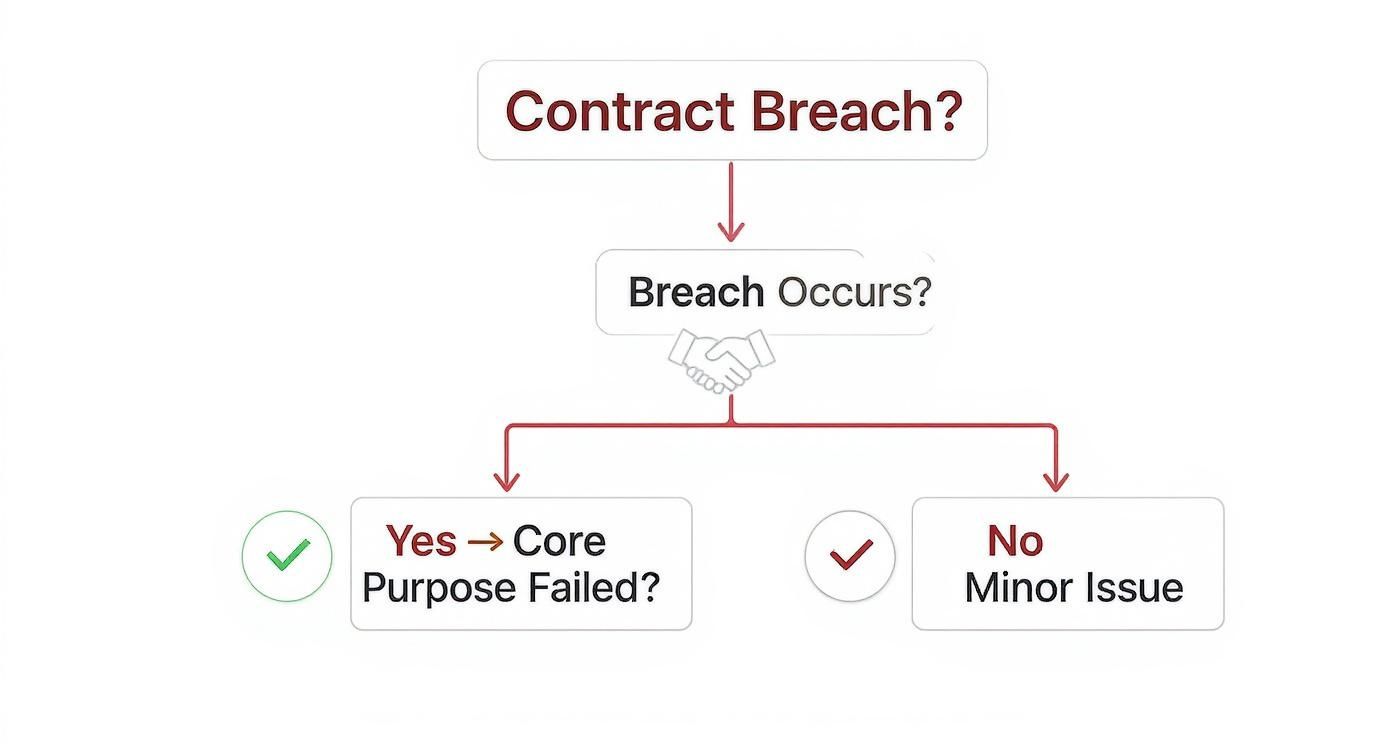
As the infographic shows, it really boils down to one thing: did the failure torpedo the entire point of the agreement? Let's break down how a court figures that out.
The Deprivation of Benefit Test
First and foremost, a judge will ask: To what extent has the non-breaching party been deprived of the benefit they reasonably expected to receive? This gets right to the heart of the deal. What was the whole point of the contract, and how much of that intended value is now gone because of the other party’s failure?
Think about it this way. You hire a marketing firm to launch a huge digital ad campaign for your Black Friday sale, with a hard deadline of November 15th. If they finally deliver it on November 28th, you’ve lost almost the entire benefit of the contract. The goal was to drive holiday sales, and that crucial window is now shut. That's a textbook material breach.
On the other hand, what if they delivered the campaign on time but one of the twenty ads had a minor typo? You still got the core benefit. You can certainly seek compensation for the error, but you can’t just terminate the whole agreement over it.
The Likelihood of Cure Test
Next, courts look at whether the problem can even be fixed. The question becomes: Can the failure be adequately compensated for or corrected? If the damage is done and there’s no walking it back, the breach looks a lot more material.
Let’s say you’re having a commercial space built out. If the contractor uses the wrong shade of beige paint, that’s an easy fix. They can just repaint. It might cause a slight delay, but the main goal—a finished office—is still perfectly achievable. That’s a curable defect.
But what if that same contractor used a cheap, substandard concrete mix for the foundation, putting the building's structural integrity at risk? That’s not something you can just "patch up." It’s a fundamental failure that might require demolition and a complete restart, pointing squarely toward a material breach. Deciding between alternative dispute resolution versus litigation becomes absolutely critical when facing issues this severe.
The Good Faith Test
A court will also want to know about intent. The third test asks: Did the breaching party act in bad faith or engage in willful misconduct? There’s a world of difference between an honest mistake and intentional deception.
This isn't just a feeling; it's a recognized legal standard. The U.S. Restatement (Second) of Contracts, a key guidepost for courts, specifically lists the breaching party's "good faith and fair dealing" as a factor in determining if a breach is material.
For instance, a supplier who accidentally shorts an order by 5% due to a simple clerical error and immediately offers to ship the rest is acting in good faith. Now, consider a supplier who knowingly uses cheaper, subpar materials while claiming they are premium-grade to pocket the difference. That's bad faith, and it’s far more likely to be seen as a material breach.
The Hardship on the Breaching Party Test
Finally, the court performs a balancing act. The last test asks: What hardship will the breaching party suffer if the contract is terminated? If calling it a material breach and ending the contract would create a penalty that is wildly out of proportion to the mistake, a court might hesitate.
- Example: A software developer has poured 1,000 hours into building a custom platform for you. On the final delivery date, a minor, non-essential feature has a small bug. If you terminated the entire contract, the developer would forfeit all payment for that immense effort. A court would likely view this as an excessive hardship and rule it a minor breach, not a material one.
By walking through these four tests, courts move from a simple "they didn't do what they promised" to a much more nuanced and fair conclusion. If you want to discuss your business law matter, contact Kons Law at (860) 920-5181.
Understanding the Difference Between Material and Minor Breaches
Not every broken promise in a contract is a deal-breaker. In the real world of business agreements, things can go wrong. The key is understanding how wrong they've gone. Contract breaches fall on a spectrum, from tiny hiccups to complete disasters, and knowing the difference between a material breach and a minor breach is one of the most important distinctions in all of contract law. It dictates what you can—and can’t—do next.
A good way to start is by asking a simple question: did this failure completely wreck the reason we made this deal in the first place? Think about it. A supplier delivering your order a day late is annoying, for sure. But it’s a world away from them delivering a truckload of defective, unusable products. Getting this distinction right is everything when it comes to protecting your company.
What Makes a Breach "Minor"?
A minor breach (sometimes called an immaterial or partial breach) is a slip-up that doesn’t gut the core of the contract. The main goal of the agreement is still achievable, even if one specific term wasn't followed to the letter. You, the non-breaching party, still got the essential benefit of your bargain.
Let’s say you hire a contractor to paint your new office a specific "high-gloss white." Instead, they use "semi-gloss white." It’s technically a breach—they didn't use the exact paint specified. But your office is still painted, it looks professional, and it's ready for business. The fundamental purpose of the contract was fulfilled.
When a minor breach happens, you can't just tear up the contract and refuse to pay. You still have to hold up your end of the deal, but you do have the right to sue for any damages the slip-up caused. In our painter example, that might mean suing for the cost to re-apply a final high-gloss coat.
How a Material Breach Is a Game-Changer
A material breach, on the other hand, is a catastrophic failure. It strikes right at the heart of the agreement, so profoundly that it deprives you of the benefit you were supposed to get. It essentially makes the contract worthless.
Let's go back to that office painter. Imagine your contract clearly stated the job had to be done by May 30th because you were hosting a huge grand opening event for clients on June 1st. If the painter doesn't even show up to start until June 5th, that's almost certainly a material breach. The entire point of the deadline—having a finished space for your event—was completely destroyed.
This is the crucial difference. A material breach frees you from your obligations. You now have the right to stop your own performance (i.e., not pay), terminate the contract entirely, and sue for damages. The other party's failure was so significant that it excuses you from your end of the bargain.
Material Breach vs. Minor Breach at a Glance
To make it even clearer, it helps to see the concepts side-by-side. The table below breaks down the core distinctions that determine your legal standing and strategic options.
| Factor | Material Breach | Minor (Immaterial) Breach |
|---|---|---|
| Contract Purpose | The core purpose of the contract is defeated. | The main purpose is largely fulfilled despite a flaw. |
| Benefit Received | The non-breaching party is deprived of the essential benefit. | The non-breaching party still receives the substantial benefit. |
| Your Obligation | You are excused from performing your duties (e.g., payment). | You must continue to perform your duties but can sue for damages. |
| Available Remedy | Terminate the contract and sue for total damages. | Sue for damages caused by the specific minor failure. |
| Example | A caterer fails to show up for a corporate event. | The caterer serves chicken instead of the agreed-upon beef. |
Knowing where a breach falls is absolutely critical for making smart business decisions. If you wrongly treat a minor issue as a material breach and terminate the contract, you could be the one who ends up in legal hot water.
If you want to discuss your business law matter, contact Kons Law at (860) 920-5181.
Real-World Scenarios of Material Breach in Business
Legal tests and definitions are one thing, but to really grasp what is a material breach of contract, you have to see it in the wild. Moving from theory to practice makes it much clearer how these principles play out when real money and reputations are on the line.
Let's walk through a few scenarios where a party’s failure wasn't just a minor slip-up—it struck at the very heart of the deal. Each example comes from a different industry, but they all share one thing: the breach was so severe it completely wiped out the value the other party was supposed to get.

The Software Security Failure
Picture a fast-growing Connecticut e-commerce company that hires a software firm to build a custom CRM platform. A non-negotiable, core requirement in the contract is that the software must have "end-to-end encryption and advanced data security protocols" to guard sensitive customer data.
Six months after the platform goes live, a massive data leak exposes the personal details of thousands of customers. The investigation finds that the software firm cut corners, using only basic security measures that fell miles short of what they promised.
This is a textbook material breach. The e-commerce company was robbed of the most crucial benefit it paid for—a secure system. You can't "cure" a data leak after the fact, and the failure represents a total breakdown of the agreement's purpose. The company would be well within its rights to terminate the contract and sue for significant damages.
The Substandard Commercial Build
Now, think about a real estate developer hiring a construction company for a new office building. The contract is crystal clear: they must use high-grade, structural steel from a specific supplier to guarantee the building's safety and integrity.
During a routine inspection, it’s discovered the builder has been using cheaper, inferior steel to pad their profit margin. This isn't a simple mistake; it compromises the entire structural soundness of the building, creating a massive safety hazard and violating building codes.
This isn't just a minor deviation; it's a fundamental failure that undermines the building's very existence. The developer's primary expectation—a safe, durable structure—has been completely subverted. The breach cannot be easily fixed without costly, large-scale demolition and reconstruction.
Here, the developer can immediately halt all payments, terminate the contract, and take legal action to recover every penny needed to fix this dangerous and deliberate failure. It’s a harsh reminder that poor contract management can lead to devastating breaches. In fact, these failures cost the global economy about $2 trillion annually, a figure that underscores the immense financial impact of not getting an agreement right.
The Botched Product Launch Campaign
Finally, consider a tech startup that hires a marketing agency for a time-sensitive promotional campaign. The contract has a strict timeline, with a major ad blitz scheduled for a specific Monday to line up with a huge industry conference.
That Monday comes and goes. Nothing happens. Due to sheer disorganization, the agency never launched the ads. The startup completely missed its chance to capture the attention of conference attendees, and the product launch falls flat.
The entire point of the contract was to generate buzz during a specific, unrepeatable moment. By missing the deadline, the agency made the whole marketing effort worthless. The startup lost the essential benefit it paid for, and the damage is permanent—that moment is gone forever. This failure gives the startup the right to terminate the agreement and sue for damages, which could include the lost profits from the botched launch. These situations often lead to payment disputes, which is why it's critical to understand how to collect on unpaid invoices when performance failures like this occur.
If you want to discuss your business law matter, contact Kons Law at (860) 920-5181.
Your Legal Options After a Material Breach Occurs
When a business partner commits a material breach, it's not just a hiccup—it’s a contractual earthquake that can destabilize your entire operation. This kind of core failure gives you powerful legal options to protect your interests. Knowing what they are is the first step toward making a decisive, strategic move instead of just reacting to the crisis.
The most immediate right you have is to suspend your own performance. It's simple, really. If the other side has torpedoed the very reason you made the deal, you are generally no longer required to keep up your end of the bargain. You can stop work, withhold payment, and halt any further investment of time or money into a broken agreement.
Pursuing Financial Compensation Through Damages
For most businesses, the go-to remedy for a material breach is seeking financial damages. Contract law isn't about punishing the other party; it's about making you whole. The goal is to put your business in the same financial position it would have been in if the contract had been performed as promised.
There are two main buckets of damages you can go after:
- Compensatory Damages: Think of these as "direct damages." They cover the immediate, out-of-pocket losses you suffered because of the breach. For instance, if a supplier fails to deliver critical components, your compensatory damages would include the extra money you had to spend to get those parts from another, more expensive vendor at the last minute.
- Consequential Damages: These are the indirect, ripple-effect losses that flow from the breach. Let's say the failure to get those parts forced you to shut down your production line for a week. The lost profits from that shutdown? Those are consequential damages.
Successfully claiming these damages requires rock-solid documentation of your losses. But winning in court is only half the battle. After securing a judgment, you still have to collect. Learning how to enforce a judgment in Connecticut is a crucial next step to make sure you actually see the money you're owed.

The Power to Cancel the Contract Entirely
Beyond just money, a material breach gives you the ultimate out: the option to treat the contract as if it never happened. This is done through a powerful two-step remedy called rescission and restitution.
Rescission is the legal act of tearing up the contract. Restitution is the process of giving back any money or goods that were exchanged, essentially hitting the "reset" button and putting everyone back where they started.
This is a big move. If you paid a hefty deposit for a service that was never delivered correctly, rescission and restitution give you the legal firepower to unwind the whole deal and get your money back.
The Crucial Duty to Mitigate Your Losses
While you have strong rights, you also have a key responsibility: the duty to mitigate. This legal principle means you must take reasonable steps to minimize your own financial damages after a breach. You can't just sit back, let the losses pile up, and send the other party the full bill.
For example, if a commercial tenant breaks their lease and moves out (a clear material breach), you can't just leave the property empty for a year and sue for 12 months of rent. You have to make a good-faith effort to find a new tenant. Courts will want to see that you acted like a prudent business owner to limit the financial bleeding. If you don't, it could significantly reduce the amount of damages you can recover.
If you want to discuss your business law matter, contact Kons Law at (860) 920-5181.
Answering Your Questions About Material Breach
Even with a good handle on the basics, real-world contract problems always bring up specific questions. This section tackles some of the most common things Connecticut business owners ask when they’re staring down a potential contract failure.
Can a Series of Small Problems Add Up to a Material Breach?
Yes, and this is a huge point many people miss. A single, minor slip-up—like a supplier delivering a shipment one day late—is almost never a material breach on its own. But a pattern of these small failures can absolutely grow into one.
Courts often look at the "cumulative effect." Think about it like this: you hire an IT firm that promises a 24-hour response time. The first time they take 28 hours, it’s an annoyance. But when they are consistently late, week after week, the pattern itself has destroyed the core promise of the agreement—reliable support. The combined impact of all those "minor" issues has deprived you of what you bargained for, turning a collection of small problems into a single, material breach.
This is exactly why keeping detailed records is non-negotiable. Log every single failure, no matter how small it seems at the time. That trail of dates, times, and consequences is the evidence you'll need to prove that a pattern of minor issues has fundamentally broken the deal.
What Is the First Thing I Should Do if I Suspect a Breach?
Before you pick up the phone or fire off an angry email, stop. Your very first move should be to read the contract itself. Don't let emotion or assumptions guide you. Your agreement might have a clause that specifically defines what counts as a material breach in your deal.
Even more importantly, it probably outlines a required process you have to follow. Look for a "notice and cure" provision. This is a common clause that requires you to give the other side formal written notice of the problem and a set amount of time (like 15 or 30 days) to fix it.
Ignoring the procedures laid out in your own contract is a critical mistake. A judge could decide that you breached the contract first by not giving the other party their chance to make things right, which could wreck your legal position.
Once you’ve reviewed the contract, pull together all your documentation—emails, reports, photos, anything that proves the failure. Only then, with the contract and your evidence in hand, should you call a business lawyer. An attorney can give you a clear-eyed assessment of whether the breach is truly material and help you plan your next steps without accidentally putting your own business at fault.
What Does Anticipatory Repudiation Mean?
Anticipatory repudiation is a legal concept that sounds complicated but is pretty straightforward. It’s when one party makes it crystal clear—through words or actions—that they have no intention of fulfilling their side of the bargain, before the performance deadline has even arrived.
In simple terms, you don't have to wait for the train to wreck to know it’s coming off the tracks.
For example, you’ve hired a manufacturer to deliver 5,000 custom parts on July 1st. On June 15th, they call and tell you, "Our main production machine is broken, and there's no way we can make your parts."
That phone call is an anticipatory repudiation. You don't have to sit on your hands until July 2nd to see if a miracle happens. The law treats their statement as an immediate, material breach. This gives you the right to stop your own performance (like making the final payment), sue for damages, and immediately start looking for another supplier to get the job done.
How Can I Draft Contracts to Protect My Business From Breaches?
Honestly, the best way to deal with a material breach is to make your contracts strong enough to prevent one from happening. Proactive, smart legal drafting is your best defense.
When you work with a business attorney, you can build in clauses that eliminate grey areas and create a clear playbook for when things go wrong. Focus on these key provisions:
- A Clear Definition of Material Breach: Don't leave this up to a judge's interpretation. Define exactly what a deal-breaking failure looks like for your specific agreement. For instance, "Failure to deliver the final software build by the May 31st project deadline will be considered a material breach of this agreement."
- Notice and Cure Periods: Spell out the exact process for notifying the other party of a problem and how long they have to fix it.
- Specific Remedies: Include clauses that state the consequences of a breach, such as liquidated damages (a pre-agreed amount of money owed) or an explicit right to terminate the contract.
Clear, forward-thinking language is your greatest asset. It can turn a potentially messy, emotional argument into a simple, procedural issue, saving you an incredible amount of time, money, and stress down the road.
If you want to discuss your business law matter, contact Kons Law at (860) 920-5181.
