
A wholesaler calls with a private opportunity that supposedly isn't correlated to the market. The returns look steady. The story sounds elaborate. A client asks whether you've reviewed it, and your first instinct is that if the paperwork checks out, it may be worth a look.
That's how many advisors get near a fraud problem. Not with obvious criminal intent, but with a product that seems polished enough to survive a first pass.
When people ask what is a Ponzi scam, they usually want the basic definition. Advisors need more than that. They need to know how the fraud works, what the warning signs look like in practice, and what happens to a registered professional when the scheme collapses and regulators start asking who sold it, who supervised it, and who ignored the inconsistencies.
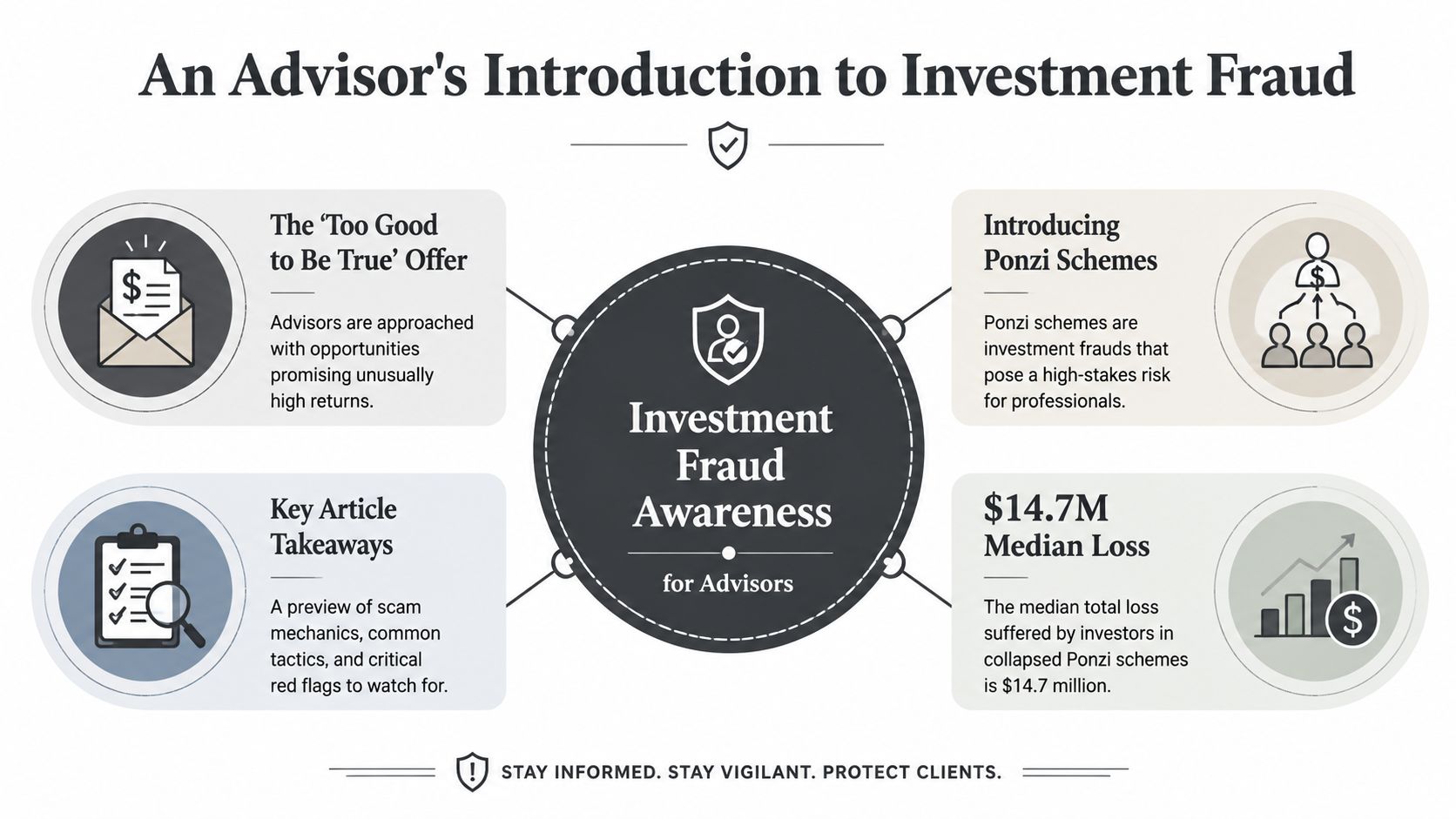
An Advisor's Introduction to Investment Fraud
The familiar setup is rarely dramatic at the start. A manager claims to have a strategy that produces reliable returns in good markets and bad ones. Statements arrive on time. Early investors get paid. Clients hear about those payments and want access. At that point, the risk is no longer abstract. Your judgment, your due diligence, and your license are all in play.
A Ponzi scheme is investment fraud built on appearance rather than performance. The operator creates the illusion of profit by using money from newer investors to pay earlier ones. There's no real engine producing the returns being advertised, or there's far less legitimate activity than investors were led to believe.
For advisors, the professional danger starts before any regulator uses the word fraud. It starts when you repeat a performance story you haven't independently verified, when you accept vague explanations for custody or valuation, or when you treat clean-looking statements as proof of legitimacy.
Why advisors should take this personally
This isn't a niche problem. A review of 1,108 Ponzi schemes from 2008 to 2023 found an average size exceeding $70 million, a median total loss of $14.7 million for collapsed schemes, and a median prison sentence of 96 months for perpetrators.
Those figures matter for two reasons. First, the losses are large enough to destroy client relationships, books of business, and firms. Second, once that kind of damage appears, every advisor connected to the product becomes subject to investigation, whether they orchestrated the fraud or failed to recognize it.
Practical rule: If an investment's explanation is weaker than its sales pitch, slow down before you let a client in.
What tends to happen next
When these schemes unravel, advisors often face several problems at once:
- Client complaints that question suitability, diligence, and disclosures.
- Firm scrutiny over outside business activities, private securities transactions, and supervisory breakdowns.
- Regulatory attention focused on records, communications, and what you knew at the time.
A generic consumer explainer won't prepare you for that. The real issue for financial professionals is proximity. In this area, being adjacent to the wrong product can be career-altering even if you never intended to participate in a fraud.
The Anatomy of a Ponzi Scam
A Ponzi scam looks like an investment program, but the core cash flow is backwards. The operator pays supposed profits to existing investors with incoming money from new investors. That's the whole trick.
Legally, a Ponzi scheme is a form of fraud in which profits paid to earlier investors come directly from capital contributed by more recent investors, rather than from legitimate investment returns or business profits. If you want the shortest answer to what is a Ponzi scam, that's it.
How the money actually moves
Think of three clients.
Client A invests first and is promised attractive returns. No real profits are generated. Later, Client B invests. Instead of putting B's capital into a genuine profitable strategy, the operator uses part of B's money to send a “return” to A. Then Client C arrives, and C's money helps pay B, and so on.
The payment history becomes the sales tool. Investors see distributions and assume the investment works. Advisors can get misled for the same reason if they confuse payout activity with actual investment performance.
A legitimate investment can lose money, underperform, or show uneven results because markets move and business operations have friction. A Ponzi operator can't tolerate that reality, so he manufactures smoothness.
Why collapse is built in
The structure only survives while enough new money keeps coming in. Once inflows slow, or too many investors ask for withdrawals, the operator can't cover the obligations. That's why the fraud always has a shelf life.
The collapse usually isn't caused by a bad quarter. It's caused by exposure. Redemption pressure reveals that the reported profits were never there.
Ponzi scheme versus pyramid scheme
Advisors should keep these separate because regulators do. In a Ponzi scheme, the investor's role is passive. The investor contributes capital and expects returns from supposed investing activity. In a pyramid scheme, participants generally make money by recruiting additional participants.
That distinction matters in investigations and in how conduct gets characterized in pleadings, U5 language, and defense strategy. Mislabeling the scheme can also lead you to ask the wrong diligence questions.
Why smart professionals still get fooled
Operators often wrap old fraud mechanics in current language. Today that may mean algorithmic trading, private credit, digital assets, or proprietary hedging strategies. The surface changes. The dependency on new money doesn't.
If you want a current example of how public debate can drift toward ponzi concerns with Microstrategy, it's useful to study the rhetoric even where the facts are contested. Advisors benefit from seeing how quickly complicated capital structures and aggressive promotion can invite Ponzi comparisons, fair or not.
Recognizing the Telltale Red Flags
Fraud detection usually doesn't start with a confession. It starts with inconsistencies. Advisors who avoid these cases tend to be the ones who treat small irregularities as cumulative evidence, not isolated annoyances.
The most reliable warning signs are practical, not theoretical. They appear in the sales pitch, the documents, the registration record, and the payout process.

The red flags that should stop you
The SEC and FINRA identify key warning signs of Ponzi fraud, including “guaranteed high returns with little or no risk,” “overly consistent returns,” “unregistered investments,” “unlicensed sellers,” and “difficulty receiving payments.”
That list is useful because it tracks what advisors encounter in the field:
- Guaranteed returns with low risk. Real investments involve uncertainty. If the promoter talks like risk has been engineered away, assume the representation is inaccurate until proven otherwise.
- Returns that stay smooth through every market condition. Fabricated statements often look cleaner than any real portfolio.
- Registration gaps. If the product, seller, or offering structure sits outside normal regulatory channels, the burden on your diligence goes up sharply.
- Payment friction. Delays, excuses, revised timelines, or pressure not to redeem are often the point where the facade starts to crack.
Documents tell on the fraud
The paper trail often looks professional from a distance and sloppy up close. Late statements, mismatched figures, unexplained revisions, and vague strategy descriptions are all signals that the back office may be fiction.
A surprisingly effective defensive habit is to review sales materials and account records the way a hostile examiner would. Not as marketing. As evidence.
For advisors building a stronger diligence culture, basic Know Your Customer guidance matters here because weak client onboarding and weak product review often travel together. The same firm that skimps on one control often skimps on the other.
What works and what doesn't
Some responses help. Others create exposure.
| Approach | What happens |
|---|---|
| Independent verification | You test custody, registration, valuations, and the actual business model. |
| Relying on reputation alone | You inherit the promoter's story without proving any part of it. |
| Escalating anomalies early | Compliance can document the concern before clients are harmed. |
| Waiting for clearer proof | The delay often becomes part of the later case against you. |
If you can't explain where the returns come from in plain English, you shouldn't recommend the product in polished English.
Real-World Examples From Madoff to Crypto
Bernie Madoff remains the reference point because his scheme captured the core pattern so clearly. Investors saw steadiness where normal market behavior should have produced variation. They received statements that appeared authoritative. The strategy carried an air of exclusivity and complexity. That combination is what traps knowledgeable victims and, sometimes, the professionals around them.
For advisors, the lesson from Madoff isn't historical trivia. It's that prestige, access, and apparent consistency can disarm skepticism. A promoter doesn't need crude marketing if reputation does the selling.
The old mechanics in modern packaging
Digital frauds use different language, but the architecture is familiar. High-yield investment programs, token projects, staking arrangements, and opaque crypto lending models can all be used to create the same false impression that money is being generated by a proprietary system rather than recycled from incoming investors.
A 2024 report summarized by Nice Actimize stated that 68% of new Ponzi schemes were crypto-based, with average collapse times under 90 days, and that FINRA reported a 42% increase in crypto-related fraud complaints in early 2025.
Those figures fit what defense lawyers and compliance professionals already see qualitatively. Crypto schemes can move faster, market faster, and vanish faster. Wallet structures, offshore entities, token conversions, and fragmented records can also make tracing and recovery harder.
Why crypto versions often create sharper advisor risk
Traditional frauds often depended on paper statements and controlled messaging. Modern digital schemes can add round-the-clock promotion, online communities, and pseudo-technical explanations that make weak products look advanced.
That changes the advisor's risk in at least three ways:
- Speed compresses judgment. A product can go from introduction to collapse before a slow diligence process catches up.
- Technical jargon hides basic flaws. “Smart contract,” “yield engine,” or “liquidity program” may explain nothing at all.
- Evidence gets messy quickly. Communications may be scattered across texts, encrypted apps, webinars, and platform dashboards.
The practical takeaway
Madoff showed how a classic Ponzi can hide behind credibility. Crypto fraud shows how the same logic can hide behind novelty.
The technology doesn't make the scheme legitimate. It just changes the vocabulary used to sell it.
For an advisor, that means the central question never changes: is there a real, verifiable source of profit, or are investors being paid with other investors' money?
Regulatory Consequences for Financial Professionals
When a Ponzi scheme collapses, regulators don't limit their review to the mastermind. They examine the sales chain, supervision chain, and communication chain. That's where advisors often discover that “I didn't know” may be relevant, but it isn't a shield by itself.

What lands on the advisor first
The early phase is usually document-heavy. The firm wants emails, texts, notes, approval records, compensation records, and client files. FINRA may seek testimony and records. Clients may send demand letters before the factual picture is complete.
According to a 2024 SEC Investor Bulletin, over 1,200 investment fraud cases were reported, and advisors often face disciplinary consequences, including Form U5 issues, even when they weren't the primary orchestrators of the scheme. That reality is important, even though the detailed source link appears earlier in the article's red-flag discussion.
The practical point is simple. An advisor can become a target based on association, sales activity, supervision questions, or recordkeeping failures, not just intent.
Why the Form U5 issue is so dangerous
A Form U5 disclosure can follow you long after the underlying matter is resolved. Firms often draft these disclosures under pressure and with self-protective instincts. If the language suggests sales practice violations, participation in unapproved activity, or involvement in investment-related misconduct, your future employment prospects can narrow quickly.
That is why advisors should treat any internal interview or termination meeting connected to a suspected fraud as a legal event, not an HR routine. Casual explanations made too early often reappear in U5 language, arbitration pleadings, or regulatory testimony.
For professionals trying to understand the broader terrain of securities regulation issues, abstract compliance rules take on a personal dimension. Registration status, approvals, supervision, written procedures, and outside activity controls all become evidence.
The investigation doesn't stay neatly civil
A Ponzi case can shift from internal review to regulatory examination to criminal interest with very little warning. If federal agents or prosecutors appear, the stakes change immediately. Advisors in that position should understand basic legal rights during federal probes before speaking casually in the hope of clearing things up.
That doesn't mean silence is always the strategy. It means sequencing matters. Facts should be gathered before narratives harden.
Common exposure points for advisors
- Private securities transactions that weren't properly disclosed or approved.
- Outside business activities that looked harmless until the product failed.
- Supervisory gaps where red flags existed in emails, marketing, or payment complaints.
- Misstatements to clients made by repeating promoter claims as if they were verified facts.
Defense reality: The record you created before the collapse usually matters more than the explanation you offer after it.
Wrongful termination claims can also arise when a firm rushes to cut ties and paints a registered representative as the problem without a fair investigation. Those disputes often overlap with U5 defamation issues, bonus clawbacks, promissory note claims, and customer arbitrations. By then, the advisor is no longer dealing with one problem. He or she is dealing with a stack of them.
Proactive Compliance and Defense Strategies
Once suspicion exists, the window for smart action is short. Advisors who respond well usually do the basics quickly and in the right order. Advisors who respond badly often improvise, delete, reassure, and explain. That tends to make things worse.
Start with verification, not debate
If a product raises concern, stop arguing over whether it “feels legitimate.” Verify the mechanics.
Use a disciplined checklist:
- Confirm registration status. Determine whether the product and seller were properly registered or exempt, and whether the paperwork supporting that position is complete.
- Test custody and valuation. Find out who held assets, who priced them, and whether the reporting source was independent.
- Map the flow of money. If you can't identify where investor funds went and how returns were generated, you don't have a diligence file. You have a hope file.
Preserve everything
The moment a concern becomes concrete, preserve records. That means emails, text messages, CRM notes, marketing decks, webinar invites, account statements, approvals, and internal chats. Don't curate. Don't summarize. Don't try to “clean up” informal language.
Preservation matters because later disputes often turn on timing. When did you first spot the inconsistency? Whom did you tell? What did the firm know? Those answers usually live in ordinary business records.
Escalate through the right channels
Advisors sometimes fear that raising a concern will make them look disloyal or difficult. In these cases, silence creates more risk than escalation.
Appropriate responses often include:
- Internal reporting to compliance or legal with a clear written description of the issue.
- Client communication controls so no one continues distributing unsupported statements.
- Guidance on FINRA-facing obligations, especially where the firm needs to assess disclosures, holds, or reporting duties.
For firms and advisors working on stronger FINRA compliance practices, the key is consistency. You want a repeatable escalation path, not an ad hoc reaction shaped by whoever panics first.
Build your defense before someone else builds it for you
Defense starts with chronology. Put the timeline together while memories are fresh. Identify what you were told, what you independently confirmed, what you presented to clients, and what approvals you obtained.
Then separate facts from assumptions. If you say you relied on firm approval, locate the approval. If you say the promoter made a representation, preserve the exact communication. If a client claims you guaranteed safety, compare that allegation against notes, emails, and disclosures.
A strong defense rarely depends on one dramatic fact. It depends on a credible record showing diligence, escalation, and honest conduct in a situation where the underlying product turned out to be rotten.
Protecting Your Career and Your Clients
The answer to what is a Ponzi scam isn't just that it's fraud. For an advisor, it's a professional hazard that can begin with a persuasive pitch and end with client claims, a damaged U5, regulatory scrutiny, and employment fallout.
The mechanics are simple once stripped of marketing language. New money gets used to pay old money. The warning signs are also familiar once you know where to look: guaranteed returns, suspicious consistency, registration problems, unclear strategies, bad documents, and payout trouble.
The harder lesson is the one many consumer guides ignore. Advisors don't need to design a Ponzi scheme to be hurt by one. Sometimes it's enough to recommend it, fail to question it, or remain attached to it after the contradictions start surfacing.
That's why vigilance has to be practical. Ask where returns come from. Verify registration and custody. Preserve records early. Escalate concerns in writing. Treat every communication as if a regulator, arbitrator, or future employer may someday read it.
If your work includes customer disputes, U5 fallout, or regulatory pressure after a product failure, securities arbitration counsel often becomes part of protecting both your license and your earning capacity. The earlier that response is organized, the better your options usually are.
The best defense is still prevention. The second-best defense is a disciplined response the moment the facts stop adding up.
If you want to discuss your business law matter, contact Kons Law at (860) 920-5181.
