So, what exactly is a derivative lawsuit?
Think of it as a lawsuit filed by a shareholder, but not for themselves. They're filing it on behalf of the corporation to right a wrong that has harmed the company as a whole.
It's a powerful legal tool that targets directors, officers, or even outside parties who have damaged the company—especially when the people in charge refuse to take action themselves. Any money recovered from the lawsuit goes straight back into the company’s treasury, not the shareholder's pocket.
The Corporation's Watchdog: A Primer on Derivative Lawsuits

Let's use an analogy. Imagine your company is a large ship navigating the open market. The directors and officers are the crew, responsible for steering it toward profit. But what happens if an officer starts drilling holes in the hull—maybe by embezzling funds or making reckless, self-serving deals? The entire ship starts taking on water.
Normally, you'd expect the captain (the Board of Directors) to step in and stop the rogue officer. But what if the captain is in on it, or just looks the other way?
This is where a derivative lawsuit comes in. It allows a passenger—a shareholder—to stand up and sue the wrongdoer for the benefit of the ship. They are stepping into the shoes of the corporation to protect its interests when its own management won't.
Who Are the Key Players?
The dynamic in a derivative lawsuit is unique because the shareholder isn't suing over a personal loss. They're acting on behalf of the entire corporate entity. Understanding the key players is the first step to grasping how these cases work.
The table below breaks down the main parties and their roles in the lawsuit.
Key Players in a Derivative Lawsuit
| Party | Role in the Lawsuit | Primary Interest |
|---|---|---|
| Shareholder Plaintiff | The owner of company stock who initiates the lawsuit. They act as a stand-in or representative for the company. | To hold wrongdoers accountable and force the company to recover its losses. |
| The Corporation | Technically the "real" plaintiff, but often named as a nominal defendant. It is the ultimate beneficiary. | To recover damages, reform its governance, and restore its financial health. |
| The Defendants | The directors, officers, or other insiders accused of causing harm through mismanagement or wrongdoing. | To dismiss the lawsuit and avoid personal liability for their actions. |
As you can see, the shareholder plaintiff is really just the catalyst for a legal action that rightfully belongs to the company itself.
Why This Legal Tool Matters
Derivative lawsuits are a cornerstone of strong what is corporate governance. They serve as a crucial check on the power of corporate leadership.
When insiders fail to act in the company’s best interests, these lawsuits give shareholders a way to demand accountability and enforce the company's legal rights. The end goal isn't a personal payday for the shareholder; it's about protecting the corporation and restoring the assets that were lost.
If you want to discuss your business law matter, contact Kons Law at (860) 920-5181.
Derivative vs. Direct Lawsuits: What’s the Difference?
To really understand what a derivative lawsuit is, you have to compare it to its cousin, the direct lawsuit. The critical difference comes down to one simple question: who was actually harmed? The answer dictates everything that follows, from who files the suit to who ultimately gets paid.
Think of it this way: if a director has their hand in the company cookie jar and embezzles funds, they're stealing directly from the corporation. Sure, every shareholder feels the pinch because the company's value drops, but the primary victim is the business itself. That’s a classic derivative lawsuit—a shareholder steps in to sue on the company's behalf to get that money back into the corporate treasury.
On the other hand, what if the board of directors stonewalls your request to inspect corporate records? Or flat-out denies your right to vote at the annual meeting? Now, the harm is personal. Your specific rights as a shareholder have been violated, not the company's. This calls for a direct lawsuit, where you sue the company or its directors to enforce your individual rights.
It’s All About the Nature of the Injury
Courts don't care what you call the lawsuit; they look at the substance of the complaint. This is what's known as the "nature of the injury." A claim that impacts all shareholders in the same way, based purely on how many shares they own, is almost always derivative.
For example, if a CEO's disastrous decision-making tanks the stock price, every shareholder suffers the same proportional loss. This is an injury to the corporation as a whole, making it the basis for a derivative action.
The key takeaway is this: If the heart of the complaint is damage done to the company, it's a derivative suit. If the complaint is about a violation of a shareholder's personal rights, it's a direct suit.
Getting this right isn't just an academic exercise. It has massive practical consequences. If you misclassify your lawsuit, the court can dismiss it early on, which means you've wasted a ton of time, money, and effort.
Derivative Claim vs. Direct Claim at a Glance
For any shareholder thinking about taking legal action, knowing these fundamental differences is non-negotiable. The procedures, the legal path, and the potential outcomes are completely different for each type of claim. A shareholder doesn't get to choose which path to take; the facts of the case dictate the correct legal road.
This table breaks down the core features of both derivative and direct lawsuits side-by-side.
| Aspect | Derivative Lawsuit | Direct Lawsuit |
|---|---|---|
| Who Was Harmed? | The corporation itself is the primary victim. | An individual shareholder or a specific group of shareholders. |
| Who Sues? | A shareholder sues on behalf of the corporation. | A shareholder sues for their own personal benefit. |
| Who Gets the Money? | Any financial recovery goes directly to the corporation's treasury. | Any financial recovery goes directly to the suing shareholder(s). |
| Common Examples | Embezzlement, breach of fiduciary duty, corporate waste. | Denial of voting rights, refusal to pay declared dividends. |
Ultimately, deciding whether a claim is derivative or direct is one of the first and most critical strategic calls in any shareholder dispute. If you want to discuss your business law matter, contact Kons Law at (860) 920-5181.
Clearing the First Hurdles to Filing Your Claim

Filing a derivative lawsuit isn’t as simple as just walking into a courthouse with a complaint. Courts have set up some pretty significant procedural hurdles, and for good reason. These rules are designed to weed out frivolous claims and make sure these powerful legal tools are used appropriately.
If you're a shareholder thinking about taking action, you absolutely must understand these gatekeeping rules. They are what separate legitimate grievances from lawsuits that get dismissed before they ever really get started. The two biggest obstacles you'll face are standing and the demand requirement. Fail to clear either one, and your lawsuit can stop dead in its tracks.
Do You Have the Right to Sue? Understanding Standing
Before a court will even look at the details of your case, you have to prove you have "standing" to bring the claim in the first place. In a derivative lawsuit, this usually means you must have owned stock in the corporation at the time the alleged wrongdoing happened. This is often called the "contemporaneous ownership rule."
This rule exists to stop people from buying shares in a company after a scandal breaks just so they can file a lawsuit. You can't buy your way into an existing legal fight. You also typically have to remain a shareholder for the entire duration of the litigation, which ensures you have a real, ongoing interest in the company's well-being.
The Critical Demand Requirement
Perhaps the most complex hurdle to clear is the demand requirement. Before you can file a derivative suit, you are almost always required to first make a formal, written demand on the company's board of directors. This is essentially a letter asking the board to investigate the issue and take action on behalf of the company, like suing the directors or officers responsible.
The whole point of the demand requirement is to respect the principles of corporate governance. It gives the board—the people elected to manage the company—the first crack at addressing the problem internally before a shareholder steps in to sue.
This process respects the board's authority and, in some cases, can even lead to a resolution without a long, expensive lawsuit. To get a better handle on this crucial first step, you can check out our detailed guide on what is a demand letter.
Once you make the demand, the board has a few options:
- Accept the demand and bring a lawsuit itself.
- Refuse the demand, usually after its own investigation.
- Take no action, which is typically treated as a refusal.
If the board refuses, you can then move forward with your lawsuit, but you're now facing an uphill battle. You’ll have to prove that the board’s refusal was wrongful or made in bad faith.
When Making a Demand Is Pointless
Sometimes, making a demand on the board would be a completely useless gesture. This is where the concept of demand futility comes in. If you can convince the court that making a demand would be futile, the requirement is waived, and you can file the lawsuit directly.
So, when is a demand considered futile? It often boils down to a few common scenarios:
- A majority of the board members were directly involved in the alleged wrongdoing.
- The directors are so controlled by the main wrongdoer that they can't make an independent decision.
- The questionable transaction was clearly not the result of a valid business judgment.
Proving demand futility is a high bar to clear. You need to present specific, concrete facts showing why the board is incapable of making an impartial decision about your demand. Vague allegations of friendship or professional ties are almost never enough.
Of course, before a shareholder even gets to this point, it's critical to establish that the court has proper jurisdiction in law to hear the case at all. Successfully navigating these procedural hoops is a complex but necessary first step in holding corporate leadership accountable.
If you want to discuss your business law matter, contact Kons Law at (860) 920-5181.
Common Triggers for Derivative Lawsuits
In any company, certain actions can light the fuse for a derivative lawsuit. When insiders betray their trust, it's often the shareholders who have to step in and hold them accountable to protect the company itself.
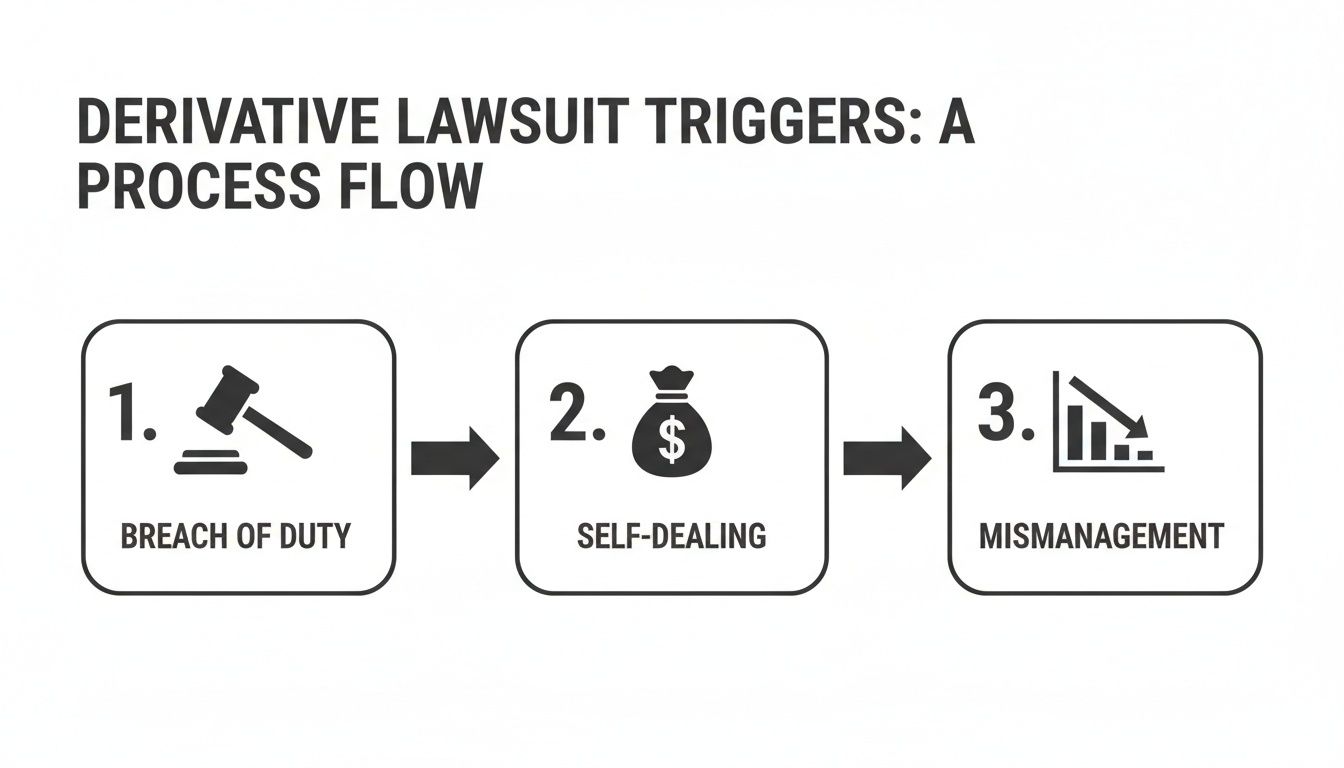
These disputes don't come out of nowhere. They almost always spring from obvious red flags—things like breaches of duty, blatant self-dealing, wasteful spending, or just plain reckless management. Spotting these missteps early can mean the difference between recovery and ruin for the business.
Here are the most common culprits:
- Breach of Fiduciary Duty: This is the big one. Directors and officers have a duty to act in the company’s best interests, but when loyalty or care is abandoned, litigation often follows.
- Self-Dealing: When a transaction benefits an insider more than the company, shareholders have every right to cry foul.
- Corporate Waste: Think lavish contracts or spending sprees that provide no real value and only drain company assets.
- Gross Mismanagement: This isn't about a simple bad decision. It's about reckless strategies made without proper research or oversight that lead to serious financial harm.
Breaches Of Fiduciary Duty And Self-Dealing
Nothing gets shareholders fired up faster than seeing directors or officers line their own pockets at the company's expense. When insiders put personal gain above their duties, they create an immediate conflict of interest.
Imagine a CEO awarding a multimillion-dollar contract to their brother-in-law's startup without even considering bids from more qualified, cheaper vendors. That’s a classic case of self-dealing that erodes trust and shareholder value. We explore more of these scenarios in our article covering breach of fiduciary duty examples.
When these situations end up in court, a judge will scrutinize the fundamental fairness of the deal. If it's clear an insider profited while the company lost, shareholders have a strong foundation for a lawsuit.
"Self-dealing often fires the spark that ignites a derivative suit when insiders put personal gain above company welfare."
Corporate Waste And Mismanagement
Corporate waste is exactly what it sounds like: a company paying wildly inflated fees or funding projects that are clearly doomed from the start. Think of a board approving a gold-plated office renovation right after gutting the research and development budget. Decisions like that directly harm the company's long-term health and can trigger shareholder action.
Gross mismanagement is a bit different. It’s about a pattern of reckless decision-making, like launching a flagship product with zero market testing or consistently ignoring clear industry data. When a board's strategy starts to look like they're throwing darts blindfolded, they are likely breaching their duty of care. Shareholders can step in, arguing that these failures of oversight caused direct harm to the company's bottom line.
Interestingly, while federal securities class action filings dipped slightly from 222 to 205 last year, over 51.2% were concentrated in New York and California. These often spawn derivative suits, particularly in the pharmaceutical (29 suits, 14%) and tech/biotech sectors (80 suits, 39%).
Identifying The Early Warning Signs
You don't have to wait for the damage to be done. Savvy shareholders can often spot trouble brewing by carefully reviewing board minutes, financial reports, and proxy statements. Sudden, unexplained transactions with related parties or unusual asset write-offs should be ringing alarm bells.
Keep an eye out for these patterns:
- Unusual contracts that haven't been vetted for fair market value.
- Executive compensation packages that are wildly out of sync with industry benchmarks.
- Sudden leadership changes that lack a clear strategic explanation.
- A pattern of skipped audits or a noticeable lack of independent oversight on key committees.
When you see these signs, especially in combination, the odds of a shareholder lawsuit go way up. The key is to act early. Raising concerns in writing creates a record and can strengthen a future demand to the board.
Preparing A Formal Demand
Before you can file a derivative lawsuit, you almost always have to make a formal demand on the board. This is a written request that clearly lays out the alleged wrongdoing and demands that the directors take specific action to fix it.
"Identifying triggers early empowers shareholders to act before harm compounds."
A well-drafted demand is critical—it can save an enormous amount of time and money while preserving your legal rights down the road.
Spotting misconduct is just the first step. Building a clear, documented record and following the correct procedural steps are what give a derivative claim real teeth. A thoughtful, prepared approach is what leads to a favorable outcome.
If you want to discuss your business law matter, contact Kons Law at (860) 920-5181.
Navigating the Lawsuit Process and Outcomes
So, a shareholder has spotted potential wrongdoing and cleared the first major hurdles of standing and the demand requirement. What happens next? A derivative lawsuit isn't a quick sprint; it's a marathon, with a structured and often lengthy path designed to make sure the claims are solid and the company's best interests stay front and center.
The journey usually kicks off with a deep dive by the shareholder's legal team. This means digging for evidence, poring over public filings, and building a strong factual case. Once the demand on the board is either rejected or excused as futile, the lawsuit officially begins when a formal complaint is filed in court.
Key Stages of a Derivative Lawsuit
After the complaint is filed, the lawsuit moves through a series of predictable, yet often complex, phases.
The whole process can be a winding road, frequently involving motions where the defendants try to get the case thrown out on a technicality. It takes real skill and a firm grasp of corporate law to navigate. Generally, here’s how it unfolds:
- Filing the Complaint: This is the official start. The shareholder lays out the alleged harm done to the company and points the finger at the defendants.
- The Board's Response: The board often forms a Special Litigation Committee (SLC). This is a small group of independent directors tasked with investigating the claims and deciding if moving forward with the lawsuit is actually good for the company. The court gives the SLC's recommendation a lot of weight.
- Discovery Phase: If the case moves ahead, both sides start gathering evidence. This is the discovery stage, which involves digging up documents, taking depositions (sworn testimony), and sending written questions (interrogatories).
- Settlement or Trial: The vast majority of derivative lawsuits settle before they ever see the inside of a courtroom. If the parties can't agree, the case goes to a judge or jury for a final decision.
Beyond Monetary Damages: What Winning Looks Like
Here’s a crucial point: "winning" doesn't always mean a huge check for the company. While getting money back is one potential outcome, many successful lawsuits result in something far more valuable in the long run: corporate governance reforms.
These reforms are designed to fix the underlying problems and stop the same misconduct from happening again. They can be even more impactful than a one-time cash payment.
For instance, a settlement might force the company to:
- Bring new, independent directors onto the board.
- Beef up internal controls and compliance programs.
- Claw back bonuses from executives who did wrong.
- Separate the CEO and Chairman roles to improve oversight.
This focus on reform is incredibly common. Data on derivative settlements shows that 47% overlap with securities class actions. Of those, only 25% end with a monetary payment (with a median of $9.2 million). The other 75% settle for these non-monetary governance changes.
A successful derivative lawsuit can reshape a company's leadership and ethical framework from the inside out, creating a more transparent and accountable organization for the long term.
It's also worth remembering that a full-blown courtroom battle isn't the only option. Exploring paths like alternative dispute resolution vs litigation can often lead to quicker, more cost-effective results that still achieve the needed corporate changes. At the end of the day, the goal is to heal the company, and that can happen in many different ways.
If you want to discuss your business law matter, contact Kons Law at (860) 920-5181.
How Companies Defend Against Lawsuits and Mitigate Risk
When a shareholder files a derivative lawsuit, directors and officers are suddenly thrown on the defensive. These lawsuits aren't just a simple attack on the company; they directly challenge the decisions made in the boardroom. Fortunately, corporate law has built-in protections for leaders who act responsibly, along with smart strategies to stop lawsuits before they even start.
The single most powerful shield for a director is the Business Judgment Rule. This legal doctrine starts with a simple presumption: that when making a business decision, directors acted on an informed basis, in good faith, and with the honest belief that they were doing what was best for the company.
The Power of the Business Judgment Rule
You can think of the Business Judgment Rule as the court’s way of staying in its own lane. Judges aren't business gurus, and they’re rightly hesitant to second-guess a board’s strategic calls, even if those decisions ended up losing money. A failed product launch or a disappointing acquisition doesn't automatically mean someone did something wrong.
To earn this protection, however, directors have to show their decision-making process was solid. The rule is there to shield directors who:
- Acted in good faith and were free of conflicts of interest.
- Were reasonably informed, meaning they did their homework before making a decision.
- Rationally believed their decision served the company's best interests.
This is where keeping meticulous records becomes non-negotiable. Detailed board minutes, notes from consultations with legal or financial experts, and thorough due diligence reports are the evidence that proves a decision was made with care and strengthens this defense immensely.
Proactive Risk Mitigation Strategies
Of course, the best defense is to avoid a lawsuit in the first place. Companies can dramatically lower their risk by building strong corporate governance from the ground up. This does more than just discourage litigation—it creates a healthier, more transparent organization.
One of the most essential steps is securing comprehensive Directors and Officers (D&O) insurance. This liability insurance covers the staggering costs of legal defense and any potential settlements or judgments that come out of a derivative suit. It protects both the company’s balance sheet and the personal assets of its leaders.
A well-structured D&O policy isn’t a luxury; it’s a fundamental part of modern corporate risk management. It provides a critical financial backstop when the costs of litigation start to climb.
Beyond insurance, companies need to build a resilient internal framework. A few key proactive measures can make all the difference:
- Establish Clear Ethics Policies: A formal code of conduct that spells out the rules on conflicts of interest, self-dealing, and corporate opportunities sets clear expectations for everyone.
- Create Independent Board Committees: An independent audit or governance committee can provide unbiased oversight on critical financial and operational issues, adding a crucial layer of accountability.
- Implement Regular Director Training: Making sure directors truly understand their fiduciary duties and stay current on legal changes is essential for them to make informed decisions.
By combining the powerful defense of the Business Judgment Rule with these forward-thinking strategies, companies can protect their leadership and stay focused on what really matters—driving long-term growth and success. If you want to discuss your business law matter, contact Kons Law at (860) 920-5181.
FAQs: Your Derivative Lawsuit Questions Answered
Even with a solid grasp of the basics, derivative lawsuits can leave you with a lot of practical questions. Let's dig into a few of the most common ones that come up for shareholders, directors, and business owners trying to navigate this complex area of law.
Who Foots the Bill for Legal Fees?
This is usually the first question on any shareholder's mind. The good news is, if your lawsuit creates a "substantial benefit" for the company, the company itself is typically required to pay your reasonable attorneys' fees. This is often called the corporate benefit doctrine.
This rule is a game-changer. It empowers shareholders to bring legitimate claims they otherwise couldn't afford to pursue on their own. And that "benefit" doesn't have to be a giant check—forcing significant reforms in how the company is governed definitely counts. But there's a flip side: if the lawsuit fails, the shareholder who filed it is usually on the hook for their own legal bills.
Can You Sue a Private Company This Way?
Yes, absolutely. People tend to associate these lawsuits with massive, publicly traded corporations, but they are an equally critical tool for shareholders in private and closely held companies, including LLCs. Bad behavior like self-dealing or blatant mismanagement can sink a small business just as easily as a large one.
All the core legal hurdles—like having standing to sue and making a formal demand on the board—still apply. The fundamental idea of holding management accountable is the same, no matter the size of the company.
What Is a Special Litigation Committee (SLC)?
When a board gets hit with a derivative lawsuit, they have a powerful defensive tool: the Special Litigation Committee (SLC). Think of it as an internal investigation team. The board appoints a small group of directors who are completely independent—meaning they have no skin in the game and aren't accused of any wrongdoing in the lawsuit.
The SLC's job is to act as a neutral party. They conduct their own deep-dive investigation into the allegations and then report back with a recommendation: should the company pursue the case, try to settle it, or push to have it dismissed?
Because the SLC is designed to be impartial, courts give its findings a lot of weight. A thorough, well-reasoned report from an independent SLC can often be the decisive factor that ends the litigation.
If you want to discuss your business law matter, contact Kons Law at (860) 920-5181.
