A Wells notice is a formal letter from SEC staff giving preliminary notice that it intends to recommend an enforcement action. It is not a lawsuit, an administrative charge, or a finding of liability, and it sets a clock that ends with a staff meeting no later than four weeks after your written submission reaches the agency.
It usually arrives as a two-page PDF on a weekday morning, forwarded by someone in compliance with the words "please review" and nothing else. Your name sits in the caption. There's a list of statutes you haven't thought about since your exam, a short factual narrative that gets at least one thing wrong, and a date by which the Division of Enforcement wants to hear from you.
If you're a registered representative, an investment adviser, or the principal of a small practice, you're likely reading it without in-house counsel and without a single colleague who has been through one before. The question of what a Wells notice means has a shorter and calmer answer than the letter suggests.
Treat the next several months as a project with a record to build, a deadline to hit, and several other forums that will read your words later. A verdict is not on that list.
What a Wells Notice Is in Plain Terms
The document comes from the SEC's Division of Enforcement, and its opening paragraph sounds worse than the situation usually is. The SEC's Enforcement Manual describes a Wells notice as a formal communication from SEC staff telling a person or company involved in an investigation that staff has made a preliminary determination to recommend that the Commission file an enforcement action or institute an administrative proceeding. It names the securities-law violations staff preliminarily believes belong in that recommendation. What it is not: a filed lawsuit, an administrative charge, or a final finding of liability.
The closest criminal analogue is a target letter. That letter tells you a prosecutor intends to present your case to a grand jury, and it is not an indictment. A Wells notice does the same job one level down the scale. Enforcement staff is telling you where it is heading, and the Commission hasn't voted on anything.
Two recipients read identical language very differently. A public company routes the notice to its board, discloses it in the next filing, and adds the standard caveat that the notice is not a formal charge and does not represent a final determination that the recipient violated the law. An individual adviser reads it alone, responds outside public view, and often has nobody to ask.

The procedure isn't a courtesy invented recently. It traces to the SEC's Advisory Committee on Enforcement Policies and Practices, which recommended it in a report submitted on June 1, 1972, so that prospective defendants could present their position before the Commission authorized an enforcement proceeding. The notice continues that purpose by inviting arguments, evidence, or other information to the Division of Enforcement and the Commission.
Two beliefs deserve correcting early.
- Only public companies get these. Individuals, investment advisers, and registered representatives receive them directly, frequently without in-house counsel and without any public disclosure obligation forcing the issue into the open.
- Responding can only make things worse. Silence leaves the staff's version of the facts as the only version the Commission reads. The response exists precisely because it can challenge the staff's factual or legal conclusions before anyone votes.
Practical rule: Read the notice as a risk memo, not a verdict. It says the staff's mind is partly made up. It doesn't say the Commission's is.
Where the Wells Notice Falls in the SEC Process
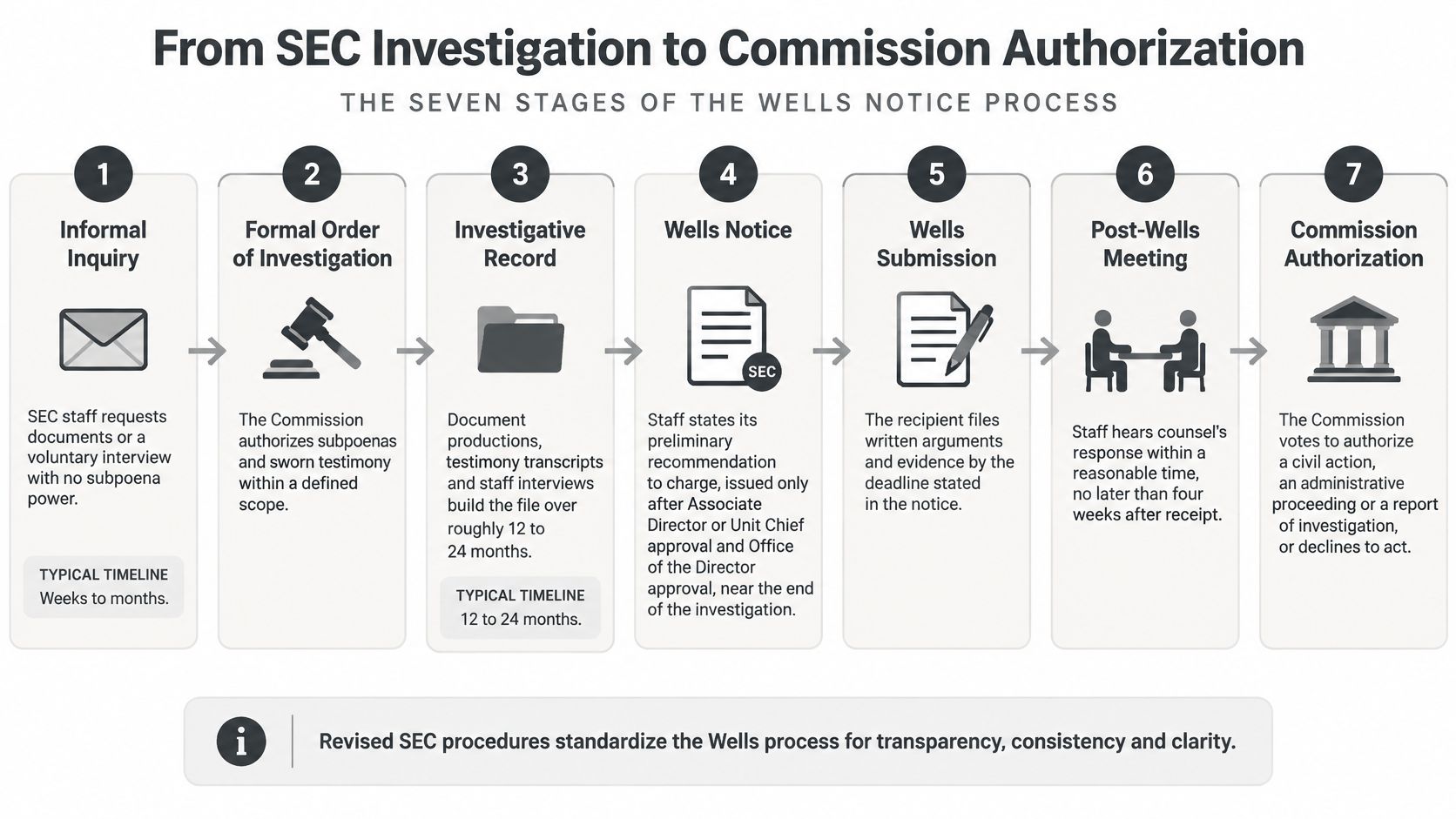
By the time the letter lands, most of the investigation is already behind you. The notice is stage four of a seven-stage sequence, and knowing your position in it tells you what you can still change and what you can only reframe.
The stages before the letter
Stage one is the informal inquiry. Staff requests documents or a voluntary interview, and there's no subpoena power behind the ask, so scope and timing are negotiable. Stage two is the formal order of investigation, the document that authorizes subpoenas and sworn testimony within a defined scope, granted by the Commission on a staff request. If you're early in this pipeline, how SEC investigations and enforcement matters begin is worth reading before you produce anything.
Stage three is the investigative record: document productions, testimony transcripts, and staff interviews. That file is what the staff summarizes in the notice and what the Commission eventually reads. Material you withheld at this stage is much harder to introduce afterward.
| Stage | What happens | Who acts | Timing |
|---|---|---|---|
| 1. Informal inquiry | Staff requests documents or a voluntary interview; no subpoena power | SEC enforcement staff | Weeks to months |
| 2. Formal order of investigation | Commission authorizes subpoenas and sworn testimony within a defined scope | SEC Commissioners, on a staff request | After staff shows grounds |
| 3. Investigative record | Document productions, testimony transcripts and staff interviews build the file | Staff attorneys, the witness and counsel | Months of production and testimony, before any notice |
| 4. Wells notice | Staff states its preliminary recommendation to charge and names the provisions at issue | Staff, after Associate Director or Unit Chief approval and Office of the Director approval | Near the end of the investigation |
| 5. Wells submission | Written arguments, evidence and a request for a meeting go to staff | You and your counsel | By the deadline stated in the notice |
| 6. Post-Wells meeting | Staff hears counsel's response and answers questions | Staff and counsel | Within a reasonable time, no later than 4 weeks after receipt |
| 7. Commission authorization | Commission authorizes a civil action, an administrative proceeding or a report of investigation, or declines to act | The Commission | After the staff recommendation |
Who signs off before the letter goes out
A Wells notice isn't a field attorney's whim. The SEC Enforcement Manual requires internal approval before staff issues one, or recommends an enforcement action without issuing one. The chain runs from an Associate Director's or Unit Chief's approval to approval by the Office of the Director. The same manual sets the meeting obligation: staff should meet your counsel within a reasonable time after the submission and, in any event, no later than four weeks after the SEC receives it.
The vote that actually decides
After the investigative record and any submission, Enforcement may seek Commission authorization to file a civil lawsuit, begin an administrative proceeding, or, in certain circumstances, issue a report of investigation, per the SEC's investor bulletin on investigations. The Commission can also decline to act. Authorization is a separate step from the staff's preliminary recommendation, which is why a submission addresses both the liability theory and the remedies proposed.
The SEC's release on fiscal year 2026 enforcement results states that revised procedures standardize the Wells process and improve transparency, consistency, and clarity. Read that as the mechanics tightening, not loosening.
The practical consequence of all this is timing. The notice lands late, after the file is closed, so your submission argues about characterization, weight, and remedy. It rarely gets to introduce new facts.
What the Notice Tells You and What It Leaves Out
Read the notice twice with a pen in your hand. The first pass is for dates. The second is for what the government thinks it has.
What the notice puts on paper
The provisions matter most. For adviser conduct, the usual candidates are Section 10(b) of the Exchange Act and Rule 10b-5, Section 17(a) of the Securities Act, and Sections 206(1) and (2) of the Advisers Act. The difference between them isn't academic, because one requires scienter and another doesn't, which changes what you have to disprove. If the antifraud theory is the core of the case, what securities fraud claims actually require is a useful primer on the elements staff has to prove.
Beyond the statutes, expect a caption naming proposed respondents individually or as an entity, a short factual narrative, and the remedies under consideration. That list is concrete: a cease-and-desist order, an injunction, disgorgement with prejudgment interest, civil penalties, an industry bar or suspension, or an officer-and-director bar. You'll also find the response deadline, and sometimes a line about whether staff will entertain a meeting.
What it deliberately leaves out
Plenty. The notice does not include the investigative file, does not identify witnesses or the exhibits staff intends to rely on, and is not a charging document. It carries no endorsement by the Commission. It offers no assurance about the outcome either way.
Two administrative tasks belong on day one. Record the date, the inquiry or docket number, and the response deadline somewhere you'll see it daily. Then check the caption: does it name you personally, or only the firm? That answer decides who needs separate counsel, and it's the question most recipients skip.
Working rule: The list of provisions is the skeleton of the government's case. Every paragraph you write should map to one of those bones, or it doesn't belong in the submission.
Your Response Options Compared Side by Side
The choice isn't respond or don't. It's which of five postures you take, and they carry different risks.
| Option | What it involves | Strongest when | Main risk |
|---|---|---|---|
| Written submission only | Legal brief answering each proposed charge with record citations and exhibits | The record contains clear documentary errors in the staff's theory | Staff may not engage and the Commission may still authorize action |
| Submission plus post-Wells meeting | Same brief with a written request for a meeting with staff | Facts are nuanced or a cooperative posture matters | New questions surface at the meeting |
| Narrowing submission | Focused argument to drop individuals, drop counts or reduce remedies | Entity and individual exposure differ | Concessions can be reused in parallel proceedings |
| No response | Nothing filed before the deadline | Almost never; only where the record speaks entirely for itself | The staff theory goes to the Commission unrebutted |
| Parallel settlement discussion | Exploratory talks run alongside the submission while defenses are preserved | Exposure is clear and the priority is limiting collateral damage | Raised too early, it signals weakness |

A written submission is the default, and it should read as a brief rather than a letter. Each proposed charge gets its own section, each factual assertion gets a record cite, and each exhibit earns its place. The post-Wells meeting is usually worth requesting on top of it, particularly where the facts are contested or where you want the staff to hear a cooperation story before it drafts a recommendation. The manual gives you a fixed window for that meeting, so the request costs you little.
Where a narrower ask wins
The most realistic outcome in a multi-respondent case is rarely a clean dismissal. It's a narrowing: your name comes out of the caption while the firm stays in, or two counts drop and the remedy range contracts. That's a genuine result, and it usually requires the submission to distinguish your conduct from everyone else's rather than defend the group.
Declining to respond is almost always a mistake. When staff drafts its recommendation, an unrebutted record reads as an accepted record. A settlement discussion can run in parallel with the submission, but raising it before the record has been framed tells staff you've already conceded the characterization, and that concession is expensive to walk back.
No one can quote you odds. The agency publishes no conversion rate for submissions, and a lawyer who offers a percentage is inventing one.
How to choose: weigh the strength of the documentary record, the number of respondents named, and how much an admission would cost you in the other forums reading the same file.
How to Build a Wells Submission Step by Step
The submission's value is technical, not rhetorical. SEC guidance describes it as an opportunity for the recipient to address proposed charges, and SEC historical materials report that staff recommendations have sometimes been modified or individuals omitted after reviewing submissions, although the SEC does not maintain statistics showing a success rate, as the SEC's Wells process exhibit sets out. Build it in this order.
- Index the record before writing a sentence. Pull every testimony transcript, every document you produced, and every exchange with staff into one numbered index. Each assertion you make has to trace to a page staff can retrieve without effort, and a brief that cites "the testimony" without a page number reads as an opinion.
- Map each charge to its elements under its own heading. Jurisdiction first, because an unregistered actor or conduct outside the antifraud provisions has a short defense. Then conduct, then scienter or negligence depending on the theory, then loss or investor harm, then causation, then remedies. When a heading has nothing strong behind it, say so and move on rather than padding it.
- Attach only the material that undermines the staff's theory. A short cover index plus the exhibits that matter beats a document dump, because staff reads to find the weakness in its own case and a 400-page appendix buries it. Identify the specific testimony or record by page and explain in one paragraph why it changes the conclusion.
- Argue remedies in their own section. Disgorgement needs a calculation you can defend line by line. Penalty tier, the scope of any bar or suspension, and the undertakings you'd accept all belong here, separated from liability so a partial win on liability still yields a better remedy.
- Vet every sentence for reuse. Financial advisers and broker-dealers should assess collateral consequences beyond the SEC case: disclosure implications, supervisory review, customer arbitration exposure, employment or Form U5 consequences, and parallel FINRA or state inquiries. Because the notice reflects a preliminary position rather than a final finding, no sentence should contain an admission that a claimant's lawyer could paste into an arbitration statement of claim.
- Build a one-page meeting outline with a specific ask. Decide before the meeting whether you want a count dropped, a respondent omitted, or a remedy capped, and put that request in one sentence at the top of the outline. Confirm in writing whether staff will grant the meeting, and keep preparing the case for the possibility that the Commission proceeds regardless.
A submission argues characterization against a record that already exists. It doesn't get to invent new facts, and it shouldn't try.
Collateral Consequences a Wells Notice Sets Off
The SEC matter is one front, and the others run on their own clocks. Choices made in the first two weeks echo for years, long after the SEC file closes.
Form U5 is the item with the longest tail
For a registered representative, the highest-stakes document may not be the Wells notice at all. A termination tied to the conduct has to be reported on the Form U5, and the narrative language the firm chooses can follow an adviser from firm to firm and into every future recruiting conversation. Advisers can dispute that language, and the dispute is time-sensitive. What a Form U5 reports and how the narrative gets corrected covers the mechanics.
A FINRA Rule 8210 request about the same facts is common, and a failure to respond is treated as a separate violation with its own exposure. Customer arbitration can follow once the conduct becomes public, and FINRA's eligibility rules set a separate clock that has nothing to do with the SEC's schedule.
| Forum or obligation | What the notice triggers | Who acts | Timing |
|---|---|---|---|
| Form U5 disclosure | A termination tied to the conduct must be reported, and the narrative follows the adviser | Member firm files; the adviser may dispute the language | At termination, when the firm files the amendment |
| Customer arbitration | Claimants can file once the conduct is disclosed | Adviser and firm | Set by FINRA eligibility rules, on its own clock |
| State securities regulator | A state inquiry or action built on the same facts | Adviser and counsel | Per the state's own process |
| Public company disclosure | Legal-proceeding and risk-factor disclosure decisions | Issuer and disclosure counsel | With the next required filing |
| Insurance and indemnification | Notice of circumstance to D&O or E&O carriers and an advancement request to the entity | Insured, company and board | Per policy notice provisions, often prompt |
Public companies face a second layer: legal-proceeding disclosure decisions and D&O notice obligations, both running on filing calendars rather than the SEC's. Indemnification and advancement from the entity may be available under bylaws or statute, but it's rarely automatic when the entity is also a respondent, so the request needs to be made early and in writing.
When the same facts are being litigated in a regulator's conference room and in public at once, managing legal disputes in public becomes its own discipline: what you tell the SEC, what your firm tells clients, and what a reporter hears have to be sequenced rather than improvised.
None of these forums pauses while the Commission decides. Map them before the submission is filed, not after.
Your Next Step After the Notice Arrives
The first 48 hours decide more than the next 48 days. Here's the order I'd work in.
- Read it, then log it. Note the date, the inquiry or docket number, and the response deadline. Then check the caption for your own name. If it names you personally, you need separate counsel from the firm, and that call shouldn't wait.
- Stop talking about it. Not to colleagues, not to clients, not to the branch manager who means well. Anything you say outside privilege becomes a potential exhibit in someone else's proceeding.
- Preserve everything. Documents, phones, text messages, personal email used for business, and the notes you just made. A litigation hold issued in week one is worth far more than a reconstructed file in month six.
- Notify the carriers and the entity. D&O or E&O notice of circumstance goes out promptly under most policies, and where applicable the entity's general counsel should hear it from you rather than from staff.
- Retain counsel who works both tracks. Securities enforcement experience matters, and so does someone who has defended a Form U5 narrative and answered a Rule 8210 request.
The reason for that fifth point is mechanical. The same submission has to survive the SEC record, the FINRA inquiry, the customer arbitration, and the Form U5 narrative simultaneously, because the same sentences get reused in all four. Drafting it with all of them in view from the first page is a different exercise than drafting it for the SEC and patching the rest later, when the deadlines overlap and the language is already locked.

Explaining a Wells notice to a spouse, a business partner, or a branch manager with no securities background is harder than it sounds, and simplifying complex concepts for that audience without losing the substance is worth the effort when the people around you have decisions of their own to make. Our regulatory compliance counsel works with advisers at exactly this stage, and Kons Law's securities regulatory practice defends financial advisors facing regulatory inquiries, investigations, and disciplinary actions.
If you want to discuss your business law matter, contact Kons Law at (860) 920-5181.
Kons Law represents financial advisors and investment professionals in SEC enforcement matters, Form U5 disputes, FINRA inquiries, and related arbitration, and we build the Wells submission with the parallel forums in mind from the first draft. If a Wells notice is sitting in your inbox and the response date is close, our securities regulatory team can review the notice, map the proposed charges to their elements, and set a schedule for the record and the meeting request. Visit Kons Law to start that conversation.
