
One number explains why financial advisor lawsuits run differently from ordinary commercial litigation: 2,597 new FINRA arbitration filings in 2025, per FINRA's 2025 dispute-resolution statistics, carrying a 13.4-month average turnaround. That timeline is the point. While the arbitration grinds forward, the Form U5 record, the regulatory file, and the cash drain of defending it all move on parallel tracks, and each can outlast the case itself.
The verdict decides money. The disclosure record decides how clients, firms, and regulators treat you afterward.
Financial Advisor Lawsuit Claims at a Glance
Breach of fiduciary duty, appearing in 1,162 cases, and failure to supervise, in 1,022 cases, were leading customer claim categories in FINRA's 2025 dispute-resolution data. Those theories put both the advisor's conduct and the firm's oversight at issue. For a working advisor, the immediate task is identifying which allegations threaten compensation, the regulatory record, or the ability to join another firm.
“Financial advisor lawsuit” is often used broadly to describe civil claims, arbitration demands, and regulatory complaints. These are separate processes, even when they concern the same conduct. Disputes commonly arise from a customer loss, an employment exit, or a compensation disagreement. Each starting point raises different questions about liability, documents, and the relief being sought.

Consider a client who alleges that a concentrated energy-stock position was unsuitable for a retiree. The client brings a fiduciary-duty claim against the advisor, and the firm's compliance department opens a supervision review. If a branch audit had flagged the account six months earlier without follow-up, the customer's counsel may also allege failure to supervise against the firm. A regulatory inquiry may examine the same account separately.
The records overlap. The response obligations do not.
The customer claim concerns the recommendation and resulting loss. The supervision review concerns what the firm identified and how it responded. Any regulatory inquiry has its own requests and deadlines. An explanation prepared for one track therefore needs to remain consistent with the account records and statements made in the others.
Use this table to separate the allegations before deciding how to respond:
| Claim type | Usually filed by | Typical forum | What decides the case |
|---|---|---|---|
| Breach of fiduciary duty | Retail customer | FINRA arbitration or court | Whether the advisor put the client's interests first and disclosed conflicts |
| Failure to supervise | Customer, typically against the firm | FINRA arbitration | Whether the firm's supervisory system was reasonable and followed |
| Negligence or misrepresentation | Customer | FINRA arbitration or court | The applicable duty, recommendation accuracy, and whether the conduct caused the loss |
| Fraud | Customer or regulator | Arbitration, court or regulatory proceeding | Alleged deception and the elements required for the particular claim |
| Wrongful termination or discrimination | Advisor | Arbitration or court | Employment agreement, termination record and statutory protections |
| Compensation or promissory-note dispute | Firm or advisor | FINRA intra-industry arbitration | Contract terms, forgiveness schedules and withheld bonus or deferred pay |
| Defamation over Form U5 | Advisor | Arbitration or court; expungement may also be sought | Whether the challenged statement is false and how required regulatory disclosure affects the claim |
Start by listing every claim, inquiry, and disputed disclosure. Match each to the relevant row, then identify the documents and response deadline attached to it. A Form U5 dispute may involve both an allegedly false statement and a required reporting obligation. A customer-loss allegation may turn partly on supervisory records rather than the recommendation alone. The label on the demand is only the starting point.
Timing also affects the defense budget and employment decisions. A contested hearing can leave an advisor carrying legal expenses while compensation or a firm transition remains unresolved. A faster decision process may offer less opportunity to address disputed testimony. Assess those trade-offs alongside the monetary claim: whether the Form U5 record remains disputed, whether a regulatory inquiry is open, and whether delayed compensation creates cash-flow pressure. Resolving the customer claim does not, by itself, resolve those separate issues.
Arbitration Versus Court for Advisor Disputes
Most advisor disputes never reach a courtroom. Customer agreements and industry rules generally send customer and intra-industry claims to FINRA arbitration, while some statutory, employment, or non-arbitrable claims stay in court. That split shapes everything: the discovery process, the speed of resolution, and how much weight the first decision carries.

| Forum | Best suited for | Typical timeline | Main limit |
|---|---|---|---|
| FINRA arbitration, regular hearing | Contested facts, credibility and intent issues | 15.9 months | Longest format; full hearing costs |
| FINRA arbitration, special proceedings | Simpler or narrower claims | 6.8 months | Limited to specific claim types |
| FINRA arbitration, paper decision | Claims decided on documents | 5.0 months | Hard to win where credibility is disputed |
| Court litigation | Statutory, employment or non-arbitrable claims | 18 to 24 months | Public filings and a wider discovery process |
| Regulatory proceeding (SEC, FINRA, CFP Board) | Investigations and disciplinary matters | 9 to 15 months | Outcomes affect licensing, not only money |
A regular hearing can run past a year. An advisor defending a customer claim while negotiating a move to a new firm has to plan cash flow, client transition, and any deferred compensation around that span. The client may be elsewhere by the time the award comes in, but the Form U5 entry and the regulatory file stay.
The paper-decision option looks attractive at 5.0 months. It is faster and cheaper. But it's the wrong tool where credibility is the issue. If the claimant says the advisor said one thing and the advisor says another, a paper decision leaves the panel with nothing but documents, and panels are reluctant to resolve credibility disputes against a claimant without hearing testimony. I would reserve the paper route for claims where the documents themselves answer the question, a forgiveness schedule, a written disclosure, a supervision checklist.
Arbitration awards are generally final with narrow judicial review. That means the first forum decision carries weight, unlike court, where an appeal can undo years of work. The response deadline is the first test. Read the agreement for the forum clause. If it says FINRA arbitration, the FINRA Code of Arbitration Procedure sets the answer deadline, and it's usually short. Calendar it before anything else is filed. For a deeper look at how these forums compare, see our investment dispute resolution overview.
What Damages Look Like and What Drives Them
The core figure in a customer claim is out-of-pocket loss: the gap between what the client invested and what the holdings are worth now, plus interest. The worked example is simple. A client moves $500,000 into a product sold as moderate risk and sees $120,000 in losses over 18 months. The claimant's number starts at $120,000 plus interest and fees. The defense asks whether the recommendation caused the loss or the market did, and that causation question is where most of the money gets decided.
Punitive damages are a real risk in fraud-based claims. A finding of intent to deceive changes the arithmetic beyond compensatory recovery, and it can change the regulatory and employment consequences on the other tracks too. A case that settles on compensatory numbers can still leave a mark if the award language carries a fraud finding.
The intra-industry side is where public discussion goes thin. FINRA reported 679 new intra-industry cases in 2025, a year in which intra-industry disputes accounted for 37% of all new filings, and the five-year pattern is larger: 5,316 intra-industry cases filed from 2021 through 2025, according to FINRA's dispute-resolution services statistics. Average turnaround was 13.4 months in 2025, with regular-hearing decisions running about 15.9 months. These cases cover withheld compensation, promissory notes, deferred pay, and restrictive covenants.
The verdict is only one track. An advisor defending a promissory-note claim while pursuing withheld compensation has to evaluate interim relief, tax and liquidity consequences, licensing disclosures, and whether a counterclaim changes bargaining strength. A 12-to-16-month dispute can stall a move to a new firm, freeze deferred compensation and production credits, and put pressure on credit obligations, all while the Form U5 record and the regulatory file keep moving on their own timelines.
Practical rule: Model the exposure over the likely dispute length, not only the amount claimed. Include interest, fees, and any loss of production credits. A $120,000 claim that stalls for 15 months while deferred pay is frozen can cost twice the claimed number before the hearing date is even set.
The drivers that move the number are account size, length of exposure, supervisory gaps, documented disclosures, and mitigation. Account size sets the ceiling. Length of exposure sets the interest run. Supervisory gaps pull the firm in and widen discovery, which raises cost on both sides. Documented disclosures cut causation. Mitigation, whether the client moved out early, rebalanced, or ignored written guidance, cuts the net loss. Each driver is an evidence question before it becomes a legal argument.
Form U5 Records and Expungement Options
A contested Form U5 is often treated as a defamation problem first. That framing is incomplete. The Form U5 is the record a firm files when an advisor's registration ends, and the entry follows the advisor through the CRD registration system. Forms U4, U5, and U6 feed into that record, so the dispute affects licensing, hiring, and future registration disclosures, not only reputation.
The procedural path is more complicated than “sue for libel.” FINRA's rules distinguish customer-dispute information involving a registered person who was named as a respondent from information involving an “unnamed person.” The FINRA expungement FAQs set out the categories and the narrow routes for relief. Form U5 libel-or-slander disputes are common enough to be a routine part of securities industry practice, especially where termination language, customer complaints, and alleged misconduct overlap.
Four decision points usually matter before anything is filed.
- Whether the statement is defamatory or required regulatory reporting. A firm's statement that an advisor “resigned while under investigation” may be required disclosure, not defamation. The claim only works where the statement is both false and outside what the form requires.
- Whether the advisor was a named respondent or an unnamed person in a customer dispute. The expungement route differs sharply. Named respondents have one path; unnamed persons have another, narrower one.
- Whether a Form U4 amendment is required to correct the record. Sometimes the fix is an amendment, not a lawsuit. Filing the wrong action changes nothing on the record and burns time.
- Whether relief can realistically come through arbitration, court, or FINRA's narrow expungement procedure. The right forum depends on which category the entry falls into. Filing in court when the agreement mandates arbitration wastes time and may cost the claim.
Licensing and hiring consequences continue while the dispute is pending, even with no award entered. Broker-dealer vetting will pull the CRD record and see the open dispute, the termination language, and any customer complaint. An advisor can lose an offer before the arbitration is even scheduled. That is why the first action is to pull the CRD record and map every entry against the four points. For the specific interaction between a contested U5 and your options, see our Form U5 FINRA guide.
Regulatory Exposure Beyond the Lawsuit
The enforcement figures show why the regulatory file deserves attention even when the lawsuit feels primary. The Commission reported 456 enforcement actions, including 303 standalone actions and 69 follow-on administrative proceedings seeking bars or suspensions from securities-market functions, with orders totaling $17.9 billion in monetary relief, according to the SEC's press release. Investment-adviser standalone matters were 72 of the 303 standalone actions, approximately 24%. Those numbers matter because a follow-on bar or suspension can restrict regulated work longer than a fine affects cash flow.
That is the practical point for a working advisor: SEC investigation, FINRA proceeding, and CFP Board disciplinary matter are parallel tracks. They can move on separate clocks, with separate records and separate consequences. A customer claim may settle while the regulatory file keeps growing. The Form U5 record may still carry termination language. Hiring, licensing, and supervisory opportunities can turn on those records before any award is entered.
The CFP Board process gives written notice of allegations, a chance to submit documents and arguments, a hearing opportunity, and appeal rights. Each stage has its own deadline, and missing one changes the default posture. That makes the calendar as important as the merits. I treat each notice as a separate litigation deadline, because a late response can shape the record before the next stage begins.
| Consequence | Issued by | Practical effect |
|---|---|---|
| Private censure | CFP Board | Disciplinary action without public notice |
| Public censure or notice | CFP Board | Published, and clients must be notified of the public discipline under CFP Board rules |
| Suspension | CFP Board | Loss of the right to use the CFP marks for a set period |
| Revocation of CFP marks | CFP Board | Permanent loss of the right to use the CFP designation |
| Temporary or permanent bar | CFP Board | Cannot apply for or obtain CFP certification |
| Follow-on bar or suspension | SEC | Restricts the individual from performing regulated functions |
| Monetary penalty | SEC or FINRA | Financial cost that can be modest next to a licensing restriction |

The response has to be coordinated across those records. Statements in an SEC response, an employer filing, an arbitration pleading, and a regulatory disclosure need to match on the core facts. An allegation is not an adjudicated finding. An advisor who concedes a fact in a CFP Board response and denies it in a FINRA answer creates two credibility problems, one in each forum. That inconsistency can cost more than the original dispute when the file is reviewed by a regulator, employer, or arbitration panel.
Privilege also affects how the defense file is built. Information sent without an attorney-client relationship is not privileged, so hold sensitive documents until the engagement is in place. Understanding privilege rules for lawyer-client chats before any written response keeps the strategy file clean. Sending information through a website or communicating through it does not create an attorney-client relationship, and confidential material should wait until an attorney has spoken with the person and a written agreement letter is in place.
Kons Law guides financial advisor clients through responding to regulatory inquiries, navigating on-the-record interviews, and addressing compliance issues. Route every regulatory contact through counsel and keep one verified account of the facts. On-the-record testimony needs the same discipline as the written response, because answers can be quoted back in another forum. For the investigative phase specifically, see our SEC investigation guide.
Defensive Steps for the First 30 Days
The first 30 days after a dispute surfaces determine how the next year plays out. Here's the sequence I walk clients through, with the reason and the common mistake for each step:
- Read every filing and calendar each deadline. The arbitration response, the regulator response, and any CFP Board notice period each have their own clock. The common mistake is treating a letter that says "please respond" as optional. It isn't.
- Stop informal discussions about the dispute. That means no calls with the complaining client, no hallway talk with colleagues, no comments to the press. Each statement can become evidence, and a casual "we'll make it right" reads as an admission in a later hearing.
- Preserve everything. Emails, texts on personal devices, CRM notes, account reviews, compensation statements, supervisory manuals, Form U4 and U5 files. Deleting or editing records is a costly error, and the discovery process will ask what you preserved and when.
- Check the employer's termination filing. FINRA requires a broker-dealer to file a Form U5, the Uniform Termination Notice for Securities Industry Registration, within 30 days after an associated person's employment ends, and the firm must generally provide the individual with a copy within the same 30-day period, per FINRA's Form U5 page. Firms may face administrative or civil penalties for incomplete, inaccurate, or late filings, so compare every line against your records.
- Review employment, compensation, and promissory-note agreements. The forum clauses, repayment schedules, and notice terms in those documents set the playing field. The common mistake is discovering a mandatory arbitration clause after filing in court.
- Build a dated timeline of the account, client, or compensation events. A 30-entry sequence with dates beats a 10-page narrative. The timeline becomes the backbone of every later filing.
- Notify your professional liability or errors-and-omissions carrier promptly. Late notice may affect coverage, and the carrier's panel counsel list may not include the lawyer you want. Ask before you retain outside counsel.
- Hold every regulatory or client statement until counsel has reviewed it. A written response sent before review can lock in a version of the facts that becomes hard to change. The common mistake is wanting to "clear things up" with a quick email.
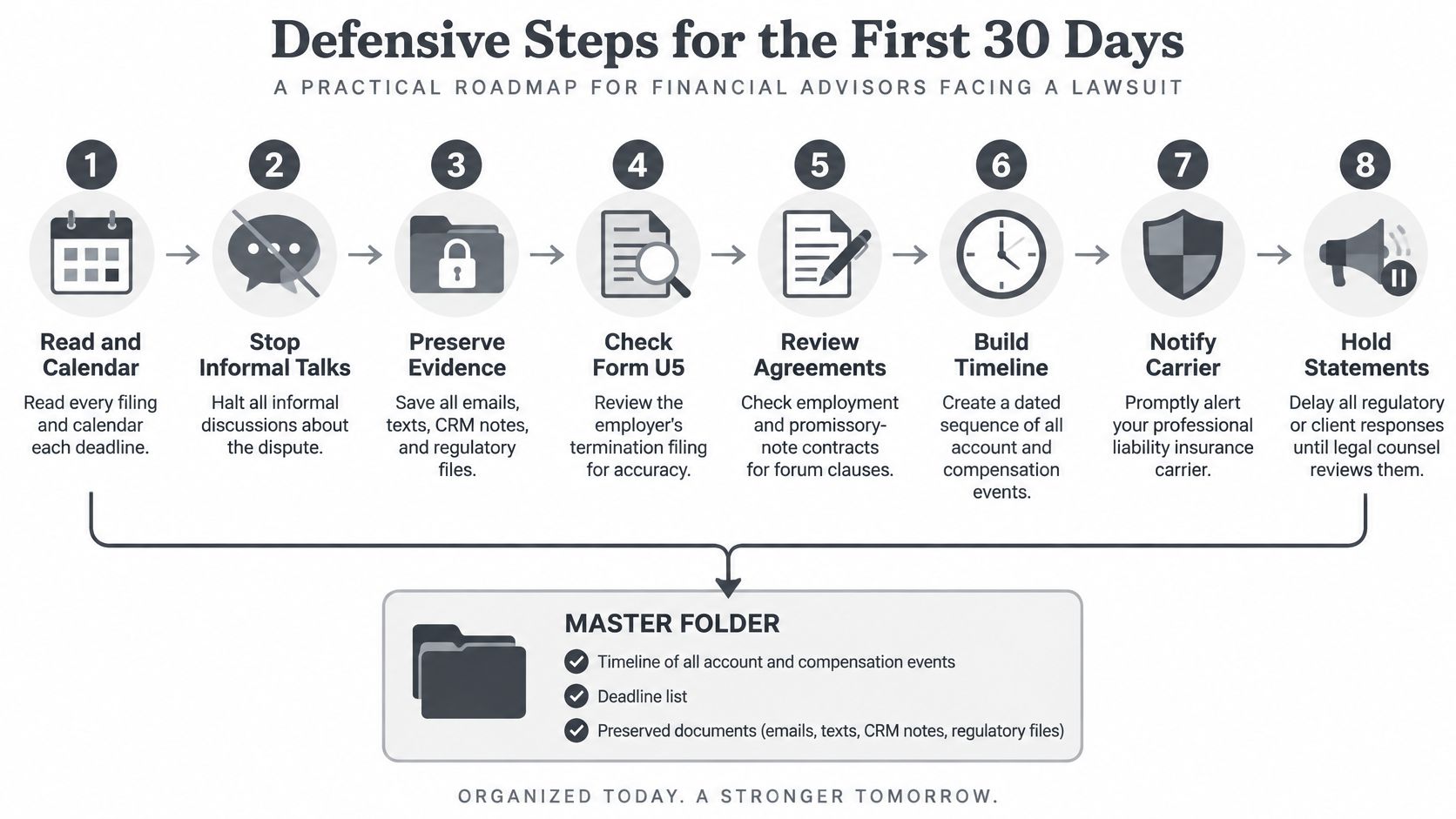
Practical rule: Keep one master folder with the timeline, the deadline list, and the preserved documents. When the arbitration panel or the regulator asks what happened and when, the answer should be a tab in that folder, not a memory.
The preparation that matters is the same preparation that wins the hearing. Our arbitration preparation guide explains how to build the record. The first 30 days set the record. The hearing just reads it back.
Frequently Asked Questions for Advisors and Broker-Dealers
Can an advisor keep working during a dispute? Often yes, but check the employment agreement and any firm supervision terms before changing client activity, and confirm whether a regulator has restricted registration. A Form U5 dispute does not automatically suspend registration, but a follow-on regulatory bar does.
Does a settlement appear on the public record? Customer settlements tied to an advisor's registration are typically reported on Form U4 and can appear on BrokerCheck. Confirm the reporting obligations before agreeing to terms, because a settlement with a confidentiality clause does not necessarily remove the public disclosure.
What must a broker-dealer do after an advisor leaves? The firm generally must file Form U5 within 30 days after employment ends and give the individual a copy in the same period. Incomplete, inaccurate, or late filings can draw penalties, and the wording of the termination reason is often the core of a later dispute.
Does a promissory-note claim go to arbitration? Often yes when the note ties to the industry relationship. The forum clause in the note or the employment agreement usually controls, and it commonly mandates FINRA arbitration.
Do I need counsel for a client complaint letter with no filing? Yes. Consult before any written response, since statements can become evidence in a later arbitration or regulatory matter. A letter is the beginning of a file, not the end of one.
What should a firm review after a customer claim? Its supervisory system, training records, and account reviews. Failure to supervise is a leading customer theory alongside breach of fiduciary duty, so the firm's own records are the first line of defense.
Deciding Whether to Hire Securities Counsel Now
The decision rule is simple: retain securities counsel now if the advisor faces any regulatory inquiry, FINRA filing, Form U5 dispute, CFP Board complaint, promissory-note demand, or withheld-compensation claim. Even a client complaint letter with no filing justifies a consultation before any written response. The cost of early counsel is a fraction of the cost of an uncoordinated response that locks in a bad record.
Practical rule: Don't wait for the arbitration statement of claim or the formal Wells notice. Once a complaint letter, a termination notice, or a promissory-note demand arrives, the record is already being written. The question is who controls the pen.
In the first call, ask which forum applies, the expected timeline, the evidence to preserve, the risk to licensing, and whether a counterclaim changes negotiating power. The forum question determines the response deadline. The timeline question determines the cash-flow plan. The counterclaim question often determines settlement dynamics in an intra-industry dispute.
Fee options include traditional hourly billing, flat fees for defined services, and contingency or hybrid structures where appropriate. In contingency representation, costs may remain the client's responsibility, so clarify that before signing. Kons Law represents investors and financial advisors nationwide in securities industry disputes and offers those fee structures where they fit the matter.
Confidentiality works only after the engagement exists. Information sent without an attorney-client relationship is not privileged. Hold sensitive documents until the engagement letter is signed, because the protection attaches to the relationship, not the email subject line.
The Form U5 entry, the regulatory file, and the arbitration calendar move on their own schedules, and they reward advisors who treat the first 30 days as the case, not the prelude to one. Kons Law represents financial advisors nationwide in FINRA arbitration, Form U5 disputes, regulatory investigations, and compensation matters, with a process built around the record, the deadline, and the realistic outcome. Visit Kons Law to schedule a confidential consultation and get the first-30-days plan in place before the next filing lands.
