A judgment debtor examination is a court-ordered hearing where the judgment debtor answers questions under oath about income, bank accounts, property and businesses, so the creditor can identify assets for enforcement.
You've won your lawsuit, but the payment still hasn't arrived. The debtor has stopped responding, and you don't know where they work or bank. Your next challenge isn't proving the debt again. It's finding a lawful, practical way to collect it.
What a Judgment Debtor Examination Really Does
Say your business has won a $40,000 judgment, but the debtor has stopped paying. That's a hypothetical amount, but a familiar problem: you have a court decision without the financial information needed to enforce it.
You're the judgment creditor, the party entitled to payment. The person or business ordered to pay is the judgment debtor. Understanding what a judgment creditor is helps distinguish your right to payment from the procedures needed to obtain it.
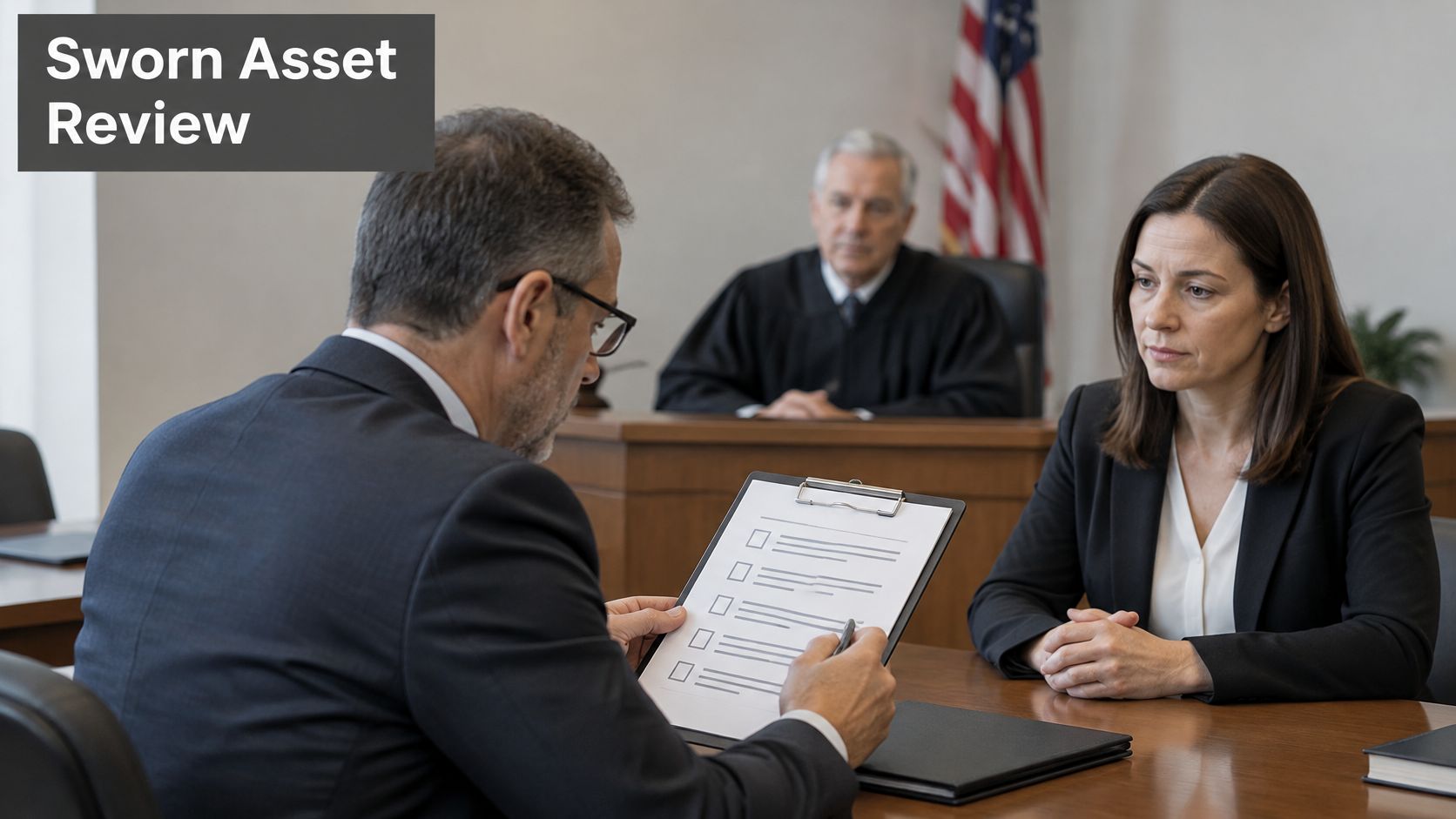
Think of the examination as a sworn asset inventory, similar to a deposition about money rather than a new trial about liability. You ask where the debtor earns income, holds accounts, owns property or operates businesses, and who owes the debtor money.
The examination investigates. It generally doesn't direct a bank to release funds or an employer to withhold wages. Instead, you obtain information that may support a separate levy, garnishment, property execution or lien.
Practical rule: Leave the hearing with identifiable enforcement targets, not merely a general impression that the debtor has money.
The procedure follows entry of judgment, and questions should connect to enforcement. Location matters, too: the California Courts examination guide explains that the debtor must live or operate a business within 150 miles of the examining court; otherwise, the creditor generally seeks the examination in the debtor's county.
A quick readiness check
- Judgment entered: You have an enforceable payment obligation.
- Payment missing: The debtor hasn't satisfied it.
- Assets unknown: You need information before choosing an enforcement method.
If those conditions describe your situation, an examination may be a sensible next step, subject to your state's prerequisites.
Rules That Decide Whether You Can Compel an Examination
There's no single nationwide application or eligibility rule. Your judgment's location, the debtor's location and the steps already taken can affect whether you can compel an examination.
When an examination is available, by jurisdiction
| Jurisdiction | When the examination is available | Key limit or option |
|---|---|---|
| California | After judgment, subject to the debtor's location and the applicable examination procedure | In qualifying consumer-debt cases, written disclosures may replace appearance, with notice at least 15 days before the examination, as described by California Courts. |
| Connecticut | When execution is returned wholly or partly unsatisfied, or the debtor fails to answer postjudgment interrogatories within 30 days, under General Statutes § 52-397 | The hearing is held where the judgment was rendered; the judge or clerk sets the hearing, and statutory service requirements apply. |
| Missouri | Before the judgment is recorded as satisfied and before the statutory presumption of payment applies | Missouri § 513.380 permits attachment and contempt for noncompliance and provides use and derivative-use immunity, except for perjury or false statements. |
| Federal court judgment | Generally follows the procedure of the state where the federal district court sits | Federal Rule of Civil Procedure 69 preserves controlling federal statutes; confirm the applicable forms, service and timing requirements. |
Read the table as a filing checklist, not permission to skip local rules. In Connecticut, for example, you need to establish a qualifying procedural trigger. An unanswered demand letter isn't the same thing as unanswered statutory postjudgment interrogatories.
Check the judgment and the discovery procedure separately
First, confirm that the judgment remains enforceable. Questions about how long a judgment lasts are separate from questions about when an examination becomes available. Also check for any stay or court order that prevents enforcement.
Then prepare discovery for the correct jurisdiction. Attorney Assistant's guidance on how to customize discovery requests for state court can help organize that drafting work, but a template doesn't replace the court's prescribed application.
Before filing, answer these questions:
- Enforceability: Is the judgment still enforceable and unpaid?
- Trigger: Have you satisfied the state's prerequisite?
- Venue: Are you applying to the correct court?
- Timing: Are you within the applicable enforcement period?
A correct answer to each question reduces the risk of obtaining an order that you can't effectively use.
How to Start and Run the Examination Step by Step
Prepare the examination as a documented court procedure, not an informal interview. Bring the judgment, payment history, required forms, service records and a focused question outline into the same working file.
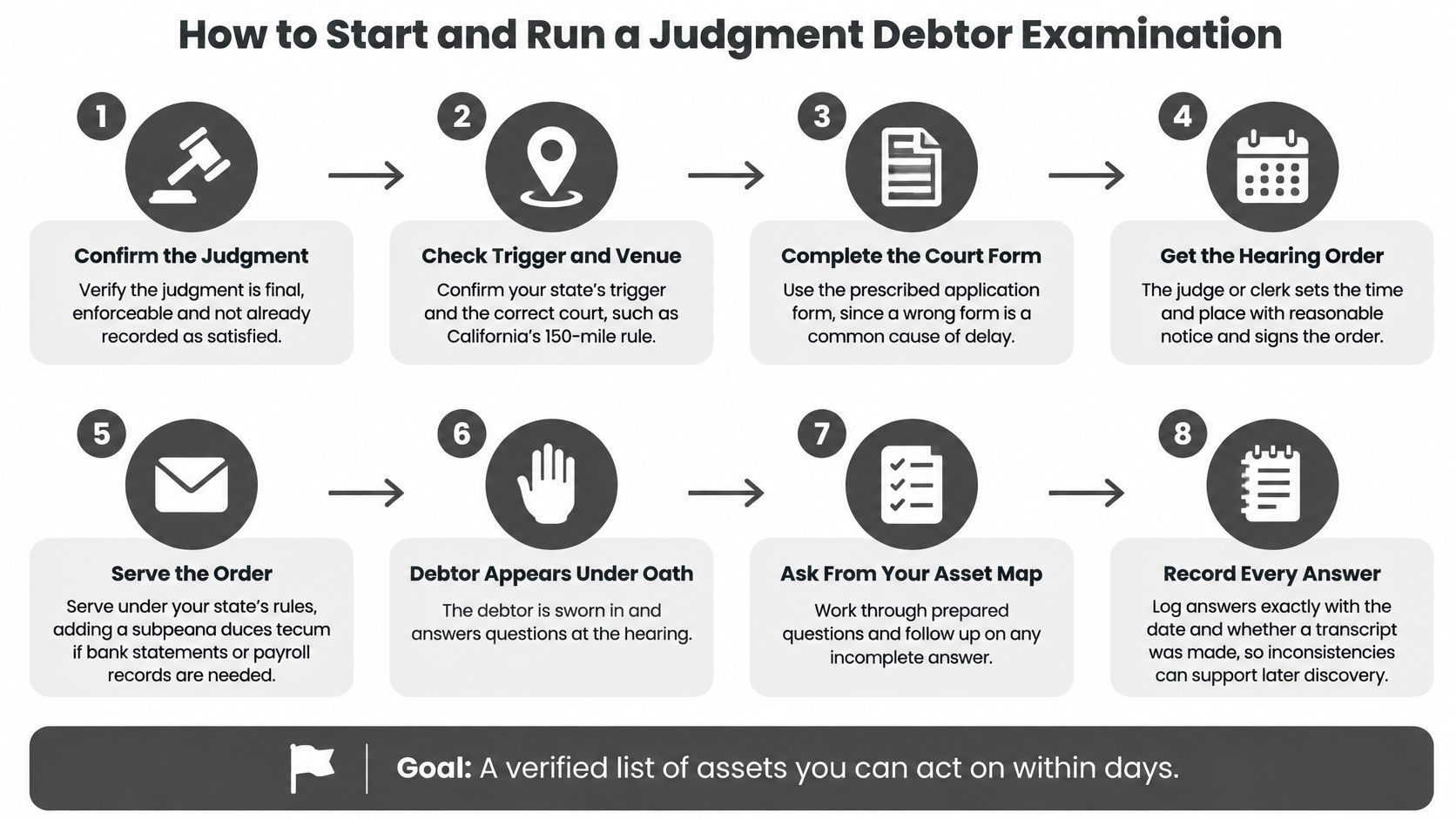
Confirm the judgment. Verify entry, enforceability, the unpaid balance and whether satisfaction has been recorded. Review any stay before spending money on an application or service.
Check the trigger and venue. Identify the rule authorizing your request and the court permitted to hear it. Keep supporting records, such as an unsatisfied execution or proof of properly served interrogatories, with your application materials.
Complete the prescribed application. Use the court's current form rather than adapting a pleading from another state. In Connecticut, the application uses a form prescribed by the Office of the Chief Court Administrator.
Obtain the hearing order. Under Connecticut General Statutes § 52-397, a judge may set the hearing with reasonable notice, or the clerk may fix its time and place and sign the order when the application is properly completed. The same statute requires service under §§ 52-46 and 52-46a and allows a subpoena or subpoena duces tecum.
Serve the required papers. Arrange service in the manner required by the governing rules and retain proof. If documents are needed, use the appropriate document subpoena to specify bank statements, payroll records or other relevant materials rather than assuming the debtor will bring them voluntarily.
Establish the sworn examination. At the hearing, follow the court's process for placing the debtor under oath. Confirm the witness's identity and, for a business debtor, the witness's role and knowledge of its finances.
Work through your asset questions. Start with identification and income, then move through accounts, property and business interests. If an answer is incomplete, ask a concrete follow-up, such as the institution's name or who maintains the records.
Preserve accurate answers. Note the examination date, record answers precisely and document whether a transcript was made. Distinguish the debtor's actual statement from your interpretation so later discovery rests on an accurate record.
Define a usable result
A useful examination file identifies the asset, its apparent owner, its location and the records needed to verify it. You should also know what remains uncertain.
Don't mark a lead as verified merely because the debtor mentioned it. Assign a follow-up task to each promising answer so you can make enforcement decisions within days.
Questions to Ask and the Assets They Reveal
Build an asset map before the hearing. Include the debtor's legal name, aliases, employers, financial institutions, real property, vehicles, business entities, receivables, transfers and obligations owed by others.
The California Courts debtor-examination guide distinguishes financial questioning from the later execution process used to reach wages or bank funds. Prepare questions that supply the identifying details that later process requires.
Asset categories, questions and enforcement tools
| Asset category | Core questions to ask | Enforcement tool it may support |
|---|---|---|
| Employment and wages | Employer name, pay frequency, net pay, other income | Wage garnishment or wage levy |
| Bank accounts | Institution, account type, approximate balance, joint owners | Bank levy |
| Real property | Address, title holder, mortgage, estimated equity | Property execution or lien |
| Vehicles | Make, model, title holder, outstanding vehicle loan | Levy on personal property |
| Business interests | Entity name, ownership percentage, management role | Charging order or turnover relief where authorized |
| Receivables and third-party debts | Who owes the debtor, amounts, payment terms | Third-party garnishment where available |
| Recent transfers | Recipients, relationships, dates, amounts, consideration received | Further investigation or a transfer challenge |
These are potential tools, not automatic entitlements. The available remedy turns on ownership, applicable law and the kind of interest the debtor holds.
Ask for details that make an answer usable
Suppose the debtor says they work in consulting. Ask whether they're an employee or an independent contractor, who pays them, how payment arrives and whether invoices remain outstanding. Those answers may lead to different enforcement procedures.
For a business debtor, focus on entity structure, ownership percentages, receivables, payment processors, equipment and related-party transfers. A question about who receives customer payments may reveal more than a general request to list assets.
Preparation techniques used to prepare for a deposition also help here: organize topics, review existing documents and plan follow-up questions without scripting every exchange.
Compare the answers with public records and earlier pleadings. A mismatch is a lead to investigate, not proof of dishonesty. Prioritize the clearest potentially reachable source, such as a specifically identified employer or bank, rather than pursuing every disclosed asset equally.
Debtor Rights, Privilege and the Limits of Questioning
A properly served examination order isn't optional unless the law or court permits an alternative. But the obligation to appear and answer under oath doesn't give the creditor unlimited access to every private fact or document.

Privilege requires careful handling. A debtor may have a valid privilege against self-incrimination concerning particular answers. The result can also turn on jurisdiction-specific immunity provisions, so neither party should assume that every question must be answered or that a blanket refusal is sufficient.
If privilege is asserted, preserve the question and objection and seek a court ruling when necessary. Don't turn a disputed legal issue into threats or an argument with the witness.
A creditor's goal is usable financial information, not maximum exposure of the debtor's private life.
Keep financial discovery targeted
The California Courts examination-question guide illustrates the breadth of financial topics that questioning may cover. That breadth makes careful document handling important.
- Personal identifiers: Avoid placing full Social Security numbers or account numbers in public filings; use applicable redaction and protective procedures.
- Joint accounts and spouses: Establish ownership and contributions instead of assuming the entire balance belongs to the debtor.
- Third-party property: Separate the debtor's assets from property owned by a company, spouse or other person.
- Protected communications and business records: Distinguish financial facts from privileged legal advice, trade secrets and unrelated customer information.
Collection settings also differ. Omni Tax Help's discussion of your rights during IRS collection visits is useful if tax collection is involved, but an IRS interview follows a different framework from a judgment examination.
Where written disclosures are a lawful substitute, assess what they provide before demanding appearance. Targeted questions, secure records and properly resolved objections produce a more useful examination than invasive questioning that delays the proceeding.
Common Mistakes That Stall an Examination and Their Fixes
Procedural mistakes can prevent an examination from producing useful results before anyone asks a financial question. Check the application, service and judgment status as carefully as your question outline.
Mistakes that stall an examination
| Mistake | Consequence | Fix |
|---|---|---|
| Using a wrong or missing court form | Rejection or delay | Use the prescribed form for the court and case type |
| Improper service of the order | Hearing may be reset; enforcement of the order may fail | Follow governing service rules and retain proof |
| Filing in the wrong venue | Examination may be moved or denied | Confirm the debtor's residence, business location and applicable geographic rule |
| Ignoring the written-disclosure option | Financial information or an alternative procedure is overlooked | Check whether qualifying consumer-debt disclosures have been filed |
| Judgment already satisfied or presumed paid | Application may be unavailable or pointless | Verify status and timing, including Missouri's presumption-of-payment restriction |
| Treating the hearing as the endpoint | Disclosed assets remain uncollected | Prepare the appropriate levy, garnishment or lien procedure |
| Answers not recorded precisely | Later inconsistencies become harder to establish | Record exact answers in the asset map on the hearing date |
Use a pre-filing review
Compare the debtor's name on the application with the judgment. For an entity, confirm that you've identified the appropriate representative rather than naming an owner merely because that person signed the underlying contract.
Review requested documents for specificity. A request for relevant account statements is easier to administer than an unexplained demand for every financial record the debtor has ever maintained.
Before service: Confirm who must receive each document, how service must occur and what proof the court requires.
Assign responsibility for the next enforcement step before the hearing happens. Otherwise, even a detailed set of answers can sit unused while you decide who should obtain records or prepare papers.
Many correctable problems involve a form, service requirement or calendar entry. Catching them early is usually more practical than trying to repair the record after a missed hearing.
Turn Sworn Answers Into a Levy or Garnishment Plan
The days after the examination matter because information alone doesn't produce recovery. The California Courts examination-question guidance helps identify financial leads; your follow-through must connect those leads to legally available remedies.

- Verify the lead. Compare the testimony with available records and obtain missing details through lawful discovery.
- Determine ownership and reachability. An individual's ownership of a company doesn't automatically make the company's accounts available for that individual's debt.
- Choose the procedure. Evaluate wage execution, bank levy, property execution, lien, charging order or turnover relief under governing law. For account-related leads, review the steps involved in garnishing a bank account.
- Check exemptions and competing claims. Identify protected funds, secured interests and other claims before estimating recovery. If support enforcement affects an account, the Texas Child Support Law Office of Bryan Fagan explains the distinct process for releasing funds held for support arrears.
- Preserve inconsistencies. Retain testimony, documents and comparison records without treating an unexplained discrepancy as established fraud.
- Proceed promptly and lawfully. Prepare the required papers and calendar follow-up discovery, including any waiting period governing another examination.
Don't send sensitive information to the firm until you've spoken with an attorney and a written agreement establishing an attorney-client relationship is in place.
Kons Law's Debt Collection practice handles demand letters, negotiated settlements, litigation and judgment enforcement for businesses, lenders and creditors, including collection litigation throughout Connecticut. If you want to discuss your business law matter, contact Kons Law at (860) 920-5181. Visit Kons Law to request a confidential consultation through the online form, or call to discuss how sworn financial disclosures may support your next enforcement step.
