
An autocallable note can end successfully and still disrupt your investment plan. Once the issuer redeems it, future payments stop, and you may not find a replacement offering comparable income for comparable risk. That's why understanding this product requires more than reading its advertised return. You need to know when the income can stop, when principal can be lost, and whose promise you're relying on.
What an Autocallable Note Is in Plain Terms
An autocallable note is a bank-issued structured debt security whose payments depend on an underlying stock, index, exchange-traded fund, or basket, and which can end early if the underlying reaches a specified level on a scheduled date.
Think of it as a loan with a built-in tripwire. You lend money to the issuing bank. If the reference asset clears a contractual line on an observation date, the bank returns your principal plus the applicable return, ending the investment early.
If the tripwire isn't activated, the note keeps running. What you receive while it remains outstanding, and what you recover at maturity, comes from the payment formulas in its offering documents.

A loan, not ownership of the reference asset
Buying a note linked to a stock index doesn't mean you own the stocks in that index. You own the bank's debt obligation, with embedded options determining the market-linked payments.
A conventional fixed-coupon bond promises scheduled interest regardless of the stock market, subject to the issuer's ability to pay. An autocallable instead follows contractual market conditions, and some designs pay a return upon redemption rather than regular contingent coupons.
The structure has an established history. An academic study published by Springer identifies BNP Paribas's introduction of the first autocallable products in 2003 and examines 1,162 autocallable contingent-income securities found in SEC EDGAR filings from June 18, 2009, through June 4, 2013. In that sample, 43.3% had a one-year term, making that the most common maturity.
The basic trade: You surrender participation in long-term appreciation in exchange for conditional income or a specified call return, plus a conditional early exit.
So, what is an autocallable note from the buyer's perspective? It's a contractual payment arrangement, not a bond with an unusually attractive interest rate. The reference asset matters, but the contract determines how its performance reaches your account.
How Barriers and Observation Dates Set Your Payout
Payout features and what each one controls
| Feature | What it controls | Reference value in filed terms | Effect when triggered |
|---|---|---|---|
| Observation date | When the autocall test is run | Scheduled dates set per note | Early redemption if the test is met |
| Non-call period | Earliest date early redemption can occur | The contract's initial period before call eligibility | No autocall before the period ends |
| Autocall barrier | Whether the note is redeemed early | Initial reference level in an at-the-money call design | Principal plus the applicable call return becomes payable |
| Coupon barrier | Whether a contingent coupon is paid that period | 75% of initial value in the quarterly-coupon example | A failed test means no current coupon; the note may continue |
| Maturity barrier | Whether principal receives conditional protection | The downside threshold specified in the final terms | Below the threshold, the contract's loss formula applies |
The quarterly-coupon example in SEC-filed offering terms requires each underlying to remain at or above 75% of its initial value for a coupon to be payable. The table separates the contractual tests because they answer different questions.

Follow the payment sequence
Start with the calendar. A favorable market level between observation dates doesn't necessarily produce a payment or redemption. The issuer applies the test on the dates, using the valuation method, stated in the contract.
Next, check whether the note is eligible to be called. A non-call period postpones the earliest possible automatic redemption. Once that period ends, satisfying the autocall condition terminates the note under its settlement provisions.
Then examine the coupon condition separately. A note can fail its autocall test yet satisfy its coupon test, allowing the investment to continue with a payment. Conversely, the investment may remain outstanding without paying income.
In a worst-of note, every underlying must satisfy the relevant threshold. Strong performance by the other assets doesn't cancel out the weakest asset's failure. A basket is therefore not necessarily diversified protection against a missed payment.
A barrier isn't necessarily a loss cushion
The coupon barrier governs income. The maturity barrier governs the principal repayment formula. Receiving coupons doesn't establish that principal will be returned intact.
Some contracts include coupon memory, which allows previously missed coupons to become payable if later conditions are satisfied. Without that feature, a missed coupon may be permanently lost. Don't assume the issuer will catch up payments merely because the asset recovers.
A downside barrier can be a switch that activates exposure to the asset's full decline, not a deductible that absorbs the first part of your loss.
Higher autocall barriers generally make redemption harder to achieve. Higher coupon barriers make income harder to receive, while higher downside thresholds generally provide less room for declines. Those features can support a higher advertised return, but they don't provide the same economic benefit.
Before calling the headline rate income, locate the observation schedule, each separate barrier, and the provisions governing missed payments.
A Worked Example From Called Early to Held to Maturity
Consider illustrative terms described in an SEC-filed offering document: $1,000 principal, a 100% call level, an 80% downside trigger, and an 8.50% annualized call return. These are scenario inputs, not a quote or a promise that every note has these features.
Illustrative payouts on a $1,000 autocallable note
| Scenario | Assumed terms | Outcome for the investor |
|---|---|---|
| Called on first observation date | 100% call level, 8.50% annualized call return | Principal plus the call return for elapsed time; no further coupons |
| Not called, stays above 80% trigger | Separate contingent-coupon terms are assumed to be satisfied | Coupons, if provided by the contract, are paid while the note runs; principal returned at maturity |
| Not called, finishes below 80% trigger | Principal adjusted by the asset's full percentage decline | A hypothetical 40% decline produces a $600 principal repayment |
| Total loss of the underlying | Underlying falls to zero | Under a full-downside formula, the principal repayment can be zero |
The calculated loss illustration applies the contractual method: original principal multiplied by the asset's remaining proportion of initial value. It doesn't subtract only the decline beyond the trigger.
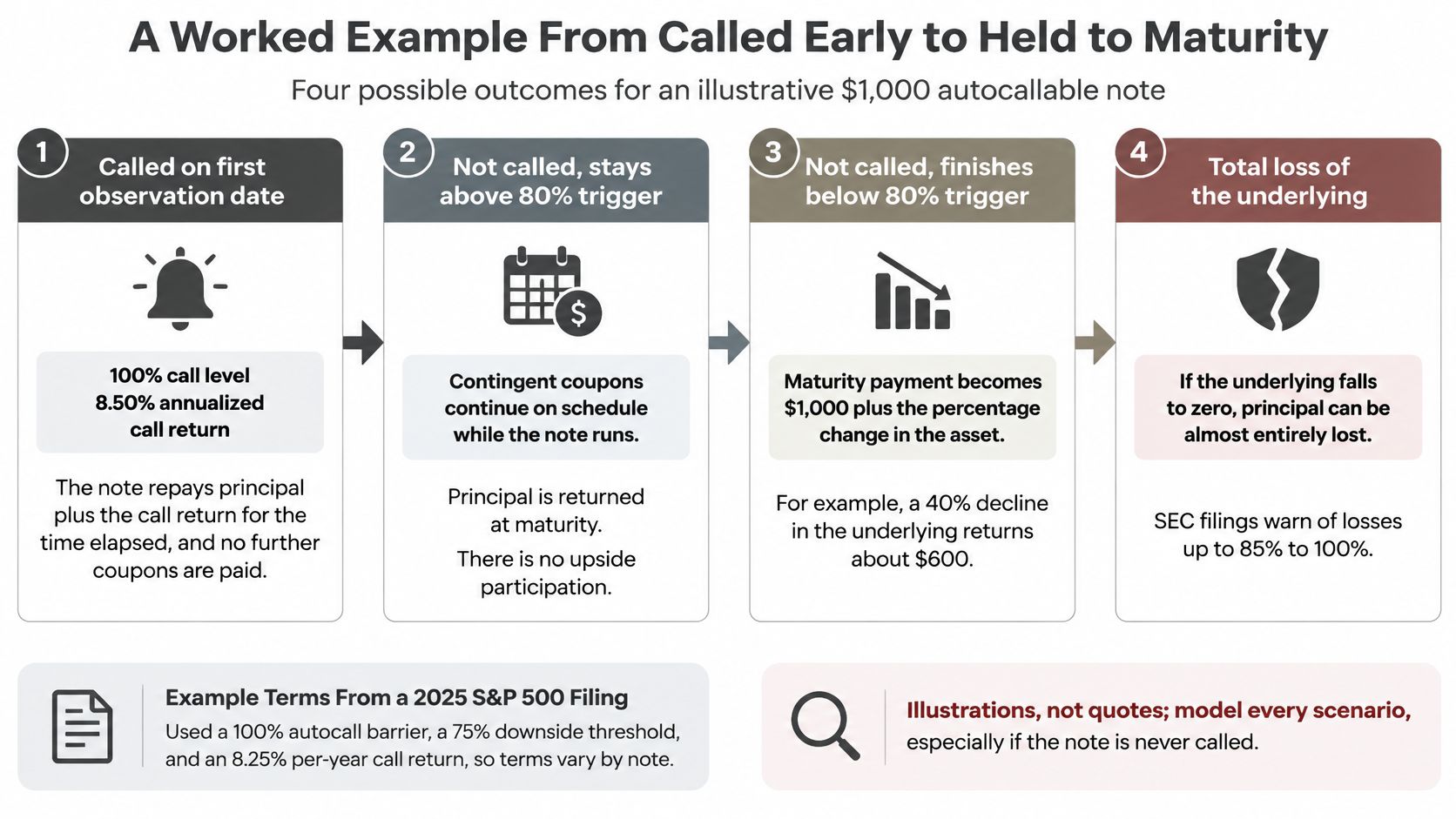
Read these as alternative outcomes
In the early-call scenario, annualized doesn't mean the investor receives a full year's return regardless of holding time. The applicable return reflects the elapsed period and the contract's calculation convention.
If the note isn't called, distinguish a downside trigger from a coupon condition. Remaining above the downside trigger doesn't, by itself, entitle the investor to coupons. A call-return-only note and a contingent-income note can have materially different cash flows.
Below the trigger at final valuation, the investor may bear the full asset decline. Under the illustrated formula, the loss isn't limited to the amount by which the asset missed the threshold.
The same SEC document describes a 2025 S&P 500-linked structure with a 100% autocall barrier, a 75% downside threshold, and an 8.25% per-year call return. Those different terms illustrate why a familiar product label isn't enough to evaluate a purchase.
Model the outcome in which the note is never called, not just the attractive redemption scenario. And keep payoff risk separate from access to cash, a distinction also relevant when evaluating products such as auction-rate securities, even though their mechanisms differ.
Why Early Redemption Can Cost You Income
Suppose you purchase a note to fund an ongoing spending need. The issuer calls it while that need continues. You get the contractual redemption payment, but you must now decide where to place the returned money.
That can be a successful contractual outcome and an inconvenient financial outcome. SEC-filed reinvestment-risk disclosures warn that a called note stops making payments and that a replacement investment may not offer a comparable return for comparable risk.
Evaluate the investment after redemption
Use this working checklist before treating an early call as a win:
- Calculate the realized annualized return. Use the actual purchase price, payments received, redemption proceeds, and holding period. Don't confuse a quoted annualized rate with the total cash earned.
- Compare available replacements. Look at products with comparable credit exposure, market risk, and liquidity, not merely a matching headline coupon.
- Match the remaining cash-flow need. Decide whether returned principal can remain in cash or whether spending obligations require immediate reinvestment.
- Account for replacement risk and costs. A new note brings a new observation schedule, payoff formula, issuer exposure, and potential transaction costs.
The structure also limits your ability to benefit from a later rally. An asset can recover enough to trigger redemption without delivering the long-term appreciation you would have received by owning it directly.
If the asset instead declines but still satisfies the coupon condition, you might receive income without participating in subsequent upside. The contract pays according to its formula, not according to the investor's broader view of the market.
Portfolio question: If several notes were redeemed together, where would you place the returned cash without increasing risk?
Advisors should examine overlapping observation schedules as well as stated maturities. Repeated purchases can create a portfolio in which multiple notes become callable during the same market recovery, leaving the client with an unplanned cash allocation.
Early repayment reduces the time your money remains exposed to that particular note. It doesn't guarantee that the overall income strategy has succeeded. The practical question is what happens after the note is called, not just whether its advertised return looks attractive today.
Principal Loss and Issuer Credit Risk Explained
The word protection can encourage a bond-like reading that the contract doesn't support. Conditional principal protection means the investor receives a specified outcome only if the contractual requirements are satisfied.
In one SEC-filed structure, a decline of more than 50.00% in the least-performing underlying can result in delivery of that underlying's shares rather than an intact cash principal repayment. Receiving shares doesn't erase the loss; it leaves the investor holding the depreciated asset.

Separate the risks before judging the yield
Market-linked principal loss comes from the contractual payoff formula. The underlying's performance determines whether the downside provision applies and how much the investor recovers.
Issuer credit risk comes from lending to the issuing institution. SEC-filed credit-risk disclosures explain that the notes are unsecured obligations, not deposits or government-guaranteed securities. An issuer default can prevent payment even when the reference asset performs favorably.
These exposures coexist. Choosing an index you understand doesn't remove the need to evaluate the bank that owes you money. For a broader business perspective on evaluating another party's ability to perform, Lighthouse Consultants' discussion of counterparty risk for UK businesses provides useful context.
A sale price isn't a maturity payment
Mark-to-market loss is different from loss under the final repayment formula. Before maturity, a note's secondary-market value can decline because of changes in volatility, interest rates, remaining term, distance from a barrier, liquidity, or the issuer's creditworthiness.
That means an investor who needs cash may receive less than the purchase price even if the note could later qualify for full contractual repayment. An expected future autocall isn't the same as an executable sale price today.
A loss alone doesn't establish misconduct. If the concern is an inaccurate description, omitted risk, or misleading recommendation, understanding what constitutes securities fraud helps separate the product's disclosed risks from possible wrongdoing.
Treat the advertised yield as compensation for contractual exposures, not evidence that the investment is safe. The issuer's ability to pay matters just as much as the reference asset's ability to meet a threshold.
Check These Terms Before You Invest
The coupon on the cover page is the sales pitch. The cost sits in the call schedule and in who is obligated to pay you. Work from the final offering documents and pricing supplement, not a sales presentation. Ask the person recommending the note to identify the controlling language for each payment and each loss.
An early call can look like a clean win until you try to replace the income. After any non-call period, the issuer may redeem when the reference asset is at or above the autocall level. You receive the stated call return, then you hold cash that may earn less than the coupon that just ended. That reinvestment gap is part of the price of the note. The reference index does not owe you the money. The issuer does, along with any guarantor the documents name. If that bank weakens, coupon and principal are claims on its credit, even when the index never misses a level.
Run the final documents through this checklist before you commit.
Locate the observation dates and non-call period. Mark the first possible redemption date, the valuation dates, and the payment dates. The market level you see during the day may not be the level used for the contractual test.
Read the autocall level and the call-return calculation together. Establish whether the quoted return is annualized, how elapsed time is measured, and what payment follows each eligible call date.
Check the coupon provisions. Determine whether coupons are conditional, whether missed payments expire, and whether a memory feature permits later recovery. Ask whether the note can remain outstanding and pay no income.
Write out the maturity loss formula. Identify the threshold, the monitoring convention, and the settlement method. Establish whether you receive cash or securities and whether losses reflect the full decline in the underlying.
Identify every underlying and any worst-of rule. Do not judge a basket by its best-known constituent or by average performance. Determine which asset controls each contractual test.
Confirm who owes the money. Read the issuer and guarantor provisions, if any, and weigh credit standing and unsecured status beside the barrier. A payment the bank cannot make is a loss the index cannot cure.
Test the exit plan. Ask whether a secondary market is expected, whether anyone is obligated to provide one, and how a bid would be obtained. Consider the bid-ask spread and a sale below your purchase price.
Prepare the replacement plan. Compare the return you would receive, the alternatives then available, the cash flow you still need, and the cost of putting the proceeds back to work. Decide that plan before an early call forces the choice.
Keep the recommendation record
Retain the term sheet, final documents, account statements, written communications, and any explanation of suitability or liquidity. If a disagreement later turns on what was recommended or disclosed, those records are what you will need in securities arbitration.
If you cannot explain the payment conditions, the call dates, and the maximum contractual downside in your own words, do not let the headline rate make the decision.
Kons Law represents investors and financial professionals in securities disputes and provides counsel on business law matters. To discuss concerns about a structured-product recommendation or your business law matter, visit Kons Law to request a consultation.
