
The most repeated advice on this topic is also the most expensive. File the proof of claim, then wait for a check. That advice treats liquidation as an automatic payout. It is not.
A claim on paper is not cash in hand. Someone has to gather the assets, sell them, pay the people who stand ahead of you, and only then divide what is left. If you miss a deadline, leave a lien unperfected, or stay quiet while property sells cheap, your recovery drops even when nobody disputes the debt.
Creditors' rights in liquidation are a set of levers: collateral, timing, objections, and active oversight of the person running the estate. Use them. Waiting is a choice to take whatever dividend is left.
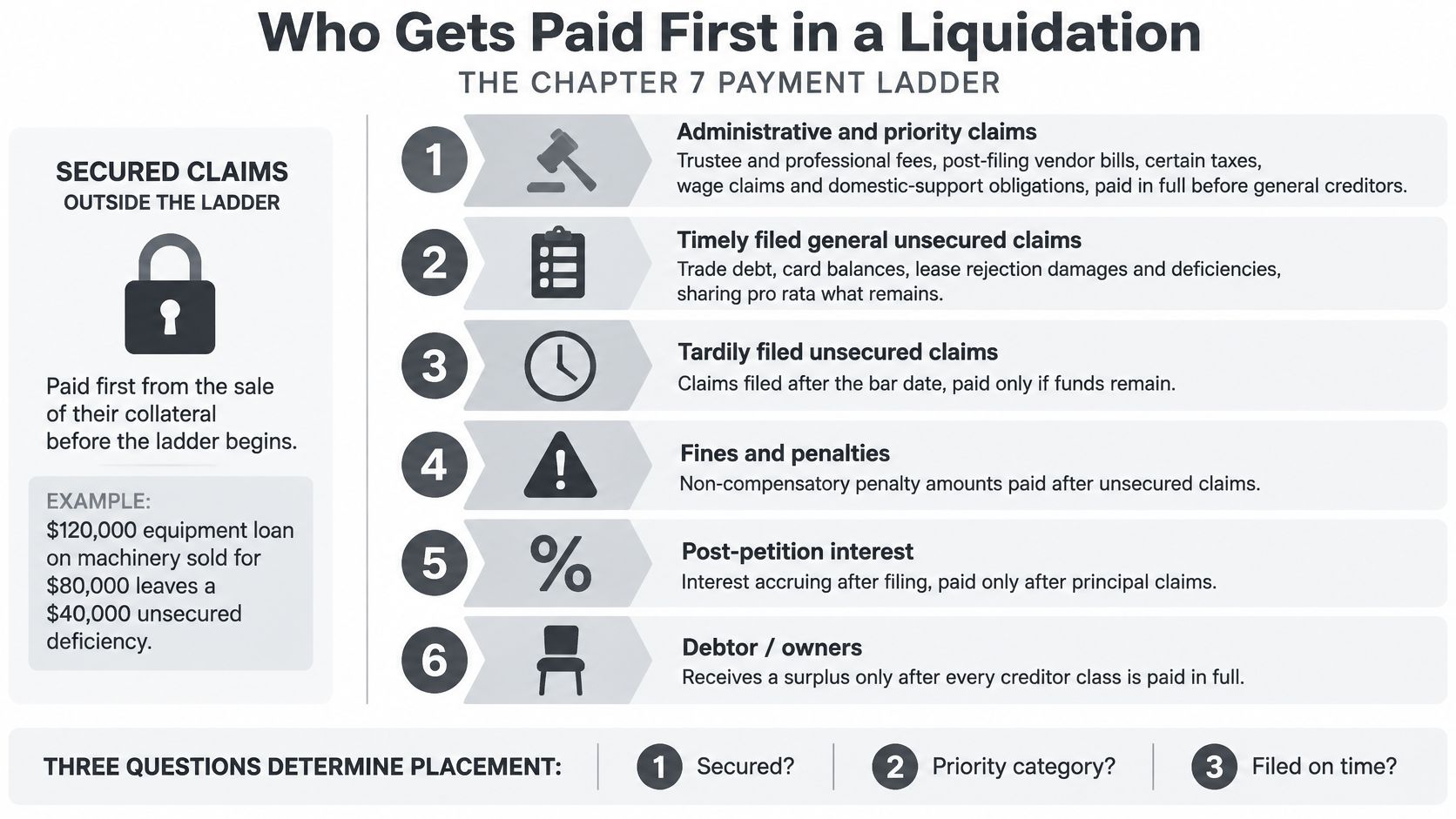
Who Gets Paid First in a Liquidation
Think of a liquidation as a lifeboat with fixed seats. Your seat depends on your claim class, not on who called the trustee first or who is owed the most. The trustee, or a state-court assignee, collects nonexempt property, sells it, and pays claims in a fixed order.
Secured claims sit outside the ladder. A lender with a perfected lien is paid from the sale of its own collateral before the general pot is built. Say a lender holds a $120,000 equipment loan and the machinery sells for $80,000. The lender takes the $80,000. The $40,000 shortfall drops into the general unsecured class and shares whatever is left with trade creditors.
| Order | Claim class | What it covers | Where it stands |
|---|---|---|---|
| Outside the ladder | Secured claims | Mortgages, equipment loans and liens | Paid from the sale of collateral before the ladder begins |
| 1 | Administrative and priority claims | Trustee and professional fees, post-filing vendor bills, certain taxes, wage claims, domestic-support obligations | Paid in full before any general creditor |
| 2 | Timely filed general unsecured claims | Trade debt, card balances, lease rejection damages, deficiency after collateral sale | Share pro rata whatever remains |
| 3 | Tardily filed unsecured claims | Claims filed after the bar date | Paid only if funds remain after timely claims |
| 4 | Fines and penalties | Non-compensatory penalty amounts | Paid after unsecured claims |
| 5 | Post-petition interest | Interest accruing after the filing date | Paid only after principal claims |
| 6 | Debtor | Owners and equity holders | Receives a surplus only after all creditors are paid in full |
The Chapter 7 payment rule
In a U.S. Chapter 7 case, the trustee gathers and sells the debtor's nonexempt property, then distributes proceeds under the Bankruptcy Code. As the U.S. Courts Chapter 7 basics explain, section 726 sets six claim classes, and each class must be paid in full before the next lower class receives anything. A general creditor receives nothing until administrative and priority claims are satisfied. The debtor receives a distribution only after every creditor class is paid in full, which is why shareholders of an insolvent company usually recover nothing.
A plain walk-through of those classes, including how wage and tax claims fit, is in Chapter 7 priorities with LifeBack Law Firm.
Place the claim before you price it. Three questions put any claim on the ladder: is it secured, is it a priority category, and was it filed on time?
Why Collateral Decides Who Gets Money Back
A secured creditor holds a reserved seat tied to specific property. An unsecured creditor is in standing room, waiting on whatever the reserved seats don't take.
Three words decide that seat.
A lien is the creditor's legal claim on particular property. Perfection is the step that makes the lien effective against other creditors, usually a public filing or possession of the collateral. A deficiency is the unpaid balance after the collateral is sold. A $100,000 truck loan secured by a truck that sells for $60,000 leaves $40,000 as an unsecured claim. That $40,000 no longer rides with the lien. It stands in line with everyone else.

Likelihood is not the same as amount
A Government Accountability Office review of 56,994 closed asset bankruptcy cases found that general unsecured creditors received distributions in 58.3% of cases, more often than any other class. They still received only 22.2% of total receipts, an average of $7,670 per case. Secured creditors received 24.8% of total receipts and averaged $8,600 per case.
Getting something and getting a meaningful amount are different measures. Unsecured creditors often appear on a distribution list. Collateral, liens, administrative expenses, and priority claims still cap what they take home.
Three checks before the sale
- Verify perfection: Confirm the filing in the right state office, on the right debtor name, covering the right collateral. A financing statement that misses the legal name can drop you into the unsecured line. Our note on what a secured creditor is walks through how that status is created and lost.
- Watch the sale price: A low bid on your collateral shrinks your secured recovery and inflates the deficiency. If two pieces of collateral could be applied in more than one order, understanding marshalling of assets in Wisconsin shows why the order of sale changes who is left short.
- File the deficiency on time: The shortfall is a separate unsecured claim. It needs its own timely proof, with the sale numbers attached.
How to File a Proof of Claim on Time
A late claim can lose its seat. In a Chapter 7 case, the general bar date is 70 days after the petition date. Governmental units generally have 180 days after the order for relief. State liquidations set their own deadlines, and the notice in that case controls. Read it the day it arrives.

File it in this order
- Read the notice and write down the bar date. Calendar it with a reminder a week out. A claim filed the day after the bar date falls to the tardy class and is paid only if money remains.
- Gather the proof. Pull the signed contract, invoices, the account statement, and any lien documents. The trustee will not reconstruct your file.
- Complete the official proof of claim. State the amount as of the petition date. Split principal, interest, and fees so a later objection can be answered line by line.
- Classify the claim. Mark it secured, priority, or general unsecured, and attach the documents that prove that box. A trade invoice does not support a secured box. A filed financing statement does.
- File with the bankruptcy court, electronically or by mail, and keep the confirmation. The confirmation is your evidence of the filing time.
- Check the claims register and the trustee's report. Confirm the claim was docketed in the class and amount you filed. A data-entry error is common and fixable only if you catch it.
- Answer any objection, and amend before the bar date if you find an error in amount or class. An amendment after the deadline is harder to protect.
Three mistakes that shrink the claim
Filing under the wrong class is the most common. A wage claim, a tax claim, and a trade balance are not interchangeable, and the wrong box can waive priority you hold.
Omitting lien paperwork turns a secured claim into an unsecured one on the register, even when the lien is valid in the filing office.
Assuming the trustee filed for you is the quiet killer. In an asset case you generally must file your own proof. If no claim is on the register in your name, you are not in line.
If the notice and the contract disagree on the amount, file the contract figure by the bar date and explain the difference in the attachment. Silence does not preserve the higher number.
Automatic Stay and How to Get Relief From It
When a bankruptcy petition is filed, most collection stops by itself. No separate court order is required. The automatic stay under section 362 is in force the moment the case is filed.
It blocks collection calls and letters, lawsuits, wage garnishment, repossession, foreclosure, and setoff. Keep collecting and you risk sanctions plus a damages claim. That risk is real even when you didn't know about the filing, so check PACER or call counsel before the next demand goes out.
How a secured creditor gets moving again
The Department of Justice civil resource manual explains that a trustee may satisfy a secured claim through a sale under 11 U.S.C. § 363, abandonment under § 554, or another disposition under § 725. A secured creditor may pursue foreclosure or setoff only after obtaining relief from the automatic stay under § 362.
The path is a motion, not a phone call.
- File a motion for relief from stay aimed at a specific asset, not the whole case.
- Show the ground. Lack of adequate protection, or no equity in the collateral for the estate, is the usual showing.
- Ask the court to lift the stay for that asset so you can foreclose, repossess, or set off.
A lender with a $30,000 lien on a vehicle worth $12,000, and no equity for the estate, has a stronger motion than a lender whose collateral the trustee plans to sell for everyone's benefit. In the second case, fight the sale terms. Don't assume the court will hand the asset back.
Two edges people miss
The stay generally does not stop collection from a non-debtor guarantor unless the court orders otherwise. You can usually keep pursuing the guarantor while the debtor's case runs.
Request relief early. Waiting while the trustee controls the asset costs time, and collateral value rarely improves in storage.
Avoidance Actions That Pull Money Back Into the Estate
Avoidance is a reversed transaction. The trustee asks the court to undo certain pre-filing transfers so the money comes back into the estate and is shared under the ladder, not kept by whoever was paid last.
A preference is a payment on an existing debt, made while the debtor was insolvent and inside the look-back window, that lets that creditor receive more than it would in a liquidation. Say a supplier receives $25,000 sixty days before the filing. If that payment improved the supplier's position over other unsecured creditors, the trustee can demand it back.
A fraudulent transfer is different. It is a transfer for less than reasonably equivalent value while the debtor was insolvent, or a transfer made with intent to hinder creditors. Moving a building to a family member for a nominal price is the classic pattern. Our overview of what a fraudulent conveyance is covers how those claims are pleaded outside bankruptcy as well. For the Chapter 7 version in one state, understanding bankruptcy transfer avoidance in Georgia is a clear primer on what the trustee can reach.

| Transfer type | Look-back period | Trigger | What it means for creditors |
|---|---|---|---|
| Fraudulent transfer (§ 548) | 2 years before filing | Transfer for less than reasonably equivalent value while insolvent, or with intent to hinder creditors | Recipient may have to return property or its value |
| State fraudulent transfer (§ 544(b)) | Generally up to 4 years, depending on state law | Same core concepts as state transfer statutes | Trustee may use a longer state-law reach-back |
| Ordinary course payments | Within the preference window | Regular payments made on normal business terms | Often defensible against avoidance |
Defenses, and what you should do
Three defenses show up constantly. Ordinary course payments made on normal terms are often safe. New value given after a payment can offset the amount the trustee can claw back. A contemporaneous exchange, goods or services delivered at the same time as payment, is not a payment on an old debt.
If you received money inside the window, expect a demand letter and keep invoices, delivery records, and the payment history. If you are still owed money, send the trustee the documents that show the transfer pattern. The trustee decides whether to sue, and a thin file often means no suit and a smaller pot for everyone else.
Bankruptcy Versus State Liquidation for Creditors
Creditors rarely pick the forum. The debtor usually does, by filing bankruptcy or handing assets to an assignee under state law. You can still push. One creditor may file an involuntary bankruptcy petition if the debtor has fewer than 12 creditors. If the debtor has 12 or more, three or more qualifying creditors must join.
| Feature | Federal bankruptcy (Chapter 7) | State liquidation |
|---|---|---|
| Governing law | Bankruptcy Code and federal courts | State statutes and state courts |
| Who runs the process | Chapter 7 trustee | Assignee or receiver chosen under state law |
| Automatic stay | Automatic on filing under § 362 | Often no automatic stay; the state statute controls |
| Priority rules | Section 726 sets six classes, each paid in full before the next | Set by state law and may differ from the federal ladder |
| Avoidance powers | Federal preference and fraudulent transfer rules | State transfer statutes with varying reach-back |
| Claim filing | Proof of claim filed with the court by the bar date | Claim filed with the assignee or receiver by the notice deadline |
| Discharge | Available to individual debtors; corporations typically do not receive one | Generally no federal discharge; outcome follows state law |
Where the differences hit your recovery
The stay, the avoidance powers, and the discharge are the rows that change the math. Chapter 7 freezes collection nationwide the day the petition is filed, and the trustee can reach preferences and fraudulent transfers under federal rules. A state process is often faster and cheaper, but it frequently has no automatic stay, so a faster creditor can still grab an asset. Reach-back periods and priority rules come from the local statute. Read that statute. Do not assume the federal ladder applies. In Florida, an assignment for the benefit of creditors is one of those state paths, and the assignee's notice, not a bankruptcy bar date, sets your filing clock.
Cross-border cases add a further step. A lien that was valid where it was created can still need local recognition before you can sell the collateral where it sits. Equal treatment of foreign creditors does not mean an identical check.
When the assets are modest and one secured creditor dominates, a state process often returns money faster. When many creditors are competing, or avoidance claims are worth pursuing, federal bankruptcy usually gives stronger tools.
Protect Your Recovery Before the Case Closes
The single action that matters most is this: confirm where your claim sits before the case closes. A closed case with your claim misclassified is very hard to reopen, and the money will already have moved.
The closing checklist
- Confirm class and amount. Match the register to your books. Separate principal, interest, and fees so you can see what the proposed dividend covers.
- Confirm the filing. The claim must be on the register, in your name, by the bar date. If it is missing, fix it before the trustee files a final report.
- Confirm the lien and the sale notice. Perfection and notice are different jobs. Our guide on how to perfect a security interest is the checklist for the first. Then read every sale notice. An unperfected lien, or a sale you never objected to, is how collateral value leaves your column.
- Decide whether to object, and whether to join a committee. Object to a low sale, a bloated fee application, or a distribution that mislabels your claim. If a creditors' committee forms, join it. That is where sale terms and investigations get shaped, not in a letter sent after the order is entered.
- Preserve preference-window records. Keep proof of what you were paid, and on what terms, so an avoidance demand does not become a default judgment against you.
- Read the final report for late-found assets. Property recovered after an apparent closing can still be distributed to unpaid claims. Keep your claim alive and your address current so those funds can reach you.
Run the cost test before you spend
Every objection has a price. Multiply your claim by the likely dividend rate, subtract the cost of pursuing the tactic, and compare that result with the cost of doing nothing.
Say you hold a $50,000 unsecured claim and the trustee's numbers point to a 10-cent dividend. The expected recovery is $5,000. A motion that will cost $6,000 to litigate fails the test unless it also raises the dividend or protects a secured position worth more than the fee. Skip any tactic where the expected dividend does not justify the expense.
Kons Law's debt collection work includes guiding clients through court proceedings, garnishment, and asset recovery, and we handle collection litigation throughout Connecticut. If you want to discuss your business law matter, contact Kons Law at (860) 920-5181.
Kons Law's Debt Collection & Creditors' Rights practice pursues demand letters, negotiated settlements, litigation, and judgment enforcement for businesses, lenders, and creditors who need a claim turned into money. If a liquidation, an assignment, or a stubborn commercial balance is sitting on your books, Kons Law can walk the priority, the deadlines, and the enforcement steps with you. Call (860) 920-5181.
