
A senior advisor has agreed to join your brokerage firm. The candidate appears qualified, has a substantial client following, and wants to move quickly. Then someone asks for a client spreadsheet before the resignation is complete, a compensation term remains vague, and the former firm sends a demand letter alleging improper solicitation. What looked like a routine hiring decision has become a compliance, employment, and arbitration problem.
A sound protocol for broker recruiting treats the move as an operational business process, not a signature on a recruiting agreement. It should control what happens before outreach, during interviews, at resignation, throughout compensation negotiations, and during the advisor's first months at the new firm. The Protocol for Broker Recruiting is central, but it works only when the firm builds disciplined procedures around it.
Why Broker Recruiting Requires a Formal Protocol
A broker-dealer can lose control of a transition long before the new advisor contacts a client. The risk often begins when a recruiter asks for too much information, a hiring manager promises compensation that compliance hasn't reviewed, or an advisor assumes that every client record is protected by the Protocol.
The Protocol for Broker Recruiting was created in 2004 by major brokerage firms to reduce litigation when registered representatives move between firms. It permits a departing representative at a signatory firm to take a limited set of customer information, including client names, addresses, phone numbers, email addresses, and account title information, provided the representative leaves a copy with the former employer upon resignation. A law-firm summary reported that the framework had more than 1,800 signatories by 2019. The historical development and purpose of the Protocol explain why it became a foundational norm in major U.S. brokerage markets.
Practical rule: The Protocol creates a controlled path for mobility. It doesn't give a firm permission to take every useful item in an advisor's book.
The legal rule is only one layer
A recruiting process should answer operational questions that the Protocol itself doesn't resolve:
- Who verifies that both firms are signatories?
- Who approves the initial outreach?
- Who reviews Form U4 information and employment restrictions?
- Who controls the client-data handoff?
- Who explains transfer disclosures to the advisor?
- Who monitors communications after the move?
- Who preserves records if the former employer files an arbitration claim?
The firm should also understand its broader regulatory environment. FINRA member firms operate within detailed supervisory and registration obligations, and Kons Law's discussion of FINRA member firms provides useful context for owners evaluating the structure around recruiting and supervision.
Technology can support administrative work, but it can't replace legal judgment. A firm might use a platform such as dreach for staffing agencies to organize recruiting activity, yet the compliance team still must decide whether a proposed contact, document, or data field is permissible.
Mobility creates a business-planning issue
FINRA Rule 2273 adds a separate disclosure obligation. Adopted in 2016, the rule requires a recruiting firm to deliver an educational communication to former customers contacted about transferring assets after a financial professional moves between broker-dealers. FINRA says the notice must highlight the direct and indirect impacts of an asset transfer. FINRA's Rule 2273 guidance describes the requirement and its application.
A formal process therefore protects more than the firm's litigation position. It protects client choice, preserves evidence, reduces transition friction, and forces the business to determine whether the recruit can succeed inside the firm's actual platform.
Pre-Contact Due Diligence Before Recruiting Outreach
The first recruiting call should occur only after the firm has completed a documented screening process. Early diligence helps the firm distinguish a portable business opportunity from a candidate whose restrictions, history, or operating model create unacceptable exposure.
Confirm the legal path
Start by verifying whether the candidate's current firm and your firm are Protocol signatories. Obtain current confirmation through the firms' compliance departments or counsel, and preserve the verification in the recruiting file. Signatory status matters because a transition outside the Protocol requires a different risk analysis and may involve stricter non-solicitation, confidentiality, and trade-secret restrictions.
Next, obtain the candidate's current registration information and review the available regulatory record. The file should address:
- Registration status: Record the candidate's CRD number, current registrations, and supervisory responsibilities.
- Employment history: Compare the candidate's disclosures with public filings and identify unexplained gaps or terminal dates.
- Customer disputes: Review customer complaint and dispute entries, disciplinary history, and any notation that warrants follow-up.
- Form U4 and Form U5 issues: Ask the candidate to explain material disclosures and obtain counsel's assessment before the firm makes a final offer.
- Contract restrictions: Identify garden-leave, non-solicitation, confidentiality, non-compete, and repayment provisions.
A background check can help identify inconsistencies, but the firm should use a lawful, documented process and give the candidate an opportunity to address adverse information. Kons Law's guidance on background checks in Connecticut is a useful resource when designing that review.
Test the book without taking protected information
Ask for an aggregate business profile, not a client dump. The candidate can discuss production history, service model, account types, geographic concentration, staffing needs, and general portability without delivering account balances, transaction histories, investment strategies, or proprietary reports.
Under the Protocol, the permitted customer fields are narrow. Account balances, transaction histories, investment strategies, household profitability data, and internal notes generally require separate analysis and shouldn't be treated as automatically protected.
Document the decision
Create a compliance memorandum before outreach begins. It should identify the signatory status, restrictions, regulatory findings, permitted information, unresolved questions, approving personnel, and proposed communication boundaries. If the facts don't support a Protocol-covered approach, pause the recruitment rather than allowing a business deadline to drive an improvised workaround.
Outreach and Interview Best Practices Under the Protocol
Recruiting outreach should sell the firm's platform, supervision, technology, culture, and transition support. It shouldn't become an informal client-solicitation planning session.
The first conversation should stay at a general level. Discuss the role, compensation framework, training, staffing, technology, and business objectives. Don't ask the candidate to send a client list, account statement, contact export, household report, or internal production dashboard. If the candidate volunteers specific customer information, stop the discussion and redirect it toward aggregate descriptions.
A useful recruiting team can also consult recruitment lead generation tips for general sourcing practices, while keeping financial-services outreach subject to the firm's compliance review.
Build checkpoints into interviews
Interview questions should test judgment as well as production ability. Ask the candidate:
- What information do you understand you may take under the Protocol?
- What information will remain with your current firm?
- Have you reviewed your employment agreement and any repayment obligations?
- Have you experienced a prior transition, and what did you learn?
- Who will supervise client communications after the move?
- What operational support will you need during data migration and account transfers?
- How will you respond if a former client contacts you before the transition is complete?
The answers reveal whether the advisor sees the move as a controlled process or as an opportunity to copy an entire business record. A candidate who resists basic boundaries may create more risk than the projected book justifies.
Explain Rule 2273 before the offer
The advisor should understand that FINRA Rule 2273 requires an educational communication to former customers contacted about asset transfers. The notice must explain direct and indirect impacts of transferring assets. Make that obligation part of the interview record, and tell the candidate that client-facing scripts, emails, and transfer materials require approval.
A compliance-first conversation also builds credibility. Candidates often want to know whether the new firm can provide real transition support, not merely a signing payment. The firm should describe who handles registration, technology training, repapering, marketing review, and escalation. Those commitments should later appear in the onboarding plan.
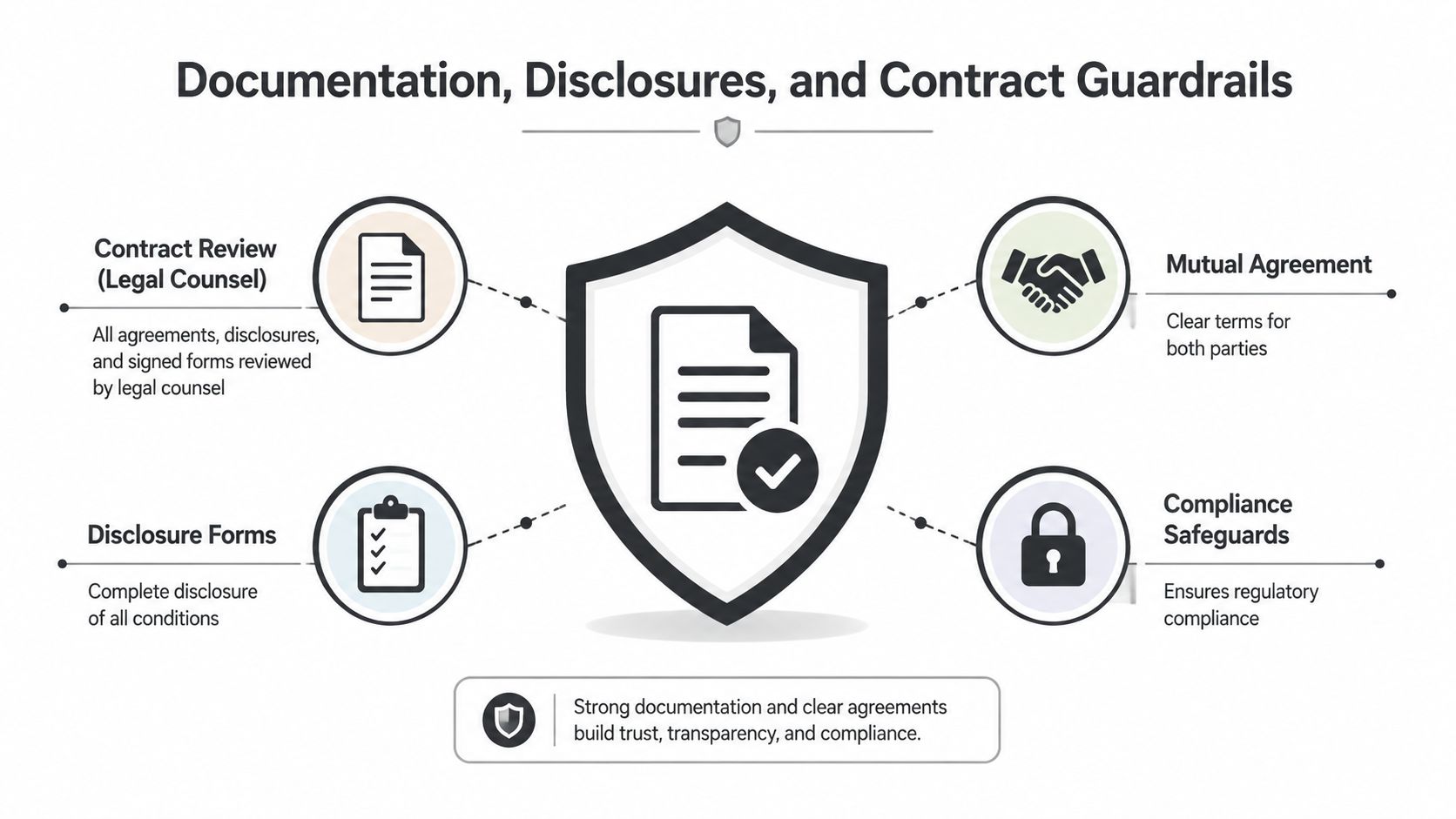
Documentation, Disclosures, and Contract Guardrails
Once the firm decides to proceed, verbal assurances become liabilities unless the parties convert them into precise documents. The onboarding file should allow a compliance officer, arbitrator, or judge to reconstruct the transition without relying on memory.
Assemble the core file
Use a single controlled file containing:
- Protocol verification: Preserve evidence that both firms were signatories when the recruiting decision was made.
- Candidate acknowledgment: Obtain a signed statement confirming the candidate understands the permitted data fields and departure procedure.
- Regulatory disclosures: Record the candidate's understanding of Rule 2273 and the firm's approval process for customer communications.
- Policy delivery: Provide policies covering solicitation, records, confidentiality, conflicts, technology, and supervision.
- Departure checklist: Confirm the return of company property and proprietary information, and document that only permitted data was retained.
- Approval record: Identify the business, compliance, and legal personnel who approved the move.
The resignation procedure matters. The Protocol generally requires the representative to leave a copy of the permitted information, including applicable account numbers, with the branch manager or manager upon resignation. Counsel should review the precise circumstances and current Protocol terms before the firm relies on that procedure.
Make compensation enforceable
Compensation documents should state production-credit formulas, vesting conditions, payment dates, eligibility requirements, forfeiture triggers, and repayment obligations. Avoid phrases such as “customary production credit” or “repay the advance if appropriate.” Those phrases invite competing interpretations.
Outstanding loans deserve separate treatment. State whether the new firm will provide assistance, whether the advisor remains responsible for the prior obligation, how any payment affects compensation, and what happens if the advisor leaves. A clear agreement should also address clawbacks, offsets, and the timing of any demand.
A transition agreement should answer the question, “What happens if the relationship ends?” before either party has a reason to ask it.
Non-solicitation and garden-leave provisions must account for the governing jurisdiction and the Protocol's limits. Counsel should assess enforceability rather than copying language from another firm. The result should protect legitimate business interests without suggesting that the advisor may misuse customer information or disregard client choice.
Compensation Negotiation and Loan Transition Safeguards
Compensation negotiations often fail because the parties compare headline numbers instead of defining the underlying economics. The firm should first map the candidate's current arrangement, including salary, commissions, bonus triggers, profit sharing, deferred compensation, production credits, and outstanding advances.
That review serves two purposes. It gives the firm a realistic comparison, and it identifies obligations that may follow the advisor after departure. A candidate may describe a “bonus” that includes repayment conditions, delayed vesting, or production requirements. Treat each component separately in the term sheet.
Separate legitimate value from improper inducement
The offer should pay for services, production, leadership, business development, and other legitimate contributions to the new firm. It shouldn't condition payment on delivering confidential records or soliciting clients before the advisor is permitted to do so. The language should make clear that the advisor must comply with the Protocol, applicable law, firm policy, and supervisory direction.
For a candidate with an outstanding loan, choose a structure deliberately:
| Structure | Business benefit | Primary risk to control |
|---|---|---|
| New firm assistance | Helps the advisor address an immediate obligation | The agreement may become unclear if assistance is treated as compensation without repayment terms |
| Advisor-funded settlement | Keeps the new firm separate from the prior debt | The candidate may face cash pressure during transition |
| Conditional transition payment | Aligns payment with continued service or defined production | Vesting and forfeiture language must be exact |
The table doesn't replace contract drafting. It helps the parties identify the commercial choice before counsel writes the terms.
Put the hard terms in writing
Define when production credits vest, how they are calculated, and when they can be forfeited. Address the consequences of resignation, termination, regulatory restrictions, failed registration, and a material breach of firm policy.
A clawback provision should also be drafted with care. Kons Law's explanation of clawback provisions can help business owners identify the issues that require precise language, including triggering events, calculation methods, notice, and collection rights.
Coordinate the offer with compliance before presenting it. A compensation package that creates pressure to move assets rapidly can undermine the very controls designed to protect the transition.
Onboarding, Supervision, and Post-Hire Monitoring
The move isn't complete when the advisor signs the employment agreement. Registration, technology access, client communications, account transfers, staffing, and revenue continuity all create pressure during the first phase of employment. The firm needs a supervised sequence that keeps business urgency from bypassing compliance.
Cerulli reports that advisors switching broker-dealer firms typically lose about 22% of assets, with broker-dealer-to-independent moves losing around 18% and independent-to-independent moves around 11%. Cerulli's research on switching costs and transition support also identifies operational matters as a top challenge for 77% of advisors, learning new technology systems for 75%, and lost revenue during the transition for 71%. These figures support a practical conclusion, transition support isn't a courtesy. It is a retention and risk-control function.
Sequence the first phase
A workable onboarding plan should assign owners and deadlines for:
- Registration and licensing: Confirm registration status before the advisor conducts regulated activity.
- Technology access: Train the advisor on the firm's systems before client data is migrated or client work begins.
- Client communications: Route scripts, emails, letters, and transfer explanations through compliance approval.
- Account conversion: Use staged repapering and reconcile records after each group of transfers.
- Supervisory review: Schedule regular meetings with a named supervisor or compliance mentor.
- Revenue continuity: Identify temporary staffing and service solutions so financial pressure doesn't encourage shortcuts.
Monitor conduct, not just paperwork
Review communications with former customers, transfer activity, marketing materials, and account records during the transition. Preserve approvals and document exceptions. If the firm uses automated alerts, configure them to identify unusual transfer volume, unapproved communications, or data movement that falls outside the approved process.
Written supervisory procedures should identify who reviews the activity, what triggers escalation, and how the firm records the outcome. Kons Law's explanation of written supervisory procedures provides a useful framework for owners reviewing whether their procedures assign actual responsibility rather than merely recite general principles.
The firm should also maintain an incident process. A concern reported early can often be contained, corrected, and documented. An ignored concern can become evidence that the firm lacked effective supervision.
Dispute Mitigation Strategies and Sample Language
A former employer may challenge a transition even when the recruiting firm believes it acted properly. The response should be controlled, factual, and based on preserved records.
Use different tracks for different transitions
For a Protocol-covered transition, the firm should confirm signatory status, preserve the resignation materials, verify the permitted data fields, and show that client communications followed approved procedures. For a non-Protocol transition, the firm should assume the permitted data path doesn't apply and require counsel to assess confidentiality, non-solicitation, trade-secret, garden-leave, and client-contact issues before outreach or transfer activity continues.
A concise certification can support either file:
Protocol compliance certification: “I confirm that I understand the information permitted under the Protocol for Broker Recruiting, have retained only information authorized by applicable law and firm policy, and have not taken or used proprietary information belonging to my former firm.”
For a non-Protocol matter, use a different acknowledgment:
Non-Protocol transition acknowledgment: “I understand that this transition is not being conducted under the Protocol for Broker Recruiting. I will not use, copy, disclose, or solicit with information belonging to my former firm unless counsel and compliance have approved the conduct in writing.”
These statements aren't substitutes for legal analysis. They create contemporaneous evidence of the firm's expectations and the advisor's representations.
Respond without escalating the dispute
When a demand arrives, preserve the recruiting file immediately. The compliance officer should identify the relevant communications, agreements, resignation documents, approvals, and client-transfer records, then provide counsel with a factual chronology.
Don't speculate about the former employer's motives, admit liability, or promise a business response before counsel reviews the facts. A measured initial response can state that the firm is reviewing the matter, has directed personnel to preserve relevant records, and will respond through the appropriate process.
Mediation may offer a practical resolution where the facts are documented and the disagreement concerns timing or scope. Arbitration or litigation may be necessary when the parties seek emergency relief, repayment, or damages. The agreement should identify the forum and governing procedures in a way that is consistent with applicable law and industry requirements.
A centralized dispute tracker helps the owner identify recurring failures, such as missing resignation copies, unapproved data requests, or unclear loan terms. The firm should treat each dispute as both a case to defend and a process test.
If you want to discuss your business law matter, contact Kons Law at (860) 920-5181. The firm advises brokerage firms, financial professionals, and departing advisors on Protocol transitions, compensation and promissory note disputes, FINRA matters, Form U5 concerns, contracts, and related business litigation. Visit Kons Law to connect with counsel about your recruiting or transition issue.
