
A senior producer resigns on Friday afternoon. By Monday morning, key clients have received transition messages, internal files are missing, and your competitors seem to know far too much about your pipeline. In that moment, ordinary litigation is too slow. You don't need a damages model first. You need the conduct to stop.
That's where a temporary restraining order becomes a business tool, not just a courtroom term. In commercial and securities disputes, the value of a TRO is speed. It can interrupt client solicitation, lock down misuse of confidential information, preserve assets in the right case, and force a fast hearing before the damage spreads further.
For Connecticut businesses, registered representatives, RIAs, and advisory teams, the strategic question usually isn't whether litigation exists. It's whether the problem is moving faster than normal motion practice. If it is, emergency relief may be the only realistic way to protect goodwill, confidential information, or control over a fractured business relationship.
What Is a Temporary Restraining Order
A temporary restraining order is the court's emergency brake. If a departing employee is using your client list, if a former partner is draining records from a shared system, or if a rival is about to exploit information that took years to build, a TRO is the mechanism used to stop that conduct before a fuller hearing takes place.

A temporary restraining order is a short-term, judge-issued order that forbids specified conduct until a full hearing can be held. In federal practice, it is limited to preserving the status quo during an emergency window, with a follow-up hearing generally set within 14 days, as described by the U.S. Courts glossary on temporary restraining orders.
What a TRO does in a business case
In commercial litigation, a TRO usually aims to hold the line. It doesn't decide the entire lawsuit. It addresses the immediate problem.
That can include orders barring a former employee from using confidential data, prohibiting solicitation of certain accounts, requiring the return of company materials, freezing a transfer of disputed property, or preventing destruction of evidence. In some cases, the relief overlaps with possession issues that businesses also confront in property-based disputes, which is why remedies such as a replevin action sometimes become part of the broader litigation strategy.
Why speed matters more than breadth
Business clients sometimes assume the strongest motion is the one that asks for everything. In emergency practice, that's often wrong. The most effective TRO applications are narrow, precise, and tied to a concrete risk that will materialize before regular notice and briefing can do any good.
Practical rule: A TRO works best when the requested restraint matches the emergency exactly.
Courts are more receptive when the proposed order reads like a targeted safety measure rather than a preview of final judgment. In a trade secret dispute, that may mean restraining use and disclosure of identified information. In a team lift-out dispute involving financial advisors, it may mean preserving books, records, devices, and communications while the court sorts out who may contact which clients and on what basis.
For businesses, the central function is simple. A TRO buys time, but only by moving fast enough to matter.
The Legal Standard for a TRO in Business Disputes
Not every business wrong justifies emergency relief. Judges expect a disciplined showing, especially when one side wants an order before the other side has a real opportunity to respond. In commercial cases, the arguments that win are usually built on immediacy, specificity, and proof that the harm can't be repaired later with a damages award.
The core showing
A strong TRO request usually turns on a few familiar themes:
- Irreparable harm: The applicant must show that waiting would cause injury money probably won't fix in a practical sense. Loss of confidential information, misuse of proprietary data, client relationship disruption, and reputational damage often fit this argument better than a simple unpaid invoice.
- Likelihood of success: The underlying claim still matters. If the contract is poorly drafted, the restrictive covenant is overbroad, or the trade secret was never protected, emergency framing won't rescue a weak merits case.
- Narrow tailoring: Judges want to see a defined restraint tied to an identified threat. Overreaching invites skepticism.
- Urgency created by facts, not rhetoric: If the movant waited too long, the court may conclude the situation wasn't emergent.
Ex parte relief is the exception, not the default
The most aggressive version of TRO practice is ex parte relief. That means the judge considers the request without the other side being present. Courts can do that, but the threshold is high. For an ex parte TRO, the legal standard is typically imminent danger or an equivalent showing of urgent harm, allowing a judge to act on the applicant's sworn statement and evidence without the opposing party's presence. That kind of application requires documenting threats, theft of proprietary information, or other conduct capable of causing immediate and irreversible damage, as summarized by WomensLaw's discussion of restraining orders.
In business disputes, that often means affidavits with dates, names, file histories, screenshots, access logs, client communications, and contract language. General suspicion won't carry the motion.
The faster the requested order, the more the papers must do the work.
If you're litigating in Connecticut, the same practical rule applies across many civil cases in Connecticut. Judges want sworn facts, not conclusions. “They stole our clients” is a conclusion. “They downloaded the CRM export, resigned the same day, and sent transition emails using nonpublic client contact information” is the kind of factual sequence that gives a court something to act on.
What usually fails
Weak TRO applications tend to collapse for predictable reasons.
- Monetary harm dressed up as emergency harm: If the injury is really lost revenue that can be calculated later, the court may deny emergency relief.
- Delay by the movant: Waiting undermines the claim that immediate action is indispensable.
- Sloppy paper records: Undated exhibits, vague affidavits, and inconsistent narratives can sink a motion quickly.
- Overbroad requested orders: If the proposed restraint would effectively end the case before a hearing, judges often pull back.
Emergency relief is available, but it isn't casual. The winning approach is disciplined and evidentiary.
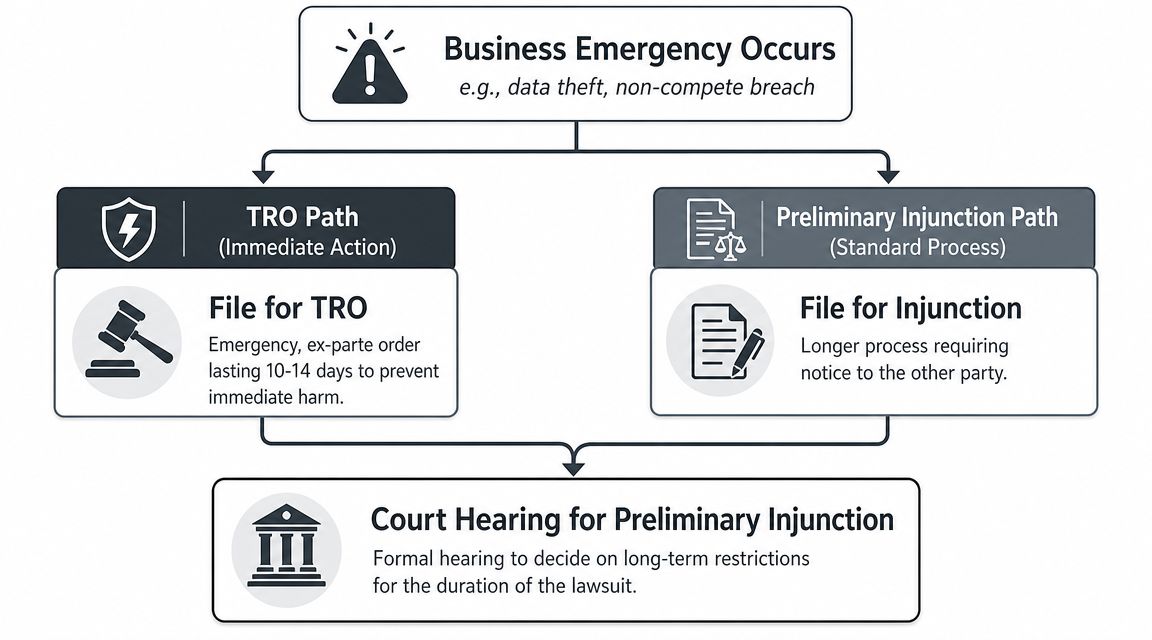
TRO vs Preliminary Injunction A Strategic Comparison
Clients often use these terms interchangeably. Courts don't. A TRO and a preliminary injunction are related tools, but they solve different problems and require different litigation choices.
A TRO is built for immediate containment. A preliminary injunction is built for staying power. If you're moving against a former advisor, business partner, or competitor, your strategy should account for both from the start.
The practical difference
A TRO addresses what can't wait. A preliminary injunction addresses what must remain in place while the case proceeds. In many commercial cases, the TRO is only the opening move, and sometimes not even the most important one. The main contest happens at the injunction hearing, where both sides have more room to present evidence and attack the record.
Here is the comparison that matters most in practice:
| Feature | Temporary Restraining Order (TRO) | Preliminary Injunction |
|---|---|---|
| Purpose | Stop immediate harm and preserve the status quo | Maintain court-ordered restraints during the litigation |
| Timing | Sought on an emergency basis | Sought after notice and fuller briefing |
| Notice | May be requested ex parte in urgent circumstances | Typically requires notice to the other side |
| Duration | Short-lived and tied to the emergency window | Lasts longer, often through a significant part of the case |
| Evidence | Heavy reliance on affidavits and fast documentary proof | Broader evidentiary presentation and more developed record |
| Strategic use | Stabilize the situation immediately | Lock in longer-term leverage and operating rules |
The trade-offs clients need to understand
A TRO gives you speed, but speed has a cost. The record is usually compressed. The judge is working with less time. If your papers are thin, the court may deny relief before you ever reach the more durable injunction stage.
A preliminary injunction takes longer, but it offers a better forum to sort out disputed facts. That matters in brokerage and advisory disputes, where the parties often fight over whether client information was confidential, whether solicitation occurred, whether restrictive covenants are enforceable, and whether the conduct at issue falls within industry norms or protocol-based transitions.
A TRO is often about stopping momentum. A preliminary injunction is about controlling the case while the merits are litigated.
Businesses should also understand the tactical downside of filing a weak TRO. If the application overstates the emergency or understates factual disputes, it can educate the other side, trigger counterclaims, and reduce your credibility before the more consequential hearing.
When each tool makes sense
A TRO tends to fit when:
- Data has already moved: Downloads, forwarding activity, device wiping, or unusual access patterns suggest immediate misuse.
- Client outreach has begun: You have evidence of active solicitation using disputed information.
- Assets may disappear: A transfer, dissipation, or concealment risk is unfolding right now.
A preliminary injunction makes more sense as the focal point when:
- The dispute is serious but not instantaneous: You need restrictions, but not in the next few hours.
- Fact development matters: The story is contested and requires live testimony or more complete declarations.
- Business operations need rules: The court may need to set boundaries that remain in place through the litigation.
For companies evaluating emergency relief in Connecticut, this is part of broader commercial litigation strategy, not a standalone filing decision. The question isn't just “Can we get a TRO?” It's “What order will protect the business without compromising the next hearing?”
How to Seek a TRO The Procedural Roadmap
When a TRO is the right move, the first day matters more than the next month. Delay creates legal and factual problems. Employees forget details, systems overwrite logs, and the opposing party has more time to shape a competing narrative.
A temporary restraining order is an emergency, short-term court order, and its force comes from speed. Its duration is strictly limited, often lasting only until a full hearing can be scheduled, as explained by WomensLaw's overview of restraining orders in New York. That procedural reality drives how businesses should prepare.
What to do in the first response window
The legal filing is only one piece of the emergency response. Before the motion goes in, counsel usually needs a reliable factual record.
- Lock down systems and records. Preserve email, CRM activity, cloud logs, device histories, and messaging records. Suspend routine deletion if necessary.
- Identify the exact restraint you need. Courts respond better to specific requests than broad demands to “stop unfair competition.”
- Collect contracts and policy documents. Employment agreements, confidentiality clauses, partnership documents, device policies, and post-employment restrictions often define the whole motion.
- Build a clean timeline. Judges reading emergency papers want sequence. Who did what, when, using which system, in violation of which duty.
The filings that matter most
Most TRO applications in commercial court include a complaint, an emergency motion, a supporting memorandum, one or more affidavits or declarations, and exhibits. In many cases, the affidavit is where the motion is won or lost.
Useful affidavits usually share a few traits:
- Chronology first: They tell the story in order.
- Concrete documents attached: Emails, screenshots, download records, client messages, and contract excerpts give the judge confidence.
- No inflated language: Emergency papers should sound controlled. Overstatement hurts.
- Personal knowledge: The affiant should explain what they know directly and how they know it.
A practical operations point often gets overlooked here. Emergency motions create document chaos fast. Firms that streamline law firm document management tend to handle exhibit assembly, version control, and affidavit review more cleanly, which matters when the court expects same-day revisions and immediate filing accuracy.
The hearing and the order you propose
In many business TRO matters, counsel appears before a judge on short notice. Sometimes the appearance is brief. Sometimes the judge wants focused argument on a narrow point, such as client solicitation, access to records, or return of devices.
Bring a proposed order that is usable. That means it should identify the restrained conduct with precision, define any prohibited use of information, specify return or preservation obligations where appropriate, and avoid broad language that a judge can't comfortably sign on an emergency basis.
Operational insight: Judges are more likely to grant relief they can enforce clearly.
If the dispute involves possession or control of business property, related remedies may also enter the picture, including a prejudgment claim to right of possession where the facts support it. In practice, the strongest emergency strategy is often the one that aligns the requested relief with the exact asset, information set, or client relationship at risk.
Defending Against a TRO Strategies and Defenses
Being served with a TRO changes the case instantly. You may have little notice, significant restrictions, and a hearing date coming up fast. The first rule is simple. Obey the order exactly as written while preparing to challenge it aggressively.

The strategic stakes are high. TROs are now used not only in private disputes but also in major policy and regulatory fights, underscoring how powerfully they can halt activity on short notice, as reflected in Cornell Law School's Wex entry on temporary restraining orders.
Immediate defense steps
The most damaging mistake is treating the order as negotiable before the court changes it. It isn't.
Take these steps immediately:
- Read the operative language closely: TROs often contain narrower or broader restrictions than the cover story suggests.
- Preserve everything: Devices, communications, account records, and metadata may become central at the next hearing.
- Map factual inaccuracies fast: Identify every statement in the plaintiff's affidavit that is incomplete, misleading, or false.
- Prepare your own timeline: Emergency defense depends on replacing the plaintiff's compressed narrative with a documented alternative.
In document-heavy cases, comparison speed matters. Tools and workflows that resemble CatchDiff's legal comparison guide can help counsel identify edits, conflicting versions, and language shifts across agreements and affidavits, which is often useful when the plaintiff's emergency papers rely on selective excerpts.
Defense themes that often work
Not every defense fits every case, but several arguments recur in successful oppositions.
- The harm is compensable: If the plaintiff's injury is lost commissions, revenue, or account value that can be measured later, emergency relief may be unnecessary.
- The plaintiff waited: Delay weakens urgency. If they knew the relevant facts and didn't act, the “emergency” framing may collapse.
- The requested order is overbroad: Courts dislike TROs that effectively grant final relief before a hearing.
- The facts are disputed: If the plaintiff's account depends on assumptions about downloads, access, or solicitation, a more complete hearing may be required before restraints continue.
- The underlying claim is weak: Restrictive covenants may be unenforceable, trade secrets may not qualify, and alleged confidential information may already be widely known or client-owned.
The preliminary injunction hearing is usually the defendant's best opportunity to reset the case.
Business-specific defense posture
Financial advisors and business owners often need to defend both legally and operationally. That may include preserving client relationships without violating the order, coordinating with custodians or broker-dealers, securing firm records, and avoiding reactive communications that create new evidence for the plaintiff.
A disciplined defense doesn't just attack the motion. It shows the court that narrower alternatives exist, that business disruption can be minimized, and that the plaintiff asked for more restraint than the facts justify.
FAQs for Financial Advisors and Businesses
Emergency relief raises practical questions that don't fit neatly into standard court explanations. In business and securities disputes, the answer often turns on the exact contracts, firm policies, and factual record in front of the judge.
One broader point is worth keeping in mind. Restraining orders are not unusual procedural devices. A review cited by Across Walls on restraining order statistics states that in 2008 U.S. courts issued an estimated 1.7 million domestic-violence restraining orders. Commercial litigants should understand that courts are accustomed to emergency restraint as a legal tool, even though the business context is very different.
Can a TRO stop a departing financial advisor from contacting clients
It can, depending on the record. Courts focus on the source of the client information, the contractual restrictions in place, whether actual solicitation occurred, and whether the advisor's conduct involved misuse of firm property or confidential records.
In advisory and brokerage disputes, judges also care about precision. A request to prohibit all client contact may be too broad if the evidence supports only a narrower ban on using certain information or soliciting a defined set of accounts. If the plaintiff can't tie the restraint to identifiable rights, the order may be narrowed or denied.
Can a TRO freeze bank accounts or business assets
Sometimes, but only in the right kind of case and with a carefully supported request. Courts are cautious about asset restraints because they can disrupt payroll, operations, debt service, and third-party relationships quickly.
The stronger applications usually identify a specific risk of transfer, dissipation, concealment, or misuse tied to the underlying claim. If the motion looks like ordinary collection pressure before judgment, courts are less likely to use emergency equitable relief.
What evidence is strongest in a trade secret TRO application
Judges tend to focus on evidence that is immediate and objective.
- Access evidence: Login histories, exports, downloads, USB activity, or forwarding patterns.
- Protective measures: Confidentiality agreements, access restrictions, employee acknowledgments, and data classification practices.
- Use evidence: Messages, outreach, proposals, or competitor activity linked to the disputed information.
- Timing: Resignation, device behavior, and client communications occurring in close sequence.
The weakest records are usually conclusory. The strongest ones show who accessed what, when they did it, and why the information mattered.
What happens if someone violates a TRO in Connecticut
Violation can create serious consequences. Courts can address noncompliance through contempt proceedings and other enforcement measures. In a business case, violation also causes strategic damage. It can hurt credibility, justify broader restrictions, and make settlement more difficult.
For companies and advisors, the practical answer is simple. If the order is unclear, get clarification from counsel and, if necessary, from the court. Don't rely on your own reading when the downside includes sanctions and a more restrictive next order.
Conclusion Navigating Your Next Steps
A temporary restraining order compresses litigation into hours and days. That's why these matters often determine the direction of the entire dispute before discovery has even started. The side that organizes facts first, frames the emergency correctly, and asks for relief the court can grant usually has the advantage.
For businesses, advisors, and securities professionals, the hard part isn't just legal doctrine. It's making sound decisions under pressure. Should you seek ex parte relief or give notice? Is the actual threat client solicitation, data misuse, account movement, or asset dissipation? Are you asking for a narrow order the judge can sign, or a broad order that invites denial? If you've been served, can you show the alleged harm is economic, disputed, or overstated before the restrictions harden into longer-term relief?
These aren't forms-driven issues. They require judgment, speed, and a realistic understanding of what courts will and won't do in emergency business litigation.
If you're considering a temporary restraining order, or if one has just landed on your desk, don't lose time arguing about labels. Focus on the record, the immediate risk, and the next hearing. Early strategic choices matter more here than in most commercial disputes.
If you want to discuss your business law matter, contact Kons Law at (860) 920-5181.
If you want to discuss your business law matter, contact Kons Law at (860) 920-5181.
