
An unpaid invoice has been sitting on your books for months. A vendor missed a delivery that threw off your production schedule. A former partner is taking a position that doesn't match the contract you both signed. At that point, civil litigation stops being an abstract legal issue and becomes an operating problem.
For Connecticut business owners, civil cases in connecticut often involve strategic advantage, timing, and damage control. The legal question matters, but so do cash flow, internal distraction, recordkeeping, vendor relationships, and whether a judgment will in practice turn into money collected. A good litigation strategy doesn't start with filing a lawsuit. It starts with deciding what outcome is worth pursuing and what path gets there with the least waste.
Clear legal guidance matters because the business-adjacent parts of the civil system aren't always well served by public-facing resources. A Connecticut civil legal needs assessment found that consumer and fraud protection and employment law remain significantly underserved, which leaves many businesses exposed when disputes move from frustration to formal claims.
If your dispute involves contracts, collections, partnership breakdowns, fraud allegations, arbitration awards, or enforcement issues, the process below is the roadmap that matters. It will help you decide when to press, when to settle, when to preserve evidence, and when waiting is the most expensive move you can make.
Introduction Navigating Your Business Through Legal Disputes
Most business disputes begin long before a complaint is filed. They start when payment stops, communication changes, or the other side suddenly reads the contract differently. By the time a business owner calls counsel, the actual question usually isn't "Can I sue?" It's "What's the smartest move from here?"

Connecticut litigation rewards preparation. The side that has the cleaner documents, the clearer timeline, and the better grasp of the business objective usually has more options. Sometimes that means a fast demand and a negotiated payment plan. Sometimes it means filing immediately to stop asset transfers or force a response. Sometimes it means deciding that the economics don't justify a full court fight.
What business owners should focus on first
When a dispute lands on your desk, start with four practical questions:
- What are you trying to recover: Money, specific property, enforcement of a contract term, or a clean exit from a bad relationship.
- What proof do you already have: Signed agreements, emails, invoices, wire records, change orders, account statements, and texts often matter more than anyone's memory.
- What is the other side likely to do: Ignore you, negotiate, countersue, claim offset, or try to delay.
- What can go wrong if you wait: Lost documents, expired deadlines, weakened bargaining power, or collection problems later.
Practical rule: Litigation is a business tool. Use it to create leverage toward a defined outcome, not just to express that you're right.
Cross-border business also creates a document problem. If contracts, customer records, or communications involve multiple languages, accuracy matters. A mistranslated term can become a discovery fight or a contract interpretation problem, which is why resources like Why Your Legal Documents Need Expert Linguistic Services can be useful when a dispute includes multilingual records.
The Connecticut Civil Court System Explained
A Connecticut civil case doesn't start with "court." It starts with forum selection. In other words, you need to file in the right place for the kind of dispute you have. Filing in the wrong venue wastes time, increases cost, and can hand the other side an early procedural advantage.
Where most business disputes are heard
Most business disputes are handled in Connecticut Superior Court. That's where contract claims, business torts, partnership disputes, trade debt claims, and many collection actions are filed. For most small and mid-sized companies, this is the working court system that matters most day to day.
Some business cases belong on the Complex Litigation Docket because they involve more complicated facts, multiple parties, or legal issues that require tighter judicial management. Not every commercial case qualifies, and not every case benefits from that track. A straightforward unpaid account case usually doesn't need it. A dispute involving layered contracts, fraud allegations, and multiple affiliated entities may.
If your dispute is headed toward formal litigation over a contract, shareholder issue, or business tort, a focused commercial litigation approach is often about matching the claim to the right procedural setting as early as possible.
When federal court matters
Federal court isn't just "bigger court." It's a different system with different rules, different scheduling dynamics, and different strategic pressure points. A case may land in the U.S. District Court for the District of Connecticut because federal law is involved or because the parties are from different states and the amount in controversy supports federal jurisdiction. In a recent fiscal year, 2,172 civil cases were filed in that court, reflecting its active role in contract, regulatory, and corporate disputes that affect businesses, according to the District of Connecticut federal court report.
For some clients, federal court is the better forum. For others, it isn't. The answer depends on the claim, the parties, available remedies, procedural posture, and how quickly you need a result.
Choosing the right court is a strategy decision
Think of venue as choosing the right tool for the job. A creditor pursuing a clean debt claim wants speed, enforceability, and procedural efficiency. A company facing a complex multi-state dispute may care more about motion practice, discovery control, and federal jurisdictional options.
Here are the usual decision points:
- State court often fits cases centered on Connecticut contracts, local businesses, and standard commercial disputes.
- Federal court may fit better when the dispute involves out-of-state parties, federal statutes, or enforcement of certain arbitration awards.
- Specialized dockets matter when the facts are too dense for a one-size-fits-all litigation path.
The best court isn't the one that sounds most serious. It's the one that puts your claim, defenses, and evidence in the strongest position.
A business owner doesn't need to master jurisdiction doctrine. But you do need counsel who treats forum choice as the first strategic move, not a clerical step.
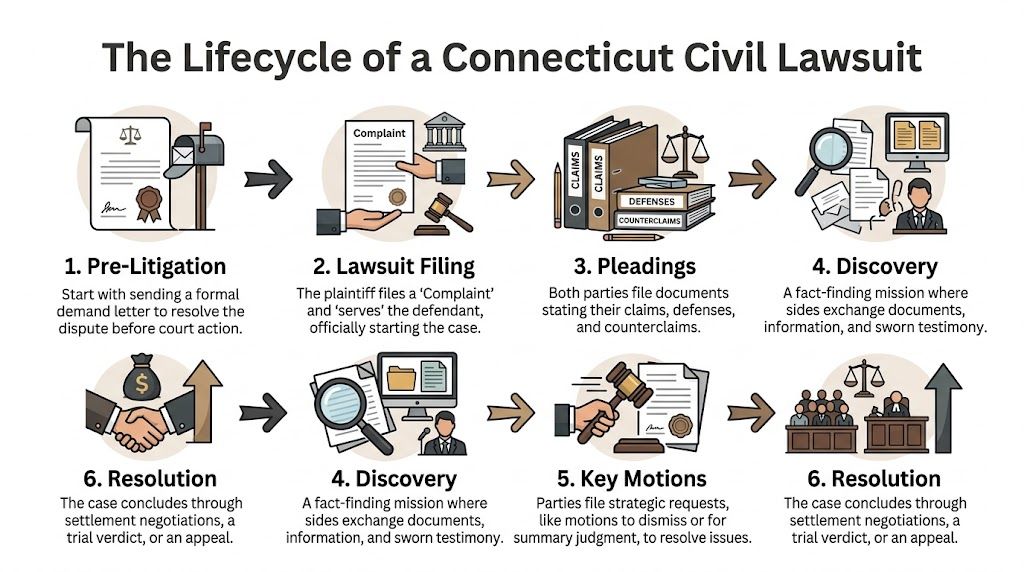
The Lifecycle of a Connecticut Civil Lawsuit
A civil lawsuit moves in stages. Each stage creates pressure, cost, and opportunity. Businesses that understand the sequence make better decisions because they stop reacting to every filing as if it's a surprise.
Before filing suit
The best-filed cases are often prepared before anything reaches the courthouse. That means gathering the contract, amendments, invoices, correspondence, payment history, internal notes, and any communications that show notice, breach, or damages. If your employees were involved, identify them early and preserve their emails and messages.
A demand letter can be effective when the claim is clear and the other side still has a practical reason to resolve it. It can also be pointless if delay is the strategy or if assets may disappear. The value of a demand letter depends on influence, not etiquette.
Businesses handling document preparation internally sometimes need a practical primer on filing mechanics and record organization. A general guide on how to file court documents can help nonlawyers understand the administrative side, but the legal judgment about what to file and when is where strategy matters.
Filing and service
A lawsuit formally begins when the plaintiff files a complaint and properly serves the defendant. This sounds simple. It isn't always simple in practice. Misidentifying the legal entity, serving the wrong address, or suing the wrong combination of parties can create avoidable delay and motion practice.
For business owners, this stage matters because it sets the frame of the dispute. The complaint isn't just a story. It's a tool. It should include claims that fit the facts, name the right defendants, preserve the right remedies, and avoid overreaching that undermines credibility later.
Common mistakes at this stage include:
- Naming the wrong party: Suing the trade name instead of the legal entity, or missing an individual guarantor.
- Overloading the complaint: Adding weak claims that create briefing opportunities for the other side.
- Failing to think ahead: Pleading a case in a way that makes later summary judgment harder.
Pleadings and early defenses
After service, the defendant responds. That may mean an answer, special defenses, counterclaims, or a motion aimed at knocking out part or all of the case early. At this point, the litigation stops being one-sided.
A business owner should read this phase correctly. A strong defense filing doesn't mean you've lost. A thin answer doesn't mean you'll win easily. Early pleadings are about positioning. They define what issues are disputed and where the case may be vulnerable.
Cases often turn on what gets narrowed early. If you can eliminate weak claims or weak defenses before discovery expands, you save money and sharpen leverage.
Discovery is where the case is built
Discovery is the longest and most expensive part of many civil cases in connecticut. This is the fact-finding stage where each side requests documents, serves written questions, and takes sworn testimony. For businesses, discovery is where internal discipline gets tested.
The court process is unforgiving when records are scattered across inboxes, phones, cloud drives, and accounting platforms. A company that responds late, incompletely, or inconsistently can damage its own case even if the underlying claim is strong.
A disciplined discovery process usually includes:
- Collecting records centrally so contracts, invoices, and communications are preserved in one place.
- Identifying custodians early so you know whose files matter.
- Preparing witnesses carefully before deposition testimony locks in facts.
- Separating helpful facts from harmful ones and building a response plan instead of improvising.
That preparation matters because litigation risk rises sharply once testimony starts. In Connecticut eviction cases, 87.5% of landlords had legal representation in disposed cases in 2024, compared with 6.8% of tenants, according to Connecticut eviction data compiled by Legal Services Corporation. The context is different from a business dispute, but the lesson carries over. Representation changes outcomes because procedure, evidence, and timing matter.
Depositions and motion practice
A deposition is not a conversation. It's sworn testimony that can shape settlement value, summary judgment strategy, and trial themes. Business owners and employees need preparation that goes beyond "tell the truth." They need to understand the documents, the timeline, and the traps built into vague or absolute answers.
For businesses facing witness testimony, this guide on how to prepare for deposition is a useful starting point for understanding what the process demands.
Motions during and after discovery can change the case dramatically. A motion to dismiss attacks legal sufficiency early. A motion for summary judgment argues that the key facts aren't disputed and that the court should rule without trial. These motions work best when the record was built with them in mind from the beginning.
Settlement, trial, and post-judgment reality
Most business disputes don't end with a dramatic verdict. They end in negotiated resolution, often after enough information has been exchanged for both sides to price the risk realistically. Settlement isn't surrender. It's often the most efficient business decision available.
If the case doesn't settle, it goes to trial. Trial is expensive, disruptive, and public. It also creates uncertainty that many businesses underestimate. Witness performance, evidentiary rulings, and judicial credibility calls all matter.
Even after judgment, the work may not be over. A favorable ruling on paper is not the same as collected money in the bank. If the defendant won't pay voluntarily, enforcement becomes its own phase, which is why the end of the lawsuit is often just the start of the recovery effort.
Budgeting for Justice Timelines Costs and Deadlines
For a business owner, the practical questions are simple. How long is this going to take, and what will it cost before it produces anything useful? The answer depends on the complexity of the facts, the quality of the documents, the aggressiveness of the other side, and whether the case is likely to settle or fight through discovery.
Timelines you should plan around
Connecticut Superior Courts handle approximately 99,000 civil cases filed annually, and for typical contract-based actions the benchmark disposition time is 12 to 15 months, according to Connecticut court case volume and timing data. That's a planning number, not a promise. Some matters resolve much faster through early negotiation or dispositive motion practice. Others take longer because the facts are disputed, the discovery record is large, or the parties litigate every issue.
From a business perspective, the timeline affects more than legal spend. It affects reserves, forecasting, executive time, vendor relations, and how long disputed receivables or liabilities sit on the books.
What actually drives cost
Clients often focus first on attorney fees. That's understandable, but incomplete. Litigation cost usually comes from several places at once:
- Front-end case development: Document review, witness interviews, claim analysis, and drafting.
- Court and filing expenses: Starting a case and filing motions carries direct court costs.
- Discovery burden: Collecting, reviewing, producing, and organizing records takes time and staff attention.
- Depositions and experts: Testimony preparation, transcripts, and expert analysis can push costs up quickly.
- Enforcement after judgment: Winning doesn't eliminate collection expense if the other side resists payment.
A cheap litigation plan that ignores collection, witness preparation, or document control often becomes the expensive plan later.
Deadlines that can kill a claim
The most dangerous timing issue isn't the trial date. It's the filing deadline. If the statute of limitations expires, the claim may be lost regardless of merit. That's why early legal review matters even when you're still trying to negotiate.
For a closer look at how these deadlines work under Connecticut law, this overview of Connecticut statutes of limitations is a useful reference point.
| Connecticut Statute of Limitations for Common Civil Claims | Statute of Limitations | Governing Statute |
|---|---|---|
| Breach of written contract | Varies by claim and facts. Review the governing statute and the contract itself. | Connecticut law depends on claim type and context. |
| Debt collection | Varies by account structure, written agreement, and accrual date. | Connecticut law depends on claim type and context. |
| Property damage | Varies by theory of liability and timing of loss. | Connecticut law depends on claim type and context. |
| Fraud and business tort claims | Highly fact-specific. Early analysis is critical. | Connecticut law depends on claim type and context. |
A chart can remind you that deadlines exist. It cannot replace claim-specific analysis. Businesses get into trouble when they assume ongoing negotiations pause the clock. They usually don't.
Specialized Strategies for Creditors and Financial Disputes
A creditor's case looks straightforward from the outside. Goods were delivered, services were performed, invoices were sent, payment didn't come in. But collections litigation is rarely just "file suit and wait." The strategy changes depending on whether the debtor is disorganized, insolvent, evasive, or preparing to fight.

The creditor's real objective
A creditor doesn't just want a judgment. A creditor wants a judgment that can be collected. That changes how the case should be handled from the start. Before filing, counsel should be thinking about guaranties, collateral, account records, the debtor's structure, likely defenses, and where recoverable assets may exist.
In many matters, the pressure sequence matters more than the complaint itself:
- Demand first when it helps: A targeted demand may trigger payment or a productive workout if the debtor is trying to protect banking relationships or avoid public litigation.
- File quickly when delay is dangerous: If you suspect asset movement, shell transfers, or intentional stalling, waiting can reduce recovery.
- Treat judgment enforcement as part of the opening plan: If the debtor has a history of nonpayment, post-judgment remedies shouldn't be an afterthought.
Winning the case is only half the job
Connecticut creditors' rights practice often turns on enforcement tools after judgment. Bank executions, wage executions where available, liens, property-related remedies, and negotiated payment structures all become relevant once liability is established. A business owner who treats judgment as the finish line may be disappointed.
That is why many creditors benefit from a tight, documented record before suit. Clean invoices, signed credit applications, guaranties, account histories, default notices, and consistent communications can shorten disputes and improve enforcement posture. In this area, discipline beats drama.
Arbitration awards still need court enforcement
Financial disputes often follow a different path. Investor and advisor disputes may proceed in FINRA, while other commercial matters may go to AAA or another arbitration forum because the contract requires it. Arbitration can resolve the merits, but the winning party may still need a court judgment to enforce the award.
Connecticut's federal court system is a key enforcement venue for that step. The District of Connecticut's CM/ECF system has processed over 46,000 dockets, and the court is used to confirm arbitration awards under 9 U.S.C. § 9, turning a FINRA or AAA award into an enforceable judgment, according to the District of Connecticut case information page.
An arbitration win is powerful, but it isn't self-executing. If the losing party doesn't pay, enforcement strategy matters immediately.
For businesses, lenders, and financial professionals, the practical lesson is simple. Build the record early, identify the payment path before you sue, and don't separate merits strategy from collection strategy.
Exploring Alternatives to Trial Mediation and Arbitration
Trial is one path. It isn't always the smartest one. Many business disputes are better resolved through mediation or arbitration, depending on the contract, the amount at stake, the need for confidentiality, and whether the parties still need a working relationship after the dispute ends.
Mediation when a negotiated result is still possible
Mediation is structured negotiation with a neutral mediator. The mediator doesn't decide the case. The mediator helps the parties test risk, identify business realities, and explore settlement terms that a court couldn't easily order.
Mediation works well when both sides need a business answer more than a legal speech. That may mean payment over time, revised contract terms, a mutual release, inventory return, or a confidential exit arrangement. It is especially useful when the record is developed enough for each side to understand the risk, but before trial costs become irrational.
Arbitration when the contract requires it or privacy matters
Arbitration is closer to a private trial. The arbitrator hears evidence and issues a decision, which is often binding. Many commercial contracts include arbitration clauses because the parties want a more controlled forum, industry-aware decision-makers, or less public exposure than open court.
Arbitration isn't automatically cheaper. It can move faster, but filing fees, arbitrator compensation, and hearing preparation can still be substantial. The question isn't whether arbitration is "better." The question is whether it fits the dispute.
A practical comparison looks like this:
| Process | Best use case | Main trade-off |
|---|---|---|
| Mediation | When both sides want flexibility and business-driven terms | No guaranteed result unless both sides agree |
| Arbitration | When a binding private decision is required or mandated by contract | Limited appeal options and forum costs |
| Court litigation | When you need formal discovery, broad remedies, or judicial enforcement tools | More public process and often longer path |
For a more detailed comparison of decision factors, alternative dispute resolution vs litigation is a useful resource.
The strategic mistake is treating ADR as something you consider only after litigation disappoints you. In many cases, ADR should be evaluated at the very beginning, before positions harden and costs stack up.
Conclusion Taking Control of Your Legal Strategy
Civil litigation is part of doing business long enough at scale. What matters is not avoiding every dispute. What matters is responding in a way that protects cash flow, preserves evidence, strengthens one's position, and keeps the case aligned with a real business objective.
The businesses that handle civil cases in connecticut well usually do a few things consistently. They act before deadlines become emergencies. They organize records before discovery forces the issue. They think about collection before they spend heavily on the merits. And they stay open to negotiated outcomes when settlement serves the company better than a long court fight.
Legal disputes become more manageable when you understand the sequence and the trade-offs. Forum choice, pleadings, discovery, depositions, settlement pressure, trial risk, and enforcement all connect. A mistake early often becomes expensive later.
If you want to discuss your business law matter, contact Kons Law at (860) 920-5181.
Frequently Asked Questions About Connecticut Civil Cases
How do I know whether I should sue or try to settle first
Start with the economics and the evidence. If liability is clear, records are strong, and the other side is still capable of paying, an early demand or mediation effort may make sense. If the other side is evasive, making bad-faith excuses, or showing signs of moving assets, filing suit may be the better move.
What documents should I gather before meeting with a lawyer
Bring the signed contract, amendments, invoices, statements, payment history, emails, text messages, notices of default, internal notes, and any proof of damages. If the matter involves goods or performance issues, include delivery records, photos, change orders, and relevant accounting entries. The cleaner the file, the faster counsel can assess strategic advantage and risk.
Can my business recover attorney fees
Sometimes, but not automatically. The right to recover attorney fees often depends on the contract, a statute, or another recognized legal basis. Many business owners assume fees follow the winner in every civil case. That's not always true, so it should be evaluated at the beginning, not guessed at the end.
What if the other side files a counterclaim
That changes the risk profile, but it doesn't automatically mean your original case was a mistake. Counterclaims are common in commercial litigation because they create an advantage and may expand discovery. The important question is whether the counterclaim has real factual support or is mainly a pressure tactic. The answer affects settlement strategy and motion practice.
If I win, how soon do I get paid
Not necessarily quickly. Some defendants pay after judgment. Others delay, appeal, or force enforcement measures. In collections matters especially, the timeline to actual recovery depends on the debtor's solvency, available assets, and willingness to comply. That's why experienced litigators evaluate the collection path early.
Is federal court better for business disputes
Sometimes. Federal court can be a strong venue for multi-state disputes, federal claims, and arbitration award enforcement. But "better" depends on your goals, claims, parties, and evidence. For many Connecticut-centered commercial disputes, state court is the practical forum. The venue decision should be strategic, not reflexive.
If you need practical guidance on contracts, collections, commercial litigation, arbitration, or other business disputes, contact Kons Law. You can discuss your matter by calling (860) 920-5181.
