
A lot of Connecticut business owners call a lawyer at the same point in the story. The relationship started with a good conversation, everyone seemed aligned, and the deal felt too straightforward to justify legal review. Then the invoices don’t match the verbal promise, the deadline slips, the vendor insists the scope changed, or the other side points to a sentence in an email and says, “That was the agreement.”
By then, the issue usually isn’t whether there was a deal. It’s what the deal required.
A small business contract lawyer helps before that gap opens. The practical value isn’t just drafting formal agreements. It’s translating business expectations into enforceable terms, spotting hidden liability, and preventing small mistakes from becoming expensive disputes. For Connecticut owners, that matters whether you’re hiring a contractor in Hartford, signing a lease in New Haven, onboarding a major customer in Stamford, or expanding into a multi-state relationship.
Why Your Next Handshake Deal Needs a Legal Review
A handshake deal often feels efficient. You talk through the work, confirm the price by email, and move forward because everyone wants to keep momentum.
That works until each side remembers the conversation differently.

The problem usually starts with assumptions
One owner thinks “launch support” includes revisions. The other thinks it means delivery only. A supplier believes shipping dates were estimates. The buyer treated them as firm commitments. A payment term that sounded obvious on the phone turns into a collection problem because the written language never pinned down when payment was due.
That’s why contract review isn’t paperwork for its own sake. It’s risk control.
Nineteen percent of small businesses encounter contract or commercial issues annually, making them the most common legal challenge, and nearly half view lawyers as a last resort rather than getting review up front (firesignmarketing.com). That’s a practical warning for any owner who thinks contract problems mostly happen to somebody else.
Practical rule: If a deal matters enough to affect your cash flow, staffing, reputation, or ability to deliver, it matters enough to put in front of counsel before you sign.
A good starting point is understanding the essential elements of contract. Offer, acceptance, consideration, and clear terms sound basic, but many disputes begin because one of those pieces is weaker than the parties realized.
Internet templates don’t solve business-specific risk
Template contracts can help you organize a deal. They usually don’t help you allocate risk correctly.
The problem isn’t that templates are always bad. The problem is that they’re generic. They don’t know whether your customer can delay approval for weeks, whether your vendor has access to confidential pricing, whether your work product includes intellectual property, or whether your business depends on milestone payments to stay liquid.
A contract should answer questions like:
- What exactly is being delivered
- When performance is due
- Who owns the work product
- What triggers payment
- What happens if the relationship ends early
- Which party bears third-party risk
If your current agreement doesn’t answer those questions plainly, it’s not protecting the deal. It’s just documenting that a relationship exists.
For a useful example of why generic forms often miss the mark, compare your paperwork against this discussion of a small business contract template. The gap between “we have a contract” and “we have the right contract” is where many small businesses get hurt.
The Critical Moments to Hire a Contract Lawyer
Some owners wait to hire a lawyer until there’s already a dispute. That misses the points where legal review does the most good. In practice, the highest-value moments are tied to business milestones.
When you form the business
Your first contracts should match your entity structure. If you’ve formed an LLC or corporation, your agreements need to identify the correct party and signature block.
That sounds minor. It isn’t.
A commonly missed mistake is signing in your personal capacity. Guidance on business contract preparation warns that signing personally can expose the owner to personal liability for breach, undermining the protection the business entity was supposed to provide (pokalalaw.com).
Sign for the company, not as yourself. If the contract names you instead of the entity, your LLC may not protect you the way you expect.
At this stage, a small business contract lawyer should review:
- Formation-related agreements such as operating agreements, bylaws, and founder arrangements
- Initial customer and vendor forms so your standard documents are usable from the start
- Signature blocks and party names to make sure the business, not the owner individually, is bound
When you hire your first worker or contractor
Early hiring documents often create avoidable confusion. Owners reuse an offer letter they found online, classify someone as an independent contractor without looking closely at the actual relationship, or skip confidentiality and ownership language altogether.
The immediate issue may look like a staffing problem. The legal issue is that your contract may not say who owns created materials, how sensitive information must be handled, or what happens when the relationship ends.
A lawyer helps separate what belongs in an employment agreement, what belongs in an independent contractor agreement, and what shouldn’t be copied from one into the other.
When a landlord, customer, or vendor sends “standard terms”
The phrase “standard contract” usually means standard for them.
Commercial leases, service agreements, supply contracts, software terms, and purchase orders often contain risk-shifting provisions that the receiving party barely notices. Renewal terms, default triggers, personal guaranty language, broad indemnity, and one-sided termination rights are common examples.
That’s where negotiation matters. If you’re dealing with a larger counterparty, you may not rewrite everything, but you can often narrow the harshest terms. A lawyer focused on contract negotiations can identify where pushback is worth the effort and where a business compromise makes sense.
When the business changes shape
Certain events should trigger legal review even if your existing documents seemed fine before:
- A major new client arrives and represents a meaningful share of revenue.
- Outside money comes in from investors, lenders, or new partners.
- You expand into new states, new service lines, or more complex vendor chains.
- You plan an exit, merger, acquisition, or buyout.
At each of these moments, the contracts need to do more than capture a transaction. They need to define control, payment rights, ownership, and downside exposure. That’s where experienced review pays for itself.
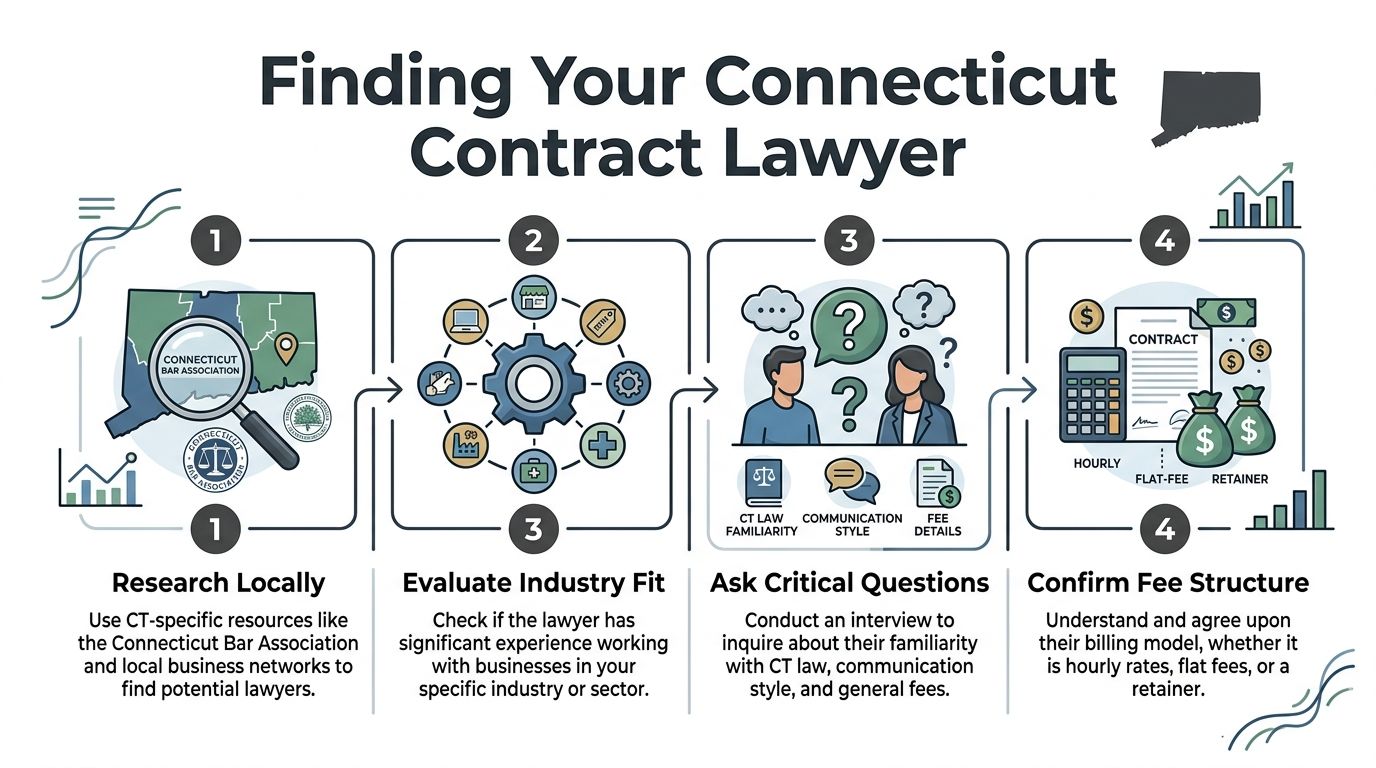
Finding and Vetting Your Connecticut Contract Lawyer
Choosing counsel isn’t about finding someone who can “look over a contract.” It’s about finding someone who understands how Connecticut businesses conduct their business, how deals break down, and which terms matter in your industry.
Start local, then get specific
Connecticut owners usually begin in one of four places:
- Bar referral resources through Connecticut legal organizations
- Referrals from accountants and bankers who regularly work with business clients
- Industry contacts who’ve signed similar leases, vendor contracts, or service agreements
- Existing outside counsel who may need specialized contract support
The most important filter comes after the referral. Ask what kind of business work the lawyer handles every week, not just whether they “do business law.”
A restaurant lease, a medical practice services agreement, a manufacturing supply contract, and a software implementation agreement may all be “contracts,” but they involve different pressure points.
Why small-firm focus can work well for small businesses
Many owners assume they need a large firm for serious contract work. Often, they don’t.
The U.S. legal market is dominated by small firms, with 75% having fewer than 6 attorneys, and those firms have become a focused, cost-conscious option for business clients (clio.com). For a Connecticut small business, that often means direct access to the lawyer doing the work instead of getting routed through layers of staffing.
That doesn’t mean every small firm is the right fit. It means you should judge the lawyer by precision, responsiveness, and commercial judgment, not by office size.
A useful business lawyer doesn’t just flag problems. They tell you which issues are deal-breakers, which ones are manageable, and which ones aren’t worth spending negotiation capital on.
Questions worth asking in the first call
Bring a short list. You’re not interviewing for courtroom charisma. You’re checking whether the lawyer can protect the business in real transactions.
Ask questions like these:
- How much of your practice involves contract drafting, review, and negotiation for businesses like mine?
- Have you worked with companies in my industry or with this kind of agreement before?
- How do you approach Connecticut-specific issues that can affect business disputes and trade practices?
- Will you explain revisions in plain English, or should I expect markup without business context?
- Who will handle the work?
- How do you bill for contract review, negotiation calls, and revision rounds?
- What should I send you before you start so you can work efficiently?
The answers tell you a lot. A strong small business contract lawyer should be able to discuss process clearly, identify recurring trouble spots, and explain trade-offs without hiding behind jargon.
What Connecticut owners should listen for
You want practical judgment, not theatrical caution. Good counsel will usually do three things well:
| What to listen for | Why it matters |
|---|---|
| They ask about your business goals | Contract advice should match the deal, not just the document |
| They focus on recurring risk areas | Experienced lawyers know where disputes usually start |
| They explain fees and scope plainly | Unclear billing creates friction before the legal work even begins |
If you need overflow or ongoing commercial support, one option in the Connecticut market is Kons Law, which handles contract drafting, review, negotiation, and broader business law matters for companies and investors.
The right fit is the lawyer who can protect the company while keeping the deal moving.
Decoding Dangerous Contract Clauses Before You Sign
Most bad contracts don’t look dramatic. The risky language is usually buried in ordinary-looking paragraphs. Owners skim, assume the clause is standard, and sign.
Then the clause starts working exactly the way it was written.
Ambiguous scope terms
A common dispute starts with a sentence like: “Provider will deliver marketing support as needed.” That feels flexible when the relationship is friendly. It becomes a problem when one side expects weekly deliverables and the other thinks occasional consulting satisfies the deal.
Contract drafting guidance consistently identifies ambiguity around deliverables, deadlines, and payment terms as a leading source of disputes, and unclear phrasing can create confusion or even undermine the contract itself (dunlapandshipman.com).
A lawyer would tighten that language by defining:
- Deliverables with enough detail that both sides know what is included
- Timing through dates, milestones, or response windows
- Completion standards so payment isn’t tied to a vague sense of satisfaction
One-sided indemnification
A small company signs a vendor agreement. Months later, a third party makes a claim connected to the project, and the small company learns it promised to defend and reimburse the other side for broad categories of loss.
That is often an indemnification problem.
Some indemnity language is fair. Some of it shifts almost every downstream risk onto the smaller party, even where fault is mixed or unclear. The dangerous part is that owners often treat indemnity as boilerplate because the clause is dense and technical.
A contract lawyer reads that section with a different question: what losses are covered, who controls the defense, and does the obligation track actual responsibility? For a deeper explanation of how these provisions work, this discussion of indemnification clauses in contracts is a useful primer.
If you can’t explain an indemnity clause in one or two plain-English sentences, you shouldn’t sign it yet.
Liability caps that don’t cap much
Another common surprise appears in the limitation of liability section. A contract may seem to cap exposure, but then carve-outs swallow the protection. Confidentiality breaches, IP claims, payment obligations, third-party claims, and “willful misconduct” exceptions may leave one side exposed on the claims most likely to matter.
The issue isn’t whether a cap exists. It’s whether the cap applies to the actual risks of the deal.
A careful review asks:
- What claims are excluded from the cap
- Whether the cap is tied to contract value
- Whether the clause is balanced or heavily one-sided
Ownership and termination traps
A designer finishes the work and assumes the client owns final deliverables only. The contract says the client owns all work product, drafts, and derivative materials. A consultant expects to leave on notice. The agreement allows termination only for uncured breach and requires continued support during a long transition period.
These are business terms disguised as legal text.
A skilled small business contract lawyer translates them into operational consequences. Who owns what. Who can leave. What gets paid after termination. What survives the relationship. That’s often where a manageable deal becomes either safe or dangerous.
Understanding Legal Fees and Preparing for Your First Meeting
Cost keeps many owners from getting help early. The better approach is to understand how fee structures work and make the first meeting efficient.

Common legal fee structures compared
| Fee Structure | How It Works | Best For |
|---|---|---|
| Hourly | You pay for time spent reviewing, drafting, negotiating, and advising | Ongoing matters, evolving negotiations, dispute-related contract issues |
| Flat fee | One set fee for a defined scope of work | Standard reviews, basic agreements, routine drafting projects |
| Retainer | You pay in advance or maintain an ongoing relationship for recurring support | Businesses with frequent contracts, repeat questions, and continuing legal needs |
No model is always better. The key is scope. A flat fee works well when the task is clearly defined. Hourly billing may make more sense when the other side is actively negotiating and the number of revisions is unpredictable.
How to make the first meeting useful
Owners often waste the first consultation by speaking in generalities. Bring documents and a concrete goal.
Gather these before the call or meeting:
- The draft agreement you were asked to sign, including attachments and exhibits
- Your formation documents if the contract involves a new entity or ownership issue
- Related emails or proposals that show what the parties discussed
- A short list of concerns such as payment timing, termination, exclusivity, or IP ownership
- Your business goal for the deal, because legal advice should support the transaction, not derail it without reason
Bring the red flags you already sense, even if you can’t name the legal issue. Owners usually know where a deal feels uneven before they know why.
If you’re still figuring out what kind of counsel you need, this overview of what is a business lawyer can help frame the broader role beyond one-off document review.
Ask for clarity, not just markup
At the end of an initial consultation, you should know three things:
- What the major risks are
- Which revisions matter most
- What the next phase will cost or how it will be billed
If you leave with a heavily marked-up draft but no understanding of the business consequences, the meeting didn’t do enough.
Your Next Step Towards Legal Protection
The most useful way to think about a small business contract lawyer is not as an emergency service. It’s as part of how a business makes decisions. Contracts affect revenue, cash flow, staffing, ownership, confidentiality, debt exposure, and exit options. Those are operating issues, not just legal ones.
That becomes even clearer when a business moves beyond private deals. Federal contracting is a good example. Small businesses often miss opportunities or create avoidable risk because government work involves specialized compliance, set-aside rules, teaming structures, and intellectual property issues. In that area alone, over 10,000 compliance protests are filed annually, which shows how technical status and eligibility issues can become (jmillerlawfirmpllc.com).
If you’re building your company’s internal systems, it also helps to understand the broader range of legal documents businesses rely on beyond a single customer contract. The right legal framework usually involves a set of coordinated documents, not one form pulled from the internet.
For most owners, the next step is simple. Identify the contracts you use repeatedly, identify the agreements you’re about to sign, and get them reviewed before the pressure of the deal forces a rushed decision. That’s how businesses avoid preventable exposure and negotiate from a position of clarity.
If you want to discuss your business law matter, contact Kons Law at (860) 920-5181.
