A land dispute usually doesn’t arrive as a legal theory. It arrives as a blocked project, an angry email, a title objection, a contractor standing idle, or a lender asking a question no one can answer quickly.
For Connecticut business owners and property investors, that is the core problem. The issue isn’t just where a line sits on a map. It’s whether you can build, lease, finance, sell, collect, or hold value in the asset you thought you controlled. When ownership, access, use rights, or recorded boundaries come into question, delay becomes expensive fast.
When Your Property Lines Are Questioned
A common version of this problem starts small. You’re preparing to improve or redevelop a commercial parcel. Plans are moving. Contractors are lined up. Then someone notices a fence, retaining wall, driveway edge, utility path, or cultivated strip that doesn’t match your assumptions about the property line.
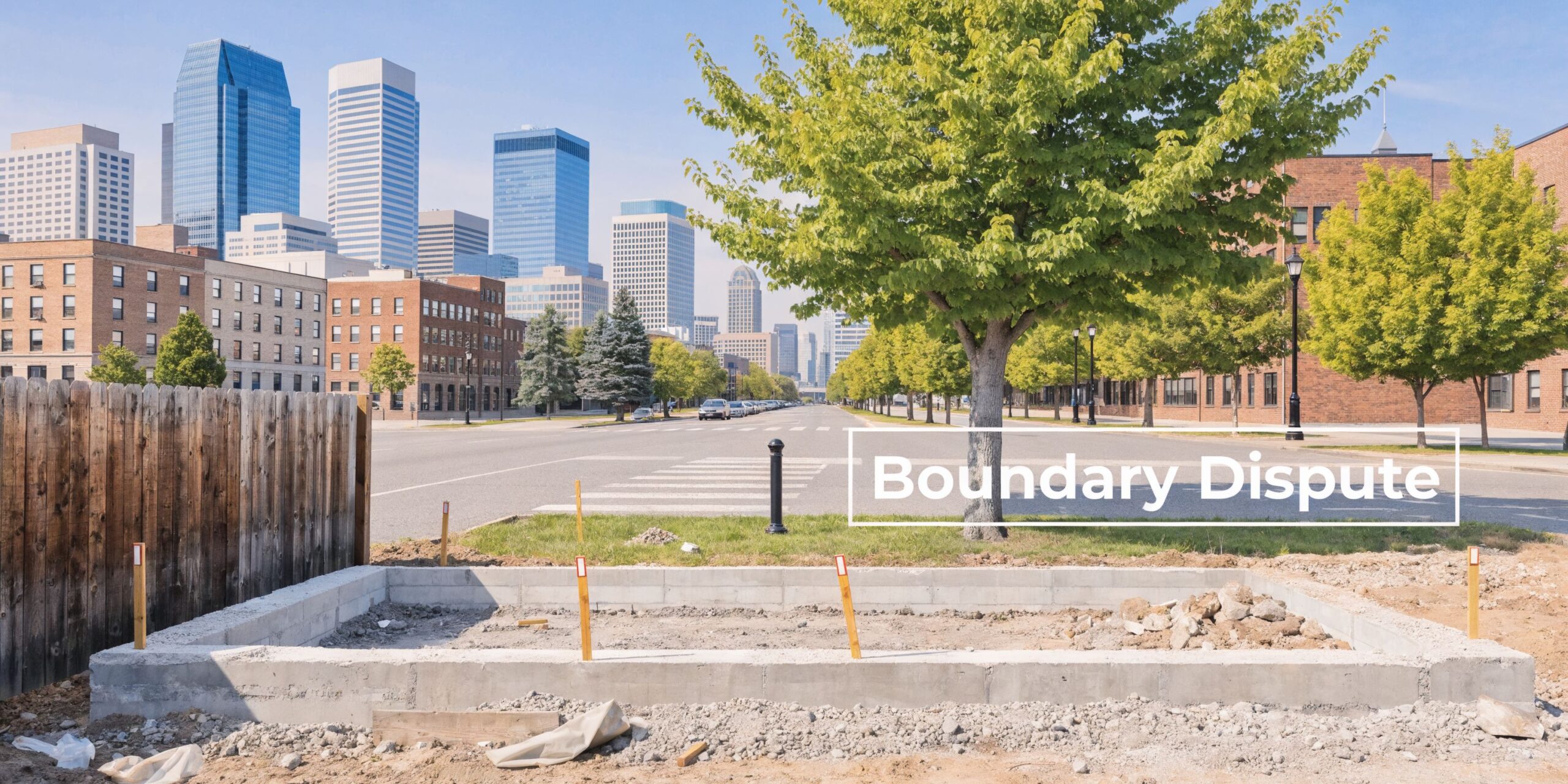
That moment changes the deal. What looked like a routine property issue becomes a business risk. A title company may refuse to insure over the problem. A lender may pause funding. A neighboring owner may claim rights you never priced into the acquisition. If you’re the party accused of encroaching, your own bargaining position drops quickly.
Why these fights become financial problems
Land disputes rarely stay small. Even when the disputed strip looks minor on the ground, the consequences often are not.
A contested boundary can affect:
- Development timing: A delayed approval or redesign can stall construction.
- Asset value: Buyers discount uncertainty.
- Operations: Access points, parking, loading areas, and utility routes may be affected.
- Exit options: A clouded title can interfere with refinancing or sale.
- Litigation exposure: One claim can turn into requests for damages, injunctions, or declaratory relief.
Practical rule: The earlier you treat a land conflict as a business problem instead of a neighbor problem, the more options you usually preserve.
Market stress also increases the number of property conflicts. The demand for land dispute attorneys reflects that pressure. ATTOM’s April 2023 U.S. Foreclosure Market Report documented 32,977 properties with foreclosure filings, an 8% increase from the prior year, as summarized at lawfirm.com’s real estate statistics page. Financial distress often triggers fights over possession, use, title defects, access, and lien priorities.
What works early and what usually does not
Some responses help. Others make the case harder.
What tends to work:
- Preserving documents: Deeds, title policies, surveys, site plans, correspondence, and permits matter immediately.
- Stopping informal “fixes”: Moving a fence, repaving an area, or arguing with contractors can create new evidence problems.
- Getting the right professionals involved: Lawyers, surveyors, and title professionals need to coordinate early.
What usually doesn’t:
- Relying on memory: “We’ve always used that area” may matter, but only if it can be proved.
- Assuming the last owner handled it: Unresolved issues often survive closings.
- Treating the dispute as personal theater: Escalation on the ground often weakens legal positioning.
Land dispute attorneys earn their value by narrowing uncertainty. The right objective isn’t to make the loudest argument. It’s to identify the controlling rights, protect the asset, and choose a remedy that makes financial sense.
Understanding the Five Main Types of Land Disputes
Most business owners know they have a property problem before they know what kind of property problem it is. Classification matters because the proof, defenses, and remedies differ.

Boundary disputes
This is the classic fence-line case, but commercial versions are more disruptive. Think loading areas, parking strips, curbing, signage, drainage work, or a building improvement that crosses the assumed line.
A boundary dispute is often like discovering two versions of the same blueprint. Both parties believe the map supports them. The question becomes which evidence controls.
Business impact:
- Construction stops
- Encroachment claims arise
- Title objections appear during sale or refinance
Title disputes
A title dispute concerns legal ownership, recorded interests, or defects in the chain of title. The simplest analogy is buying a car and later learning someone else claims ownership or a prior lien was never cleared.
This often shows up after acquisition, during diligence for a sale, or when a lender’s counsel reviews the file more carefully than the original transaction team did.
Common triggers include:
- Conflicting recorded documents: Deeds, releases, or easements don’t line up.
- Unresolved prior interests: Older claims remain in the record.
- Probate or entity issues: The party who signed may not have had full authority.
If you work with investment or rental property, careful contract and occupancy planning also matters. A practical primer on lease agreements for rental property is useful because poorly drafted lease documents can complicate access, possession, and use-right disputes that later spill into broader land conflicts.
Easement disputes
An easement is a right to use land for a limited purpose. Access roads, utility routes, shared driveways, drainage corridors, and service paths are common examples.
These disputes often feel unfair because ownership and use are split. You may own the land but not have full control over it. Or you may depend on land you don’t own to reach your own parcel.
For a business, an easement fight can be more damaging than a simple line dispute because it affects function, not just geometry. If trucks can’t reach a loading area or customers can’t use an access route, the property may still be legally owned but operationally impaired.
A parcel without workable access can lose practical value long before a court enters judgment.
Adverse possession
Adverse possession is the doctrine most non-lawyers have heard of, usually in oversimplified form. In practical terms, it concerns whether long-term use or occupation can ripen into legal rights.
For investors, this issue often appears in older properties where historical occupation doesn’t match record lines. It can involve maintained strips, driveways, walls, outbuildings, or long-standing use patterns that everyone ignored until a transaction forced the issue.
The danger is timing. A problem that remained dormant for years can become urgent when you try to redevelop, refinance, or sell.
Trespass
Trespass is unauthorized entry or use. In land disputes, it often overlaps with the other categories but deserves separate attention because it supports immediate protective remedies in the right case.
Commercial trespass can involve:
- recurring entry by contractors or neighboring owners
- storage of materials on your parcel
- unauthorized utility work
- ongoing use of private roads or service space
Trespass claims matter because they can support requests to stop conduct now, not just determine rights later. When operations are being disrupted in real time, that difference matters.
Why proper framing changes strategy
Two disputes can look identical on the ground and still require very different legal treatment. A fence inside the line may be a boundary case, an adverse possession claim, a trespass problem, or evidence of a broader title defect.
That’s why land dispute attorneys spend time framing the case before pushing toward resolution. If the theory is wrong, the evidence gathered will be wrong too. And once a case starts from the wrong premise, fixing it becomes more expensive.
The Connecticut Legal Landscape for Property Disputes
Connecticut land disputes turn on local law, local procedure, and local evidence. General property instincts help, but they don’t replace state-specific analysis. A business owner can be directionally right about fairness and still lose because the legal standard is narrower than expected.
Connecticut law shapes leverage early
One reason these cases become difficult is that Connecticut treats property rights as formal rights, not loose neighborhood understandings. A prior owner’s handshake arrangement, a long-used path, or an assumed boundary may matter factually, but the legal significance depends on how the claim is framed and proved.
For adverse possession, Connecticut has a 15-year requirement under Conn. Gen. Stat. § 52-575, which directly affects whether a historical use argument is mature enough to assert or defeat. That timing issue alone can alter negotiation power, case valuation, and whether immediate litigation makes sense.
Limitations issues matter in other property-related claims as well. Business owners dealing with overlapping tort, contract, and real estate questions should understand how timing rules can narrow or expand available claims. This overview of Connecticut statutes of limitations is a useful starting point for spotting timing risks.
Local records often decide supposedly simple cases
Connecticut disputes often depend on a dense mix of:
- Land records: Deeds, plats, easements, and historical conveyances
- Municipal approvals: Zoning files, inland wetlands records, subdivision approvals, and permits
- Survey evidence: Boundary retracement, monumentation, occupation lines, and mapping history
- Use evidence: Maintenance patterns, access history, improvements, and objections or lack of objections
A business owner may think the key issue is “Who’s right?” The more practical question is, “What evidence will a judge, arbitrator, title carrier, or municipal body rely on?”
Zoning and land use can turn a private dispute into a public one
Some property conflicts aren’t only between neighbors. They also intersect with municipal rules. A setback issue, access route, site-plan condition, or permitted-use question can magnify what started as a line disagreement.
That matters in Connecticut because local land use boards and municipal records can either strengthen or weaken your litigation position. If an approval assumed a boundary location that later becomes contested, the dispute can affect compliance, expansion plans, and financing.
The strongest property cases are rarely built from one dramatic fact. They’re built from consistent records that tell the same story.
Practical Connecticut takeaways
For business owners and investors, the Connecticut approach demands discipline.
- Check the record before escalating: The deed alone is rarely the whole story.
- Match the claim to the remedy: Quiet title, injunctions, declaratory relief, damages, and negotiated boundary adjustments serve different purposes.
- Expect local nuance: Municipal history can matter more than broad property principles.
- Treat timing as strategic: Delay can help one side and hurt the other.
Land dispute attorneys who practice in Connecticut don’t just argue legal doctrines. They work through how state statutes, local approvals, title history, and site facts interact. That’s where many cases are won or lost.
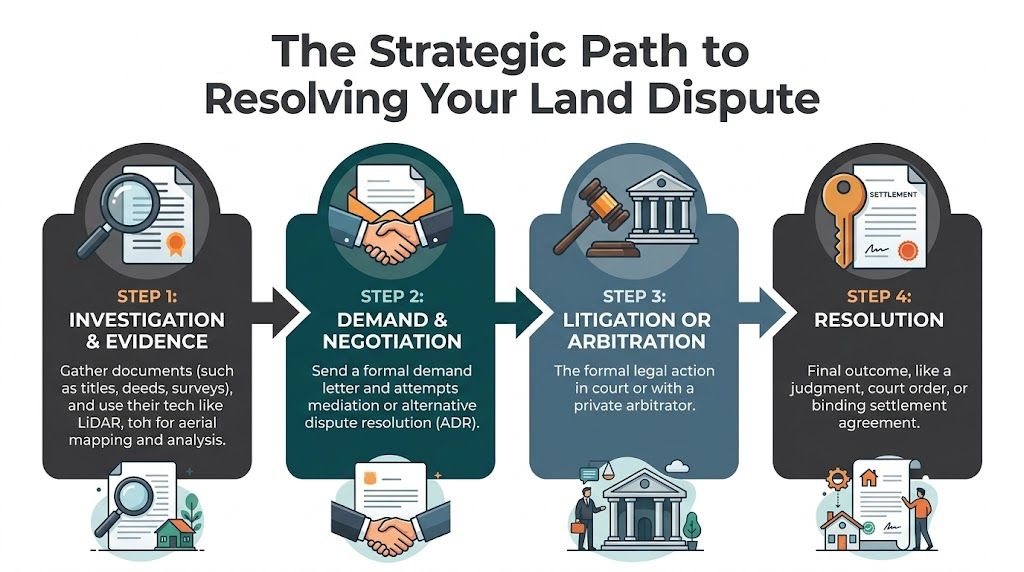
The Strategic Path to Resolving Your Land Dispute
A good land dispute strategy is not a shouting match with documents attached. It’s a sequence. The strongest cases usually begin with disciplined investigation, then move through targeted pressure, then into formal resolution only if needed.
Start with evidence, not conclusions
At the beginning, the temptation is to decide what happened and then look for proof. That approach creates blind spots.
A better sequence is:
Collect the core documents
Pull deeds, title commitments or policies, surveys, site plans, recorded easements, permits, correspondence, and any purchase diligence materials.Preserve physical evidence
Photograph fences, walls, curb lines, pavement seams, utility markers, drainage features, signage, and use patterns before anything changes.Identify non-legal witnesses
Surveyors, prior owners, contractors, property managers, and municipal staff may have useful factual knowledge.Map the business consequence
Define what the dispute is costing. Delay, redesign, financing pressure, reduced access, tenant issues, or sale disruption all matter.
Where geospatial evidence changes the case
In the right matter, technical evidence gives land dispute attorneys an advantage that argument alone cannot. One important tool is LiDAR, which uses laser pulses from aerial or ground-based platforms to build detailed terrain models.
According to CBIZ’s discussion of geospatial data in litigation, LiDAR can generate high-resolution 3D models, with vertical accuracy often exceeding 10 cm RMSE, and can benchmark up to 1,000,000 points per second when used in appropriate technical settings. The same discussion explains that, in complex cases, this kind of geospatial integration can cut litigation timelines by 20 to 30% when it clarifies boundaries, easements, or encroachments, and that litigation-grade work should be validated against ground control points under ASPRS standards, including Class 1 accuracy of 15 cm or less horizontal and vertical. Read that analysis at CBIZ on geospatial data in litigation.
That doesn’t mean LiDAR belongs in every case. It does mean that when vegetation, terrain, historical alterations, or old occupation lines obscure the facts, objective mapping can change settlement posture quickly.
The demand letter is not a formality
A demand letter should do more than complain. It should narrow the issues, identify the factual basis of your position, preserve claims, and put the other side on notice that continued conduct may increase exposure.
An effective letter usually does three things at once:
- States the rights at issue
- Attaches or references real evidence
- Offers a controlled path to resolution
Weak demand letters create noise. Strong ones move the other side from denial to risk assessment.
Negotiation and mediation
Many land disputes should try negotiated resolution before full litigation. That’s not softness. It’s economics.
When parties can define a workable fix, they may preserve value that a judgment cannot fully restore. Solutions may include boundary line agreements, easement clarification, relocation of improvements, access protocols, maintenance obligations, or structured payment terms tied to corrected use rights.
Still, negotiation works only when the facts are developed enough to create pressure. Mediation without evidence often becomes a long conversation about emotions.
Litigation and arbitration
If voluntary resolution fails, the case moves into formal process. Depending on the contract structure, business relationships, and forum issues, that may mean court or arbitration. If you want a broader comparison, this guide to alternative dispute resolution vs litigation lays out practical differences.
Dispute Resolution Methods Compared
| Factor | Litigation (Court System) | Arbitration (Private Forum) |
|---|---|---|
| Public record | Usually part of the public court file | Usually private or less public |
| Procedure | Formal rules of pleading, discovery, and evidence | More flexible, but still structured |
| Speed | Can be slower, especially with crowded dockets | Can move faster, depending on the forum |
| Appeal options | Broader ability to appeal rulings | Narrower grounds to challenge awards |
| Judicial tools | Strong court power for injunctions and enforcement | Useful where parties already agreed to arbitrate |
| Best fit | Good for title rulings, injunctions, and precedent-driven fights | Good for contract-based property conflicts where privacy and efficiency matter |
Expert selection can define the outcome
Even strong facts can be lost through weak expert work. In boundary and land-use litigation, the expert is often the bridge between technical data and legal proof.
The most useful experts are not just licensed. They are careful, methodical, and able to explain why the underlying records, field observations, and mapping support a specific conclusion. A flashy report from the wrong professional can do more harm than no report at all.
A land case often turns on whether the technical witness can teach the decision-maker what matters, and defend every step under attack.
The right strategy is cumulative. Documents support the survey. The survey supports the legal theory. The legal theory drives the demand. The demand shapes negotiation. If negotiation fails, the same groundwork supports a credible trial or arbitration presentation.
Calculating the True Cost and Potential Remedies
Most business owners ask the right question quickly. What will this cost, and what do I get if I pursue it?
The honest answer is that land disputes are rarely cheap, but inaction is often more expensive. If a title issue blocks a sale, if a boundary conflict stalls development, or if an access problem limits operations, the legal spend is only one part of the balance sheet.
What you are actually paying for
A land dispute budget usually includes more than attorney time.
Typical cost categories include:
- Legal analysis and pleadings: Claim evaluation, demand work, negotiations, motions, and hearings
- Survey and expert work: Boundary retracement, mapping, geospatial analysis, and testimony
- Title and record review: Historical documents, municipal files, chain-of-title issues
- Business interruption: Delayed closing, redesign costs, contractor downtime, or impaired occupancy
- Enforcement work: If you win but still need compliance, collection or post-judgment enforcement may follow
If the dispute touches a construction project, related remedies may overlap with contractor payment or project security issues. In those situations, understanding the mechanics of claims preservation can matter. This resource on how to file a mechanics lien is helpful for seeing how property-related influence can operate in adjacent disputes.
The remedies that matter most
The best remedy depends on the business goal. Sometimes money is secondary. Clarity is the essential asset.
Possible remedies include:
- Declaratory relief: A court states who has what rights.
- Injunctive relief: The court orders someone to stop trespassing, remove an encroachment, or allow access.
- Quiet title relief: Ownership or title rights are formally established.
- Damages: Compensation for loss of use, interference, or related harm.
- Negotiated correction: Boundary adjustments, easement agreements, releases, or recorded settlements.
A practical mistake is assuming every dispute should be fought to a final ruling. Sometimes the right answer is a recorded agreement that removes uncertainty and protects the property’s marketability. Sometimes the right answer is immediate injunction work because delay is destroying project value.
The business calculation
A disciplined cost-benefit review asks:
- What asset value is at risk?
- What operational function is blocked?
- Can the problem be cured by agreement?
- Will a judgment solve the actual business problem?
- What happens if nothing is done for six months?
That last question matters more than many clients expect. Delay can harden positions, complicate proof, and make eventual resolution costlier. For businesses and investors, land dispute attorneys are often not just spending money to litigate. They are buying back certainty in an asset that was supposed to be usable, financeable, and transferable.
How to Choose the Right Connecticut Land Dispute Attorney
Not every litigator is the right fit for a land case. Not every real estate lawyer is the right fit for a business-driven property conflict either. You need someone who can connect documents, site conditions, strategic advantage, and remedy selection.
Use a business-focused checklist
Start with the basics, but don’t stop there.
Look for:
- Relevant dispute experience: The lawyer should handle contested property matters, not only closings or leases.
- Connecticut familiarity: State law, land records, local procedure, and municipal practice all matter.
- Comfort with experts: Boundary cases often require coordination with surveyors, title professionals, and technical witnesses.
- Litigation judgment: The attorney should know when to negotiate, when to press, and when to seek immediate court relief.
- Business fluency: The legal theory matters, but so do financing pressure, deal timing, operational impact, and exit strategy.
For a broader consumer-oriented perspective, this discussion of qualities clients look for in an attorney is a useful complement to the more case-specific questions above.
Ask how the lawyer handles evidence
A good interview question is simple: “How would you evaluate this before filing anything?”
The answer should involve documents, surveys, title review, factual investigation, and remedy analysis. If the response jumps straight to “We’ll sue,” that’s a warning sign. Good land dispute attorneys usually begin by trying to control the facts.
Accessibility still matters
Even strong lawyers are less useful if they’re hard to reach or structurally unable to handle the matter. That problem is sharper in rural areas. A 2023 study on the rural lawyer shortage described “legal deserts” where some counties have fewer than 1 lawyer per 1,000 residents, leaving rural populations underserved for matters such as farm boundary and easement disputes, as summarized at Birk Legal’s real estate transactions and disputes page.
That statistic matters for businesses too. Investors with outlying parcels, agricultural assets, or distribution property outside dense urban centers often assume specialized help will be easy to find locally. It may not be.

Questions worth asking before you hire
- Have you handled disputed boundary, access, title, or land-use litigation in Connecticut?
- How do you decide whether to negotiate first or file immediately?
- What experts do you typically involve in a property case?
- How do you communicate about risk, cost, and timing?
- Can you align the strategy with my business objective, not just the legal claim?
If your matter may expand into broader commercial conflict, it also helps to understand how the attorney handles business disputes generally. This overview of a commercial litigation attorney near me gives a useful sense of what to look for in a business-focused litigation practice.
If you want to discuss your business law matter, contact Kons Law at (860) 920-5181.
Frequently Asked Questions About Land Disputes
Can’t I just work this out directly with the neighbor or adjoining owner
Sometimes, yes. Direct resolution can save time and money when both sides are acting in good faith and the facts are clear.
The problem is that informal discussions often happen before anyone has reviewed the controlling documents. If you make concessions too early, or agree to a temporary use arrangement without proper wording, you can complicate the case. Talk is fine. Unstructured talk can be costly.
Try to solve the problem calmly, but don’t negotiate blind.
What should I do first if I discover a land dispute
Start by freezing the facts.
Do these things first:
- Gather documents: Deeds, title policies, surveys, contracts, permits, emails, and site plans
- Photograph current conditions: Take clear images before anyone moves or removes anything
- Avoid self-help: Don’t tear out a fence, block access, or alter the site impulsively
- Write down the timeline: Note when you discovered the issue and what has happened since
- Get legal advice early: Early analysis often prevents avoidable mistakes
How can I prevent land disputes on future properties
The best prevention starts before purchase and continues during ownership.
A practical prevention checklist:
- Review survey and title materials carefully before closing
- Confirm access, utility, and easement issues during diligence
- Match legal descriptions to actual site conditions
- Document agreements with neighbors in recordable form when appropriate
- Inspect boundary and access conditions before major improvements
Many disputes don’t begin because someone acted maliciously. They begin because assumptions survived untested for too long.
Is litigation always the best answer
No. Sometimes it’s necessary, especially where access is blocked, title must be clarified, or active trespass is causing harm. But some land disputes are better resolved through a negotiated agreement that preserves function and removes uncertainty from the property record.
The right question is not “Can I sue?” It’s “What result protects the asset best?” Good land dispute attorneys keep that question in front of every decision.
If you’re dealing with a boundary conflict, easement problem, title issue, or another business-related property dispute, Kons Law can help you assess the risk and choose a practical course forward. If you want to discuss your business law matter, contact Kons Law at (860) 920-5181.
