When you open a brokerage account, you sign a mountain of paperwork. Buried in that fine print is an important detail most investors miss: a mandatory arbitration clause. This isn't just legal boilerplate. It fundamentally changes how you can resolve disputes with your financial firm.
Instead of heading to court if you suspect misconduct like fraud or negligence, this clause directs you to a private, specialized forum: the FINRA arbitration process. Think of it as a dedicated court system for the securities industry, designed to be more efficient and faster than a traditional lawsuit.
An Overview Of The FINRA Arbitration Process
The entire system is built to handle conflicts between investors, financial advisors, and brokerage firms in a binding way. Rather than a judge and jury, your case is presented to a panel of one or three neutral arbitrators with experience in complex financial matters.
Here's a breakdown of the key players:
- The Claimant: This is usually the investor who believes they were wronged and is filing a claim to recover their financial losses.
- The Respondent: This is the brokerage firm and/or the individual financial professional (often called brokers) accused of the misconduct.
Kicking Off A Claim
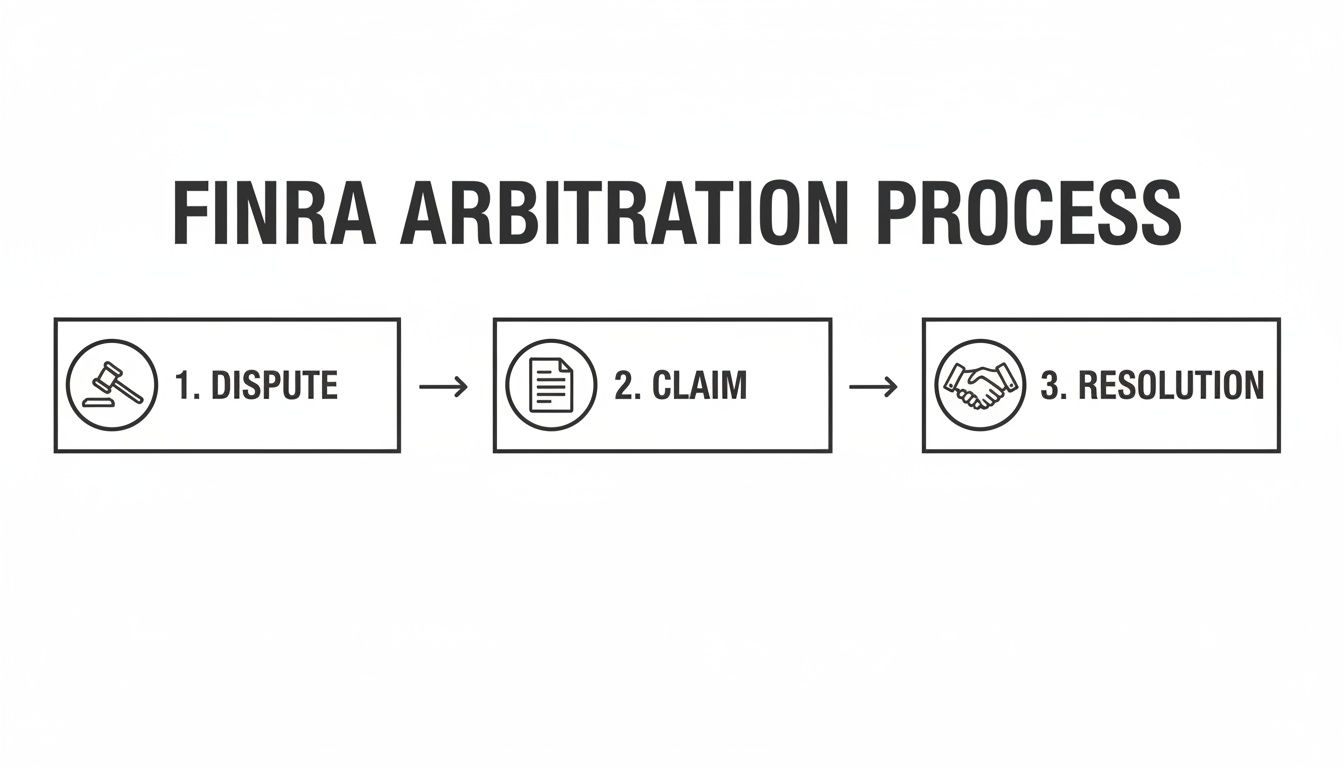
The process officially begins when the Claimant files a Statement of Claim. This is the single most important document you'll prepare. It's far more than just filling out a form; it's your opportunity to tell your story in a detailed narrative, outline the specific wrongdoing, and calculate the exact damages you are seeking.
This document sets the stage for everything that follows.
Case Volume And Timelines
FINRA's forum is a busy place, underscoring its essential role in the industry. For example, early 2026 data showed 428 new cases filed through February alone, with customer disputes making up 68% of that total.
This data also provides a critical insight into timing. The average case, from filing to a final decision, took about 13.4 months to resolve. While that's not instant, it's significantly faster than the years a case can languish in the court system.
Because FINRA arbitration is a formal legal proceeding with binding results, truly understanding the nuances of securities arbitration is vital before you begin. If you want to discuss your business law matter, contact Kons Law at (860) 920-5181.
How To Initiate Your FINRA Arbitration Claim
Starting a FINRA arbitration claim is more than just filling out forms. It’s about building a compelling case from the ground up. The first step is to tell a clear, fact-based story that shows exactly what happened, who was responsible, and why you are entitled to recover your losses.
The most critical document you'll create is the Statement of Claim. This is your opening move and the first impression you’ll make on the arbitrators. It sets the stage for the entire dispute.
The Statement Of Claim: The Heart Of Your Case
A powerful Statement of Claim isn't just a list of complaints; it's a strategic narrative. I've seen strong cases get kneecapped right at the start because this document was weak or confusing. To be effective, it needs to be both detailed and direct.
It should clearly lay out:
- A Factual Narrative: A straightforward, step-by-step account of your relationship with the broker or firm and the timeline of events that led to your financial losses.
- Identification of Misconduct: Specific allegations of wrongdoing. This could include unsuitability, negligence, breach of fiduciary duty, or outright fraud.
- Calculation of Damages: A precise calculation of how much money you lost and a clear explanation of how you arrived at that number.
- Requested Relief: A clear statement of what you are asking the arbitration panel to award you, such as compensatory damages, interest, and legal fees.
A vague or poorly written Statement of Claim gives the other side an immediate opening to dismiss your allegations as unfounded. It can signal to the arbitrators that your case lacks merit before you even get a chance to argue it.
Practical Filing Steps
Once your Statement of Claim is drafted and finalized, you'll need to officially file it with FINRA and serve it on the respondent (the person or firm you are suing). This entire process is managed through a dedicated online system.
Navigating the FINRA DR Portal: The whole process is handled through the FINRA Dispute Resolution Services Portal. This is where you will upload your Statement of Claim, submit supporting documents, and manage case communications.
Handling Filing Fees: FINRA charges a non-refundable filing fee based on the amount of damages you are seeking. For example, a claim for damages between $100,001 and $500,000 comes with an $1,850 filing fee. This fee must be paid when you submit your claim.
Properly Serving the Respondent: After you file and FINRA accepts your claim, they will officially serve the Statement of Claim on the respondent. This act formally puts them on notice and starts a strict deadline for them to respond.
What To Expect After Filing
Once the respondent is served, the clock starts ticking. They have 45 days to file their official response, which is called the Answer. In the Answer, they will respond to your allegations, present their side of the story, and list any legal defenses they believe they have.
It is also not uncommon for the respondent to file a counterclaim. For instance, they might allege you have an unpaid debt on a margin account. Understanding these first steps takes the guesswork out of the process and allows you to move forward with confidence.
If you want to discuss your business law matter, contact Kons Law at (860) 920-5181.
2. Assembling Your Panel and Building Your Case
Once your claim is filed and the other side has answered, the FINRA arbitration process splits into two crucial paths that run at the same time. You’ll be selecting the arbitrators who will ultimately decide your case while also digging into the discovery process to gather the proof you need.
Think of arbitrator selection as choosing the judges for your trial. Unlike a typical court case where a judge is simply assigned to you, here you get a say in who hears your arguments. This is a huge strategic advantage that can genuinely shape the final outcome.

Choosing Your Arbitrators
FINRA will send both sides a list of potential arbitrators, including their professional backgrounds and track records from past cases. Your job is to carefully review this list and rank your choices. This is where an experienced attorney is indispensable—they know how to spot red flags or recognize favorable backgrounds that an untrained eye would miss.
Arbitrators fall into two distinct categories:
- Public Arbitrators: These are individuals without significant ties to the financial services industry. They bring a valuable outside perspective.
- Non-Public Arbitrators: These are industry insiders, like current or former brokers, compliance officers, or firm executives who understand the inner workings of the business.
For most customer cases, the panel will have three arbitrators: two public and one non-public. This structure is meant to strike a balance between unbiased fairness and deep industry knowledge. A well-chosen panel can truly make all the difference.
The Discovery Phase: Uncovering the Evidence
While the panel is being selected, discovery gets underway. This is the formal process where both sides exchange documents and information relevant to the claims. It's far more focused and efficient than the drawn-out discovery you see in court litigation.
To keep things moving, FINRA provides a Discovery Guide that lists documents considered "presumptively discoverable." This means things like account statements or the firm’s commission reports must generally be turned over without a big fight, which helps streamline the entire exchange.
This is where the real story of your case begins to unfold. Smart, targeted discovery requests can uncover the “smoking gun” email, the revealing internal report, or a pattern of misconduct that proves your claim. Mishandling discovery is one of the quickest ways to sink an otherwise solid case.
Beyond the standard list, you can serve specific Information Requests for other materials you believe are important. The other side can object, but the chairperson of your arbitration panel will resolve these disputes. Framing requests in a way that the chairperson is likely to approve is another area where skilled legal counsel is critical, especially in a complex breach of fiduciary duty claim that hinges on internal firm documents.
The sheer volume of cases shows just how important this process is. In 2023, the FINRA forum handled 2,903 new arbitration case filings. Of those, 1,643 were customer disputes, proving its central role for investors. Expertly managing panel selection and discovery in this high-volume system is absolutely essential.
If you want to discuss your business law matter, contact Kons Law at (860) 920-5181.
Navigating The Final Hearing And Award
After months of preparation, the final arbitration hearing is where your case truly takes shape. This is the moment to present all the evidence, testimony, and arguments you’ve carefully assembled before the arbitrators who will render a final decision. Think of it less like a rigid courtroom trial and more like a focused, private proceeding where the merits of your case are front and center.
The hearing itself follows a logical sequence, similar in some ways to a court case. It kicks off with opening statements, moves through the presentation of evidence and witness testimony, and wraps up with closing arguments. This is your opportunity to tell your story directly to the decision-makers.

The Hearing Structure Unpacked
Knowing the order of events helps take the mystery out of the process. While arbitrators can adjust the flow, most final hearings follow a well-established path, ensuring both sides have a fair chance to present their case and challenge the other’s.
Here’s what you can generally expect:
- Opening Statements: Your lawyer lays out a powerful roadmap of your case, detailing the firm's misconduct and the harm it caused. The respondent’s attorney will then present their own version of events.
- Claimant's Case-in-Chief: As the claimant, you go first. This is where your attorney calls witnesses—including you, industry experts, or others with firsthand knowledge—to testify under oath and presents key documents as evidence.
- Cross-Examination: After each of your witnesses testifies, the other side’s attorney gets to question them. Their goal is to find inconsistencies in the testimony and weaken your narrative.
- Respondent's Case-in-Chief: Now it’s the brokerage firm's turn. They will present their defense by calling their own witnesses, like the broker in question or a compliance officer, who your attorney will then cross-examine.
- Closing Arguments: Once all the evidence is in, both sides make their final pitch. This is the last opportunity to connect the dots, summarize the evidence, and persuade the panel that your position is the correct one.
Key Differences From A Courtroom Trial
Although the structure looks familiar, a FINRA arbitration hearing operates very differently from a traditional courtroom trial. Perhaps the biggest distinction is how evidence is handled. The formal, complex Rules of Evidence that govern court proceedings simply don't apply here.
In FINRA arbitration, the standard for evidence is relevance. This means arbitrators can consider a much wider range of information than a judge or jury might. While this makes the process more efficient, it also means you need a skilled attorney to object to irrelevant information that could unfairly prejudice your case.
This less formal approach is a defining feature of arbitration, designed to resolve disputes without the cost and delay of court. To get a clearer picture, it helps to compare the two forums side-by-side.
Court Litigation Versus FINRA Arbitration
The table below breaks down the key differences between litigating in court and resolving a dispute through FINRA arbitration.
| Feature | Court Litigation | FINRA Arbitration |
|---|---|---|
| Decision-Maker | Judge and/or Jury | 1 or 3 Arbitrators |
| Rules of Evidence | Strict and formal | Relaxed and flexible |
| Appeals | Broad rights to appeal | Extremely limited grounds for appeal |
| Public Record | Proceedings are public record | Hearing is private, but award is public |
| Timeline | Can take years to resolve | Typically resolves in 12-18 months |
As you can see, arbitration is built for privacy and finality, whereas court offers a more public process with broader avenues for appeal.
The Final Award
Once the hearing is over, the arbitrators meet privately to deliberate. Their written, binding decision is called the Award, and it is typically issued within 30 business days after the hearing concludes.
The Award itself is usually a concise document. It will state which party prevailed and specify any monetary damages or other relief granted. It’s important to understand that arbitrators are not required to write a lengthy opinion explaining the rationale behind their decision.
An Award can provide several types of financial relief, including:
- Compensatory Damages: Money to reimburse you for your actual investment losses.
- Interest: Pre-judgment and post-judgment interest on your damages.
- Costs: Repayment of certain expenses, like filing fees.
- Attorneys' Fees: In certain circumstances, the panel may order the other side to pay your legal fees.
The final Award is legally binding and carries the same authority as a court judgment. Because the grounds for vacating an arbitration award are incredibly narrow, the decision is, for all practical purposes, final. This finality is a cornerstone of the entire arbitration process.
If you want to discuss your business law matter, contact Kons Law at (860) 920-5181.
Settlement, Mediation, And Post-Award Options
A final arbitration hearing isn't the final destination for every FINRA case. In fact, most disputes never make it that far. Settling the case is not only common but is often the smartest move for both investors and financial firms, saving everyone time, money, and uncertainty.
The most powerful tool for reaching a settlement is mediation. This is a voluntary, structured negotiation where both sides meet with a neutral third-party mediator. The mediator’s only job is to help the parties find a way to resolve the dispute themselves.
Understanding The Mediation Process
Unlike an arbitrator, a mediator can't force a decision on anyone. They are a confidential guide, helping each side realistically assess the strengths and weaknesses of their case. This confidential setting allows for creative solutions that an arbitrator simply can’t order in a final award.
While the process is flexible, it usually follows a proven path:
- Joint Sessions: Both parties and their attorneys start together, outlining their positions for the mediator.
- Private Caucuses: The mediator then meets privately with each side. This is where the real progress is made. The mediator can speak frankly about risks and settlement numbers without revealing confidences to the other party.
- Shuttle Diplomacy: The mediator moves back and forth between the two private rooms, carrying offers and counteroffers and helping to close the gap.
If you reach an agreement, you sign a binding settlement, and the arbitration is over. You control the outcome, avoid the risk of a hearing, and can move on. Because it’s such a valuable process, it's critical to understand how to prepare for mediation to get the best possible result.
The key benefit of mediation is control. In a final hearing, you hand over decision-making power to the arbitrators. In mediation, you and the other party retain complete control and only agree to a settlement if its terms are acceptable to you.
What Happens After The Award
If your case does go all the way through a final hearing, the arbitrators will issue a binding decision called an Award. This is the final word. Under FINRA rules, any money awarded must be paid within 30 days of receiving the decision.
The finality of a FINRA arbitration award is one of its defining features. Once the Award is issued, your chances to challenge it are almost zero. This isn’t like a court verdict that can be appealed for all sorts of reasons. An arbitration Award can only be challenged in court under a few, very specific circumstances.
These limited grounds for overturning an award include proving things like:
- The award was the result of corruption, fraud, or other illegal tactics.
- An arbitrator was clearly biased or corrupt.
- The arbitrators refused to postpone a hearing or hear critical evidence, resulting in an unfair process.
- The arbitrators went beyond the powers they were given.
Proving any of these is incredibly difficult, which is by design. The system is built to provide a final, binding resolution.
The Challenge Of Expungement For Professionals
For financial professionals, having a customer dispute on their public record can be a serious blow to their career. FINRA Rule 2080 creates a path for brokers to seek expungement—the complete removal of a dispute from their Central Registration Depository (CRD) record. However, this is designed to be a very tough process.
To get a claim expunged, the professional must convince the arbitration panel that the claim was factually impossible, clearly false, or that they had no involvement in the alleged misconduct. A successful expungement requires a special finding from the arbitrators, which a court must then confirm. The bar is set high to protect the public record, offering relief only in the most clear-cut cases.
If you want to discuss your business law matter, contact Kons Law at (860) 920-5181.
Why An Experienced Attorney Is Your Greatest Asset
While FINRA arbitration is designed to be more efficient than a traditional lawsuit, it's far from a casual chat. This is a formal legal proceeding where rules, evidence, and strategy decide the outcome. Brokerage firms know this, and they never show up without a team of skilled, experienced lawyers. Going it alone is a tremendous risk.
An attorney’s real value starts long before the final hearing. Their work begins the moment you decide to file, shaping the entire narrative of your case. They act as your strategist, advocate, and guide through what can be a confusing and intimidating system.
The Strategic Edge In Every Phase
A knowledgeable securities attorney brings critical advantages to each stage of the FINRA process. They know how to use the forum's complex rules to your benefit—not let them be used against you.
An experienced lawyer is indispensable when it comes to:
- Crafting the Statement of Claim: They will transform the facts of your case into a powerful legal document. This claim clearly outlines the misconduct, calculates your damages, and is structured to withstand the brokerage firm's initial attempts to have it dismissed.
- Arbitrator Selection: An attorney knows how to scrutinize arbitrator disclosure reports to spot potential biases or identify panelists with backgrounds favorable to your type of case. This is a nuanced skill that can make or break your chances of getting a fair panel.
- Conducting Discovery: They draft precise, enforceable demands for the evidence you need to prove your case. Just as importantly, they fight back against the firm’s common tactics of hiding key documents or overwhelming you with irrelevant paperwork.
- Arguing the Case: At the hearing, they present a clear and compelling story through direct witness testimony, strategic cross-examination, and a persuasive closing argument. Their job is to make sure the arbitrators hear and understand your side.
You are going up against a brokerage firm that has likely been through this process hundreds, if not thousands, of times. Their legal team knows every rule, every deadline, and every procedural tactic. Having an experienced attorney on your side simply levels the playing field.
Navigating A Complex And Balanced System
The FINRA forum is its own world with a unique set of rules and statistical realities. For instance, while arbitrators have significant authority, they tend to operate within established patterns. Punitive damages, though possible, have been awarded in only 3% of cases from 1988 to 2025.
For professionals dealing with a damaging Form U5, FINRA Rule 2080 sets an extremely high bar for expungement, requiring a unanimous decision from the panel. You can learn more about how arbitrators view different remedies and rule changes by reviewing recent analyses of FINRA's evolving rules.
This shows that success isn't just about being "right"—it's about presenting a case that aligns with the legal standards and unwritten norms of the forum. A lawyer who specializes in FINRA arbitration knows exactly how to frame your arguments and present evidence in a way that resonates with the panel, maximizing your chance of a favorable award.
If you want to discuss your business law matter, contact Kons Law at (860) 920-5181.
Common Questions About The FINRA Arbitration Process
Even though FINRA arbitration is designed to be more direct than a traditional lawsuit, it’s a formal legal process with its own unique set of rules. If you’re facing this for the first time, you understandably have questions.
Let's walk through some of the most common questions we hear from our clients.
How Much Does FINRA Arbitration Cost?
The total cost of a FINRA arbitration really depends on the amount of money at stake. FINRA itself charges fees on a sliding scale for both the initial filing fees and the subsequent hearing session fees.
To give you a real-world example, a claim seeking damages between $100,001 and $500,000 requires a $1,850 filing fee just to initiate the case. Beyond that, you also need to account for other necessary expenses, like attorney's fees and the cost of hiring expert witnesses to support your claim. While it's typically less expensive than years of court litigation, it is still a serious financial commitment.
Can I Represent Myself In A FINRA Arbitration?
Legally, yes, you can represent yourself—this is known as appearing pro se. But it's a very risky decision. You can be certain that the brokerage firm will be represented by skilled securities lawyers who live and breathe these rules every single day.
The FINRA process is a legal battlefield with binding outcomes. Facing a seasoned legal team on your own puts you at a severe disadvantage from day one, potentially jeopardizing your ability to recover your losses.
Is The Final Arbitration Award Kept Private?
No, final awards are public documents. FINRA is committed to transparency, so it publishes all arbitration awards in an online database. This allows everyone to see how arbitrators have ruled on similar disputes in the past.
The key exception is a settlement. If your case is resolved through a private settlement agreement before the arbitrators issue a final award, the terms of that agreement almost always remain confidential.
What Is The Difference Between Arbitration And Mediation?
While both are common ways to resolve disputes outside of court, arbitration and mediation are fundamentally different.
- Arbitration: This is a formal, binding process where a neutral panel of arbitrators acts much like a panel of judges. They hear evidence, review legal arguments, and issue a final decision, known as an "award," that is legally enforceable.
- Mediation: This is a voluntary, non-binding negotiation. A neutral mediator helps the two sides talk through the issues and tries to guide them toward a settlement they can both agree on. A mediator has no authority to force a decision on anyone.
It's crucial to understand these procedural differences, just as it's important to know when a financial dispute involves actual misconduct. You can learn more about how to identify serious issues in our guide on what is securities fraud.
If you want to discuss your business law matter, contact Kons Law at (860) 920-5181.
